
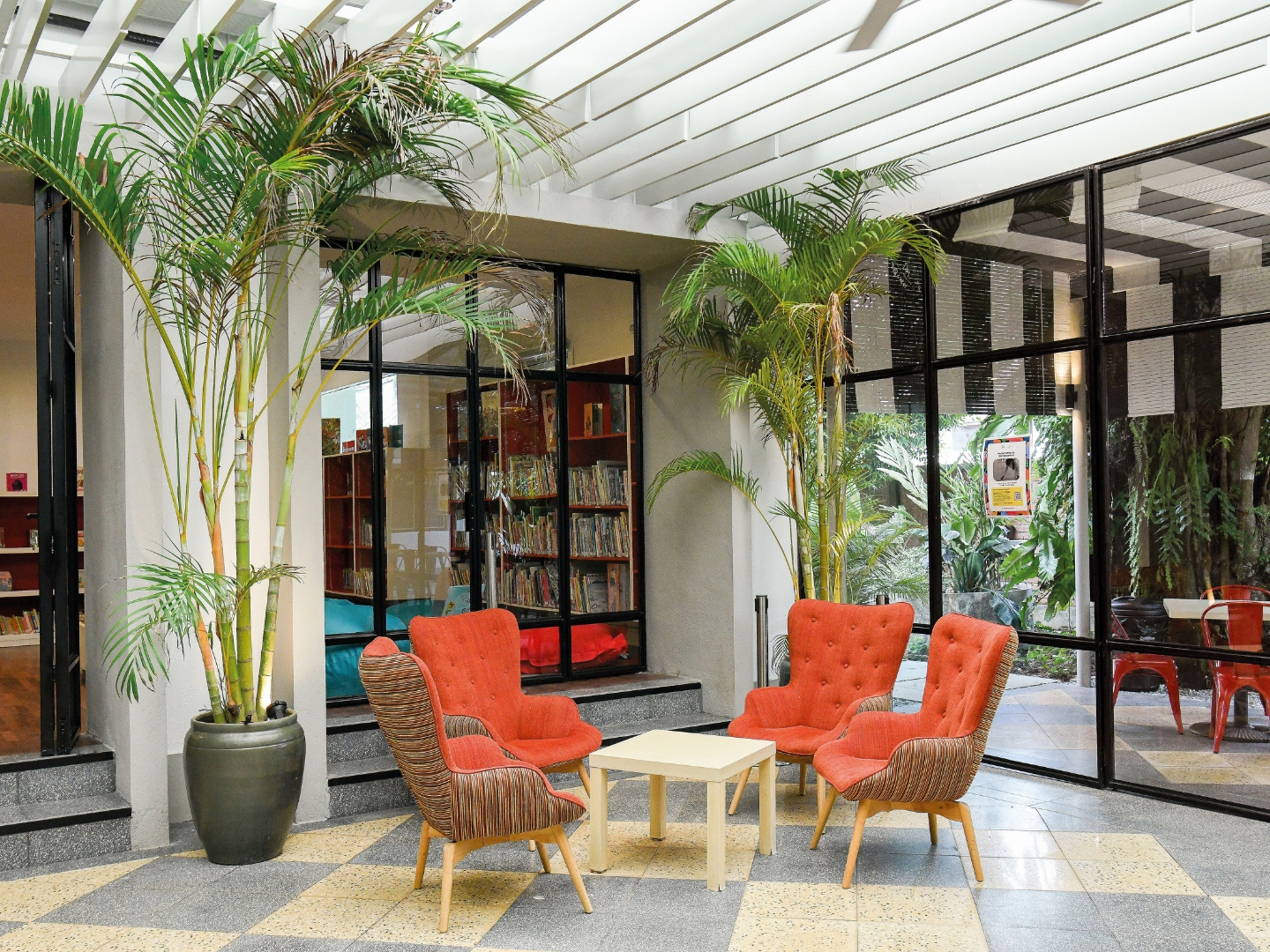
One of many little nooks that visitors can sit in and enjoy a quiet read (All photos: Shahrill Basri/The Edge)
For more than 60 years, Alliance Française Kuala Lumpur (AFKL) has called a beautiful colonial bungalow in Lorong Gurney, KL, its home. The language centre and cultural hub, established in 1961, caters to students of all ages and demographics, frequently hosting exhibitions and programmes out of its long- standing location.
“We’ve always loved this bungalow. There was talk in the past about modernising and moving into an office block, but we’re very attached to this place. It’s really our pride, somewhere we can call our own,” shares president Tengku Datin Paduka Setia Zatashah Idris.
Over time, the structure has undergone multiple phases of reconstruction, most recently the refurbishment of a 3,000 sq ft area that was unveiled on March 23 and named L’Espace — an airy, breathable redesign of the café, library, office and garden areas. What was once a dreary and drab courtyard is now flooded with light and punctuated with vibrant foliage both in and out, modelled after the chic and contemporary aesthetics of a boulangerie (French bakery) with a touch of local tropicality.
outside.jpg

The non-profit organisation tapped renowned Californian architect and interior designer Brian Quirk, known for his work on various lifestyle and F&B projects in Malaysia, to reimagine this zone adjacent to the central hall. Given the volume of families and visitors to the venue on Saturdays, the committee handed Quirk a brief to create a common area that could accommodate everybody and endow visitors with a sense of belonging.
On why they felt now was the time for change, the president says, “We realised it gets so busy here on Saturdays: There are a lot of families, plenty of programmes happening, and as a bungalow, you can imagine the layout before was very enclosed. “The plan was to build what we call in French a tiers-lieux, or third place — not home or work, but something in between. That’s what we wanted to push forward, a social hub,” notes executive director Laurent Elisio Bordier.
Persuading students to return to in-person learning after the pandemic was a key consideration as well. Both Zatashah and vice-president Datuk Setia Aubry Rahim Mennesson remark that remaining at this property, as opposed to relocating to an office block, enables AFKL to collaborate with brands and host various cultural events.
peepo.jpg
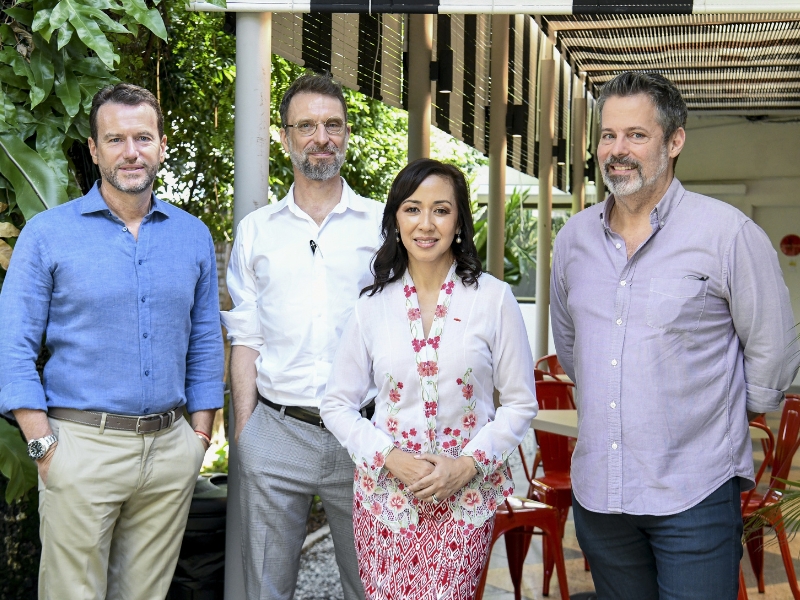
“The thing I noticed first was that there was a lack of variety in spaces. I wanted to create an almost origami-like sequence where you could open and close doors to form different combinations,” explains Quirk.
He adds how this revised set-up provides more spots and corners for people to meet within and retire to. Given the sparsity of doors and windows in older heritage constructions, he prioritised expanding these openings to achieve a more organic and intuitive flow between the rooms, facilitated by the existing grey structures which were extruded into transitionary portals. “Individually, each zone was very dark, so the absolute top concern was light.”
Favouring brevity over poetry, the renovated portion was simply dubbed L’Espace — “space” in French. The committee describes how, despite having deliberated on several other options, the sheer succinctness of the title felt fitting.
cafe.jpg
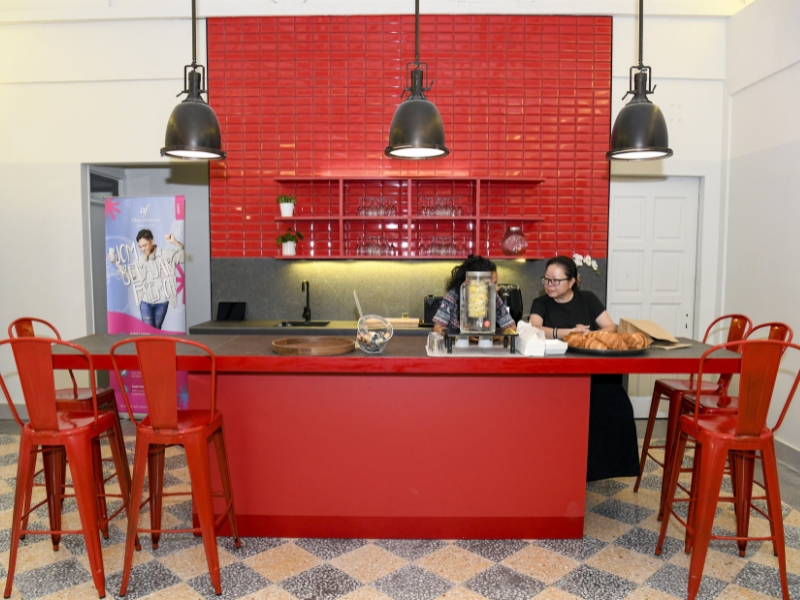
The overall black-and-white palette, particularly applied to the slim frames and outdoor blinds, complements the old colonial style, here presented with a modern flavour. A high slatted ceiling imbues the room with natural brightness and levity, comfortably blending the external and internal domains. Plush vermillion seats and brilliant green palms in the central area add contrasting pops of colour and texture, and are arranged in pockets with smaller tables to create miniature nooks where one may enjoy a quiet read.
Red had to have a prominent place in the composition, being AFKL’s brand colour, and appears in the iconic Tolix chairs (“We tried where possible to use French designers,” says Quirk) as well as the bar, tile wall and library shelves.
The new L’Espace also preserves several existing elements of the heritage bungalow: the polished terrazzo floors, once neglected and haphazardly waxed over, now glimmer in the sunlight. Likewise, Quirk discovered a series of original wooden beams after crawling into a manhole in the ceiling, which now forms an elegant highlight above the café.
garden.jpg
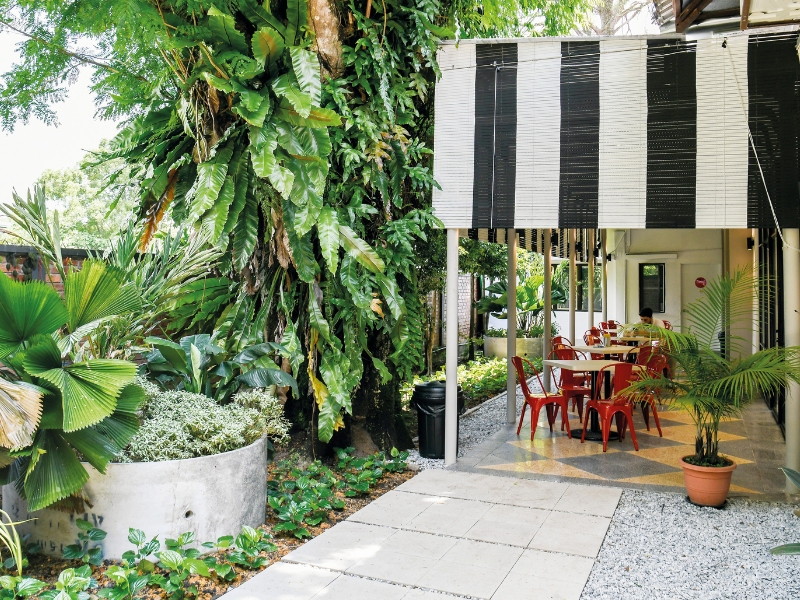
Outside, the garden has been revitalised and populated with edible local fauna as an immersive learning portion for students. Given the location’s susceptibility to floods, the architect also ensured water would be able to stream through the area, elevating the bookshelves to mitigate damage.
Since the launch — inaugurated by French ambassador to Malaysia Axel Cruau at the 2025 International Festival of Francophone Authors in Malaysia — attendees, students and teachers alike have responded with overwhelming enthusiasm to the inspiring new environment. Quirk’s reinterpretation of the boxed-up rooms into a fluid spatial stream allowed them to boost the event’s capacity, holding a total of 2,000 people throughout the day and around 500 at peak time.
Asked what attracted him to this opportunity in the first place, Quirk says, “I like creating spaces that make a difference. Doing a project [like this] changes the whole dynamic of an institution — I could see potential in this bungalow. I love doing modern insertions into old buildings that respect the existing structure but are still contemporary. You’ve got to find a balance.”
This article first appeared in issue No. 116, Summer 2025 of Haven.