

Lim dons a top and pant set in a turqoise and gold print (Photo: Zahid Izzani/The Edge)
Traditional textiles can say a lot about a country’s people, their history and evolution. In Malaysia, there is arguably no material as emblematic as batik. It is believed that Southeast Asian trade routes first introduced Javanese batik to the Malay archipelago around the 15th Century. As the years passed, the craft began to embody local creativity, coming to depict the distinct floral and geometric patterns we know and love. States along the east coast, particularly Kelantan and Terengganu, became hubs for the craft, with independent manufacturers specialising in either the hand-drawn (batik tulis) or block-printed (batik cap) variants. To this day, many still journey to these regions looking for an authentic piece of Malaysia to wear or display.
Terengganu batik in particular has a special place in entrepreneur Lim Lian Cy’s heart. “It all began in 1990, when Malaysia was promoting tourism,” she recalls. “Then, my family was living in a fishing village named Bandar Marang, just across from Pulau Kapas. We had a lot of tourists coming through who wanted to buy and wear local clothing. My mother had a small grocery store and decided to open a batik shop next door. We sold it by kodi — one has 20 pieces of fabric, which could be worn as sarong”.
Upon noticing the family had a sewing machine in-store, one customer asked if Lim’s mother could sew a pair of shorts from the batik. “She didn’t know how to sew, but the client encouraged her and agreed that they would still buy the cloth. If my mum could not manage to sew something wearable, they would willingly lose out on the money they spent,” she says.
Somehow, by luck or fate, a pair of simple shorts with an elasticised waistband was produced and the happy client came to collect them the next day. Lim notes this was the beginning of a new chapter for the family, one that placed batik at the heart of their livelihood. “My mum saw this as an opportunity and slowly began to make more pieces, from shorts to singlets. She’d make the easiest ones to sew, and enlisted local seamstresses to help with more complex styles. At night, after we had closed down both shops, I would follow her to the tukang to source more fabric.”
Fast forward to 2020. Lim, who had moved to Kuala Lumpur and was working as a pharmacist, returned to Terengganu during the pandemic. There, she decided to go on the hunt for batik to bring a piece of home back to the city with her. “I went to the local marketplaces and found so many beautiful pieces. But when I brought them back to KL and looked closer, these items that had been so colourful and vibrant when I first saw them seemed to have lost their luster.”
20250818_peo_chantek_batik_boutique_zhd-202.jpg
Speaking to local craftsmen revealed the upsetting reason — digitally printed batik. Beautiful from afar but lacking the finer details upon thorough inspection, it saturates much of the contemporary market. Lim was appalled. “When I purchased those pieces, I asked the vendors if it was genuine handmade Terengganu batik and they said yes. I felt cheated. So, I began to learn how to differentiate between printed and handcrafted. If I, as someone who comes from Terrenganu and whose mum sold batik for years, couldn’t tell the difference, what about other people who don’t have that experience and know even less about the craft? I’m not against digital printing — it has its own beauty — but it is important to be honest with buyers because they are trying to support artisans and Malaysian heritage.”
This inspired Lim to start Chantek Batik, a clothing label that utilises only handcrafted textiles in all its designs. The materials are sourced directly from local manufacturers, primarily from Terengganu and Kelantan (“Though we offer tailor-made services, we do not accept fabric clients bring in because we cannot trace and authenticate the origin. We want everything that comes from us to be real and handmade,” she states).
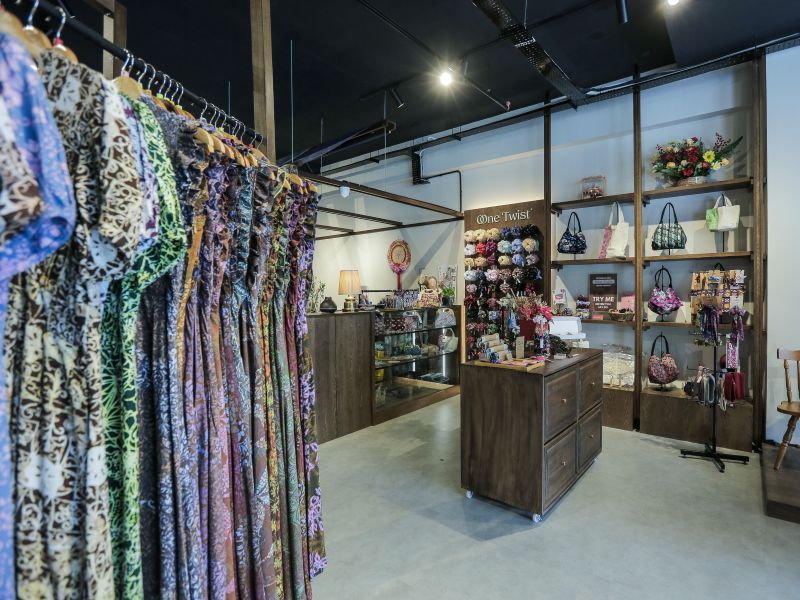
She began by taking orders online, producing made-to-measure skirts in a small room at home. As her client base grew, she rented a double story house to expand production and do fittings, but this quickly proved to have its own issues. “It was not ideal for larger groups as there were no changing rooms. Sometimes, we would have a client in the bathroom and another in the kitchen and so on!” she chuckles. In January, Chantek Batik finally moved into a physical store in Shah Alam where customers can walk in to shop ready-made pieces or book fittings for custom garments where they can browse through the multitude of fabric options available. Lim uses this as an opportunity to educate people on the differences between genuine batik and its printed counterparts.
20250818_peo_chantek_batik_boutique_zhd-183_ver_2.jpg

The brand is Lim’s love letter to a textile that brings back memories of a childhood in Terengganu, especially as the number of craftsmen is fading. “Back then, in a single region, you could find so many people producing by hand. Nowadays in Terengganu, you probably can’t even find 10,” she says. “These people are purely making art. We as businesses can help them gain exposure and open the eyes of people to the beauty of it. We should use our specialty in marketing and design to bring their hard work to the attention of the public.”
Lim can often be spotted attending to customers personally, donning pieces boasting the complex geometric motifs of classical batik, which she is personally a big fan of. However, she still adores modern interpretations which embody a more minimalistic approach. What matters most is that the history is still protected in the techniques used to make it.
“Some people might not like how the art is evolving, but youngsters prefer simpler styles. It is more approachable to them. Traditional batik’s “golden age” has already passed, and it doesn’t do any good to force young people if they don’t naturally gravitate towards it. Back then, people also had more time to create complex designs, and the world was less filled with digital noise. They had the conditions to produce intricate details. Things are different now. The only non-negotiable is that core techniques are preserved. So long as the original method of wax resist dying is used, I’m all for it!”
Shop at chantekbatik.com.my or swing by S-G-09, Gaya Resort Homes, Persiaran Kemuning Damai, Seksyen 32, Shah Alam, Selangor. For tailor-made bookings, contact (012) 935 0633.
This article first appeared on Aug 25, 2025 in The Edge Malaysia.