
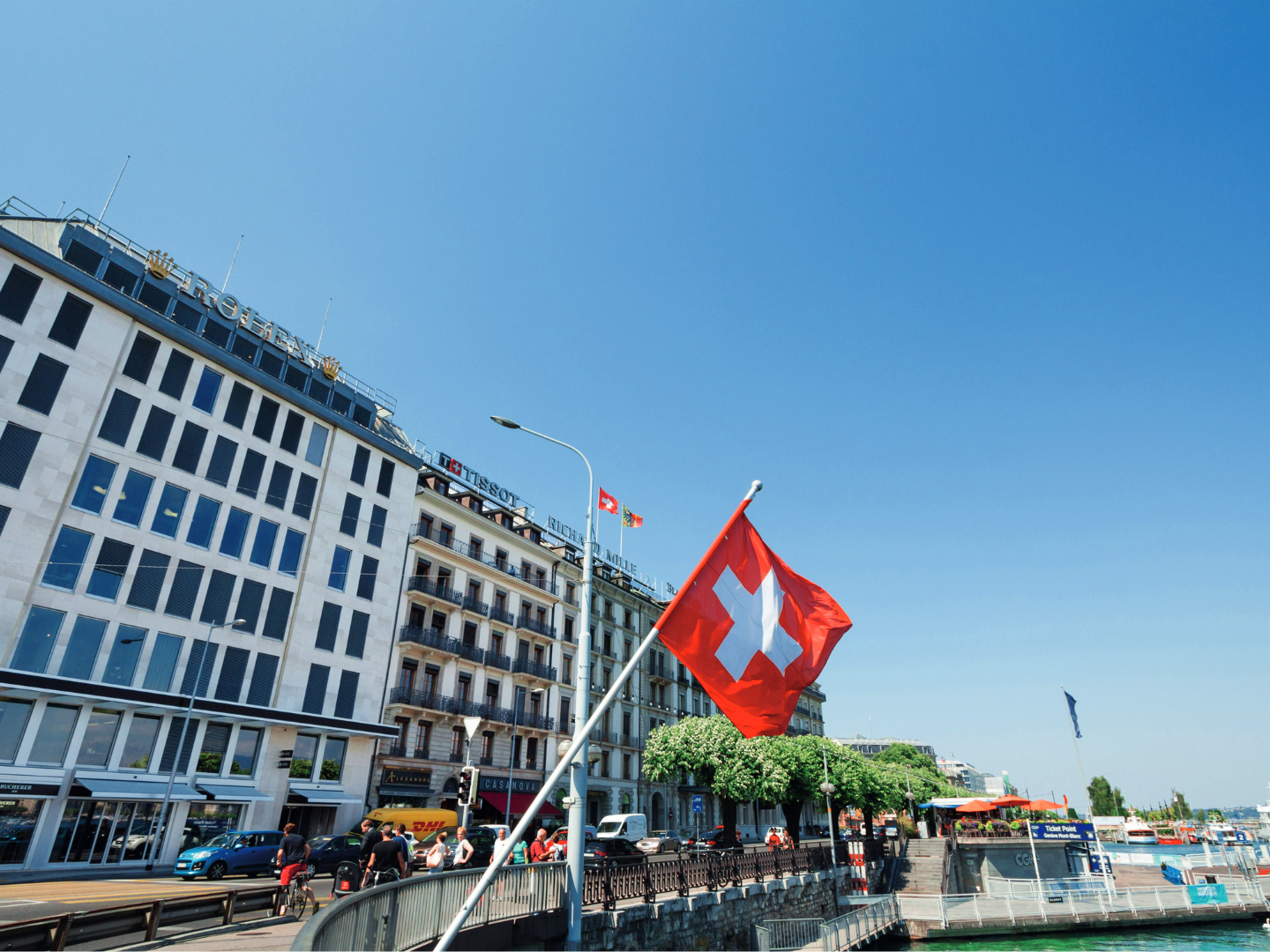
Rue du Rhône in Geneva is a premier destination for luxury watches (All photos: 123RF)
In collaboration with luxury watch consultancy LuxeConsult, investment banking firm Morgan Stanley recently released its ninth annual Swiss Watcher report, providing insights into the state of the horological industry. The 2025 data presents a widening gap in the sector as a handful of elite brands continue to dominate and money concentrates at the top, while the majority of competitors struggle with shrinking margins driven by unfavourable currency shifts, soaring raw material costs and cooling global demand.
A central feature of the report is its top 50 brand ranking, a closely watched barometer of performance. This year, it reveals an extreme polarisation with just four privately-owned companies — Rolex, Audemars Piguet, Patek Philippe and Richard Mille — commanding half of the entire Swiss watch market. Count Cartier and Omega in and that is 65% of the pie occupied.
Unsurprisingly, Rolex remains the undisputed leader, capturing a third of the total market share alone. According to the firm, the Crown surpassed CHF11 billion (RM56 billion) in wholesale sales for the first time despite a strategic 2% reduction in output to about 1.15 million watches. This marks the second year in a row that Rolex has lowered production volumes, managing scarcity to preserve long term desirability.
The report also highlights robust performance by Richemont-owned Cartier (#2), which secured its position by leveraging a diverse product portfolio, spanning from accessible icons to high-complication pieces and strong secondary market price retention.
However, one of the most discussed headlines is Omega’s fall, as it dropped from third to fifth place by turnover, overtaken by Audemars Piguet (#3) and Patek Philippe (#4). Concurrently, Longines (#7) exited the so-called “billionaires’ club” following an 18% sales decline to CHF920 million. While Swatch Group maintains its role as the industry’s high-volume engine, accounting for roughly 60% of all entry- and mid-tier watches, the numbers suggest a loosening grip on the market, a narrative the group has moved to aggressively contest.
In a rare public rebuke, Swatch Group fired back with a scathing open letter, slamming the report’s findings as “highly inaccurate”, its methodology “questionable” and conclusions “negligent”. While listed companies are mandated to disclose consolidated sales and earnings, they are not required to publish performance data for individual brands. Consequently, analysts typically rely on estimates to map the competitive landscape.
The report cites five sources to calculate turnover and unit sales, and by extension, market share and rankings. They are figures reported by public companies, public statements by CEOs over the years, direct discussions with watch brands, data from the Fédération de l’Industrie Horlogère Suisse and dialogue with industry contacts. While published figures offer a reliable bigger picture, the lack of brand level information makes the data unsuitable for determining exact numbers.
“The quality of the remaining three sources (public CEO statements, direct discussions with brands and dialogue with industry contacts) speaks for itself: they are inherently unreliable,” Swatch Group noted. “Making precise statements on this basis is highly unprofessional and purely speculative. Reputable research would clearly distinguish between verified data and estimates. This is not the case here.”
Furthermore, the group pointed to discrepancies exceeding 50%, adding that such significant errors occurred despite the availability of global public data. “Even the average deviation of 24% for Swatch Group would significantly reshuffle the ranking of top brands. Omega, for example, could rank anywhere from second to sixth, instead of [being] listed as fifth.”
body_pics_1.png

Setting the record straight, the group corrected the findings by noting that Tissot achieved 3% growth — contradicting the report’s estimated 5% decline — and clarified that the “loss-making” Longines actually generated a positive 16.6% profit on net sales. Beyond methodological concerns and the baseless use of point estimates, the group also condemned the inclusion of “defamatory and potentially damaging” statements that could undermine the commercial reputation of its brands.
Swatch Group is not alone in its frustration. In fact, Rolex’s sister company Tudor has expressed similar grievances. Speaking to Swiss daily Le Temps, a spokesperson pointed out that the maison has been operating in a 100% wholesale capacity since its founding, not the 76% estimated by Morgan Stanley. Tudor also noted that the report’s growth percentages simply do not match real-world numbers, questioning the integrity of the authors.
While Morgan Stanley included a disclaimer acknowledging potential conflicts of interest, LuxeConsult offers no such disclosure in the document.
Ultimately, the fallout from the 2026 Swiss Watcher report serves as a cautionary tale that in the world of high-end horology, where precision is paramount, the margin for error is significantly less forgiving. At the time of writing, both Morgan Stanley and LuxeConsult have yet to comment on the pushback.
This article first appeared on March 16, 2026 in The Edge Malaysia.