
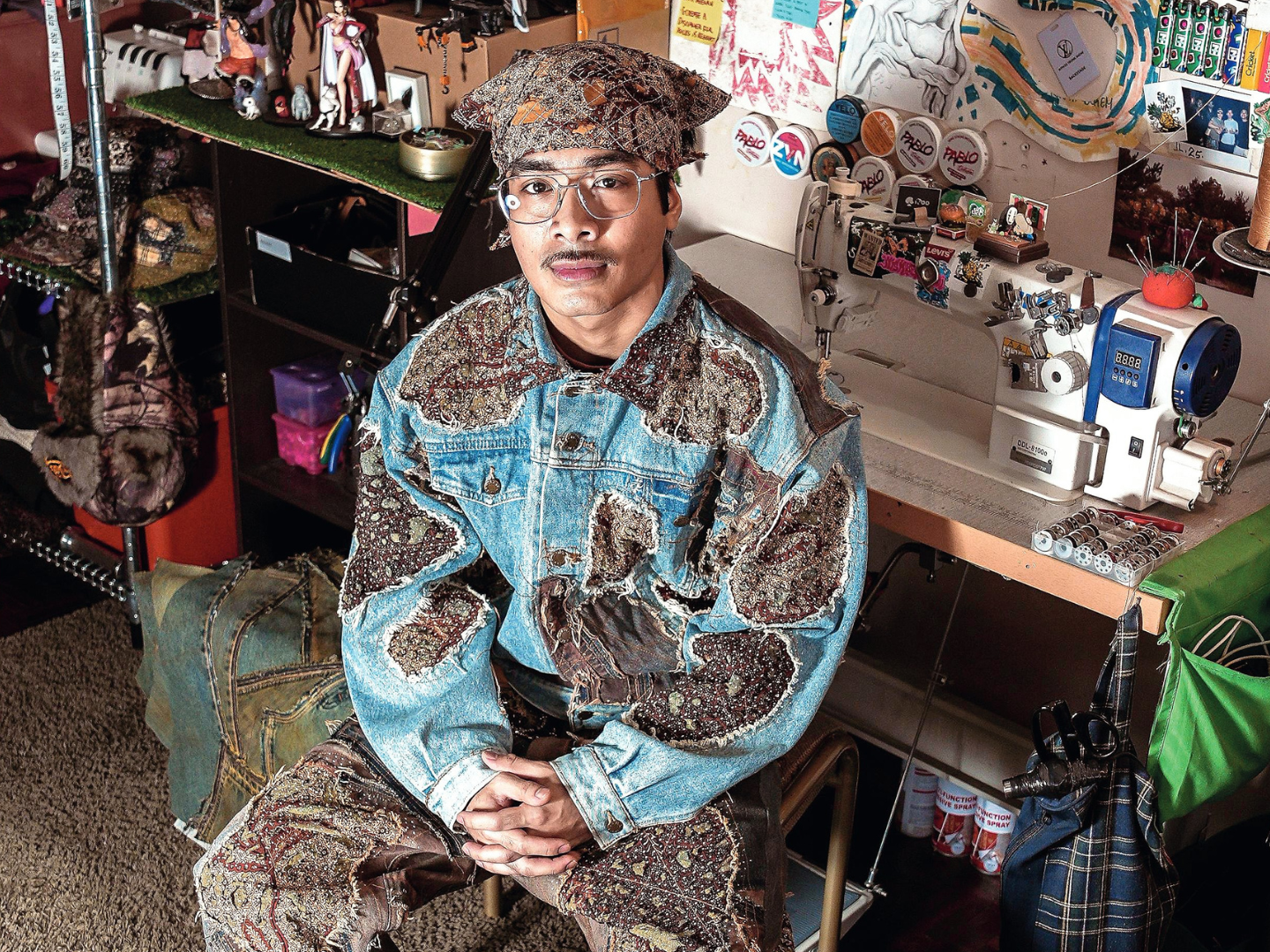
Street art and vintage fashion are some of the inspirations for Amni Yah’s design style (All photos: Zahid Izzani/The Edge)
Few fabrics have endured the test of time like denim. Over the last century, it has transformed from utilitarian workwear into a universal wardrobe staple — durability and versatility allowing the cloth to move effortlessly between function and style, shaped by wash, fit and form. In some instances, denim transcends practicality, offering a medium for artistic experimentation.
For Amni Yah, clothing is exactly that — a canvas. “I make art on clothes,” he says, simply.
At 23, the founder of Ss.ethereal approaches design without rigid labels. His work exists somewhere between apparel and craftsmanship, shaped by instinct rather than industry conventions. What began as a creative outlet has turned into a distinct practice for multiple interests to converge.
Amni’s relationship with art began long before he entered the world of fashion. Growing up abroad — in India, Sweden and France — he often visited galleries and exhibitions with his mother, moments that also became quiet opportunities for bonding.
He soon found his forte in drawing, though working on a flat surface felt limiting. In search of something more tactile, he dabbled in other media, creating three-dimensional forms such as sculptures. “Any craft that required working with my hands, I would be obsessed with it.”
1.png
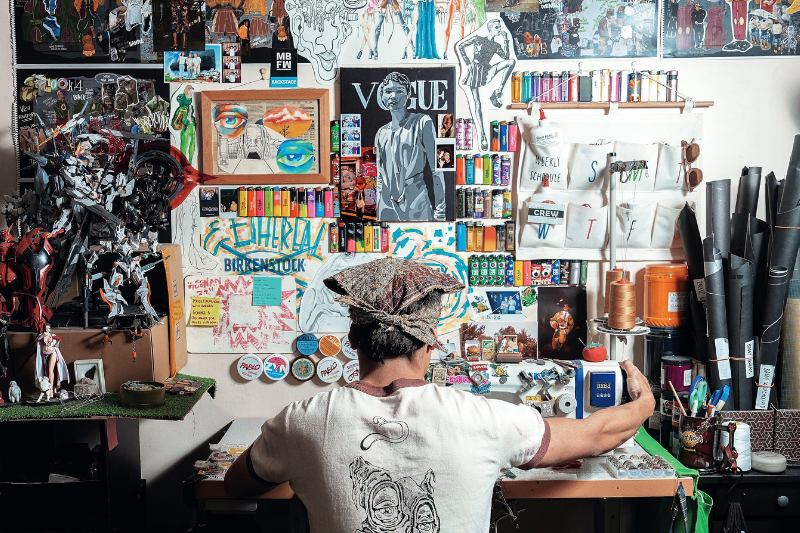
The Covid-19 lockdown sparked a reunion with pencil and paper, but the restlessness resumed. He turned to bleach, using the chemical agent to etch motifs directly onto fabric.
When the moment came to pursue tertiary studies, fashion became the natural extension.
Interestingly, Ss.ethereal was never intended as a clothing brand. It began as a name or marker for his work, rather than a commercial venture.
The word “ethereal” reflects how he perceives what he makes — slightly surreal, otherworldly madness. The prefix “Ss” holds a more personal significance, being derived from his parents’ initials.
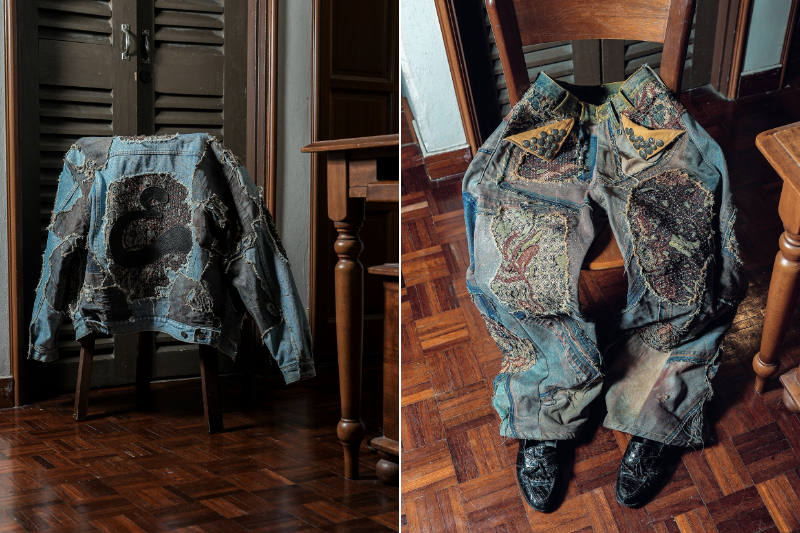
Currently, the label encompasses a range of pieces — caps, jackets, jeans and shirts — unified by a distinctive visual language. An encapsulation of controlled chaos, each garment is an intricate masterpiece. Denim often forms the base onto which fragments of other fabrics are layered, stitched and reworked. The result is a kind of organised disorder, embellished with intentional hardware such as bold buttons, pins and chains.
2.png
His biggest influences reveal themselves subtly. Street art remains a constant source of inspiration, as does the visual culture of MTV, a channel he grew up watching. Vintage fashion and subcultural aesthetics, including elements of hip-hop, rock and even piratecore (“I want to look like Jack Sparrow!”), surface in the details — from oversized silhouettes to the inclusion of knotted ties and metal accents.
In a studio as decorative as his designs, Amni meticulously constructs each piece by hand. No two are alike as he relies on upcycled materials sourced from thrift stores or his own wardrobe.
“Usually, you purchase a new item once the old one can no longer be used. To me, it can be transformed into something so you can continue to use it,” he says.
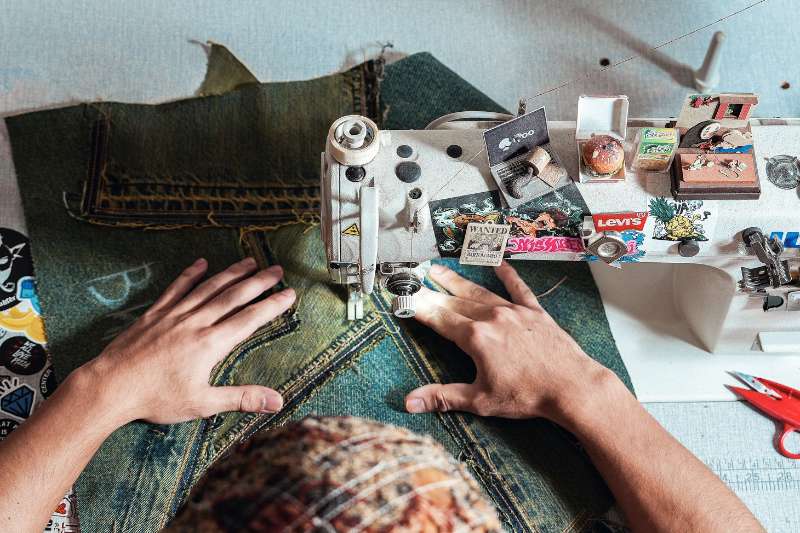
The ideas come to life with deconstruction. Amni focuses on carefully unpicking each stitch, uncovering the faded tones of the cloth. He then proceeds to cut and reshape the fabric, positioning them randomly until the composition feels and looks perfect.
“The beauty in upcycling is that I don’t ever sketch my designs first; the fabrics give it to me.” This approach allows each piece to unfold organically, typically taking two days to a week to complete, depending on the time needed to cobble the components together.
3.png
While denim serves as a reliable foundation, Amni continually pushes its boundaries. Dyeing techniques introduce muted tones — greys, browns and ochres — that lend the garments a weathered and antique quality.Weight and texture are equally important. He gravitates towards materials that are heavier and sturdier, favouring structure over stretch.
Another prominent characteristic of Ss.ethereal is protruding, uniform patterns. Sashiko — which translates into “little stabs” — is a traditional Japanese embroidery technique that prevents distressed fabrics from moving. The stitching can also be seen in Japanese labels such as Proleta Re Art, which uses it as both reinforcement and decoration. The seams bind together layers developed through patchwork techniques such as boro and appliqué.
Amni’s creations have since made their way onto platforms such as Malaysia International Fashion Week, and some items can be found on the racks of Snub in George Town, Penang. Ultimately, he hopesthat people feel a sense of happiness wearing his designs. For an independent artisan working largely on his own, these milestones mark a steady progression.
Growth for Amni is less about scale and more about refinement. Driven by his craft, each item is measured against the last piece completed as he strives to outdo himself. “Every design that I make, if it can, needs to be better than the previous one,” he laughs.
Looking ahead, his ambitions go beyond the usual path of a fashion label. Mass production is not an option. Instead, he envisions something more immersive, where his work can be experienced in its entirety, like in an art museum.
In an industry built on replication and trends, Ss.ethereal resists the rhythm of cycles, upholding art, sustainability and individuality through each release.
This article first appeared on March 30, 2026 in The Edge Malaysia.