

Models wearing the topography-inspired pieces at the recent Kuala Lumpur Fashion Week (All photos: Tanoti)
Piercing the air, as if Gaia herself were reaching out to the heavens, mountains have always represented man’s connection to the divine and planet. Across Southeast Asia’s diversity of distinct ethnic groups, religions and mythos, elevations have been a constant for aeons.
They are believed to be the residences of ancestral spirits and deities, as well as guardians of the communities that settle near their feet. Many are both storied and real places of worship, and legends speak of gods descending from the celestial realm to mould these ridges as spiritual anchors, demonstrating their power and influence over the human world.
Whether you hold fast to these epics or credit such magnificent scenery to nothing more miraculous than the collision of tectonic plates, it is without doubt that the massifs adorning the corners of the Asean territories are paramount to the local landscape. Their striking presence accumulates widespread interest in preservation efforts to maintain their integrity in the face of climate change and the destruction of nature. Passed down through generations, this commitment has been largely unfading through thick and thin. For most activists, advocates and artists who speak of these earthly wonders in their everyday lives and work, their devotion can be traced to a single awe-inspiring encounter.
“When I was 18, I visited Kinabalu Park in Sabah,” recounts designer and textile artist Fitri Nasaruddin. “Waking up early in the morning to see the majestic peak of Mount Kinabalu from my room window was a vivid memory that never left me.” The iconic apex — the tallest in Malaysia, housed in the renowned Unesco World Heritage reserve — is just one of several across the region that enjoy a topmost spot on countless trekking bucket lists around the globe.
When the opportunity to collaborate on a collection with Sarawakian weaving house Tanoti came knocking, Fitri — recalling the mesmerising experience of beholding the scenery with his own eyes — knew instantly what he wished to highlight in his designs. Debuted at Kuala Lumpur Fashion Week (KLFW), Summits underscored the “siblinghood” among the Asean nations, reflecting nearly 60 years of unity and resilience.
2.png
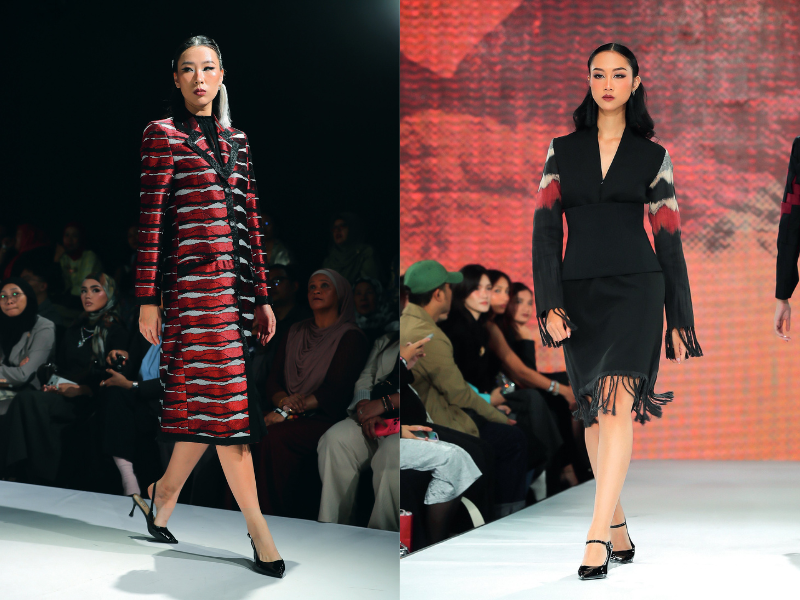
Presented in a palette graduating from white and peachy orange to red and black, the looks brought together a medley of textiles and textures — from fluid pleats that rippled like mist over hilltops to structured songket and pua kumbu ikat, evoking the enduring contours of mountainous terrain. The line-up started with dreamy maxi dresses, as if in homage to the abovementioned mystical quality, before transitioning into the commanding silhouettes of fitted jackets and a boxy red-and-black top and trouser ensemble.
Tanoti founder Datuk Jacqueline Fong, who gave show attendees a sneak peek of what to expect when she entered the Esplanade KLCC Park venue in a tailored black pantsuit with a red version of the pattern rendered as a statement collar, says: “What this collection has done was converge the prominent topological elements of this region to produce a beautiful new identifier that is uniquely Asean, then translated that into textiles via various techniques.”
The hero motif, asymmetrical and printed in rows, was formed by marrying the outlines of the countries’ highest pinnacles into a single undulating crest that, as Fitri explains, illustrates “the heights each nation has reached and the collective success we have built since gaining independence”. Following the band, shapes materialise as references to each nation’s history and ambitions — Mount Kinabalu; Puncak Jaya, Indonesia; Mount Fansipan, Vietnam; Hkakabo Razi, Myanmar; Tatamailau, Timor-Leste; Mount Apo, the Philippines; Phou Bia, Laos; Doi Inthanon, Thailand; Bukit Pagon, Brunei; Mount Aural, Cambodia; and Bukit Timah, Singapore.
3.png

Summits arrives at a critical time for Malaysian fashion. As the industry grows younger and the market becomes increasingly saturated with foreign brands and styles, heritage textiles — and, more crucially, the techniques behind them — risk being lost to time. Creative outputs that strive to memorialise these endangered trades (as well as the events where they are displayed) are opportunities for budding designers, journalists and enthusiasts to familiarise themselves with these traditional heirlooms and see them as aspirational and relevant to contemporary times.
Fong elaborates on the lasting impact of uplifting local crafts: “For Tanoti, [the KLFW show] was an opportunity to show that heritage does not belong only in museums, exhibitions, ceremonial settings or markets. It can evolve, be desirable and have a place in mainstream commerce. And when there is demand for heritage craft, we create the economic conditions for artisans to continue practising their skills and passing them on to future generations.”
For Fitri, Summits fulfils an inherited calling to spotlight the lesser-known facets of his culture and identity, while serving as a bridge between craftsman and consumer, elder and youth. “On the one hand, traditional artisans and cultural custodians get to see their age-old techniques enter contemporary fashion spaces,” he says. “On the other hand, younger generations begin to discover, wear and truly appreciate their roots. When you blend these elements, you spark a cross-generational dialogue.
“It moves heritage from something seen as static history into living, wearable fashion that unites people through shared pride and mutual respect.”
1.png

Both designer and founder, who believe in wearing their hearts on their sleeves, hope the clothes will resonate most with the contemporary fashionista who values craftsmanship and indigenous knowledge.
To Fong, these looks are more than just beautiful things to wear; they are a way of expressing what she stands for. True statement-making, after all, goes beyond commanding attention in a room — it lies in the conversations you spark and the stories others are inspired to explore and carry with them.
This article first appeared on Aug 17, 2026 in The Edge Malaysia.