

The original collection first debuted the jewellery house's emblematic clover in 1968 (All photos: Van Cleef & Arpels)
There is something enchanting about finding a four-leaf clover — perhaps because it is highly regarded across many cultures. The ancient Celtic and druids viewed it as a protective charm to ward off evil spirits while folk tales from the Middle Ages claimed it had the power to help people see fairies.
To a large extent, finding one feels all the more special because of its sheer rarity — recent studies have found that the probability of coming across such an elusive sprig is about one in 5,000. Commonly bearing three leaflets, the additional leaf has been perceived as a small emblem of good fortune since the 17th century, collectively symbolising health, fortune, love and luck.
For Van Cleef & Arpels, however, luck is more than a happy coincidence. The philosophy has been woven into the luxury jeweller’s story for generations.
“To be lucky, you have to believe in luck,” Jacques Arpels, nephew of founder Estelle Arpels, famously liked to say. He would search for clovers in the garden of his home at Germigny-l’Eveque and then gift them to his employees as a sign of encouragement, conveying the sense of optimism that has since become inextricably linked to the maison.
4.png

Since Van Cleef & Arpels’ beginnings in 1906, the symbol has found a place within its archives, appearing alongside other talismanic elements such as wooden pendants and ladybugs. But only in 1968 did the four-leaf clover take on its most recognisable appearance.
That year, the first Alhambra creation (inspired by the concept of good luck and named after the quatrefoil details found all over the Alhambra Palace of Granada, Spain, including on its windows, fountains and façade panelling) made its debut in the form of a long necklace composed of 20 motifs framed by double rows of golden beads — a design still instantly recognisable today. Crafted in textured yellow gold, the piece was an immediate sensation, thanks to its simple yet distinct aesthetic that enabled effortless transitions across various settings. Celebrity style icons including Françoise Hardy, Romy Schneider and Elizabeth Taylor further popularised the dazzling accessory.
More than half a century later, the legendary collection continues to captivate with different materials and shades added to the assemblage. Polished, textured or guilloché yellow, rose or white gold merge with ornamental stones, diamonds and Sèvres porcelain, each iteration shining in its own way.
3.png
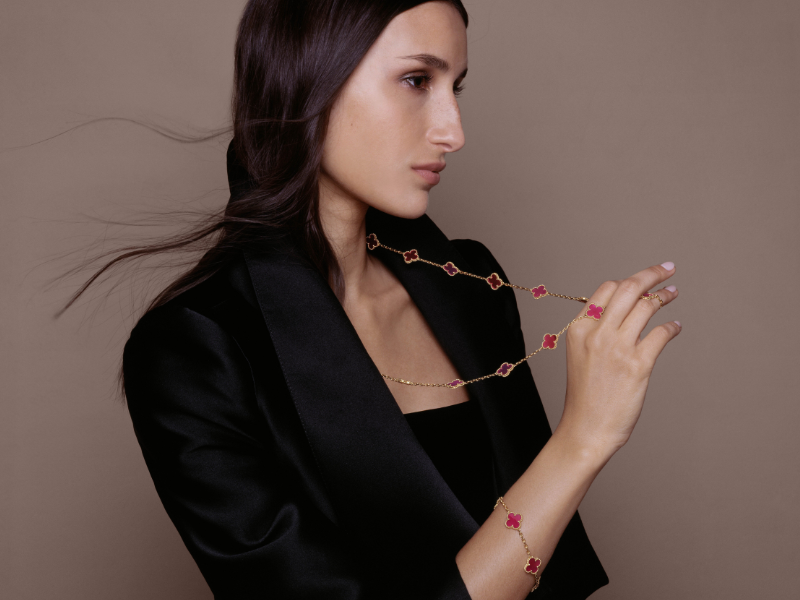
For 2026, Van Cleef & Arpels chose to see life through rose-tinted glasses, with a new suite rendered in vibrant pink enamel. Five fresh Vintage Alhambra and Magic Alhambra creations make up the release: 20- and 10-motif necklaces, a five-motif bracelet, a pendant and a pair of two-motif earrings.
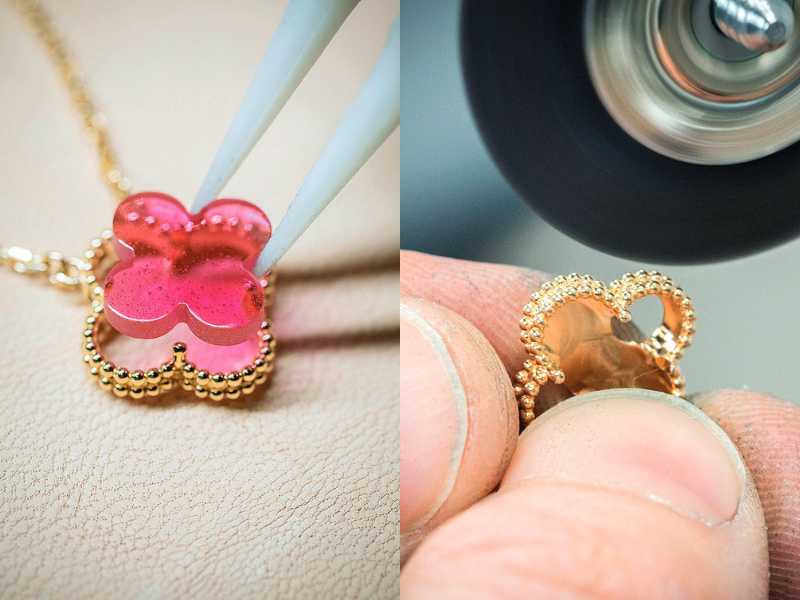
Departing from the solid, opaque or semi-opaque materials previously used in Alhambra pieces, the translucent pink enamel possesses an almost glass-like quality, allowing light to dance across its surface. Tiny bubbles suspended within the medium give each motif a sense of depth, while the surrounding yellow gold provides a warm counterpoint to the vivid hue.
This unique shade was not achieved simply by selecting a pigment. Instead, the maison’s workshops drew on a technique inspired by the 17th-century “gold-ruby” process in which colour is created from the presence of fine gold particles within the enamel. Producing the desired result is a complex process — the particles must be exactly the right size, shape and concentration. Perfecting the procedure itself took several years of research and development in the house’s ateliers.
Early examples of this ancient art form date all the way back to the Mycenaean civilisation of Greece. Enamelling then spread throughout the Mediterranean and eventually to far-flung civilisations, where it was notably reserved for royalty. Its ability to produce rich hues and distinctive surface effects made it a prized decorative material, often paired with precious metals and gemstones.
The craft has always been part of the luxury jeweller’s creative vocabulary, with the material applied to valuable objects, boxes, chatelaines, timepieces and, particularly, clips. Its designers had the means (and benefit of a broad palette and varied techniques) to let their imagination run wild with their creations.
2.png
Through the 1930s, enamel appeared in geometric designs influenced by Art Deco, alongside landscapes based on distant cultures and figurative scenes, especially depictions of athletes in motion such as golfers and ice skaters. In the 1950s and 1960s, the medium found another expression through the maison’s La Boutique pieces focusing on everyday accessories. Charming animal and floral designs featured accents illustrated in enamel, with some bouquet variations exhibiting transparent petals made using the plique-à-jour technique.
This carried on into the late 1980s as the house continued to dream up whimsical adornments in the form of realistic miniatures. Inspiration from faraway lands and storied tales brought butterflies, balloons, fairies and pirates to exquisite life.
Later, enamelling became an important part of the Van Cleef & Arpels horological world, starting with the first Poetic Complications watch in 2006 named Lady Arpels Centenaire. Gradually, the craft was used more elaborately, as seen in the Lady Arpels Pont des Amoureux. Portraying a romantic, moving love story, the dial was created using the monochromatic grisaille technique, which entails the layering of fine white powder over a dark background.
At present, the maison’s enamel workshop is proficient in at least 15 different techniques, including miniature painting and enamel decalling. Its in-house school also runs a three-year programme dedicated to supporting the transmission of this specialised knowledge to artisans.
1.png
Besides preserving established methods, the métiers d’art division is tasked with refining existing and developing new processes. Among them is façonné enamel, which conjures up three-dimensional forms with pronounced effects of volume and transparency, such as on the Perlée Extraordinaire Fruits Enchantés and the Lady Arpels Jour Enchanté watches from the Extraordinary Dials collection.
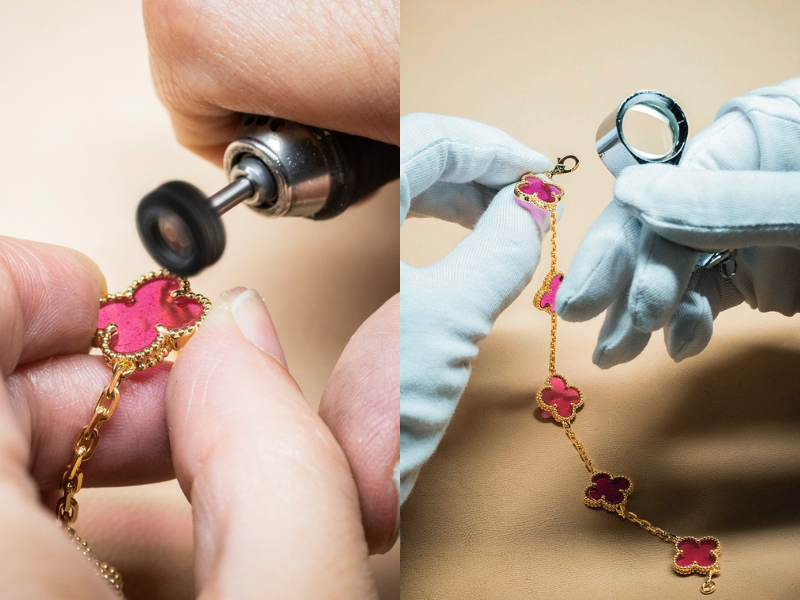
The new Alhambra brings this balance between inheritance and experimentation into clearer focus. One by one, the clovers are precisely fitted into their gold settings. It is important that each motif is carefully handled to ensure the smooth contours remain uncompromised. Meticulous polishing helps to achieve uniform curves and enhance the material’s reflection. The reverse has been considered as well, with rounded claws designed for gentle contact against skin and clothing.
Despite having evolved through decades of changing tastes and forms, the clover design stays rooted in its original purpose — to bring a little luck to its carrier. As the house continues to blend craft, invention and storytelling, this new collection is a reminder that even enduring symbols can shine anew.
This article first appeared on Sept 28, 2026 in The Edge Malaysia.