
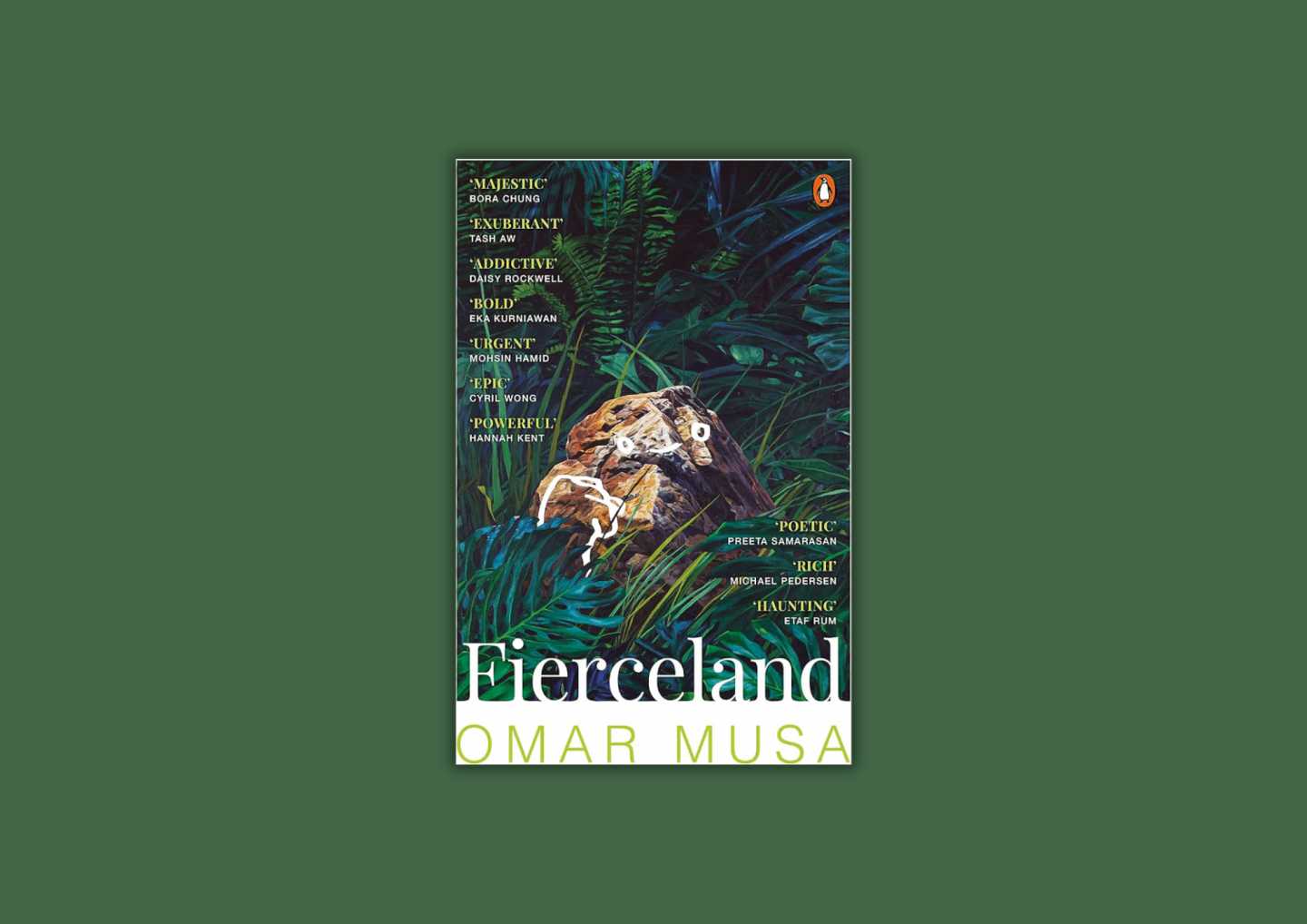
Omar Musa's latest book reaches towards the epical through its daring use of language, sustained throughout its length (Photo: Penguin Southeast Asia)
The storytellers’ bequest is the hands of their ancestors. This, according to Omar Musa, is the genesis of Fierceland.
“I was in a library in Canberra, and I found this dusty dissertation, long forgotten and abandoned, about my nenek’s people — the Kedayan, people of the borders of Sabah, Sarawak and Brunei.
“There was an amazing story in there about an ancestor of ours called the Fierce One, who was so strong he could use the entire trunk of a tree as a blow pipe, and he was shooting out the stars. The stars were dropping from the sky and he wanted to see where they landed, so he went on this epic journey, and every place he travelled to he called Fierceland.
“I wrote this all down. Years later, I am trying to put it into this novel and I say, ‘Man, I should have made a photocopy of this dissertation.’ I go back to the library and upend the whole place looking for this dissertation, but nothing comes up, and it never turns up ever again. I then started to question myself, question my faulty memory — did this happen, did I dream it, was I high, did someone tell it to me in a dream and I reshaped it as memory?
“But it didn’t matter whether Fierceland existed at all, because it now exists and I brought it into existence. I have created my own mythology.”
Kota Kinabalu — derived from the Dusun expression of “the revered place of the dead” — was the Jesselton of the North Borneo Chartered Company and subsequently the administrative capital of British North Borneo. But before it was the capital of Sabah, it was a place of names, encapsulating the heterogeneity of cultures, religions, languages, practices and myths.
For the émigré Pole Józef Teodor Konrad Nałòcz Korzeniowski, who would become the Joseph Conrad of literature in English, “the East” was not the deserts of Arabia or the sprawling subcontinent of India. It was further, the islands and archipelago of the Malay isles and Borneo, the allure of which lay in the “passion for pepper”. That search drove traders and sailors to “defy death in a thousand shapes; the unknown seas, the loathsome and strange diseases; wounds, captivity, hunger, pestilence, and despair”.
The territory of commodity would characterise the experience of modern European empires and, some would argue, the neo-colonial influence of capital to this day.
2.png

In a sometimes painful, sometimes funny, always poignant novel set in Jesselton on the eve of WWII, The Last Days of Jesselton — written by Malay language novelist Ruhaini Matdarin and translated by Pauline Fan — the protagonist notices a change in the financial fortunes of a famed Bangsawan troupe on a tour to Sabah:
“A hundred days ago, they had arrived in Jesselton at the Company’s invitation, to perform in honour of the Queen of England’s birthday. Today, they had come at the invitation of a coal entrepreneur, who was the owner of various industries across Borneo.”
In Fierceland, the local entrepreneur transmutes into transnational capital. The principal political posture is of environmental devastation in the felling of trees. There is corruption at the highest levels of politics. Even the names of Mahathir Mohamad and Najib Razak make appearances. All that we, in this country, know of the tumultuous politics of Sabah over so many decades is here. At times, it would seem that in aspiring to do a lot, perhaps too much, Fierceland attempts to drag us there.
Yet, that falls short of actually happening. Any form of political hectoring or didacticism is shrewdly subverted in the affecting trail of the journey back home. Fierceland is a novel that is constantly in the making, with onomatopoeia pulsing everywhere, as would be reflective of a slam poet. And there is always the excitement of discovering new forms of language. It is perhaps this experimentation and improvisation that enables Omar to use the inflective “lah” effectively. There is a predictable observation that he employs Manglish (a puerile and pointless term if there ever was one). Instead, Fierceland juggles with the prospect of almost creating a kind of patois.
“I Am Forest” — a rhythmic prologue of sorts — begins with all the sounds of gravel and sand that can be heard trudging through the jungle: “... unstitch my mist, open me inside-out, bare my breast to moon and matahari …”
All this transpires while the unravelling of the contemporary story of Sabah (and by extension the rest of aspirational Malaysia) takes place. The novel stretches as far as Benin and Nigeria, with allusions to Italy and always presided over by the looming shadow of the British.
1.png

It is foremost the tale of Rozana (Roz) and her brother Harun. They are children of a palm oil tycoon Yusuf and his Chinese wife Susan, or Yeung Yin Lam, who converts somewhat begrudgingly to Islam. Both children now live abroad — Harun a tech entrepreneur in Los Angeles and Roz, an artist in Sydney. They return to Sabah to attend the funeral of their father. Thus begins their search of origins.
Their quest sheds light on what is surely the principal character of Fierceland — Yusuf — who encapsulates all the contradiction, corruption, avarice, violence and aspirational nature following the departure of the British. In the jungle — called “the forest” — are the predictable encounters with wild beasts, ethereal beings and, naturally, the pontianak. At times, the author almost seeks to collect a cabinet of curiosities. There is even — and how can there not be — a reference to the Rafflesia.
The magical thing about Fierceland — and this is where the novel is most masterful — is its ability to break through the trudge, with infectious and patterned sentences, making this search of origins also one for the reader.
On the birth of Roz, a formal and well-known custom is heightened by the power of poetic recollection:
“Abah and Mak said that, on the day I was born, the 15 seconds before my first cry felt like 15 hours. When I finally cried out, they said the same words together at the same time, unrehearsed — sayang, sayang. Joyous, breathless laughter. They ran a sweet segment of mandarin over my gums, then Abah whispered a verse from the Quran into my ear. I saw them do this with Harun, too, I swear I remember it. Always filled me with joy to hear them sing the word out: Sayang.”
Fierceland is a family saga of incredible ambition. “I have created my own mythology after all,” professes the writer. It is reaching towards the epical, a state of myth best achieved in its daring language and willingness to venture into the carbuncle of phrasing. It is this rapture, sustained throughout the novel, that saves it from being a didactic tract on contemporary environmentalism, or a pitiful story of origins revolving around kebayas and motherhood.
Most of all, Fierceland demonstrates the best qualities of nuance and sensitivity, in its careful, clever use of the word “sayang” — surely the most infectious and beautiful word anywhere in the world.
'Fierceland' by Omar Musa is published by Penguin Southeast Asia and is available at all leading bookstores.
This article first appeared on Dec 15, 2025 in The Edge Malaysia.