
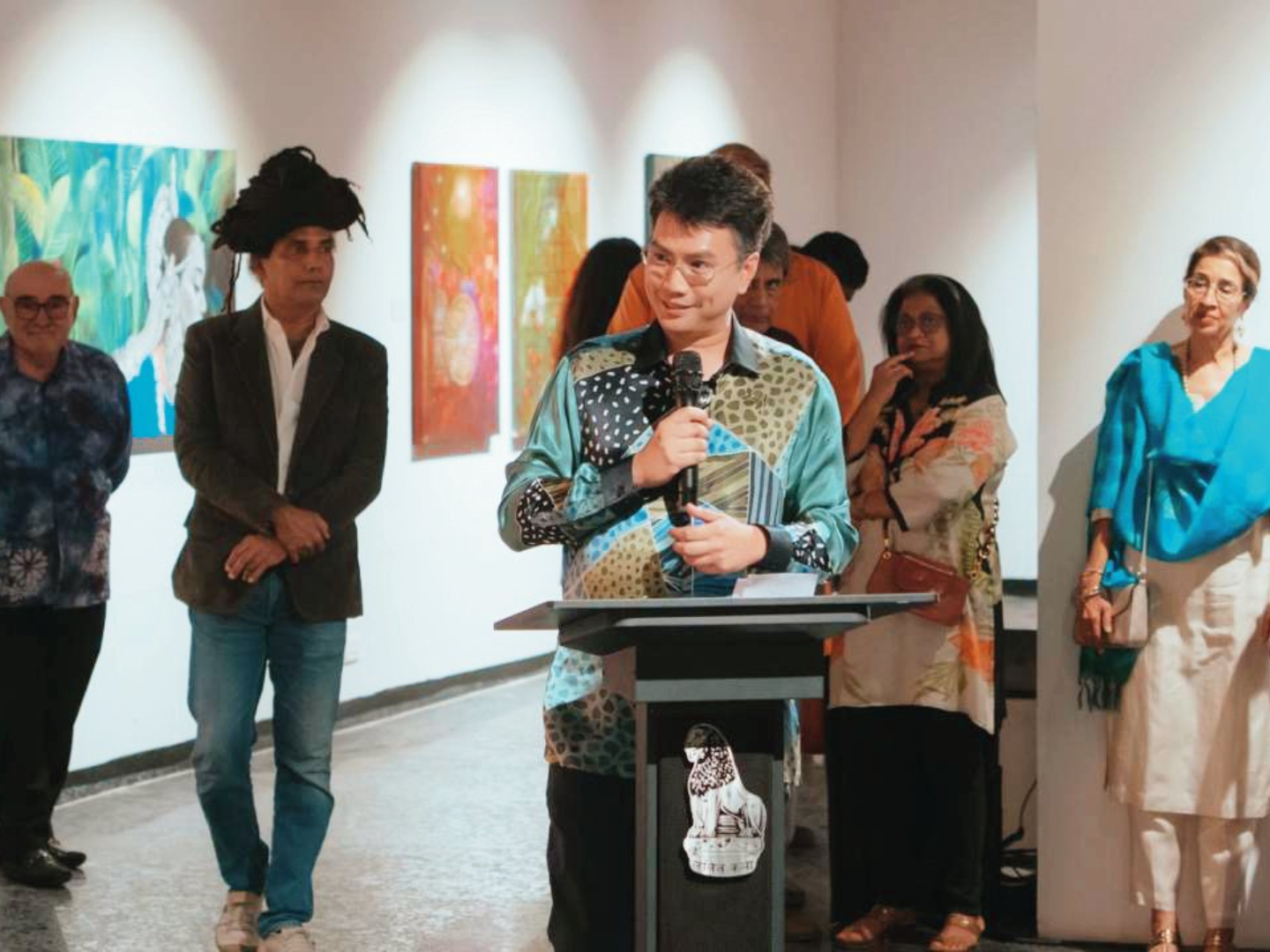
Tunku Zain Al-‘Abidin giving a speech at the launch of Let A Thousand Flowers Bloom, an exhibition featuring paintings and photographs inspired by Odissi dance (All photos: Tunku Zain Al-‘Abidin)
There is no country I visited for the first time that has had as much impact on me as India.
It helps that it is the seventh most vast country (over three million sq km) on Earth and the most populous (having now surpassed China) with more than 1.5 billion people. Its natural beauty certainly surprised me, but I knew that its civilisation — of ancient origins, enriched and devastated by unique foreign interchange, evolving uncertainly and dynamically since the country’s independence, and the subject of political contestation both at home and abroad — would provoke me intensely.
It was perhaps wise that the trip, encompassing two weeks from the end of January, began in Chennai. For in the capital of Tamil Nadu, a Malaysian can at least observe things that are immediately familiar, hearing the Tamil language being spoken and sung, seeing its names and script, and eating its cuisine (albeit with a much greater focus on vegetables).
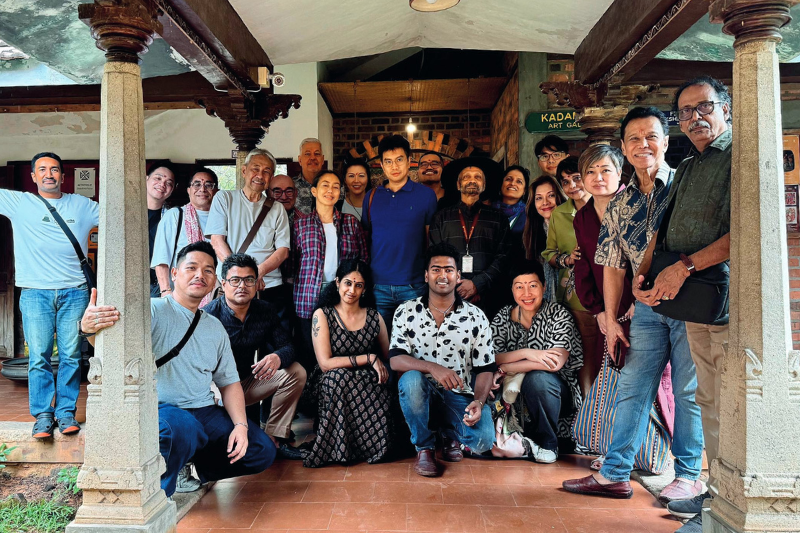
Here, I joined a delegation from the Sutra Foundation: an eclectic multi-ethnic crew of arts enthusiasts and philanthropists with past and present jobs encompassing every imaginable sector of Malaysian life. We were there with the original intent of bringing Meniti Cakerawala 2.0 — of which I was patron during its unprecedented tour across Malaysia last year — featuring astrophysicist Tan Sri Mazlan Othman and Sutra Foundation’s Datuk Ramli Ibrahim relaying the science and magic of astrophysics through poetry, music and dance. Alas, an unfortunate injury sustained by the former meant a necessary shift to the visual arts.
Still, the launch of Let A Thousand Flowers Bloom at the Lalit Kala Akademi, featuring 21 Indian and Malaysian artists’ representations of Odissi, inspired by the late Dr Dinanath Pathy, provided a cultural immersion that verified, without a shadow of a doubt, the unique position of the Sutra Foundation in the cultural space between the two countries. In the words of T S Tirumurti, former Indian high commissioner to Malaysia, “In India, they are ambassadors for Malaysia. In Malaysia, they are ambassadors for India.”
4.png
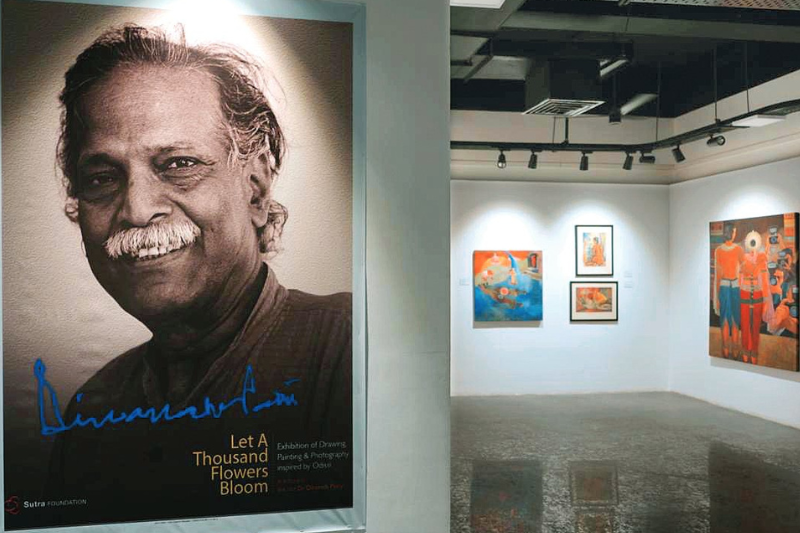
In my interactions with the arts, music is my most familiar medium, and dance very much my least. Yet these visual stills inspired by such graceful motions enabled me to better understand not just the physicality of the dance and the effort expounded in their movements, but also their geographical and historical origins, with scenes amid temples and the land being a common choice. It was also fascinating to see how some artists were far more abstract in projecting their emotions of the dance: I thought of Mussorgsky’s Pictures at an Exhibition, comprising musical compositions that so effectively depict the paintings of Viktor Hartmann, and wondered if an orchestral work should be the next step.
It is somewhat of a theme of Sutra lately: to bridge apparently vastly different fields of human endeavour, as with Meniti Cakerawala. It is indeed an effective way to build new audiences and, as I discovered during the trip, to make new friends. An excursion to a famous silk store yielded gifts for both home and away, with camaraderie weaved upon the realisation that the bilateral relationship between the two countries relies heavily not only on shared appreciation for culture, but acknowledging its shared origins too: as evidenced amply in our shadow puppetry, royal court instruments, dance forms and, of course, the content of the stories that they tell: stories that for decades have sometimes fallen afoul of those who seek to “purify” Malay culture of non-Islamic elements.
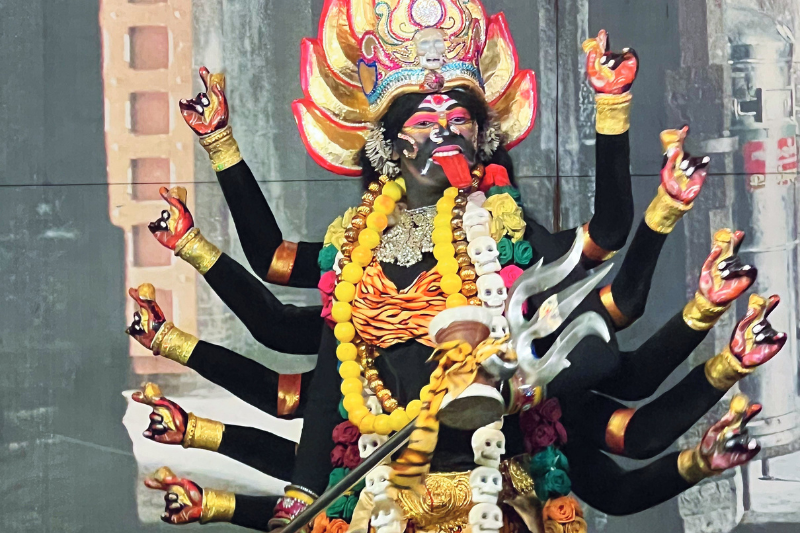
Via connoisseurs’ homes, a sprawling cultural village highlighting the traditions of south India in reassembled houses from different states, and onwards to Puducherry, the artistic frenzy did not cease — with pulsating Carnatic singing and the mesmerising Kaliyattam folk dance — preparing the mind and body for even more unique glimpses into the spiritual intensity of the region, particularly at Auroville where frankly, I approached the limits of my comfort zone. It was finally time to switch gears, and tasting a special Viluppuram coffee (to “change the mindset” of a tea drinker) was the passport for release from this former enclave of French India to the capital of the Bombay Presidency of the British Raj.
2.png
There were so many great civilisations in what is now India, each with its own universe of crazy and tragic histories and emotional highs and lows. The demise of the Mughals is particularly sad, but in Mumbai the landing site of George V as Emperor of India in 1911 still stands imposingly, a symbol of a city now cosmopolitan in its branding, flamboyant in its affluence, assertive in its growth. The itinerary saw a commensurate shift of mood, as I began a flurry of meetings with universities, think tanks and other civil society organisations working to improve local, state or central governance, or seeking partnerships with Malaysia, or in many cases, both. This schedule was curated by my hosts, the Indian Council for Cultural Relations (ICCR), an autonomous organisation under the Ministry of External Affairs of the government of India, under a visitors’ programme designed to improve bilateral ties by introducing like-minded scholars, advocates and practitioners from overseas to their Indian counterparts.
6.png
Before embarking on the trip, I was prepared to exercise restraint in my encounters. Especially when a government institution is a host, one is mindful not to say anything that might be interpreted as politically partisan. I was advised by many to particularly avoid mentioning any individual politicians or parties — such is the perceived level of polarisation: it is not worth losing any goodwill by stating an opinion (or asking a question implying one) in this foreign land. Having spent some time in the US and experiencing the exclusionary nature of its polarised politics, I assumed this was sensible advice. Yet, I quickly found it to be overly cautious, for the vast majority of my Indian interlocutors were perfectly happy to share their views not just about their government, but also — of great sociological interest to me — their experience of the multiple layers of identity they feel as Indians: of class, caste, religion, state and language.
The latter is particularly powerful yet overlooked in outsider understandings of the country: I felt it strongly not just in Tamil Nadu, but in Maharashtra and Karnataka, where Marathi and Kannada respectively are galvanising newfound local patriotisms alongside, it must be said, cricket — even more frenzied in the Twenty20 format. (I am more familiar with India’s flourishing squash players though, who often come to the Seremban 2 courts to play in PSA tournaments.)
Questions of federalism abounded in a myriad of contexts, and I found myself explaining Malaysia’s system several times, in answering questions about autonomous decision-making, fiscal decentralisation and policy variations in education, healthcare and environmental protection. Indeed, it was easy to see why mutual understanding across both countries is smoothed by institutional familiarity: we are both constitutional democracies with a mostly ceremonial head of state, with an executive head of government determined by a majority in the lower house of parliament, an upper house to represent the states, an ideally independent judiciary, and states with their own governor, chief minister and legislative assemblies. Had the princely states survived — they disappeared rapidly between 1947 and 1971 due to the political vicissitudes of independence and democratisation, many of the 565 polities having lasted for centuries prior — the similarities might have been even more palpable.
Yet, it was also intriguing to note that as I went on to Delhi and Bengaluru (where the welcome surprise was the freshness of the highland air, facilitating stunning gardens and birdlife), a common refrain was that the two countries could be working much more deeply together. From university partnerships to data centres and semiconductors, foreign policy and humanitarian interventions, India and Malaysia could do so, so much more, especially in the context of US-China rivalry and Asean continuing to forge solidarity. With Malaysian Prime Minister Datuk Seri Anwar Ibrahim visiting India in August 2024 and Indian Prime Minister Narendra Modi visiting Malaysia in March 2026 (replacing an intended visit during the Asean Summit), there is an unprecedented sense of optimism for new initiatives.
3.png
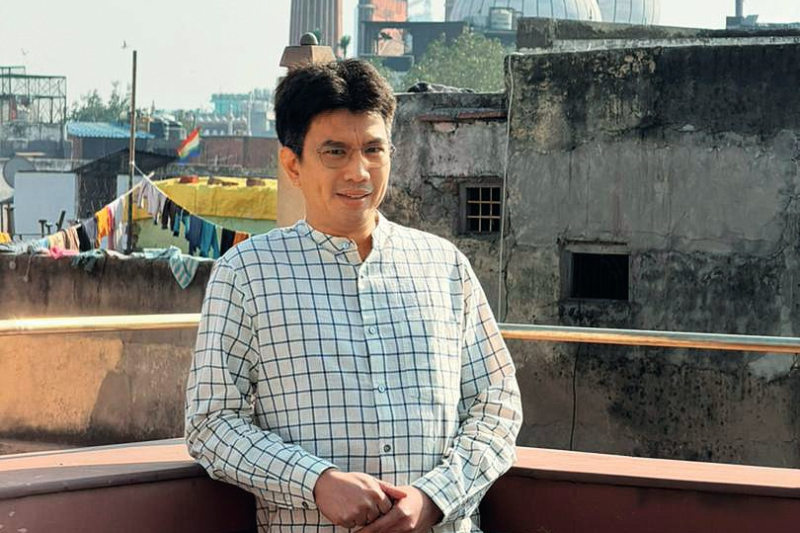
Again it was culture that provided comfort, for it was in music and dance that the two leaders’ affinity for the country of the other shone through with doubtless authenticity: Anwar really does love Dost Dost Na Raha and Modi really was blown away by how Malaysians presented the Swagatam dance.
Over the years, I have enjoyed much hospitality at India House off Jalan Duta (the only major diplomatic mission or residence to actually move to the area intended for embassies decades ago, as “Embassy Row” now de facto refers to Jalan Ampang Hilir where many more ambassadors live and work). But I felt it necessary once to cause some discomfort. It was around the time our recently acquired Scorpène submarines were in the news for being overpriced and defective — and India had also bought several — so I loudly asked a delegation of visiting naval officers, “And how much did you pay for yours?” Although the ministry officials were shocked, then annoyed, an ex-admiral was glad for this intervention, highlighting how military procurement, opaque under the guise of national security, is an easy cover for corruption, a topic still of great concern today. But it also highlighted the importance of multi-track diplomacy: that relationships occur not just between governments, but between militaries, academics, civil society and, of course, arts practitioners. And sometimes, when there is difficulty in one area (for no two countries will always align perfectly on foreign policy), it is the other channels that will help repair the relationship.
5.png
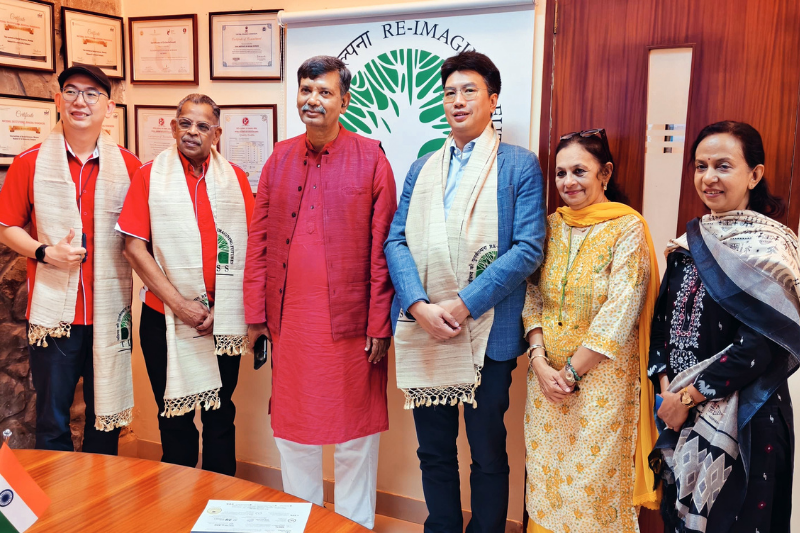
Two months after the conclusion of my trip, it was an honour to be invited to share my experience of the ICCR Distinguished Visitors Programme at an event commemorating ICCR Day and 15 years of the Netaji Subhas Chandra Bose Indian Cultural Centre in Kuala Lumpur. In my speech, I apologised to the Indian high commissioner, the soft-spoken intellectual powerhouse His Excellency B N Reddy, for not having called on him since he hosted a lunch to inspect the itinerary prior to my departure. In quick succession were Chinese New Year, Ramadan and Hari Raya Aidilfitri. Instinctively, he immediately responded with sympathy, displaying a cultural sensitivity that itself says so much: your traditions, your festivals are important, take the time and focus, celebrate with family, commemorate with community.
Perhaps that is one consequence of representing an ancient civilisation with so much inherent diversity. But it is also time to pick up the pace and leverage the bilateral relationship, propelled so much by our shared cultural traditions and appreciation, to help address the problems of the world today.
I am sure to some extent my reactions will have been similar to that of so many others who went to India before me. Yes, I got my money shot with the Taj Mahal and ate much more Mughlai cuisine than I thought I could accommodate (luckily fasting month began soon after), but what ICCR added to the trip was invaluable.
I have brought home to my colleagues at the university and think tank opportunities for partnerships and expansion, but I also hope the message that our growth — economic and cultural — will benefit from a deeper appreciation of this vast and inescapably significant country, with whom our ties have been essentially eternal.
Tunku Zain Al-‘Abidin, founding president of the Institute for Democracy and Economic Affairs, was a guest of the Indian Council for Cultural Relations across India in January and February 2026. Let A Thousand Flowers Bloom opens on April 25 and will run until May 3 at One Bangsar in KL.
This article first appeared on April 20, 2026 in The Edge Malaysia.