

The Ferrari F80 is the newest heir to the supercar mantle (All photos: Ferrari)
They say that the calmest place to be is in the eye of the storm, but this cannot be further from the truth, especially if the storm in question is the Ferrari F80.
We are at the Misano Circuit in Italy to put Ferrari’s latest supercar through its paces. “Supercar”, in the Prancing Horse’s vernacular, is a category and not just a noun, with the brand eschewing the superlatives some of its contemporaries use.
When cars are engineered the way Ferrari’s special edition models are, bombastic words are not required to impress, because it is just a simple matter of dropping the bass. Limited to 799 units, the F80 is a track-ready beast that boasts a bespoke chassis with cutting-edge electronic drive control systems, an active suspension mounted directly to the carbon-fibre tub and a hybrid powertrain forged in the crucible of the brand’s motorsports programmes.
In spite of the F80’s race-car aesthetics, it can be road-registered by its owner, just like its predecessors. As with all the Ferrari special edition models, the biggest hurdle is getting an allocation.
Don’t be fooled into thinking its road-going sensibilities suggest compromise; Ferrari’s true challenge lay in crafting a super sports car that could be driven at ten-tenths on the racetrack — and then driven home.
The F80 proved its mettle during the launch test-drive, which also included a 190km road session that saw us traverse winding roads, knobbly small-town streets and highways. A special car like the F80 comes along every decade or so and is a snapshot of Ferrari’s motorsports zeitgeist. This also explains the 800V hybridised twin-turbo V6 powerplant at its heart — a nod to the engines employed in Ferrari’s Le Mans-winning 499P, as well as in its F1 cars.
Petrolheads will lament the absence of a charismatic V12, especially since this was the engine of choice for the most recent three special editions — F50, Enzo and LaFerrari. However, with the Prancing Horse’s holistic “Ferrari for every Ferrarista and every occasion” approach to its product range today, there are other V12 alternatives for enthusiasts, such as the 12Cilindri or, if you’re lucky, one of the coveted Icona SP models.
Pushing the envelope
kens.jpg
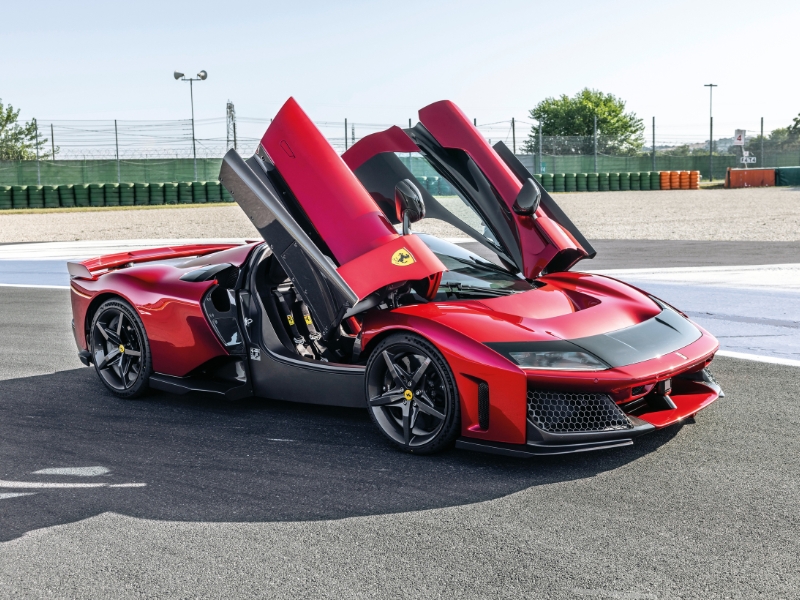
If the Icona series — special editions that pay homage to historical models — embody the emotional, the supercars like the F80 represent the empirical, where the objective is to push the envelopes of technical, production and design to go faster and harder than before.
Every design aspect of the F80 is functional to aid aerodynamics and cooling, because it is sculpted by the wind for speed. The F80 may not be pretty in the traditional sense, but it is all about finding the beauty in this brutal beast, with details that include discreet vents and NACA ducts that channel air flow to optimise cooling.
When the going gets fast, furious and frightening, the F80 generates downforce to the tune of 1,050kg at 250kph, thanks to the combined efforts of the active rear wing, a rear diffuser (measuring in at a record-breaking 1,800mm), flat underbody, front triplane wing and S-Duct.
There is an aura to the race-bred F80’s tense, futuristic design that makes it look fast, even when idle. The active height- and angle-adjustable spoiler imparts a different visual personality to the car than when it is fully deployed; yet, the F80 is no less a bristly and belligerent character.
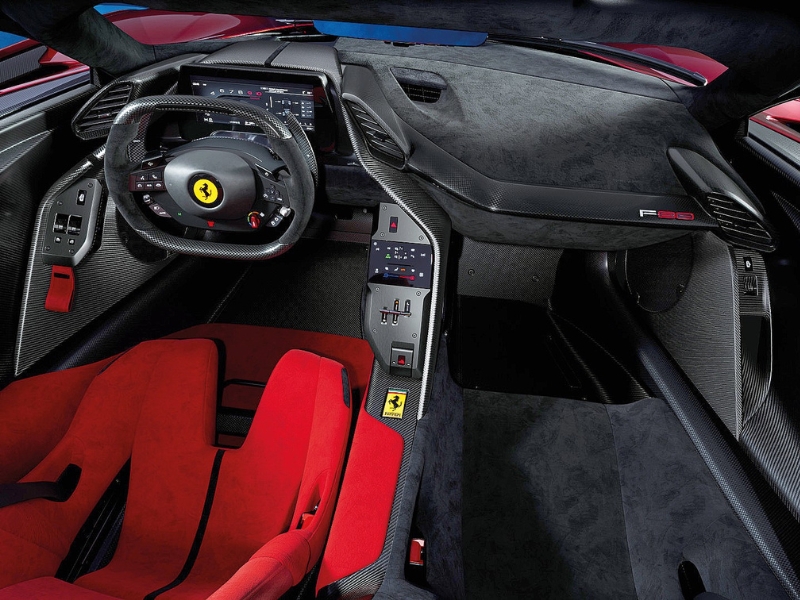
The driver-oriented cabin imparts the feel of a single-seater, but it has been homologated for a “1+” (versus a full 2). The reduced cockpit width and setback position of the passenger’s “seat” aid weight savings and minimise drag.
From the driver’s seat, secondary controls for the climate system, wing mirror adjustment, front lifter and so on are grouped on a “floating” central face-plate, while essential drive controls are positioned around the steering wheel.
Crucially, Ferrari has brought back some physical controls on the steering wheel to replace the haptic functions. Such a deliberate, tactile feel to the dynamic controls serves to augment the fast driving vibe and is more intuitive to engage with racing gloves on.
The new steering wheel is smaller than before and features flattened top and bottom portions. It is chunky enough for the driver to grip snugly and never proves to be more than a handful. This new design provides the driver with perfect legibility of the digital instruments and will appear in future Ferrari models.
Blistering power
b683.jpg
The F80 features an electric front axle with dual motors, so it is effectively all-wheel driven, a configuration Ferrari feels is most appropriate to tame the super sports car’s prodigious performance.
In true sports car fashion, the electric motor is engineered to aid and abet your motoring mischief, as opposed to zero emissions zipping around. The moment we engaged “full send”, the 1,200hp F80 went ballistic and slingshot itself to the end of the front straight, with time only for a hastily gulped breath before further ultraviolence ensued.
There is next to no turbo lag, too, with the F80 the first Ferrari to apply e-turbo technology. Coupled to the gob-stopping hit from the electric motors, you’re looking at a hugely elastic powerband of monumental proportions. The flexibility of the F80’s power delivery beggars belief, as the super sports car pulls with the virile vigour of an athlete out for a night on the town.
Flat-out, the soundtrack is more thundering typhoon than Dyson duster from the outside, although regulatory killjoys are trying their best to diminish one of the best bits of a sports car — the drive-by sound.
With a soul-stirring mechanical soundtrack, things are far more strident within the cabin, especially with every up-/down-shift of the 8-speed dual-clutch gearbox punctuated by an evocative shift shock that leaves the driver well and truly shaken and stirred.
The choice of a relatively lighter V6 (compared with an 8- or 12-cylinder) contributes to the precise balance of the F80’s handling, with the steering wheel serving up organic, feel-some feedback that lets one drive it remarkably fluidly.
The F80 is agile and can be confidently manhandled to change its angle of attack on the fly. Regardless of whether you are braking, accelerating, cornering or changing directions quickly, the F80 can be steered with great confidence at stupendous speeds. Moreover, the driver is always aware of the grip levels of the sticky Michelin Pilot Cup Sport 2 R tyres.
CCM-R Plus carbon-ceramic brakes and carbon rims round off the F80’s race-car package, with the former delivering eye-watering stopping power with a pedal feel that allows for millimetre-precise modulation.
The level of steering communication never threatens to overwhelm one with nitty-gritty minutiae. It transmits only the important, meaty details so the proceedings never deteriorate into fidgety hacksawing, but remain sublimely composed, with the driver always in control and right in the thick of action.
body_pics.jpg
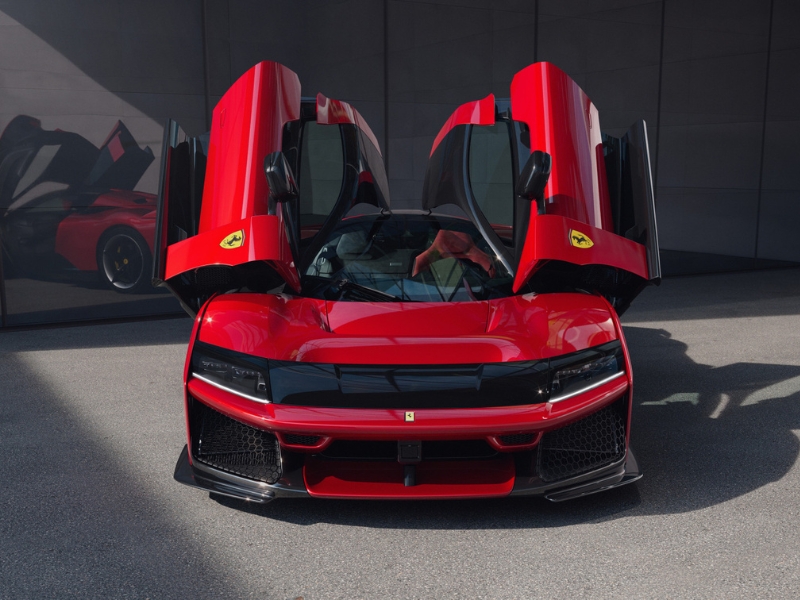
The F80 looks perfectly at home on track, so it is a surreal experience to take this otherworldly road-legal track beast onto public domains. Even away from the smooth surfaces of the race track and on the patchy tarmac of real-world surfaces, the F80’s chassis offers that same confidence-inspiring performance.
This does not mean the F80 is easy to drive, because its stratospheric limits force you to up your game exponentially to take full advantage of the car’s trick dynamic abilities. Even if its design is not instantly recognisable as a Ferrari, the F80 exudes a formidable road presence, and passers-by will certainly appreciate it as something special.
The F80’s vital statistics may be full of magical numbers, but the real magic is how Ferrari has distilled the supercar’s complex computational wizardry into an addictive blend of scintillating, yet satisfyingly organic driving pleasure.
This article first appeared on Aug 4, 2025 in The Edge Malaysia.