
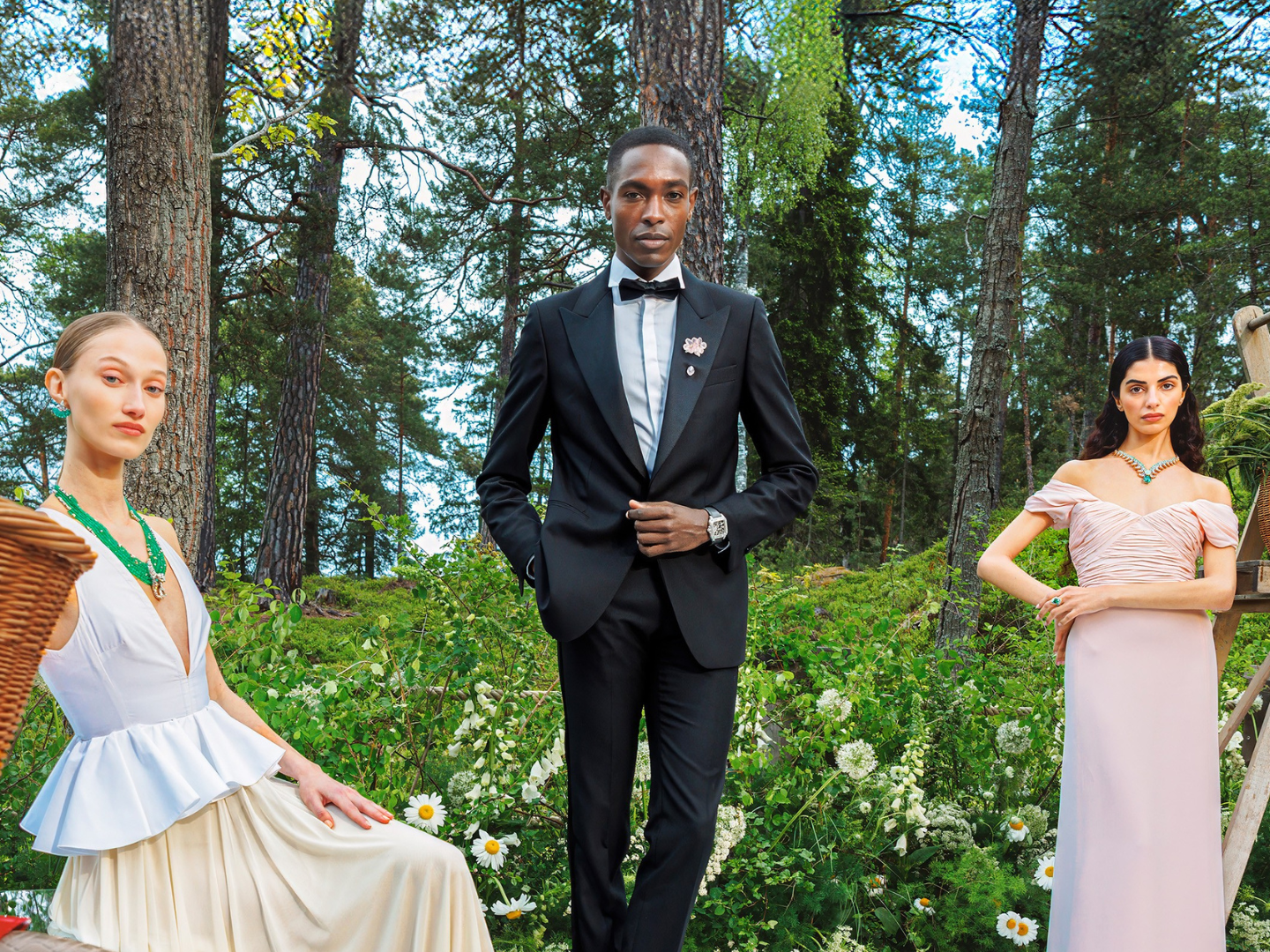
Models stand against lush woods decked out in pieces by Cartier, appearing as artworks come to life (Photo: Cartier)
At first, it seems utterly contrarian to base a high jewellery collection on the Swedish philosophy of lagom. Translated simply as “not too much, not too little”, lagom means balance whereas, to the uninitiated, high jewellery is the finest and most luxurious expression of jewellery that money can buy, characterised by the rarest gemstones and consummate craftsmanship and design. Several steps up from fine jewellery, this rarefied realm of precious, exceptional stones fit for only pashas and potentates seems a literal world away from what lagom espouses but somehow, the house of Cartier made it work.
Christening its 2025 high jewellery showcase En Équilibre (French for “in balance”) and selecting Stockholm, Sweden, as the venue for the collection’s global unveiling, caught many off guard. In the previous year, when the Nature Sauvage collection was presented in Vienna, Austria, no one raised an eyebrow as the former seat of the Habsburgs, a city practically laden with numerous sumptuously appointed palaces — a perfect bedfellow for the iconic jeweller’s offerings — made complete sense.
“We chose Stockholm not for the weather,” jokes Arnaud Carrez, senior vice president and chief marketing officer at Cartier. “We believe this city embodies the perfect balance between tradition and innovation, between urban life and nature, and also comfort and durability.”
The destination
hotel.jpg

While Stockholm, at first glance, has nothing in common with the jewel box-like Vienna or Cartier’s famously red-hued opulence, it has its own allure. Nestled between the sea and lush nature, the Swedish capital is generally considered a “cool” city by most, blending its famously minimalist style and preference for a soft neutral colour palette with a thriving design and fashion scene. It boasts numerous homegrown labels, sought-after in every corner of the globe. From Fjällräven backpacks to Acne Studios jeans, not forgetting democratic homeware brand Ikea and the Hennes & Mauritz clothing empire, with its diffusion labels like Arket, Cos and & Other Stories, to Gunnar Asplund architecture, long seen as the flagbearer of 1920s Nordic Classicism, Sweden has cultivated a distinctive yet diverse aesthetic.
And so it was the city built on 14 islands and connected by 57 bridges that the world’s luxury media and a coterie of handpicked guests descended upon, for a few fairy-dusted days. Dotted with more than 24,000 islands, islets and skerries, Stockholm is also the country’s largest archipelago, justifiably living up to its nickname, the “Venice of Scandinavia”. Dig a little deeper and you will discover that Sweden’s monarchy is among the world’s oldest, dating back to the 10th century and whose present King Carl XVI Gustaf and Queen Silvia spend time between the Royal Palace in Stockholm’s old city of Gamla Stan and another castle in Drottningholm.
Those who visit Stockholm invariably tell of a vibrant yet relaxed city that has achieved the perfect balance between nature and urban life, and where creativity and design consciousness are juxtaposed against understated yet authentic architecture. In short, a palpable sense of equilibrium.
boutique.jpg

“We must not forget that Cartier has had a relationship with Sweden since the beginning of the 20th century,” says Pierre Rainero, the maison’s director of image, style and heritage. And indeed it has. Despite opening its first standalone boutique in Scandinavia (along Stockholm’s Smålandsgatan) only seven years ago, Cartier has records of a tiara being created for the Swedish royal family in 1904. “And in terms of art and history, Sweden and France’s links go back even further,” he adds.
The presentation of En Équilibre is yet another link in the shared story of two countries. Comprising 115 exquisite pieces, the collection was unveiled at the Nacka Strandsmässan, a former car factory turned atmospheric events space, a short drive from the city centre. Going one step further to ensure a Swedish sense of place was maintained amid the flurry of diamond, sapphire and emerald perusals, the maison even thoughtfully set up its own fika café, paying a respectful nod to the Swedish tradition that blends a coffee and snack break with socialising and forming connections. Visitors to the jewellery showcase could catch their breath over a cuppa (Swedes apparently consume the most cups of coffee per capita, with a daily average of three to four cups), preferably accompanied by a kanelbulle (cinnamon bun), the indisputable king of fika treats. Socker Sucker, one of Stockholm’s most innovative patisseries, was chosen to helm the café.
The collection
dentelee.jpg
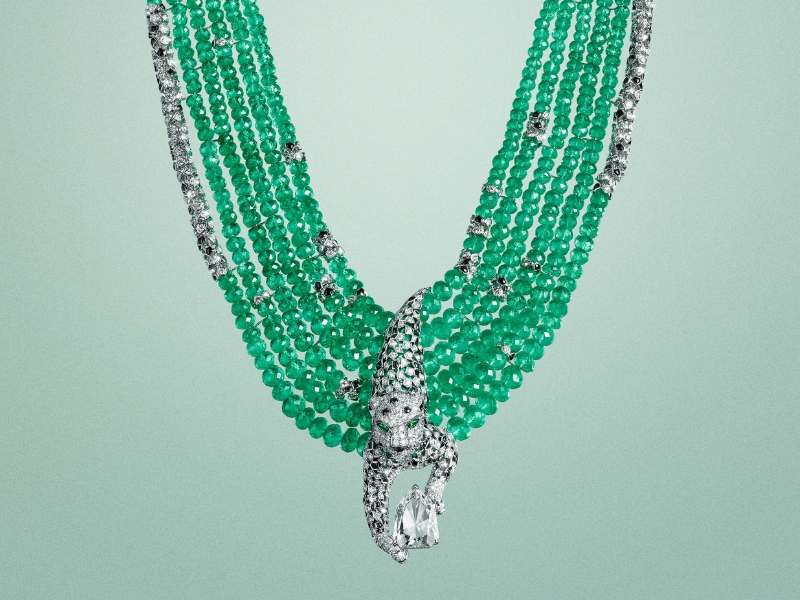
The En Équilibre journey opened with the Panthère Orbitale, a necklace of amethyst and coral beads with a diamond and onyx panther at its heart, perched on a coral cabochon. Particular attention was paid to the threading technique for this piece while a special coral spot setting was introduced for the very first time. Lovers of emeralds would not fail to miss the Panthère Dentelée, fashioned using a cascade of 800 faceted beads made from Colombian emeralds, totalling almost 275 carats for both necklace and matching earrings. Word has it that the threader took a year to perfect the necklace’s harmony, as its asymmetry and different strands proved a major challenge initially.
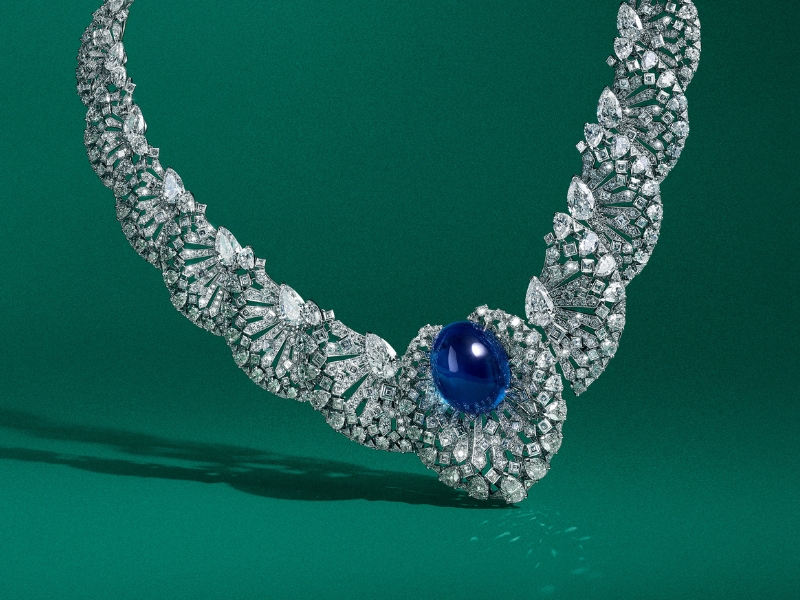
The attention-arresting Pavocelle, whose name is inspired by the Latin pavo or “peacock” and the French ocelle (the eyespots of a peacock’s tail) is underscored by one remarkable 58.08-carat oval-shaped cabochon-cut sapphire from Sri Lanka. Sculptural elements, composed using platinum and diamonds, echo the sapphire and are also reminiscent of a peacock’s ocelli. But what makes the necklace or jewelled collar additionally noteworthy is that its reverse side is as beautiful and complex as the front. And although carat-heavy, Cartier’s extraordinary workmanship has resulted in a suppleness that sits it beautifully and comfortably on the skin. The modular necklace’s main motif is removable and may be easily transformed into a collar brooch. If the Pavocelle is a little beyond reach, there is the Azulejo to consider, a white gold ring with sapphire beads, tapered and brilliant-cut diamonds, and best of all, a single and singular 15.35-carat sugarloaf Ceylonese sapphire as its star.
pavocelle.jpg
Those with a penchant for marine life would surely gravitate towards Janolus, inspired by and named for a genus of sea anemone. As always, with design dictated by the key stone, here the necklace shines with opals, garnet beads and brilliant-cut diamonds. But two gems vie for attention: a 5.74-carat cabochon light opal, below which is an astonishing 23.48-carat cushion-shaped blush green tourmaline. Whichever the jewel, what cannot be reinforced enough is Cartier’s dedication to savoir faire or, succinctly put, “know-how”. The Panthère Dentelée necklace consumed a total of 1,678 hours of work while the Pavocelle and Panthère Orbitale necklaces took 5,739 and 1,424 hours, respectively.
Another masterpiece is Shito, whose impressive twin emerald drops from Zambia, weighing 49.36 carats in total, dangle seductively from a long, gem encrusted strand. With its clasp positioned to the side, leaving the sliding system at the back, this spelt a true technical feat for the jeweller who had to integrate it into a small space without compromising on either aesthetics or mechanism.
The event
models.jpg
Undoubtedly, the apex of the event was the crisp evening at Artipelag, the renowned art museum founded by Björn Jakobson, the tycoon behind infant care brand BabyBjörn. Guests were ferried from Stockholm to the museum, located on 22 acres of pristine land in Hållauden and right by Baggensfjärden, a serene bay surrounded by pine forests, aboard the Östanå I, a 120-year-old listed historic ship of Sweden.
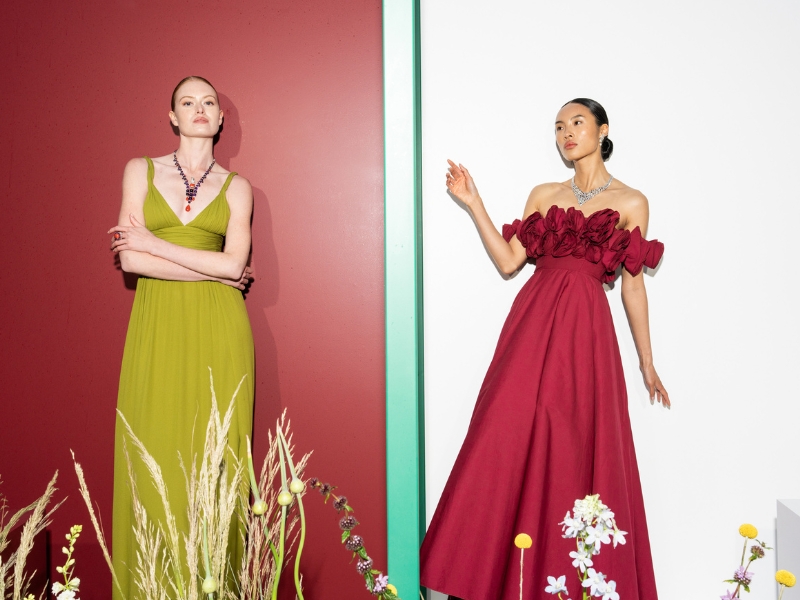
After sailing past the Solar Egg, Artipelag’s famous cliffside landmark in the form of an ovoid sauna that doubles as a social sculpture by the Swedish duo of Bigert & Bergström, passengers disembarked at the seashore jetty before being led up a path flanked by sentinel-like large oaks. Along the way, Cartier had taken the time and trouble to establish delightful tableaux vivants, where models, dressed in Giambattista Valli and, naturally, the latest masterpieces from En Équilibre, appeared as artworks come to life.
It was the late Johan Nyrén (son of Carl, regarded as the most Swedish of Swedish architects of the second half of the 20th century) who earned Jakobson’s commission to create a destination where nature and culture could be melded into a wholesomely singular experience. Lush woods and meadows continue to surround, even camouflage, Artipelag’s organic, treasure-rich form. And seeing as it was the end of spring, flowers remained in bloom, offering the eye charming little pops of colour set against a backdrop of vivid green.
sawai_and_valli.jpg
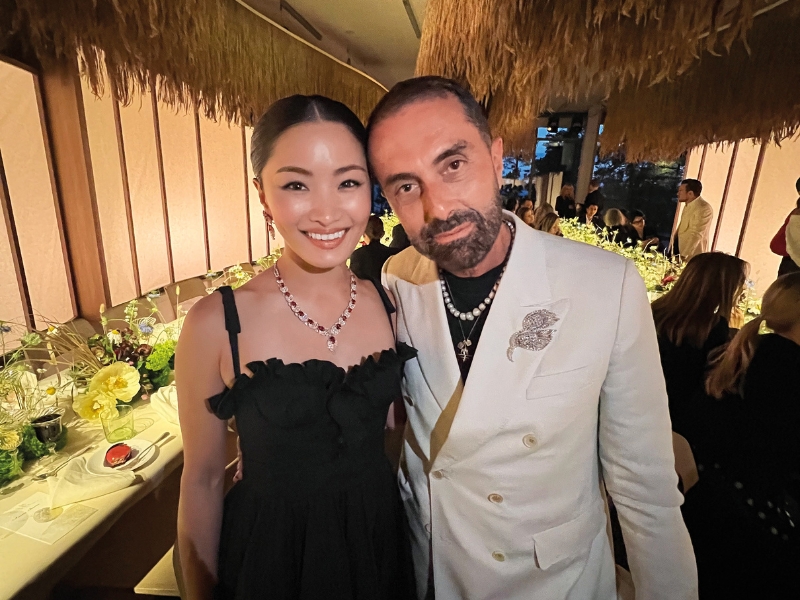
Once within Artipelag’s sleek interior, a quartet of renowned actors — friends of the maison, Zoe Saldaña and Alexander Skarsgård, and brand ambassadors Deepika Padukone and Anna Sawai — appeared, to join in a dinner of Nordic char, turbot and nettle broth. It was only when dessert was served that the northern sun finally gave way to night.
As the evening wound down, guests proceeded to an upper level for more merry-making, fuelled by music from Canadian rock band The Beaches and a set by DJ Dorion Fiszel. Conversations continued to veer from the upcoming Midsommar festival — a major celebration in Sweden whose origins are tinged with mystery and where bonfires and flower wreaths are de rigueur — to the perfection of Stockholm as a choice of venue for an astounding jewellery collection that encapsulates the essence of balance.
Perhaps it is no coincidence that Cartier chose the magical weeks leading up to Midsommar to launch En Équilibre. The summer solstice is seen in many cultures as a time of rebirth and renewal, as the Earth’s tilt shifts and transition into the next season begins. The extra-long daylight hours of midsummer are a reminder that the sun sustains life and how everything, sooner or later, bows to the cycles of life. Rainero, before parting, offered a final pearl of wisdom. “We must remember that the way we define balance is also how we define ourselves.” As the maison continues to evolve, it has never overlooked the elements of nature in all that it does — as a source of inspiration, as a resource and unveiling things when they should be unveiled, always in perfect rhythm, in harmonious cadence. In equilibrium.
See more of the high jewellery collection here.
This article first appeared on June 16, 2025 in The Edge Malaysia.