

Model Claudia Rosie wears a sleeveless mini dress and accessories by Chanel. Photographed by Eric Chow.
In the documentary In Vogue: The Editor’s Eye, released in conjunction with Vogue’s 120th anniversary, Anna Wintour says in the opening scene that she makes it a point to not celebrate anniversaries, stating “that one should always look forward rather than backwards”. That is perhaps most relevant now as she moves on from her role as editor-in-chief (EIC) of US Vogue — a position she has held for nearly four decades — to focus on her position as Vogue’s global editorial director as well as chief content creator for Condé Nast.
Netizens were quick to react, declaring it the “end of an era”, but it seems — as is usually the case — they got it wrong. The Business of Fashion described her moving away from the role as “not the end” but an “elevation”, reflecting the expansion of her duties at Condé Nast, which has her overseeing all the titles at the organisation, including GQ and Vanity Fair, the only exception being The New Yorker.
“Anna is still in her office and is very much the boss,” says a publisher of Vogue from the region. “She is the global director, so the editors of Vogue from all over the world report to her.”
That includes Chloe Malle, who was named head of editorial content for the American edition, often referred to as “Big Vogue”, on Sept 2. In an interview with The New York Times, during which she outlined her strategy, Malle stated unequivocally that, “the truth is that nobody is going to replace Anna”. Nonetheless, all eyes will be on her first issue, which is set to hit the stands next year.
Much like the way Wintour redefined Vogue upon assuming the position, it seems that Malle too will chart the future of the American edition — her own way. During the interview, Malle hinted at the possibility of a reduced number of print editions and focusing only on collectibles or special editions.
“We all look at print as something that is collectible, something you might want to archive and hold onto,” agrees Wintour, during a recent interview with The New Yorker. “I think it also has to represent a news-breaking moment. You need a reason to put somebody on the cover for any of the stories you might be running inside. That it has to be more important, substantial, separate from the day-to-day news-breaking stories.”
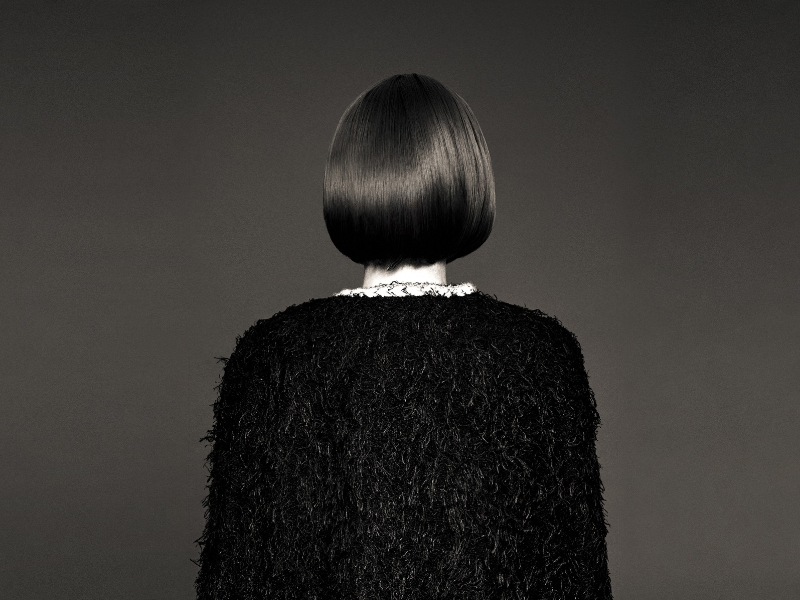
Cape in black fantasy wool tweed, embellished with white-and-gold braid and jewelled buttons by Chanel
When the announcement came that Wintour would no longer hold the position of EIC, the accolades were swift and abundant from industry players and observers who pointed to her many firsts as Vogue editor. Yet, in her interview, Wintour points out that her influence was confined solely to print with a scattering of events, compared to Malle, who now has numerous platforms to reach her audience.
In 1988, upon assuming the editorial helm at Vogue, Wintour set the tone for her stewardship with a cover that was unlike the pretty girls with the perfect hair who, till then, had adorned Vogue. Her debut featured a model showcasing a US$50 pair of jeans, worn with a US$10,000 Christian Lacroix sweater. The printer was convinced it was a mistake as it departed so significantly from what Vogue represented till then.
When criticised for supposedly abandoning traditional Vogue readers for a younger audience, the reply was typically Wintour and non-apologetic: “Sure, but I haven’t met a woman yet who wants to look old.”
“What stands out to me most is her leadership style,” says Gilbert Cheah, the APAC Ambassador for US Vogue’s Vogue 100 Community. The Vogue 100 comprises a select group of creative voices from the globe that range from actors and artists to athletes and activists. “She’s decisive but also open to different views, seeking out people with strong perspectives and giving them the space to do their best work.”
Cheah’s admiration for Wintour goes back to the 1990s when he was living in New York and she had already established her iconic status.
“She’s always been an inspiration and role model to me,” he says, “so meeting and eventually working with her was especially meaningful.”
Wintour’s decisiveness is something New York-based Malaysian designer Zang Toi knows only too well. He was featured by Vogue as one of four new faces in the March 1990 issue. As a fledgling young designer, Zang apparently sent out photocopies of his sketches to various publications, including to Vogue where Wintour was also relatively new in her position. Captivated by what she saw, she was quick to remove another designer, making way for him.
“It was a dream-like experience to be the very first Asian designer championed by Anna Wintour,” he says. The feature followed his second collection for spring 1990. “Anna Wintour has a great eye when it comes to spotting new talent and is not afraid to promote it with lightning speed.”
His appearance in Vogue gave him the stamp he needed to mark his entry into the fashion scene. Her decision to feature him, he believes, was not about presenting a diverse line-up but was driven solely by her belief in him.
Zang believes that his story could happen again today because it was driven by talent. “It was about talent rather than diversity for her at that point of her career,” he says.
“She has a remarkable eye, having helped launch the careers of countless designers, photographers and creatives, and their gratitude and loyalty are part of why her influence has lasted so long,” says Cheah.
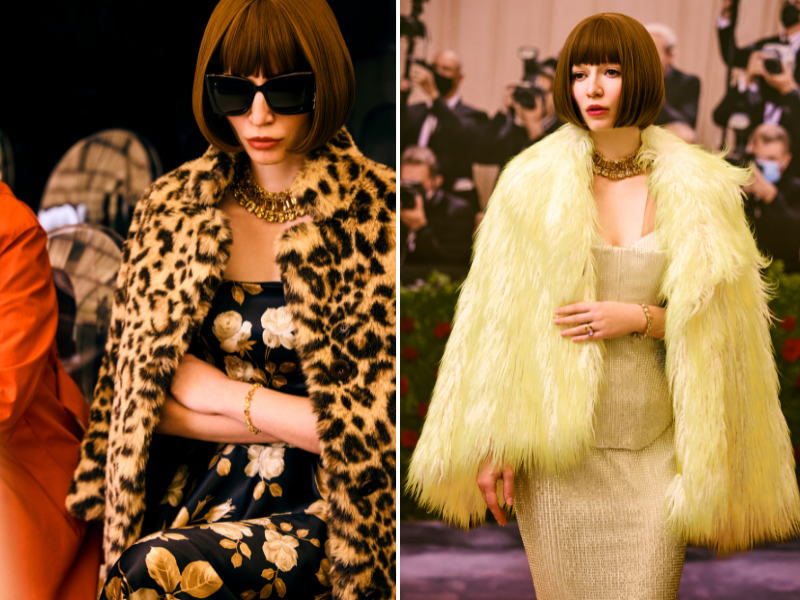
Left: Cat-eye sunglasses by Chanel; accessories by Swarovski; and floral print dress by Dolce & Gabbana. Leopard print faux fur coat in recycled polyester, available exclusively online and at Coach Pavilion KL. Right: Two-piece top and skirt ensemble (RM18,500) by Fiziwoo Couture; accessories by Swarovski. Faux fur coat, stylist’s own.
Datuk Seri Dr Farah Khan, founder and president of The Melium Group, believes that Wintour succeeded in transforming Vogue into more than just a fashion magazine.
“She made it a cultural authority, connecting fashion with art, politics, entertainment and society,” she states. “She has always had a gift for identifying talent early and placing designers, photographers and models onto a global stage. That shaped the way we all view fashion, as not only clothes but as storytelling and influence.”
“Anna has that unique talent of combining fashion and cultural moments,” concurs Zang. “She was the first to tap into the Bright Lights, Big City moment in New York that was about capitalism, featuring big, bright and bold colourful fashion that replaced the quieter and neutral-coloured fashions championed by the Armani era.”
Her vision consistently pushes fashion into broader cultural relevance, states Cheah. “She was the one who brought the stars of the film, music, sports and even political worlds into fashion’s orbit, elevating both sides in the process. And, of course, she transformed the Met Gala into the world’s most prestigious red carpet event, a cultural moment in its own right.”
For designer Alia Bastamam, the term editor does not quite capture the extent of Wintour’s influence at Vogue.
“She redefined what fashion means to the world,” she says. “She turned it into a cultural language and a global business, making fashion far more accessible.”
Alia has been featured in Vogue Singapore, including having her design worn by Yuna on the cover. From Wintour, she has learnt the importance of turning passion into something sustainable and profitable.
“That has taught me to not only immerse myself in design and aesthetics, but to also be committed to the business of fashion, where creativity and commerce fuel each other.”
For Farah, a significant aspect of Wintour’s ability to combine fashion with storytelling provides the impetus for broader conversations — from history to diversity to celebrity culture.
This is, perhaps, best exemplified by the Met Gala themes that capture a worldwide audience, the latest being Superfine: Tailoring Black Style, which took place earlier this year. The exhibition honoured Black Dandyism, used to describe men who approached aesthetics as a lifestyle, attitude and a form of self-assurance. For the Black community, the term was used positively to encapsulate people and their ambitions.
“To me it is about education, it is about liberation, it is about joy and it is about the self-respect that is given to yourself by dressing well and dressing with style, humour and wit,” said Wintour when interviewed during the event.
The exhibition comes five years after Vogue and its EIC were criticised for a lack of diversity at the height of the Black Lives Matter movement. The theme has been described as Wintour’s promise to address the lack of diversity that had occurred at Vogue.
“I want to say plainly that I know Vogue has not found enough ways to elevate and give space to black editors, writers, photographers, designers and other creators. We have made mistakes too, publishing images or stories that have been hurtful or intolerant. I take full responsibility for those mistakes.”

Short jacket in red, pink, black and white fantasy tweed, embellished with braid and jewelled buttons; necklace in metal and resin; gloves in red, pink, white and black fantasy tweed and red leather; 11.12 bag in red, pink, black and white fantasy tweed and metal, all by Chanel.
And as the hype grows for the sequel to The Devil Wears Prada, the film that immortalised her so-called authoritarian leadership style, much was also written about the apparently tyrannical way in which she ran Vogue upon her stepping down. Some accounts of these have become legendary.
In the book How to Lose Friends and Alienate People, author Toby Young recounts a scene in which the EIC of Vogue trips on her Manolos and falls smack in front of an intern. The intern, who had been instructed NEVER to speak to the editor, reacts by calmly stepping over her as if nothing had happened, before dashing down the corridor.
When asked about The Devil Wears Prada at a forum for students at Oxford, Wintour responds to depictions in the film as “highly amusing”, and that it is always an “honour to be played by Meryl Streep”.
At the same forum, she was asked whether leaders should be feared or loved, to which she replied succinctly: “Both.”
“She’s much warmer and more approachable than people might expect,” says Cheah. “That so-called intimidating aura has more to do with her celebrity than with who she really is.”
“Today, authority and power can feel like unfashionable concepts,” says Alia. “But in her hands, they defined an era. Her decades of leadership truly shaped what fashion has become on a global scale.”
It is this authority combined with vision, adds Alia, that set the standard for fashion, not just culturally and commercially, but also in the worlds of art, film, music and even politics.
It was under her leadership, reminds Cheah, that Vogue moved swiftly into digital spaces, building its platforms on YouTube and Instagram into major successes, while its publication still retained its authority.
Farah, who like Wintour, is often referred to as one of fashion’s most influential women, says that it is Wintour’s discipline and decisiveness that she takes inspiration from.
“They are legendary,” she states. “I’ve learnt that clarity of vision is power. Once she believes in something — a designer, a cause, a point of view — she firmly stands behind it.”
Contrary to public perception, Cheah says Wintour is not one to micromanage. Instead, she “provides clarity, sets direction, and then trusts her team, which fosters both accountability and creativity”.
There is also her ability to balance tradition with change.
“She keeps the aura of Vogue yet constantly reinvents it for new generations. That balance is something every leader must master.” On a personal level, Farah adds, “I’ve admired her ability to create cultural moments that extend beyond fashion, that’s something I bring into my own work.”
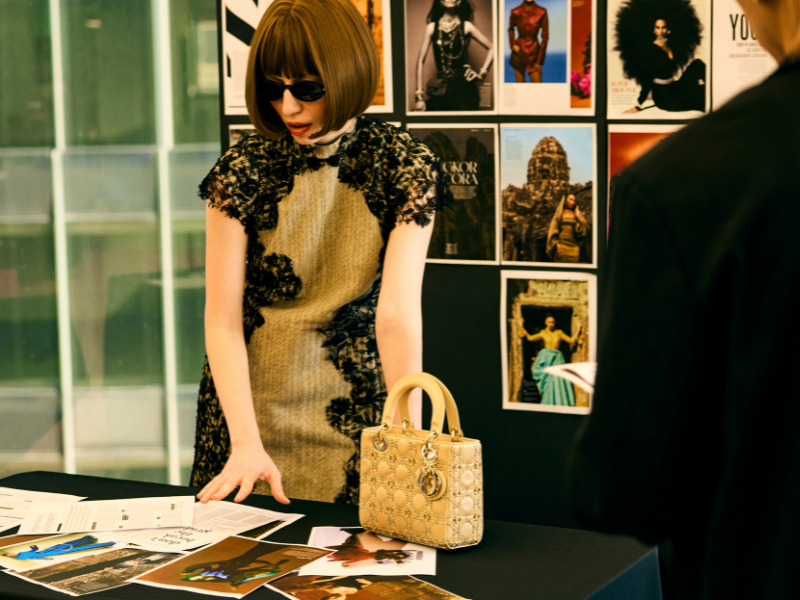
Short flared dress in beige horsehaireffect linen blend and black lace (POA) and Lady Dior in cannage embroidery satin with beads, all by Dior
The extent of Wintour’s influence is perhaps better reflected in her current role as chief content creator for Condé Nast as well as her continued leadership of the Met Gala as it also takes into account the business side of publishing.
“She has transformed the Met Gala into the most important annual fashion event in the world, merging creativity, philanthropy and business,” says Farah, reflecting on the impact that Wintour has had on the creative industry. “She has proved that editorial vision and business strategy must co-exist. Under her leadership, Vogue became a platform, a brand and an engine for cultural influence. Her model showed that in today’s creative industries, you cannot separate artistry from commerce — the two must amplify each other.”
In her interview with The New Yorker, Wintour declared the time was right for her to step away from the EIC role. “It seemed like a good moment to bring in someone with a different perspective from a different generation who could look at things in a new way.”
For Farah, Wintour is “The Architect of Modern Fashion Culture”, a title that is unlikely to be filled by another, particularly as influence today is dispersed across social media and digital platforms.
“For me, working with her and the Vogue 100 team has been incredibly fulfilling,” says Cheah. “Anna Wintour is much more than a fashion leader; she’s someone who has shaped the way we see, consume and appreciate style and culture today.”
“There won’t be another Anna,” says Farah. “I doubt there will be a single editor with Anna’s dominance but there are leaders who shape fashion in new ways, across new mediums. There will be other icons, each with their own language of influence. What remains is the need for curation, authority and vision. The form may change, but the role of tastemakers — whether through print, digital or experiences — will always be necessary.”
Credits:
Creative direction + Styling | Colin Sim
Photographer | Eric Chow
Hair stylist | Keith Ong
Makeup artist | Rachel @ Plika Makeup
Model | Claudia Rosie
This article first appeared on Sept 15, 2025 in The Edge Malaysia.