
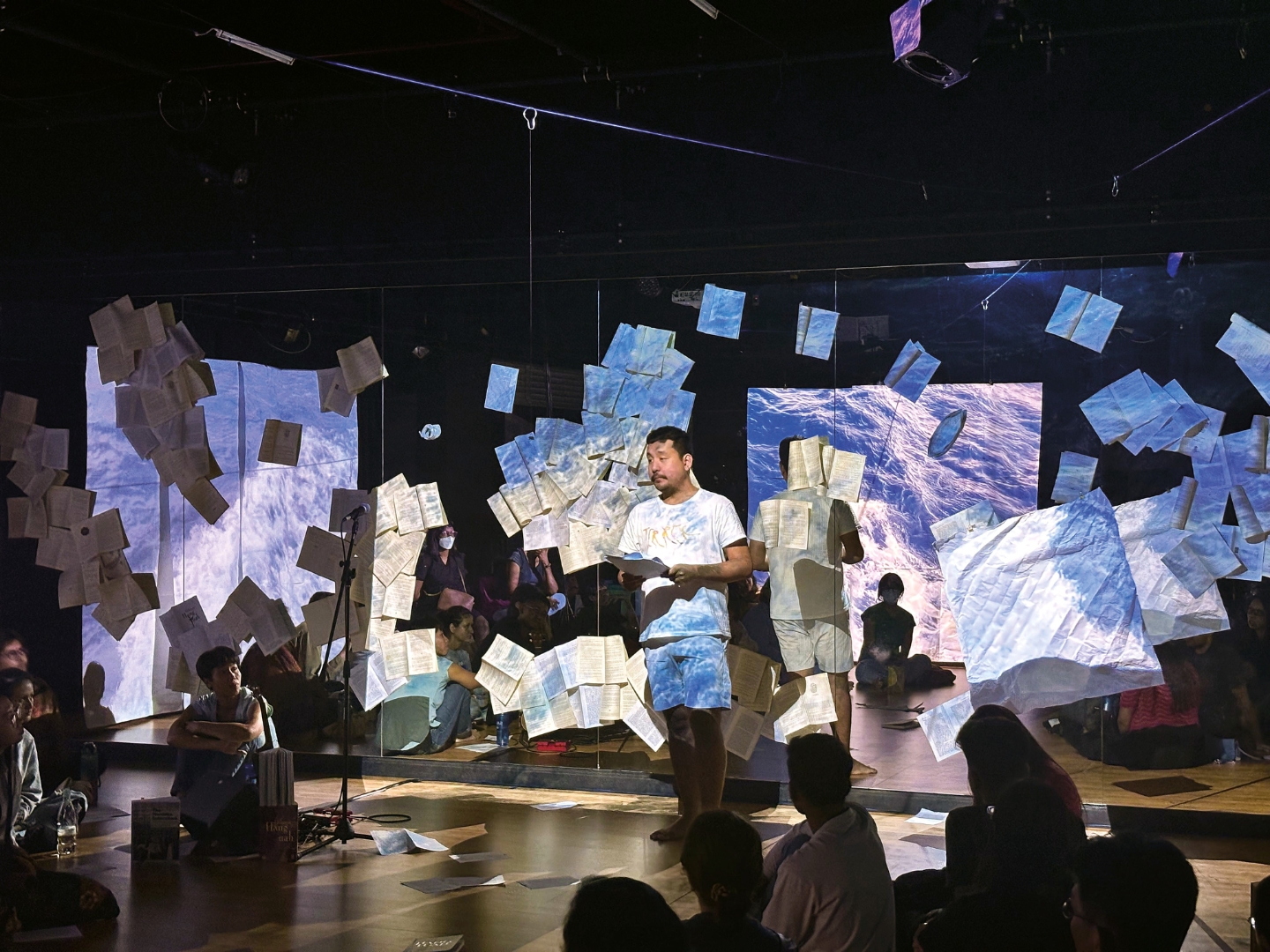
Fragments of Tuah's cast at rehearsal (Photo: Five Arts Centre)
For an extended and intense period of time, the mythological foundations on which our negeri (states) are set upon proved to be a source of some impatience for many of the formative figures in modern Malay intellectual life.
On a quest to hasten the process of modernity and, in the long view, to agitate for independence and self-governance, personalities such as the great pendeta (scholar) Za’ba — Zainal Abidin Ahmad — and even before him, Munshi Abdullah Abdul Kadir (acknowledged as the father of modern Malay literature with his Hikayat Abdullah and the Malay language teacher of Stamford Raffles), advocated the values and worldview of the enlightenment: reason, judiciousness and rationality.
Perhaps such attitudes had been aggravated by the provocative remark of the lexicographer and scholar-administrator R O Winston, who waved off the annals of Malay history even as he assiduously and exhaustively documented that trove as “mere superstition and fable”.
Before being ushered into the contemporary world of popular literature, film and pseudo history in romances such as Puteri Gunung Ledang, the figure of Hang Tuah remained somewhat opaque, blurry and quaint.
It took another, more recent, scholar-administrator — a tall, gangly figure whose love for the land he once administered, and his lasting friendship with the first prime minister of Malaysia, Tunku Abdul Rahman, compelled him to remain in the land following independence — to begin a collective remembrance (even resurrection) of the figure of Laksamana (Admiral) Hang Tuah.
Mubin F Sheppard, an Irishman, collated and rewrote the tales that would become The Adventures of Hang Tuah, tales in the spirit of British boy stories that would make their way into classrooms and the syllabus of a Malaya poised for independence. Moved by these stories and seeking unifying symbols of loyalty, faithfulness and heroism, Tunku Abdul Rahman — soon to be independent Malaya’s first prime minister — urged the making of a motion picture, to be directed by the famed Phani Majumdar. Written by the historian Buyong Adil and the then-aspirant Jamil Sulong, the 1956 film would feature P Ramlee in the role of Hang Tuah and Ahmad Mahmud as Hang Jebat, reprising the roles of rivalry that existed as much on screen as it did in their personal lives.
books_800px.jpg

It was Sheppard who commissioned a young British woman sculptor Waveney Jenkins to imagine and cast an image of the Laksamana in bronze at the Muzium Negara. Upon completion, there were criticisms that the nose on the image was too “aquiline”. Redone and erected, it has stood at the main wall of the museum until today. Or, in the words of Mark Teh, director of Five Arts Centre’s most recent documentary performance production Fragments of Tuah, “He has always existed in our collective consciousness. An oral myth has been literally cast in bronze in our very own history museum.”
Over the decades, the Hang Tuah figure has reappeared in many incarnations. Soon after independence, the writer and political figure Kassim Ahmad propelled the Tuah-Jebat rivalry to explore the nature of political awareness and consciousness. Who was the greater hero —Tuah of blind loyalty or Jebat, the rebel who stood for justice. It remained an enduring philosophical contestation.
More recently, however, new studies and comparative versions have emerged from, among others, the National Laureate Muhammad Haji Salleh and the critical scholar Ahmad Adam.
“I came to Hang Tuah very recently,” Teh admits. “It was in the last 3½ years that I began to be drawn to him. It was during Covid when we were all confined to our homes that I began to come across a lot of videos by content creators with big followings that advanced the idea that Tuah truly existed. And they spoke of his journeys and identified the many tombs and his various birth places. I began to be interested in these new variants and began digging.”
The documentary performance is described as, “Rather than offering a single truth and linear biography, Fragments of Tuah is a layered collage of perspectives and materials drawn from archival documents, episodes in the Hikayat Hang Tuah, songs, memories and representations of the character in our landscape.”
fragments.jpg

One of the more evocative and novel aspects of the show is that it falls on the often neglected parts of the Hang Tuah tale, beyond the Tuah-Jebat duel and into the final phase of the former as a pengembara (wanderer).
“Much of what is explored is in the last two chapters of the Hikayat. By now, the glory of Melaka has waned; the Sultan is enfeebled and has given up everything; and he makes this decree of what lies beyond the grave. Here, Tuah steps forward,” Teh explains.
“Our exploration lies in this: the warning from a dying king and fading civilisation. This is the spiritual and mythical layer which is most powerful in the Hikayat. Yet, very few people discuss it. They talk about nationalist values, of claims to his actual existence, which leads back to nationalistic ideas. This selectiveness was what we found most interesting.”
This grapples with the nature of storytelling, from the dissemination of the tale from mouth to mouth, and the inscribing of the oral to the transmutation into the written versions by scribes that contain character shifts and plot variations. In Hikayat Hang Tuah, Tuah duels with Jebat while in the epical Sejarah Melayu, Tuah’s rival is another Hang — Kasturi.
“Some interesting aspects include the notion of the unknown author and copyist; as well as handwritten manuscripts that were copied and passed down. The different versions made us think of how the Hang Tuah myth has been handled. Claims originating from social media began to emerge in museums, academia and exhibitions. Fragments of Tuah is really looking at what the nature of storytelling is — how has history evolved, changed, operationalised and even weaponised it,” Teh elaborates.
In this navigation, much of the spirit of the traditional storyteller — the penglipur lara — is expounded. That, and also the sensibility of the contemporary comedian.
“It is exploring that space between cerita (story) and berita (news). Here, there is one performer essentially retelling fragments of the story in different formats: the penglipur lara as a penipu lara — the figure who invents, tells, spreads variants and travels.”
team.jpg

Conceptualised and constructed over a period of three years by Five Arts Centre’s Faiz Shazwan Kuhiri (he wrote the original songs and music), Syamsul Azhar and Wong Tay Sy, the production also features multimedia designer Bryan Chang and musicians and performers OJ Law and Shahriman Shuhaimie.
Fragments of Tuah addresses a radical and fundamental question about the nature of story and storytelling, the foundations on which a collective culture in Malaysia and the region have evolved. Upon the national altar, such myths — layered with metaphor and wonder — have naturally been atrophied or, in the words of Teh, “meme-ified”. Wading the Hang Tuah lore in the most contemporary of settings is an effort at testing the enduring power of myths and the many facets of storytelling.
Or just as Teh says, “It is simply an act of trying to go deeper.”
Five Arts Centre’s production of 'Fragments of Tuah' will be staged at klpac at 8.30pm from Aug 28 to Sept 7. For ticket details, visit cloudjoi.com.
This article first appeared on Aug 25, 2025 in The Edge Malaysia.