
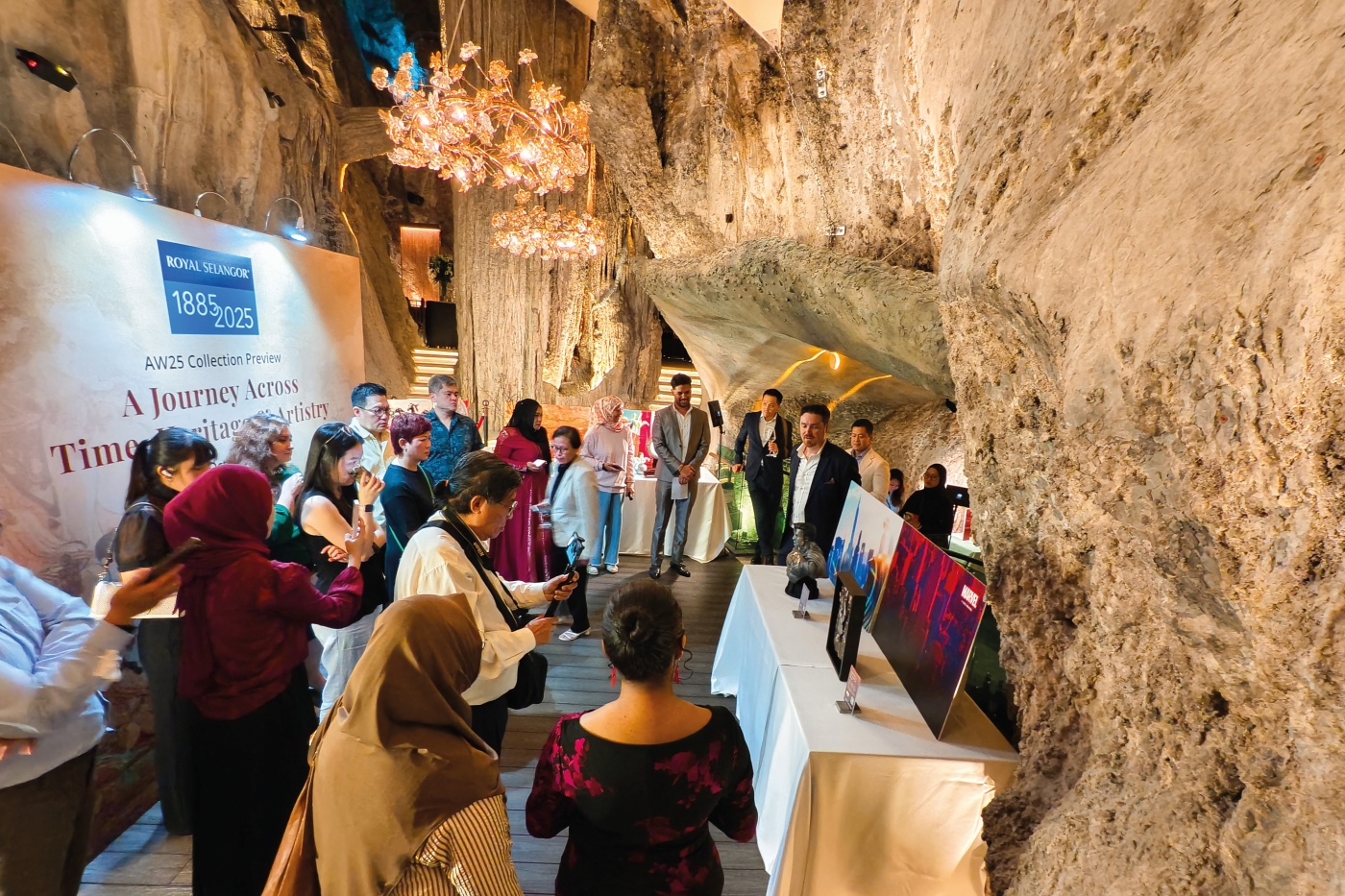
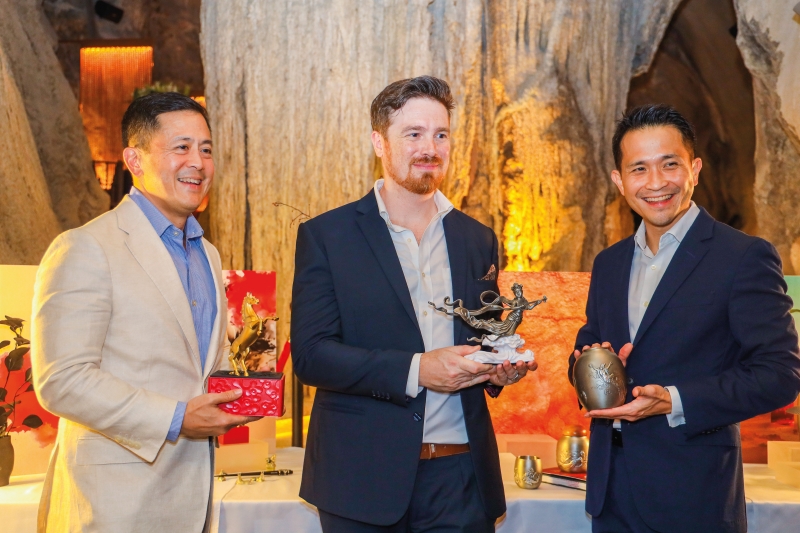
Royal Selangor displayed its Autumn/Winter 2025 collection among imposing stalactites and stalagmites at Jeff’s Cellar (All photos: Royal Selangor)
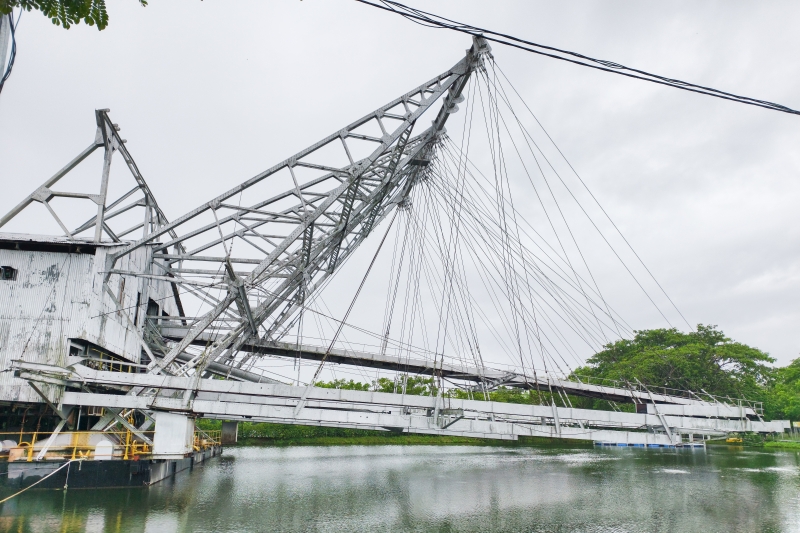
The silence is strange. Footsteps echo eerily in the multi-storey Tanjung Tualang Tin Dredge No 5 in Batu Gajah, Perak. In the state’s tin-mining heyday, there would be up to 70 operators, working in shifts, crawling in and out of the monstrous behemoth’s metallic organs to manipulate its chain of buckets and extract mineral-rich sediment that lay on riverbeds and in the lakes of the Kinta Valley. The cacophonous clang and clamour was said to be audible 24 hours a day to surrounding villagers, even up to 8km away.
There were 123 such dredges in the region — the highest number ever recorded in the Malay peninsula — during the industry’s prime in the late 19th century, resulting in the rapid development of Perak. Its moniker, meaning “silver” in Malay, is believed to have been named after the silvery sheen of tin ore deposits saturating the land. Coupled with other productive mining locations, such as the Klang Valley’s Kuala Lumpur and Ampang, Malaya was once the largest tin producer in the world.
However, during the tail end of the 20th century, the commodity’s relative importance to our economy steadily declined with falling prices, marking the end of its glory. The TT5 Dredge is the last of its kind in the country.
Hovering just above the surface of rippling water with its mechanical fangs outstretched, the floating relic is a reminder of a once booming industry that gave rise to a profusion of businesses, including that of 14-year-old Yong Koon, a pewtersmith from Guangdong, China, who had left Dabu to join his brothers working as tinsmiths in KL. Together, they set up a shop crafting simple household items and objects for Chinese altars to honour deities and ancestors. Founded in 1885, Ngeok Foh, Hakka for Jade Peace, eventually evolved through Selangor Pewter into Royal Selangor in 1992.
Now helmed by the fourth generation, the family business has moved far beyond its humble start, elevating its craftsmanship and product line, and forging collaborations with eminent global artists and organisations. Presented among imposing stalactites and stalagmites in a 260-million-year-old limestone cave at The Banjaran Hotsprings Retreat in Ipoh, Royal Selangor’s Autumn/Winter 2025 collection serves as a compelling testament to how the brand is fusing time-honoured pewtersmithing technique with contemporary design to secure its place in the 21st century.
silk_road_short_vase.jpg
The new collection extends several of its most popular lines, featuring a second release for Malaysiana and Warisan, which celebrate our country’s rich and diverse natural and cultural heritage, as well as Savoy, an ode to Art Deco elegance. A third wave was introduced for Sculptura and a fourth for Woodland.
Royal Selangor’s managing director Datuk Yong Yoon Li says the decision to expand its existing ranges rests on two core factors. “We look at the historical sales of the design language and see what type of products do well. The second criterion is based on pure aesthetics. If we think something looks beautiful, even though it doesn’t sell a lot, we will try using the same design language on new products.”
Sculptura, which started off as a punt, he admits, explores the interplay of form, volume and perspective through pewter. It presents abstract interpretations of our nation’s beloved creatures, such as the gentle pygmy elephants of Borneo. For those looking for a physical symbol of strength, resilience and confidence, the Sculptura Bull (also available in a limited edition of 500 pieces, gilded with 24-carat gold) is mounted on a rising slope in solid walnut-stained rubberwood, evoking a powerful charge of energy.
Inspired by the quiet beauty of the British countryside, Woodland is among Royal Selangor’s bestsellers. “To be honest, it had been sitting on our shelf for the longest time, probably 20 years,” says Yong.
“I remember when I joined, our country manager in the UK, Peter Coleman, recommended we do something that revolved around the English hunting culture. We thought about it for a long time and finally decided to go for it in 2018. We started a range around forest animals and foliage — us Malaysians are a bit removed from the sport lah — and it became a big hit.”
woodland_iv_group_1.jpg
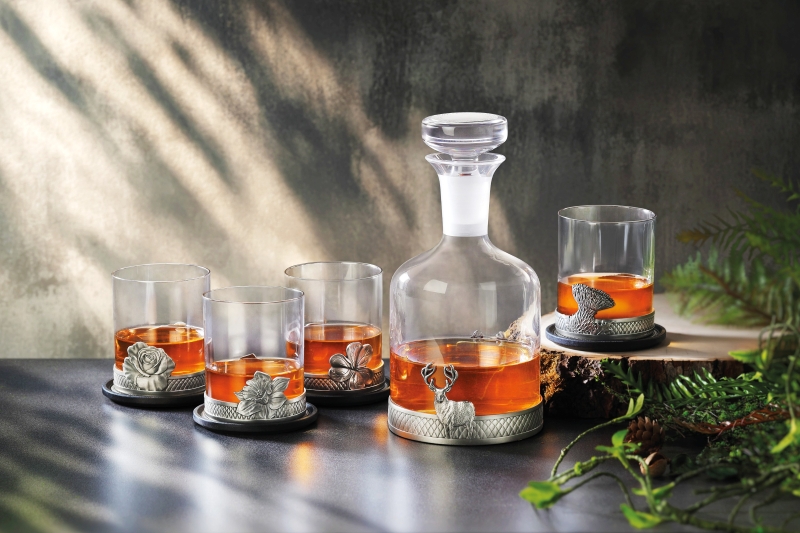
Classic flora and fauna found in the British Isles inform the latest extension, from an elegant stag decanter to a four-piece coaster set engraved with a daffodil, thistle, rose and shamrock. Together with four matching glass tumblers, they make the Woodland Whisky Gift Set, which houses all the bar cart essentials in a handsome wooden box.
To mark its significant 140th anniversary, Royal Selangor launched four special editions of its classic Melon Teapot, albeit sized down. These pieces honour the brand’s deep connection and established roots in Malaysia, Singapore, the UK and China.
The iconic, decades-old design is steeped in the company’s early history and a touch of luck. During WWII, a villager named Ah Ham narrowly escaped a piece of shrapnel as he bent down to pick up a pot he saw on the ground. Convinced of its protective powers, he kept and treasured it for decades, retelling the story of how it saved his life to guests while pouring tea.
In the early 1970s, Ah Ham decided his lucky totem could use a polish and asked a friend to take it to the pewter factory. It was then that the Jade Peace hallmark was serendipitously discovered at the bottom. After tireless persuasion, the vessel eventually found its way to the Royal Selangor archives.
If he had to pick, the Melon Teapot would be the product that best embodies the spirit of the brand, Yong expresses. “It’s not only part of our history, but really reflects the ethos of the company. When you look at it today versus 100 years ago, the design remains evergreen. It is still well made.
084a5452.jpg
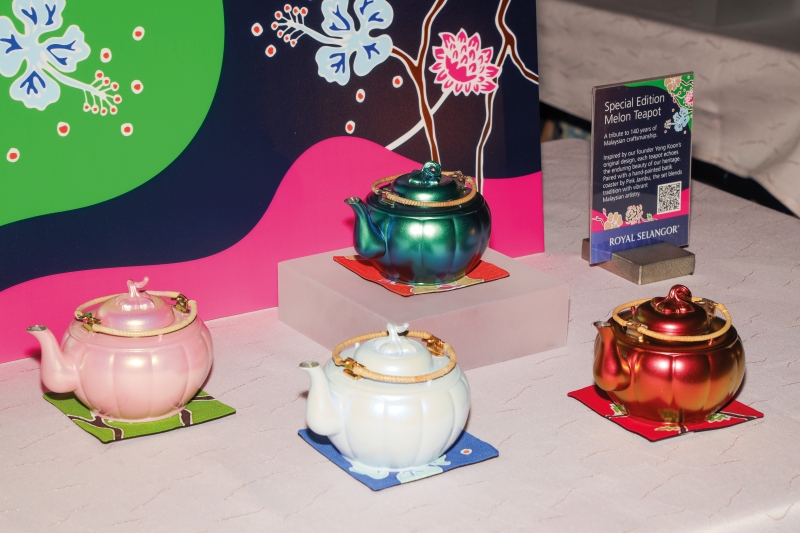
“The mini version of the Melon Teapot has worked out to be a canvas of sorts. Everytime we want to do something new, we experiment on it. This time, we’ve also paired it with a collaboration with Pink Jambu.”
Four hand-painted floral batik coasters were crafted by the local artisan: hibiscus for Malaysia’s pearl-white variant, orchid for Singapore’s iridescent teal tribute, English rose for the UK’s gold-copper version and lotus for China’s blush pink iteration.
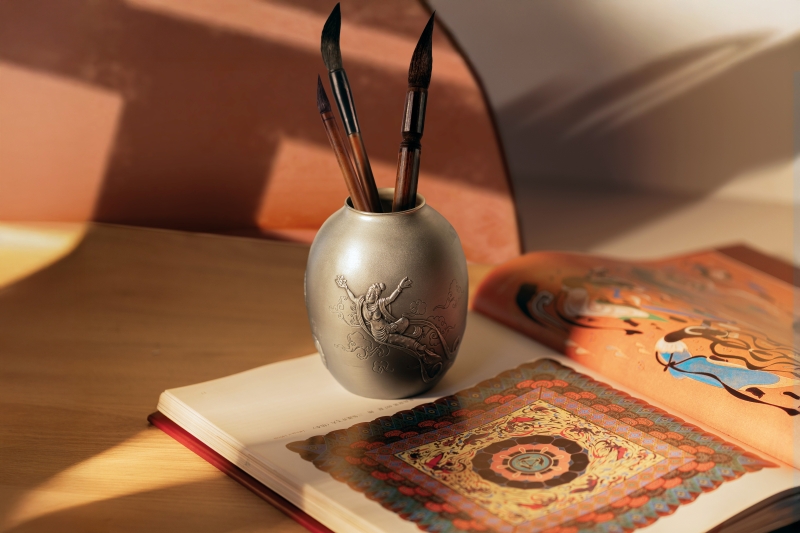
Special attention should also be given to Silk Road, which pays homage to one of the world’s richest crossroads of culture bridging the East and West. The collection looks to the Mogao Grottoes in Dunhuang, China, where a system of 492 cells and sanctuaries housing murals and painted sculptures chronicles the evolution of Buddhist art in the region.
At the heart of this new range is the apsara, or feitian in Mandarin, celestial maidens often depicted gliding through the sky and dancing or playing instruments with flowing ribbons trailing their robes.
Yong says he was inspired by a trip to the mystical site. “It’s actually a very scary place. It’s in the middle of nowhere. You take a four-hour flight from Beijing and land in a desert. Some 2,000 years ago, these people were walking from Dunhuang to Istanbul, just to sell their wares. I sat on the sand dune and thought, ‘How did the people just go?’ ‘How did they know how to come back?’
084a5676.jpg
“For those who travelled, since they weren’t going to see their families for one or two years, they would pray for good fortune and safety. And this is where these grottoes were made. Traders have been digging these holes to pray to Buddha. If you think about it, since they’ve been doing it for so long, there must be an ecosystem and a bit of an industry surrounding it.
“The artists and sculptors must have been doing this for generations. I thought that was very inspiring, the grit of human determination in preserving this art. It also represented their desire to go connect with other humans.”
While covering other stops along the Silk Road might seem like a natural progression for this particular line, Yong notes that Dunhuang offers plenty of ideas on its own. “The apsara is just one thing from the bigger picture. There’s also the scenery, the monks and of course, the Buddha.”
The Autumn/Winter 2025 release rounds off with a new Keepsakes line, combining pewter with repurposed wood to create jewellery boxes to hold your most precious heirlooms. On the other hand, DC and Marvel fans will want to add the Superman bust and Spider-Man vs The Sinister Six Plaque to their collection.
Consisting of 92% to 97% tin, with a small proportion of copper and antimony, Royal Selangor’s high-quality pewter is shaped, cast and finished using a combination of traditional and modern techniques. “We don’t change the ways of pewtersmithing, but we can get creative when we come up with designs and marketing and retail, which can be fun to play with,” says Yong.
img_20251024_145226.jpg
“When we’re talking about design creation, the discussion often revolves a lot around how technology can be used to help us create the product. For example, 3D-scanning and printing and artificial intelligence-based iterations of renderings help us visualise our designs faster. We employ a lot of technology in that sense, but the smithing and crafting side remains as is. That preservation of craftsmanship is one of our core pillars.”
Other ways Royal Selangor has pushed the boundaries of pewtercrafting is through collaborations. Yong brings up its longstanding partnership with London’s Victoria and Albert Museum. “The V&A had never licensed any of their products to anyone. We said we wanted to use their [William] Morris prints to produce a range called Vinifera for wine. We also wanted to use the old English artefacts to reproduce replicas for the home. It took us three to four years because they couldn’t understand it. Now they’re one of the biggest licensing museums in the world.”
Today, Royal Selangor’s collaborators include cultural institutions such as the British Museum and Taipei’s National Palace Museum; blockbuster franchises Star Wars and Lord of the Rings; as well as illustrious artists like Taiwan-based Chiang Yi-tze, who devoted his life to the study of Confucianism.
“Master Xu Xiao Yong too. He’s a Shanghai-based sculptor who does mega projects. When we first met, we said we wanted to do a guan gong, guang yin sculpture. It took him 2½ years to do it. Why? He needed to meditate,” Yong quips. “Today, it’s still one of our bestsellers despite the steep price tag. They’re highly intricate.”
Looking to the future, what does he hope for the company a decade down the road when it celebrates its 150th anniversary? “I think it’s amazing to have been around for 150 years doing the same thing. It’ll be a proud moment for everybody in the business. Multigenerational families have worked with the company, from grandmother, mother to daughter. In a way, it’s fulfilling to not only give employment to the person, but also teach them a skill and preserve a niche art form,” he says.
0177029e_limited_edition_sculptura_gilt_bull.jpg

On the topic of family, Yong hopes the Royal Selangor legacy will continue on with the fifth generation, but does not want to put pressure.
“I think a lot of the time, it always feels like you need to have a family member to helm the family business. Sometimes, it’s not so good. In a way, you’re forcing a round peg into a square hole. It’s not shameful to hire an outside CEO or managing director to take the company forward. The family can still own the business and drive it in terms of long-term direction, but they don’t have to be in it on a daily basis,” he says candidly.
As the company ramps up to take on the holiday season, ushering in a new year, followed closely by Chinese New Year and Hari Raya Aidilfitri, Yong says 2026 is going to be exciting. “With Visit Malaysia 2026, we also have this new project with the Sultan Abdul Samad Building in the centre of old KL.”
While the details are under wraps, he hints that it will be 8,000 sq ft in size.
“It’s also the Sultan of Selangor’s silver jubilee. As a brand, we will have witnessed two silver jubilees. Tuanku’s father’s was in 1985 and we did a lot of commemorative memorabilia.”
There are plans to celebrate Sultan Sharafuddin Idris Shah’s 25 years of reign as well. “He has been a great support.”
This article first appeared on Nov 3, 2025 in The Edge Malaysia.