
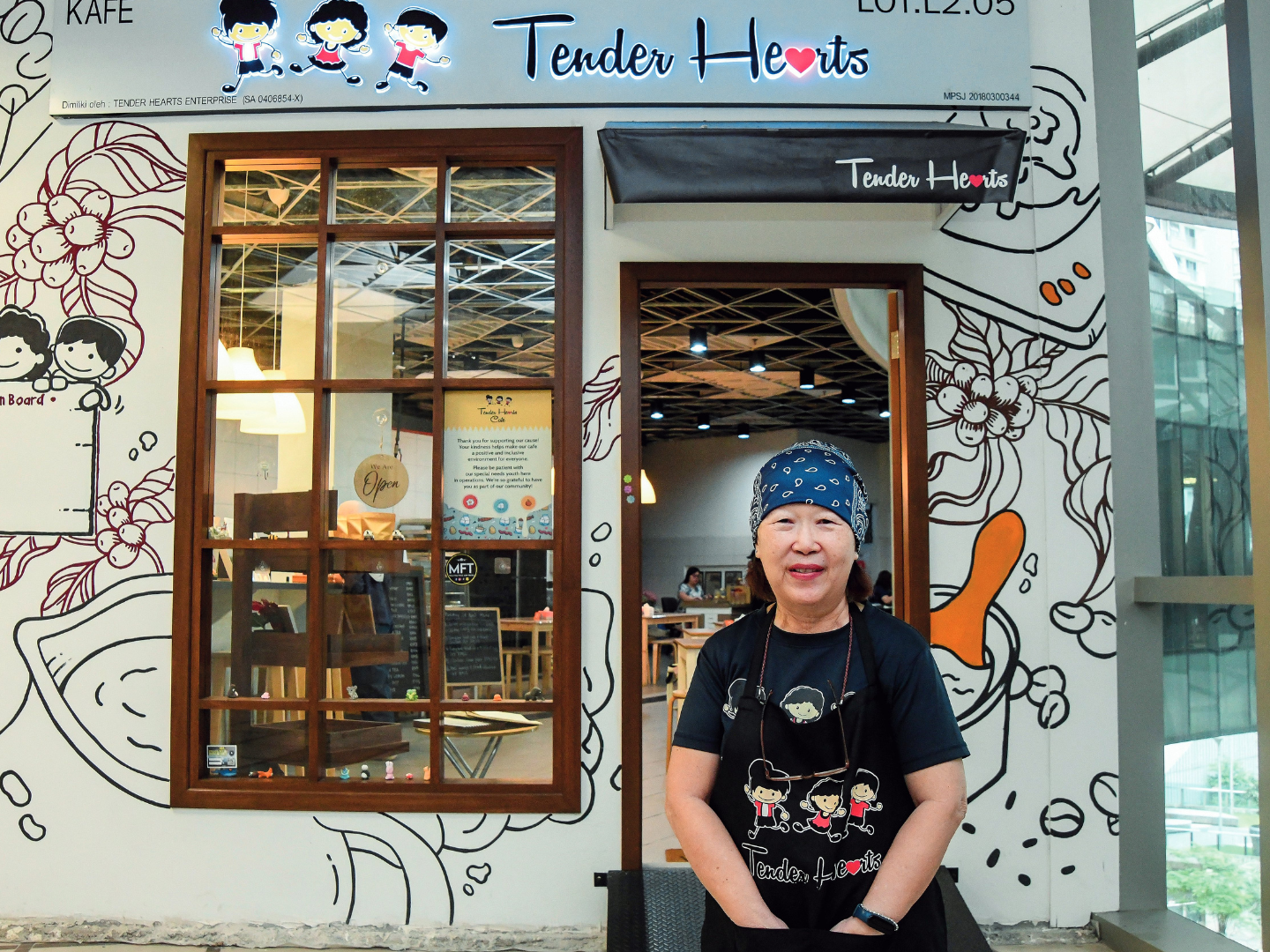
Lee started Tender Hearts in 2016 (All photos: Shahrill Basri/ The Edge)
"The name Tender Hearts just came to me whenever I thought about special needs kids. I think it’s because of how pure their hearts are. It felt like a calling to do something for them,” says Tender Hearts Café founder Sharon Lee about one of her reasons behind establishing an F&B social enterprise that employs adults with disabilities.
The biggest driver, though, was watching her youngest daughter Su Anne Lee — who was diagnosed with global developmental delay and attention deficit disorder (now known as attention deficit hyperactivity disorder) — struggle to find a job after completing high school.
“I’ve been doing charity and volunteer work with special needs NGOs since my college days. So I knew there was a gap after [special needs children] finished both primary and secondary education. There’s no transition between school and employment. With that experience and knowledge, I decided to do something on my own.”
As it turned out, it was not hard to pick which industry to venture into. “I love to bake and cook. I started baking during my secondary school days. There was no internet then, so I would buy lots of magazines with my self-earned pocket money and try out the recipes,” Lee, 66, says.
Her father gifted her with her first oven when she was in Form Four. Since then, she has not stopped experimenting and mixing ingredients to make cookies and other baked goods for family and relatives.
Tender Hearts was formally registered as a business entity in December 2016. Together with two other mothers and their special needs daughters, Lee and Su Anne started taking orders from home. One time, they received a bulk order for 1,000 pieces of cookies. Working with just three small ovens was not possible. Lee had to reach out to more people for help. “That was a turning point because I knew I had to do something bigger so I could work with more parents.”
3.png
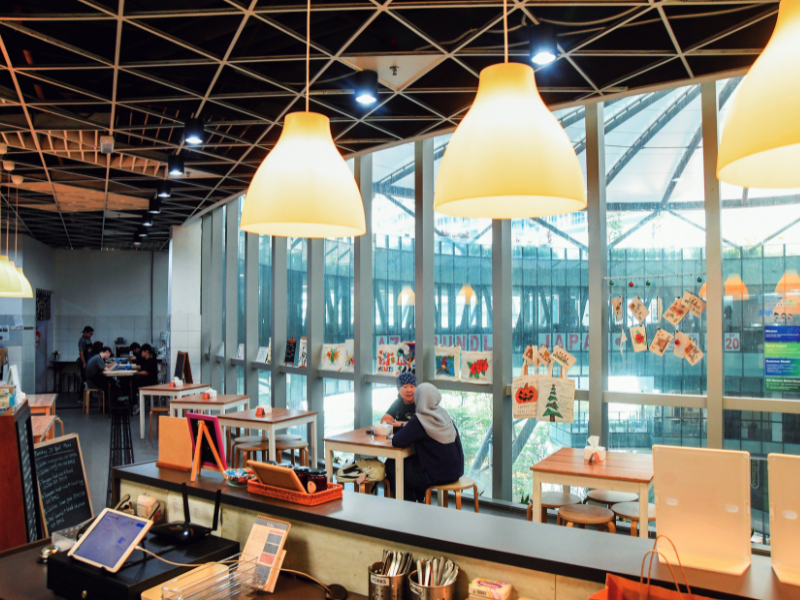
The funds from this commission made it possible for the team to shift their operations from a personal kitchen and pop-up bazaars to a 700 sq ft commercial unit at Summit USJ Mall in Subang Jaya, Selangor, in 2018.
Eventually, Tender Hearts transformed into a full-fledged café with more special needs workers joining the crew. “I just wanted a small space that sells snacks, cookies and simple food, but we ended up serving proper lunch since there was demand from the office crowd.”
Even after moving to their third location in KL Gateway Mall in Kampung Kerinchi, Kuala Lumpur, three years ago, Lee still finds it a challenge to decide on the menu. The items have to be as simple as possible so the employees can assist with preparation, and they also must be attractive and tasty enough to appeal to the customers.
“We try to come up with different things every day since there are regular patrons. We don’t want them to get bored eating the same meal. We don’t have a big menu because we want the kids to get involved. All we have is a green chalkboard, which the workers use to write the daily offerings on.”
Lee says she never intended for Tender Hearts to be a one-woman show. “I wanted to get as many people on board and create a support group. [About] 90% of the caregivers are not working since many gave up their careers to look after their children. So, sometimes, they come here as well. Those are the extra hands I need.
“For example, Kak Ros steps in to take over the kitchen on Tuesdays and Thursdays so I can have a break in between. Others supervise different stations in the restaurant. That’s how we have been managing in the last 10 years.”
1.png

This sense of community was one of the reasons the business remained in operation even after Lee was diagnosed with breast cancer in 2018. “It was very difficult, but maybe it was also a blessing because if this had happened earlier, I might not have been able to run Tender Hearts. Treatment alone took around seven months for 16 rounds of chemotherapy and 15 rounds of radiotherapy.
“I still dropped by the shop whenever I had the strength to drive to give them moral support. There was one Down’s syndrome boy who told me, ‘Aunty, I will fight the cancer with you’. I felt so touched so I knew there was no turning back, even with my health condition. Really, it was the children who kept me going and distracted me from my pain.”
Seeing them happy and proud to be working, as well as having something to do is a joy Lee cannot find elsewhere. “If they are not here, most of them will just be sitting at home. The parents are ageing and they don’t know where to turn to.”
Looking at the future of her daughter and others in the same situation, Lee feels it is necessary to equip special needs kids with living skills such as housekeeping and cooking their own meals. “This is important to prepare them for when their parents are no longer around to care for them.”
Early this month, she began organising living skills lessons based on a Japanese syllabus at the restaurant. Scheduled to run every Saturday, the programme comprises 20 modules that emphasise building independence through practical training in cooking, cleaning and social interaction, among other things.
Lee envisions this as an ongoing project that will benefit both parents and children in the long run. “It’s difficult to put a time frame as to when we can complete the modules because it depends on how fast they can learn. There will be a lot of repetitions and hands-on activities.”
2.png
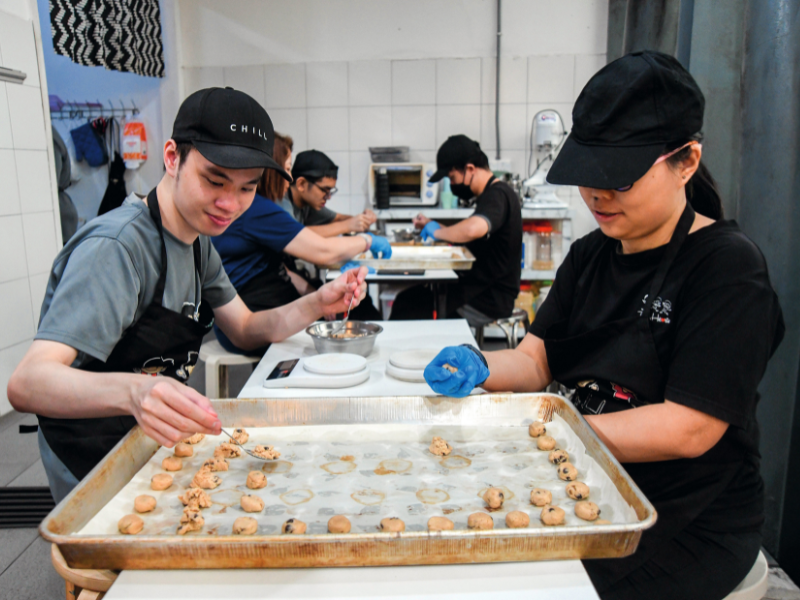
Alongside the weekly class, Lee also offers a group home service where she gathers interested individuals for comprehensive team training to promote independent living. Participants share a house unit where they can bond and look after one another. “The goal is to create a big supportive family who can rely on each other when they grow older.”
Aware of the mental, physical and financial capacity required to continue on this journey, Lee hopes for more people and organisations to take interest in Tender Hearts’ efforts and dedication to the cause. “I wish there were philanthropists or companies who would do this with me. I can work by myself but it will take a longer time because sustaining the café itself is already tough.”
On a national level, there is still more that needs to be done, Lee says. Although awareness about individuals with disabilities is better now compared with 20 years ago when her daughter was first diagnosed, not enough action has been taken to address pressing matters for the community, including the high unemployment rate, discriminatory hiring practices, lower wages, workplace bullying and inaccessible environments.
“There are so many families desperate for help. The elderly in their 60s and 70s will not be able to look after their children forever. If you just keep them at home, they will eventually develop behavioural problems and parents wouldn’t know how to handle them.
“After completing high school, maybe they can do vocational training that will prepare them for the workforce. And employers should give them opportunities. Job coaching is very important. Don’t just hire them for the sake of CSR. With proper guidance and patience, they will be able to contribute to the job, whether it is serving food in a restaurant or filing data in Excel spreadsheets.”
Her dream is to create a safe and reliable environment for people with special needs to thrive and make a living. “I hope I remain healthy for a long time. There are still so many things I want to do for the community,” Lee says.
L2.05 Level 2, KL Gateway Mall, Kerinchi, KL. Open Mon to Fri, 11am to 3pm.
This article first appeared on May 11, 2026 in The Edge Malaysia.