
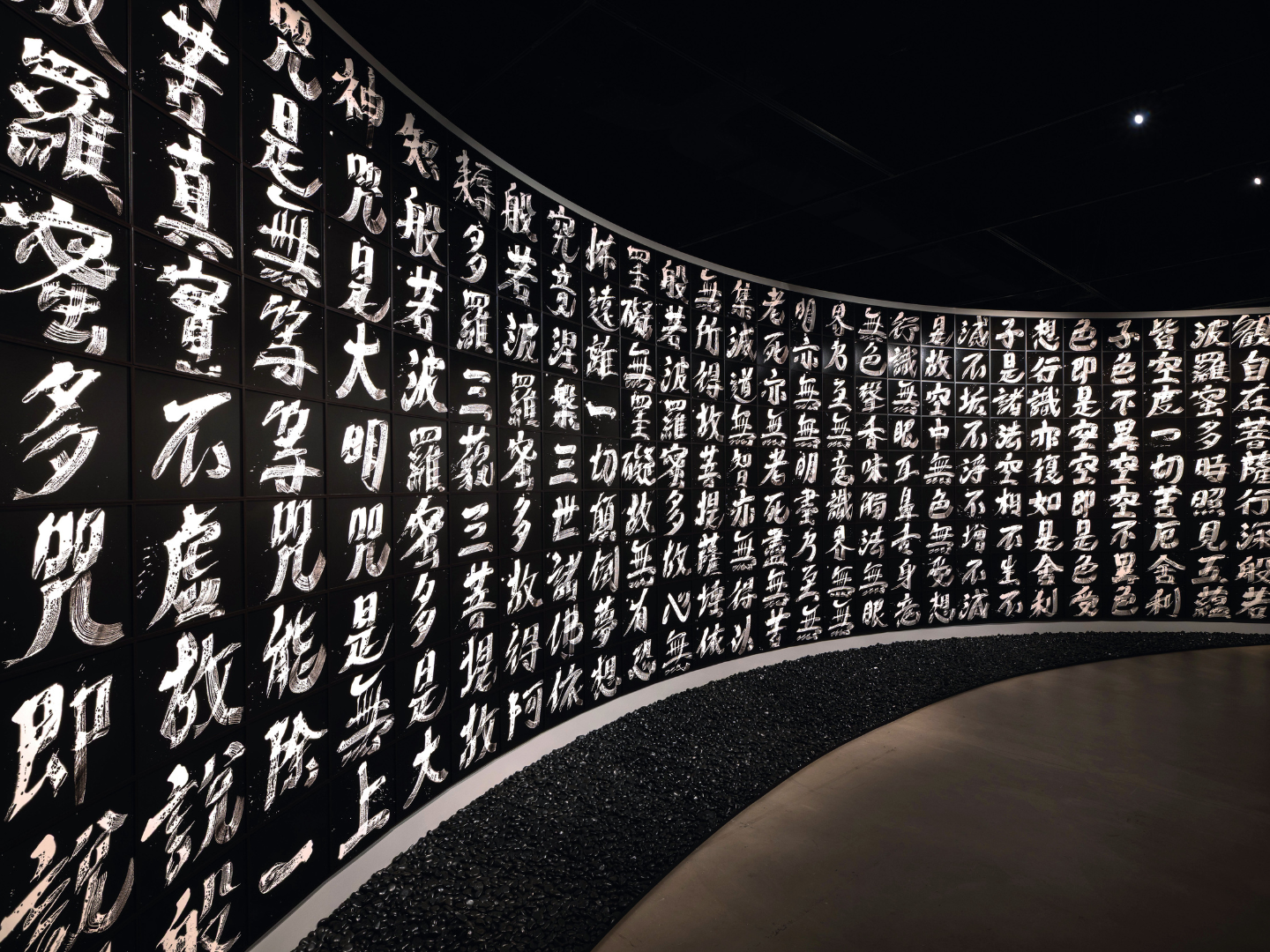
Brush Impression, Heart Sutra (2023) (Photo: Singapore Art Museum)
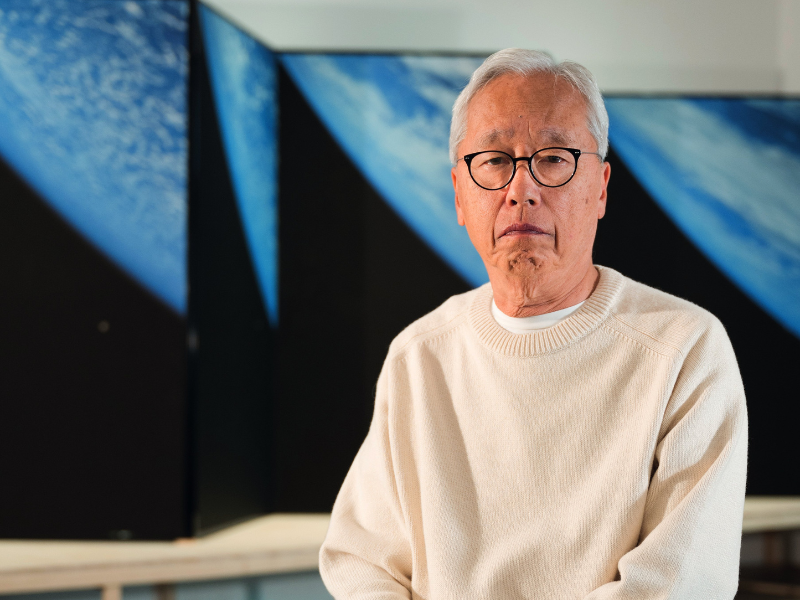
Looking out to sea — the waters which have transported people, cultures and stories across the globe over generations — was one of Hiroshi Sugimoto’s earliest experiences with consciousness.
Born in Tokyo, 1948, to a family who ran a beauty supply store in the city’s Taito Ward, Sugimoto’s fascination with science and the natural world began early. He was a voracious reader of Kodomo no Kagaku, a children’s magazine covering topics ranging from astronomy to engineering. By the time he started snapping railway trains and family vacations with his father’s Mamiya-6 camera in the seventh grade, his eye had already begun to notice the photograph’s immense storytelling power.
Complex philosophical and artistic concepts, supplemented from his time studying sociology and politics at Rikkyo University as well as photographic technique at ArtCentre College of Design in Los Angeles, made his work a platform for conceptual exploration. His inaugural collection, Dioramas (1976), pictured natural history displays as a demonstration of how the camera can infuse life, not just still it. Ever since, his exhibitions have incited lensmen, enthusiasts and, of course, the introspective to cross land and sea.
Staged at the Singapore Art Museum, Hiroshi Sugimoto: Form Is Emptiness marks the virtuoso’s first major showcase in Southeast Asia, bringing together over 60 works from 11 series spanning a 50-year practice. Its crux is the Heart Sutra, the Buddhist text ushering practitioners towards deeper enlightenment through a profound articulation: All tangible and physical form are “empty” — not indicating nothingness, but an absence of inherent and intrinsic existence.
2.png
Laid out to resemble a mandala, the exhibition starts with Seascapes, featuring seven from Sugimoto’s ongoing collection of more than 200 images documented since 1980. Sea and sky are captured in perfect balance, the horizon piercing across the middle. In Baltic Sea, Rugen (1996) and N. Pacific Ocean, Ohkurosaki (2013), the bisection is sharp and obvious, then blurred by fog in Tyrrhenian Sea, Scilla (1993) and Ligurian Sea, Framura (1993). In this space stretching far beyond the limits of human sight, air, water and light converge to evoke the primordial origins of life on Earth. None of the frames carry geographic indicators. Ocean and ether are shared experiences uniting all mankind around the globe through millennia, particularly diasporas for whom the deep blue represents the pursuit of homeland and the rejection of fixed identity.
Sugimoto’s attachment to the sea and its symbolisms are constant. Bodies of water from Seascapes (all, except the Sea of Japan as seen from Rishiri Island, differing from the earlier set) also appear in Five Elements. The series of nine optical glass pagodas typifies the quintessential elements — fire, water, earth, air and void. Used to craft the lenses of cameras and telescopes, the material has enabled the observation of the distant and microscopic, broadening our understanding of our place in history and the environment. In the spheres, denoting water, is where the audience may glimpse the encapsulated photographs. As the eyes make out the shape of the horizon and the current, the viewer gets a glimmer of the awakening Sugimoto felt as he gazed out at these same panoramas.
Equally, if not more, meditative are the Sea of Buddha portraits. Following a seven-year-long negotiation, the photographer was granted permission to picture the 1,001 gold-leafed Senju Kannon (the bodhisattva of compassion, also known as Guanyin in Chinese culture) statues housed at Kyoto’s Rengeō-in temple. Removing all modern additions and working with the natural morning light, he imagined what the figures might have looked like when they were first installed 800 years ago.
Standing in the circular room where the nine frames surround an aluminium-and-steel manifestation of the mathematical equation for Dini’s surface, the body feels drawn to make its round slowly and contemplatively. Each frame is angled identically but no two effigies are perfect copies. The photos crop suddenly; still, you are aware that the rows of idols continue to extend past the boundaries — the way you know the ocean stretches past where the horizon lies. You encounter each likeness, its benevolence hard to tear your gaze from, with the exact mindfulness you would embody while counting prayer beads.
3.png
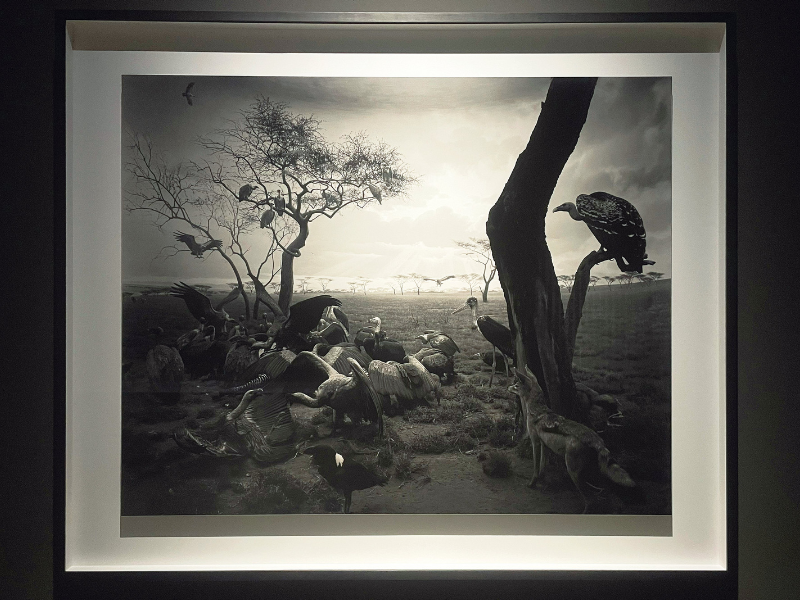
Sugimoto’s affinity for immortalising moments in time was the same motivation for his accumulation of rare and mesmerising fossils. In a corridor lined by his Dioramas, a wooden table and shelves contain an assortment of rock slabs, some just bigger than an adult hand while others stand as tall as a small child. A colony of brittle stars, their spindly arms frozen in a wave-swept motion, huddles on a large tablet; you wonder whether the mass of trilobites (an extinct species of marine arthropods from the Paleozoic Era) populating the stone below had congregated for similar reasons. Lone dragonflies and frog skeletons adorn some smaller specimens, while a fish swallowing a tinier one epitomises the ruthless circle of life. These artefacts could be considered as nature’s own photographs.
The exhibition culminates in Brush Impression, Heart Sutra, a magnificent installation comprising 288 gelatine silver prints produced using expired photographic paper. Arranged like a towering scroll of text unfurled by divine hands, the foundational Buddhist script was handpainted in the shadows of Sugimoto’s dark room. The artist’s hand, gripping a brush dipped in fixer, was guided only by memory and rhythm. A brief burst of light activated the chemical, bringing the invisible strokes to the surface. Repeated for all 274 characters of the text, the process was something of a ritual or chant. The display offers a particularly grounding and bodily experience, achieved not merely through sheer scale but the contemplation it inspires, as well as its perspective on deterioration as evolution rather than an end.
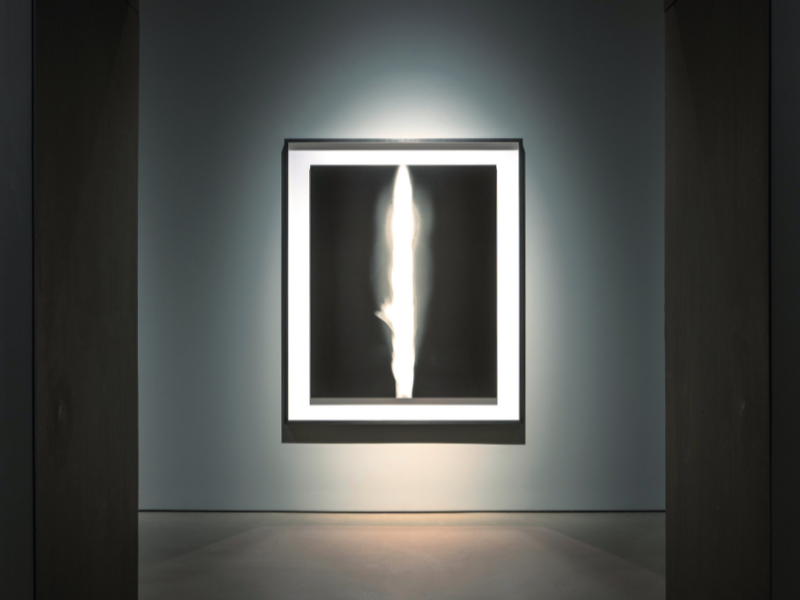
Other works, no less impressive than the ones elaborated above, inhabit the space — Opticks, focusing on a prism’s play of colour and light, and the most vibrant pieces in the otherwise rather black-and white showcase; In Praise of Shadows, long-exposure shots of candles burning through the night, the flames’ entire lifespans caught in a single picture; Portraits — images of hyperrealistic wax figures at London’s famed Madame Tussauds wax museum; Theaters, where, as with the candles, Sugimoto compressed hundreds or thousands of single images taken over the full duration of a film into depictions of empty cinemas illuminated by haunting, glowing screens; Spacescape, pondering perception and scale via a folding screen portraying Earth and the moon in various stages of orbit; and Accelerated Buddha, Sugimoto’s first video work.
1.png
There is no set order to experience the exhibition. The paths and rooms flow into the next, looping and reconnecting. The option to retrace your steps or move forward is always present. On this non linear route, moving at your own pace, you are bound to reunite with works you viewed earlier, each time with a stronger understanding. Sugimoto’s primary concern emerges like a mantra — nothing in the world materialises in true isolation, and if naught is truly fixed in reality, then perhaps detachment and inner peace are not as far-fetched as we often agonise.
'Hiroshi Sugimoto: Form Is Emptiness' runs until Oct 4 at Singapore Art Museum.
This article first appeared on June 15, 2026 in The Edge Malaysia.