
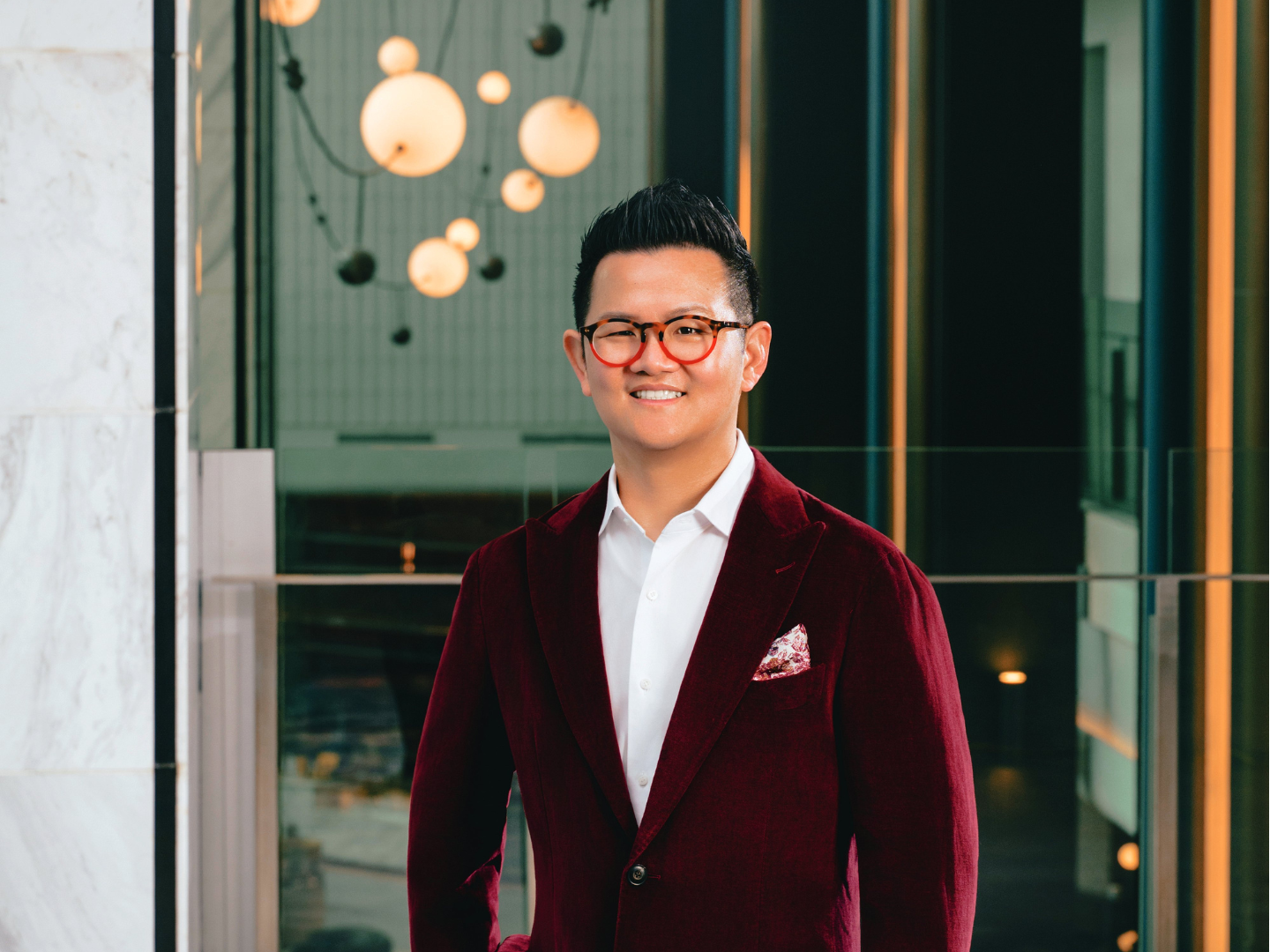
Datuk Bobby Ting spearheaded the development of Malaysia's first Voco Hotel (Photo: Andy Phe)
For globetrotters and luxury stay aficionados, the debut of any new hotel brand in a country is always a good sign. Besides bearing a physical testament to the robust good health of a market, it also demonstrates economic confidence, growing domestic and international arrivals, the creation of jobs — both directly and indirectly — healthy capital investments, the overall growth of the destination’s lifestyle and luxury demographic, as well as general affluence and spending power.
So, when news broke that Kuching was chosen as the site for Malaysia’s first Voco Hotel, it underscored Sarawak’s increasing importance. After all, Voco is IHG’s fastest-growing premium brand, with over 100 hotels and counting, from Times Square in New York City, the largest of its kind in the Americas, to Voco Guilin Yangshuo in China, which also marked its 100th property around the world.
Established in London in 2018, the Voco brand was created with the aim of combining all the informality and charm of an independent property with the quality and assurance of a strong global brand. Just eight years old, Voco has gained tremendous traction since, remaining well on target for an ambitious 200-hotel goal by 2028.
Voco’s name is derived from the Latin “to invite” or “come together”, and the official opening of Voco Kuching on July 28 aims to do just that. Sarawak Premier Tan Sri Abang Johari Tun Openg, best known as Abang Jo and the dynamic sixth leader of the state since 2017, is scheduled to officiate the launch ceremony.
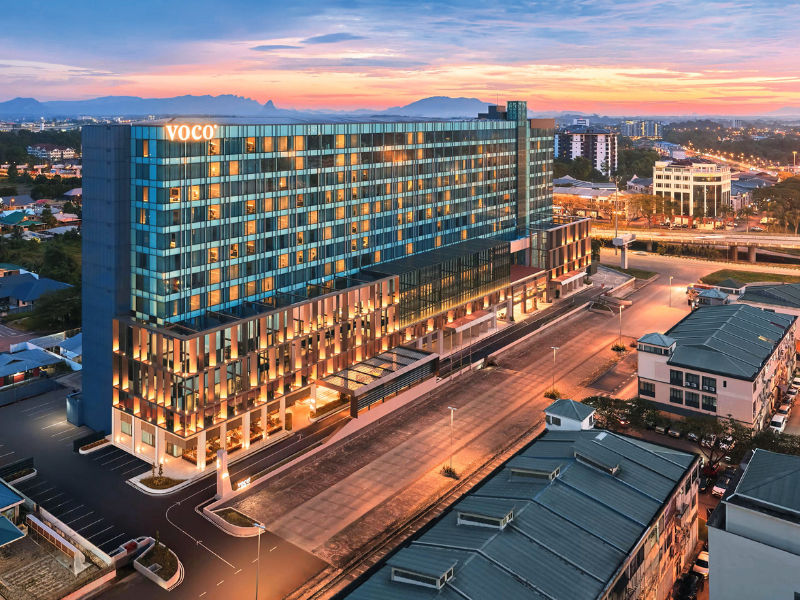
One key feature of many a Voco Hotel is that they tend to be independent properties or former hotels that have been rebranded, but renovated with the brand’s signature unstuffy design DNA. Those familiar with Sarawak’s capital will recognise the latest Voco site as the former Four Points by Sheraton Kuching.
1.png
Old is gold
Working feverishly behind the scenes is Datuk Bobby Ting Sie Ching, the youngest of the late Sarawakian magnate Tan Sri Ting Pek Khiing’s four sons and managing director of Elica Equity, whose Wisma Elica will be Voco Kuching’s new home. “This goes beyond simply reopening a hotel,” says the 45-year-old who holds a Bachelor of Business and an MBA from the University of Technology Sydney.
“We were initially searching for a suitable location for a senior wellness centre, but the scale and potential of the former Four Points building pushed us to think more ambitiously. Rather than allowing such a prominent property to remain dormant, we reimagined it as Wisma Elica, a mixed-use development that brings together Voco Kuching by IHG, with 322 rooms; Care Collective, a 128-bed senior wellness centre; as well as retail; a supermarket; a rehabilitation clinic; and office spaces. Ultimately, this project is about breathing new life into a landmark building and transforming it into a vibrant destination that contributes to Kuching’s tourism while supporting the growing needs of an ageing society and creating lasting value for both the community and the city.”
The merging of a fancy hotel with an integrated wellness and senior living destination might, at first glance, seem unorthodox, but Ting assures it is a complementary move. With four award-winning property projects already under his belt — The Republic, Liberty Grove, Upton and Avanti, all community-based contemporary residential apartments — and with two more in the pipeline, it is safe to say the baby-faced developer has enough experience to know what works.
“Traditionally, we have always been in property development. But, at the same time, we were also looking at other business models that could give us recurring income — something other than the acquisition of land, construction, building and selling. I also felt we were ready to diversify and invest in something where we could enjoy a first mover advantage,” he says.
With the Department of Statistics Malaysia projecting that the country will reach aged nation status by 2048, when citizens 65 and above will comprise 14% of the total population, it does make sense for businesses to seriously consider this market segment. “We have a 23-acre piece of land in Kuching on which we wanted to create a purpose-built facility. But after commissioning KPMG to do extensive market studies, we learnt that life expectancy was actually extending. People are living longer, which is fantastic!”
The findings align with what is termed a “silver tsunami”, referring to the specific demographic of “golden retirees”, essentially older adults with ample funds and the spending power to live out their well-deserved retirement in comparative luxury. Already, the Klang Valley, Ipoh and Penang are seeing a boom in high-end assisted living set-ups, where monthly stays hover around the RM5,000 price bracket and can rapidly surge upwards, depending on the level of comfort and care.
With Care Collective opening at Wisma Elica, a premium, resort-level option is made available for the first time in Sarawak. “This is actually a joint venture,” Ting clarifies. “We didn’t want to start from scratch and wanted to work with someone experienced.” The Kuching outpost would be Care Collective’s 11th property and the largest senior wellness centre of its kind in East Malaysia.
In order to test the waters, two open houses were held in the middle of this year, and Ting shares how both were incredibly well received. “We offered 3D/2N trial stay packages, which let both child and parent experience what it would be like, and the response was tremendous,” he says. “We wanted an appealing option where it would be someone’s personal choice to check into the facility, versus being forced, so to say, by the kids.”
Daycare and short-term stays also enable the possibility of checking in if a little more attention is needed, especially after an injury or medical procedure. “This also works well if, for example, a trusted helper goes on long leave or if the main caregiver is out of town. Even those who feel burnt out and need some extra TLC or a change of scenery are welcome to come over!”
Leaving no stone unturned, Ting says there will be a club lounge, not unlike a hotel’s executive lounge, available to all residents. “You can go there for more dining options. There will also be rooms for games, karaoke and even a beauty salon so aunty can just take the lift down for a colour and perm. The hairdresser could also be called in or a mani-pedi arranged without having to leave the comfort of her room.”
Rates are expected to start from RM5,000 for a quad-share room, while it is RM9,000 for single occupancy and up to RM16,000 monthly for a suite. “This would include full board, laundry, caregivers and physiotherapy to ensure whoever is under our care is looked after completely, for continued good health and mobility,” he says.
Every journey at Care Collective begins with an assessment to ensure there are no major underlying medical conditions. For regular checks and screenings, there is the assurance and convenience of a major hospital less than 2km away. Interest has already come from beyond Malaysia, from Singaporeans and Indonesians as well as Malaysia My Second Home (MM2H) residents. “We are not an old folks’ home but more of a place to enjoy the best of your golden years — the extension and enjoyment of life, if you will,” Ting stresses.
2.png
The suite life
Although occupying the same building, Voco and Care Collective share two-thirds and one-third of the space respectively, each with its own distinct entrances and lift lobbies. “Originally, I wanted to split things 50-50 as I was then more focused on the senior business models. I even wanted to cut my ballroom in half!” says Ting.
But with Sarawak growing at a steady pace under solid leadership, which is reflected in the uptick in its tourist arrivals and greater demand for MICE (meetings, incentives, conventions and exhibitions) locations, it seems he called the idea early.
“Everything has worked out nicely,” he sighs with relief. “Although my parents came from families of nine to 10 siblings each, my wife and I only have our two boys while other friends only have one child. It goes without saying that my generation will look after our elders, but we are building for the future. After studying the Kuching market, we found that the available choices just weren’t great. Most of the homes were basic at best or downright depressing, while the general trend is to hire an untrained, live-in domestic helper to do the caregiving work. So, while the demand and numbers pointed us in this direction, we were still considering building something new when I brought up the idea with my dear friend Datuk Danel [Abong] who said, ‘Hey, brother, why don’t you put it there?’
“There”, of course, referred to the old Four Points by Sheraton Kuching. “This was about three years ago. After thinking long and hard, reviving the hotel ticked more than a few boxes for me. We still get to venture into the senior living industry. Second, we could also repurpose the building which had been sitting empty since it shuttered in 2019. My father loved the hotel but he was already unwell at that point, and I think it was just too much to handle.”
Once the idea began taking shape, the next and biggest hurdle lay in securing the funding. Ting mentions that the property was already in receivership by then. “I had to commit to bailing the company out, basically,” he says, in reference to Global Upline Hotels & Resorts. Being the proverbial white knight inevitably came at a hefty cost. He demurs at first but eventually shares a ballpark figure of about RM30 million to RM40 million, while another RM120 million was set aside to get the hotel up and running.
On what gave him the guts to go ahead, he says, “It was the numbers — they made sense. And besides, I always look at things economically to see whether there’s a good chance it will work out, or not. Hey, I don’t just simply dump money, you know,” he laughs.
3.png
Although running hotels was a passion of his father’s, Ting nevertheless spent a large chunk of his childhood growing up in and around them. The late Tan Sri famously loved the hospitality business, consulting for several properties: the aforementioned Four Points by Sheraton Kuching, the Century Kuching Hotel, the Century Santubong Beach Resort and the Sheraton Langkawi Beach Resort.
“I was never actively involved in the hotels as I was already heading Hydro-Icon by then,” he says, referring to the Sarawak-based company that specialised in the design, engineering and construction of water and wastewater treatment equipment and systems. “But what I did realise about the hospitality industry was that, while it required massive initial capital investment, the returns on it could be good.”
Filial and family-oriented, Ting acknowledges that the revival of the hotel is a subtle way of honouring his late father’s legacy. “My dad designed that building 20 years ahead of its time,” he smiles. “From the hotel capacity to the two basement levels, the size of the meeting rooms and the sheer width of the corridors, everyone who has visited post-revamp can’t believe the structure dates back two decades. The hotel was indeed built with very ‘good bones’ and all that was needed was a dramatic uplift to bring the design, look and feel to the present day. I don’t mean to be biased but I find it to be a very attractive structure. We just made everything cosier and more accessible, allowing the public to easily interact with the building.”
Once the finances were secured, the refurbishment process was infinitely more straightforward, taking just under a year and a half to overhaul and complete.
Borneo by design
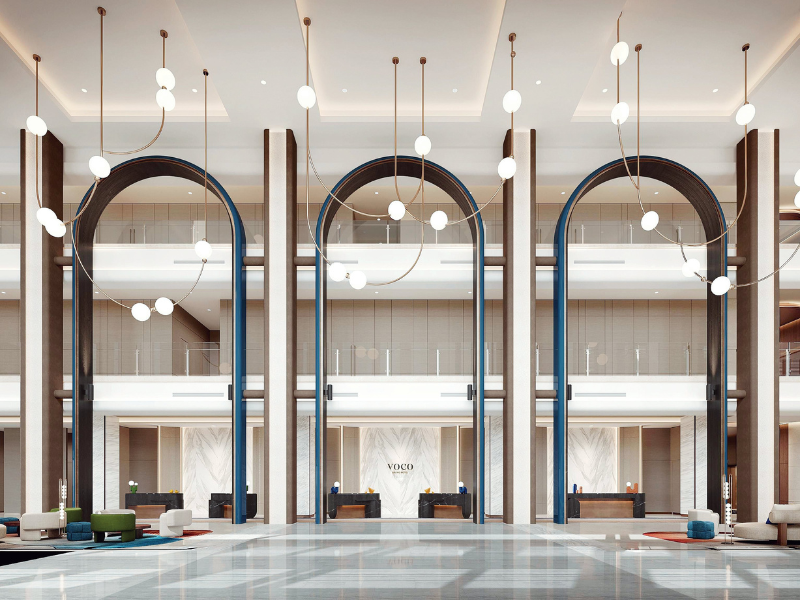
As Voco Kuching is the flag-bearer for the global hospitality brand in Malaysia, the evocation of a strong sense of place proved imperative. Naturally, local design accents abound, with layered textures inspired by traditional East Malaysian beadwork while designer Jonathan Liang created the staff uniforms. Sape exponent and songstress Alena Murang, who is also a visual artist, was commissioned to create Cradled by Mountains, a striking 4m x 2.4m painting that adorns the lobby and features the peaks surrounding Kuching, such as Serapi in the Matang range, as well as Singai, Staat, Santubong and, slightly further out, Gading.
“We knew we needed a piece that could anchor the space with a true sense of Sarawak and Alena was a natural choice. Our brief to her was simple, with just one question: What does home mean to you? Her deep connection to Kuching is reflected in everything she creates, making the collaboration feel intuitive from the very start,” says Ting.
4.png
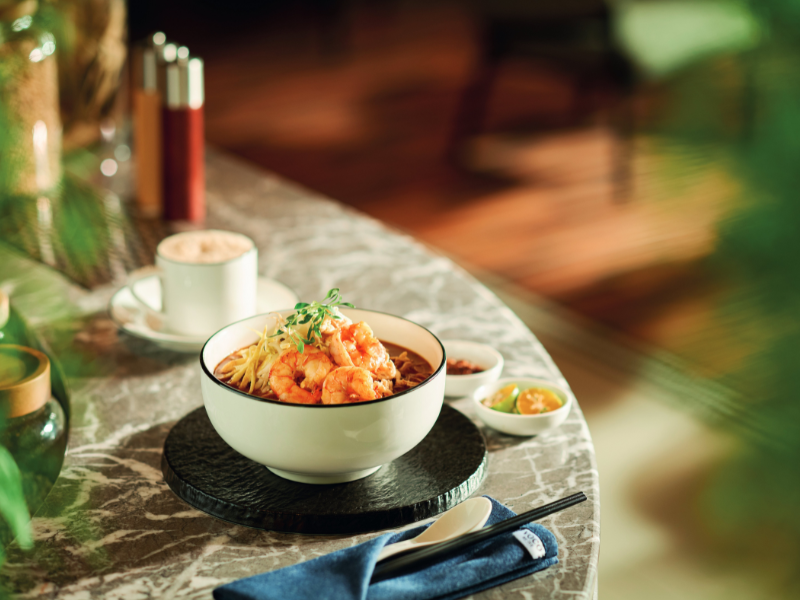
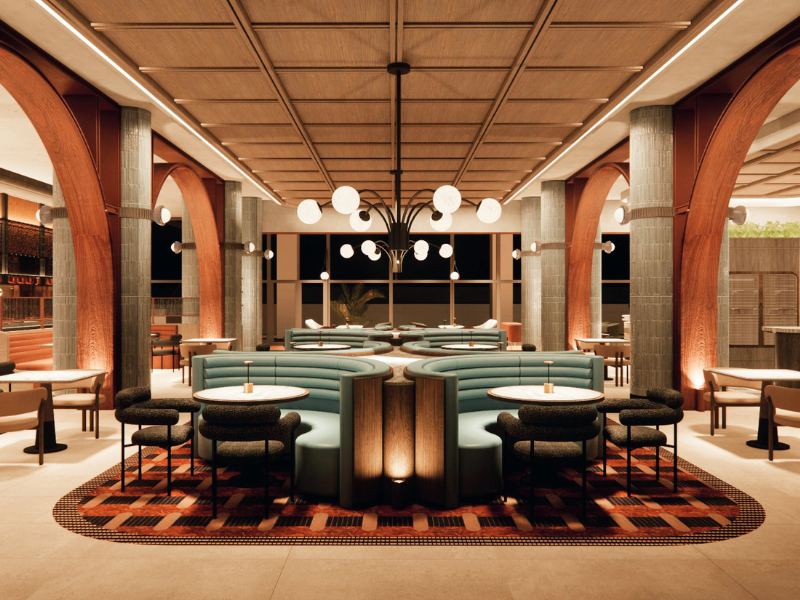
Luma, the hotel’s main dining room and whose name evokes the handlooms, textiles and weaving traditions of East Malaysia such as the ceremonial pua kumbu and linangkit embroidery, offers all the deliciousness of Kuching without even having to step out of the hotel. “We are a true foodie city and any visit should begin with a bowl of Sarawak laksa,” he adds.
Guests will be delighted to know that Voco Kuching has partnered with the iconic Ah Mui Laksa, where limited bowls of the beloved local institution’s noodles in rich, prawn-based broth will be served at Luma for breakfast. Those who enjoy liquid pleasures can seek solace at AMPM, which concocts beautiful brews by day and more potent libations by night.
“Kuching is a wonderful place,” Ting agrees. “And I can’t think of a better way to spend a weekend than by soaking up its old-world charm. For guests, I suggest wandering the old town, especially along Carpenter Street and the main bazaar where local craftsmen still create beautifully unique pieces. As a family, we also never miss tucking into freshly grilled satay, also on Carpenter Street, followed by gula apong ice cream by the waterfront. Brunch calls for kolo mee at Little Skill Cafe, a favourite of our children’s. For lunch, Muara Tebas Seafood offers freshly-caught seafood by the water, alongside a glimpse of local culture. Dinner at See Good for sharing dishes is unbeatable while we also like ending the day at Siniawan, where the atmosphere, food and little retro discoveries make it feel especially memorable.”
On the decision to team up with IHG, Ting says he wanted a partner that would be aligned with his vision of creating something distinctive. “We wanted more, versus simply operating another branded hotel. And Voco stood out for its contemporary personality, flexibility and emphasis on delivering memorable guest experiences while allowing each property to retain its own identity. It aligns naturally with what we wanted to create in Kuching, a hotel that feels modern, vibrant and welcoming, while reflecting the warmth and authenticity of Sarawak. Partnering with IHG also gives us global reach while preserving the individuality of the hotel. So, opening Malaysia’s first Voco is both an honour and a responsibility. Guests can expect a relaxed arrival, thoughtful design-led rooms and a warm Sarawakian welcome, all within a well-connected location just minutes from Kuching International Airport.”
5.png
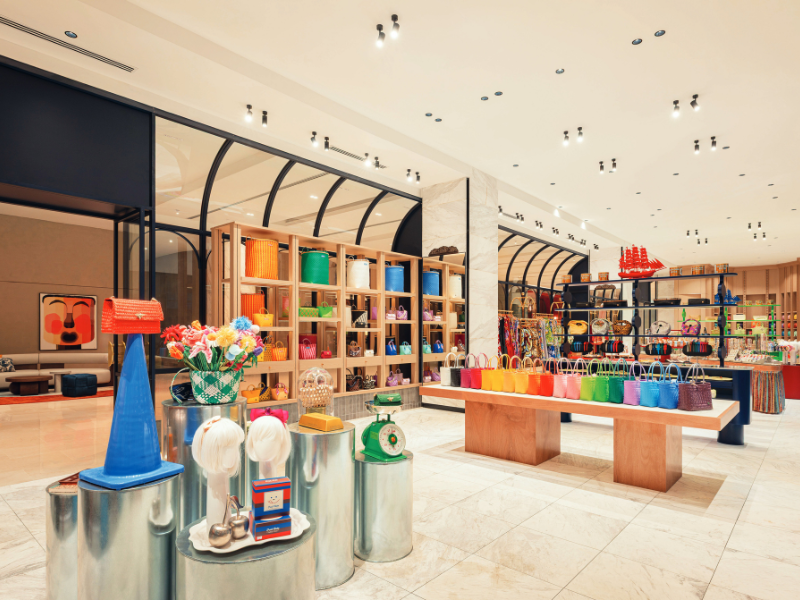
With the finish line in sight, Ting does let on that he will make a quick trip to enjoy some quality time with his wife, celebrated designer and founder of Kuching Food Aid Datin Shen-Tel Lee, who has been a veritable tour de force with the hotel’s pre-opening concept and execution. Incidentally, Lee will be operating Best Borneo, an eagerly anticipated retail space at Wisma Elica together with her chum and owner of the perennially popular Wonderboom café, Olivia Ling. “It has been quite a journey so, once the dust settles, my wife and I will head to Japan for a few days, which is always our go-to country for a reset. This time, we are drawn to Yufuin, a quiet onsen town just outside of Fukuoka.”
As the Voco Kuching officially opens this week, Ting recalls the journey with both a shudder as well as overwhelming gratitude. “And once we committed [to the project,] there was no turning back,” he laughs. “There were moments when the scale felt overwhelming and times when it was genuinely daunting. But we have always believed that when you commit fully to a vision, you will find a way forward. What kept us going was the knowledge that we were building something meaningful for the future. This was never just about a hotel. It was about creating a development that contributes to Kuching’s growth, both in tourism and in addressing the needs of an ageing population through Care Collective. That sense of purpose carried us through every challenge, and looking back now, it was all worth it.”
This article first appeared on July 27, 2026 in The Edge Malaysia.