
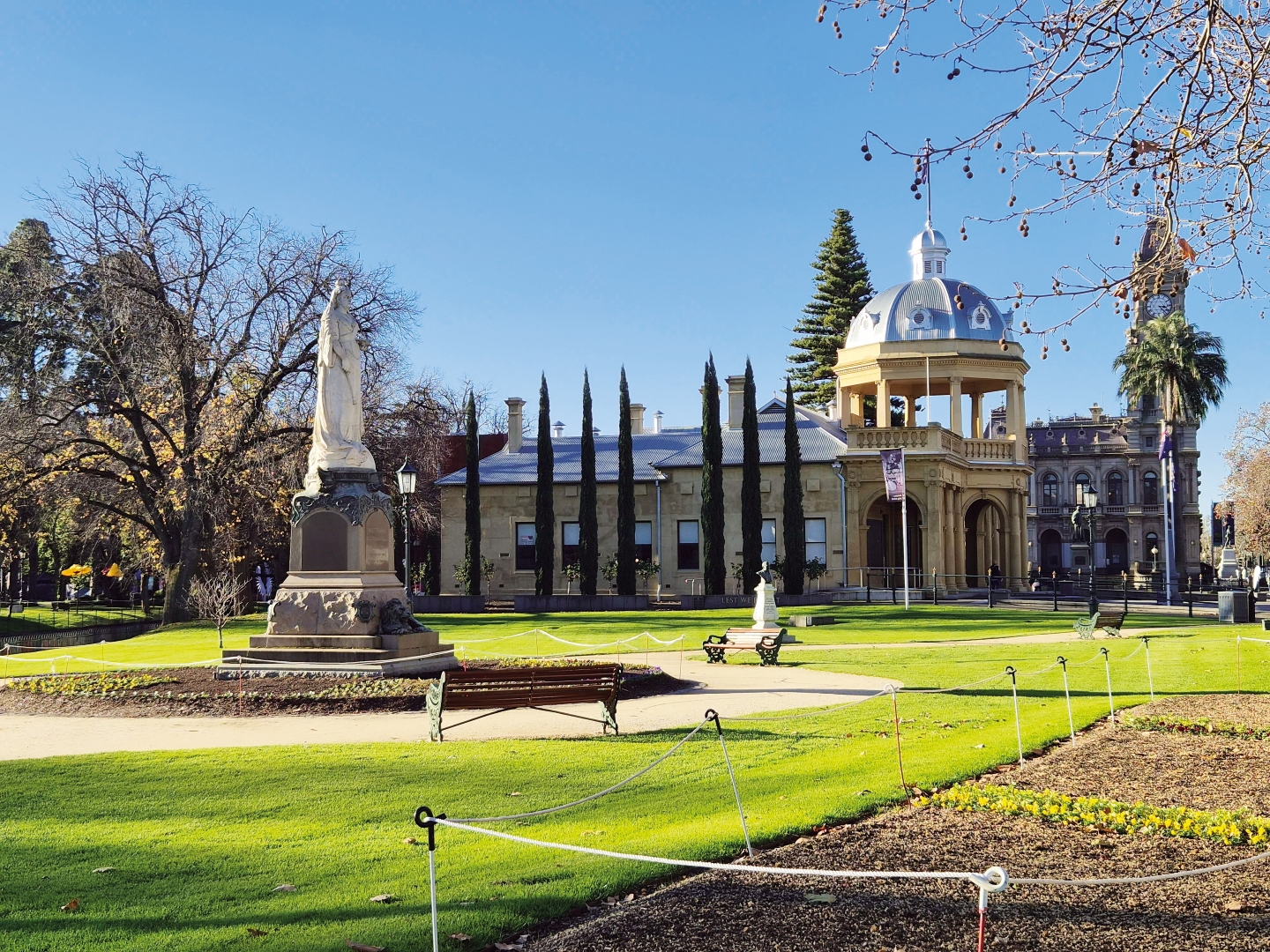
A carved statue of Queen Victoria is surrounded by manicured gardens (All photos: Quincy Tan/The Edge)
On a late spring day in September 1851, Margaret Kennedy and Julia Farrell — the wives of two workers in a nearby sheep station — made the discovery of the decade in Bendigo Creek, Australia: small, glimmering nuggets of honest-to-goodness gold. The exact circumstances of the event, it must be said, vary by source. Some tell the poetic tale of two women happening upon an unexpected windfall while simply washing their laundry. Other accounts state Kennedy was well aware of the secretive prospectors in the area, and had recruited a friend to hunt for the precious goods.
Apocrypha aside, the ripples of that encounter are indisputable. Almost overnight, the pastoral site in North Central Victoria began drawing hordes of diggers, lining the banks of the water in search of great fortune. The gold rush hit its peak by 1853, attracting large migrant populations from Great Britain and Europe, who would work the alluvial supply, as well as the Chinese in 1854, who resorted to profiting from the abandoned deposits. Over the years, much of that wealth trickled down to Melbourne, resulting in rapid infrastructural development and urbanisation across the entire state, but it was Bendigo that held the title of world’s richest city those decades. The glittering returns were so abundant it even earned the Cantonese name “dai gum san” — big gold mountain.
1.jpg
While ore no longer flows in the streets after a storm and the stamping of batteries does not reverberate throughout town, today’s Bendigo is no less flush with historic intrigue, cultural charm, natural wonders and culinary delights that excite throughout every season. In 2019, it was designated a Unesco Creative City and Region of Gastronomy, recognised for its exceptional quality of sustainable produce and diverse cuisines that trace their roots back to its cosmopolitan population.
Need a holiday that beats the heat while steering clear of the mainstream recommendations Down Under? Here is everything you need to know about this hidden gem of a vacation destination.
Lay of the land
Located just under two hours by car or 90 minutes by train from Melbourne, the Bendigo region was known for tens of thousands of years as Djaara Country, home to the Dja Dja Wurrung, Taungurung and Barapa Barapa peoples. These First Nation communities shaped the land and waterways, and their languages and stories continue to be honoured through public events and art showcases.
At Djaa Djuwima, a First Nations gallery, visitors can explore exhibitions dedicated to cultural reconciliation, heritage and connection to custodians past, living and emerging. For an immersive deep-dive, local tourism agency Dumawul (a word representing thanks between two individuals) hosts walking experiences led by knowledgeable Djaara guides through one of three possible areas: the vibrant Ulumbarra Central Business District; Larni Garingilang, or “Home of Growth”, which traverses the Bendigo Botanic Gardens and delves into native plant life; or Kooyoora, the majestic “Mountain of Light” that begins with a traditional smoking ceremony and traces formations sculpted over millennia.
1-2.jpg
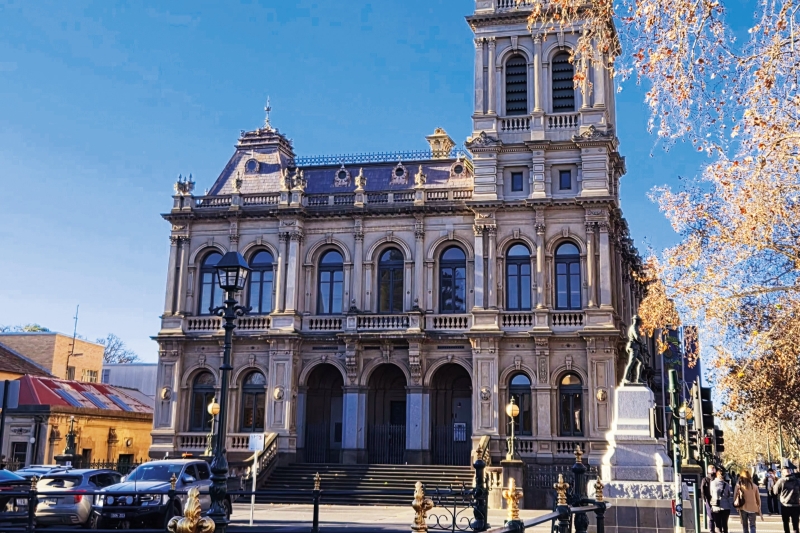
By the early 19th century, European settlers had established a presence within the country. Once news of the gold rush spread, the influx of fortunes and British influence quickly became reflected in the city’s architecture.
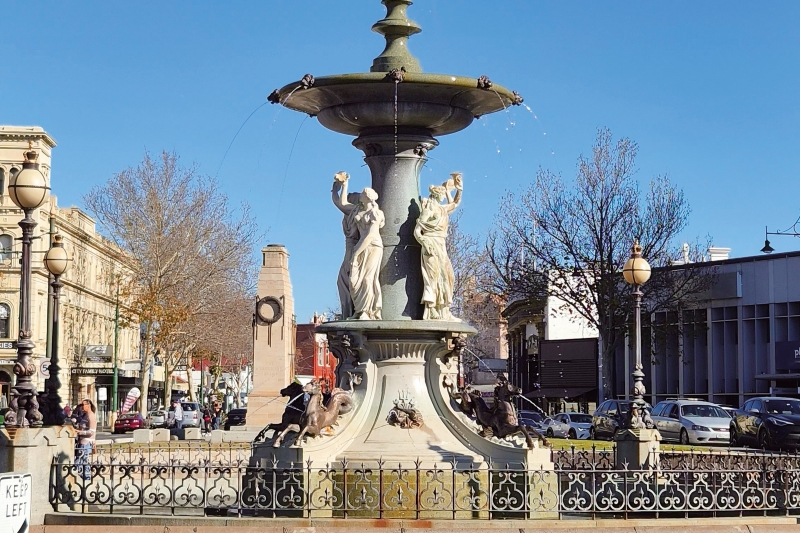
A stroll through the CBD reveals the hallmarks of old-world opulence and imperial sway. Its distinctly ornate, Occidental style — evinced by the elaborately carved Alexandra Fountain, French Renaissance-inspired Bendigo Visitor Centre and skyline-defining Sacred Heart Cathedral — has been preserved in memory of this valuable history. Architect William Vahland, who was responsible for many of the region’s most prominent buildings, had envisioned for Bendigo to become the “Vienna of the South”, and invited several of his peers to emigrate and recreate a Baroque, embellished aesthetic sensibility.
Streets like Pall Mall are no coincidence either, as English place names were adopted throughout Bendigo to feel closer to its Eurocentric reference points. The territory had even briefly been called Sandhurst after a military college in England in the 1850s, but the current moniker (allegedly taken from the nickname of a heavyweight boxer, William “Bendigo” Thompson) was voted back in by the end of the century.
2.jpg
Where there is gold, of course, there are strongholds to store it. Grand, neoclassical banks with ornate columns and pediments, such as the former Colonial Australia Bank, were designed to convey power, instilling trust in the clientele while flaunting the cash it was meant to protect.
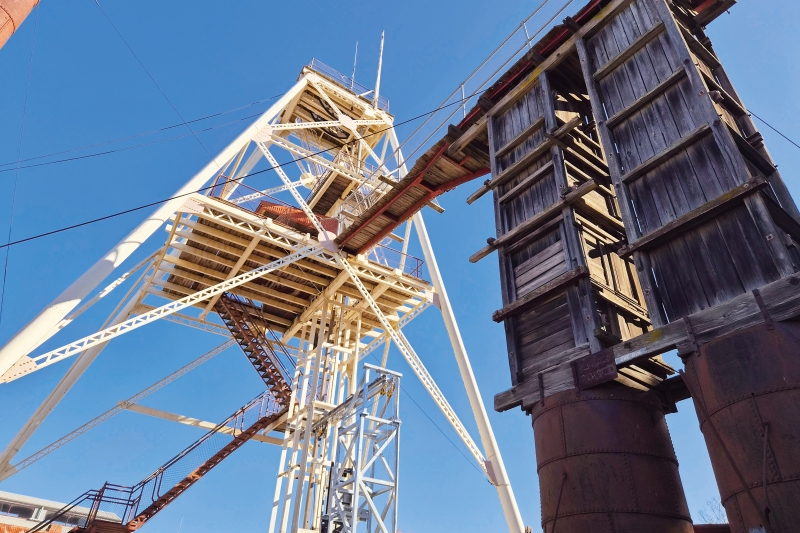
Underground, though, conditions were nowhere near as flashy. To find out where the city’s greatest resource came from and what it took to get it, take a different kind of trip down under at the Central Deborah Gold Mine, one of the 5,500 registered mines that operated in the early 20th century. Spanning 412m down with over 15km worth of drives and cross cuts, Central Deborah was where about 929kg of gold was yielded — barely over 0.1% of the staggering 700,000kg found in the entire region.
A guided 75-minute tour brings you deep beneath the hard stone strata where, for decades, miners toiled to extract the rare metal. At 61m underground — the second of 17 floors — you will don a hard hat and light to learn about the nitty-gritty of mineral formations, tunnel construction, historic equipment, explosives formations and what the average workday for a miner might have looked like. No need to worry, as unlike the old days when elevators were two-sided cages and water was perpetually ankle-deep, the paths have been widened and the entire property upkept to modern standards, so patrons of all ages can appreciate the site’s past in comfort and safety. Self-guided options are also available, where guests can stroll through heritage-listed buildings and even attempt panning for gold.
3.jpg
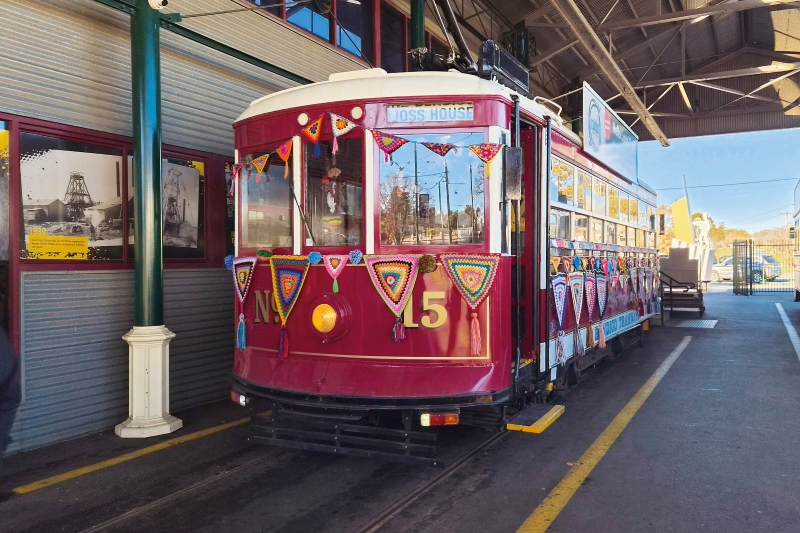
After a romp beneath the rocks, you can resurface to catch one of the Vintage Talking Trams. Run by Bendigo Tramways, these restored vehicles are a quaint and efficient way to glimpse the city’s highlights while listening to educational narration on the history of each landmark. Tip: Snag a day pass so you can easily alight and take in each stop before hopping seamlessly back on the next transport.
As a result of its sizeable Chinese population, which stood at around 20% in the 1850s, Bendigo also boasts several key sites of cultural and religious importance. Situated within the Chinese precinct is the Golden Dragon Museum, which shares the legacy of the community from their arrival to present. These artefacts, photographs and heirlooms are so closely tied to the inhabitants that many present-day descendants can trace their ancestry to those memorialised in the institution. The location is also home to two Imperial Dragons: Loong, the world’s oldest which debuted in 1892; and Dai Gum Loong, the world’s longest, commissioned in 2019. A short tram ride away is the heritage-listed Bendigo Joss House Temple, one of Australia’s oldest surviving Chinese places of prayer, where worshippers are able to fulfil their religious duties.
Dash + dine
The sheer volume of restaurants, bars and wineries in the greater Bendigo region promises two things: you will never go hungry, and you will not be able to try them all in one visit. Fortunately, these are both good problems to have. While embracing the spirit of adventure and trying out whichever haunt might strike your fancy can be plenty of fun, those looking to see the best of the city on a tight schedule should hit up Bendigo Guided Tours. Founded by veteran guide Jamie Roberts, the group provides incredibly bespoke experiences oriented around your choice of historical sightseeing, wine dinners or fine dining. They can even handle transport directly from the airport, train station or Melbourne — an ideal option for those who wish to imbibe or avoid queuing for an International Driving Permit.
Throughout the cold months, the company is hosting A Winter’s Taste of Bendigo, a limited-time, all-inclusive journey through the heartiest eats and seasonal treats found around town. Roberts notes that his criteria is to spotlight eateries that champion local ingredients as much as possible, ensuring tourists taste the best of the terroir. The path begins at Ms Batterhams, a basement turned lounge bar beneath a former school hall. Its curated sharing menu makes it a great family pick, but for a light bite, the shatteringly crisp zucchini tempura with herby green goddess mayonnaise and tangy pickled radish makes for a satisfyingly warm treat. To pair is a 2024 Ellis Rosé, dry and refreshing with an inviting fruitiness, perfect for a cool yet sunny day.
4.jpg
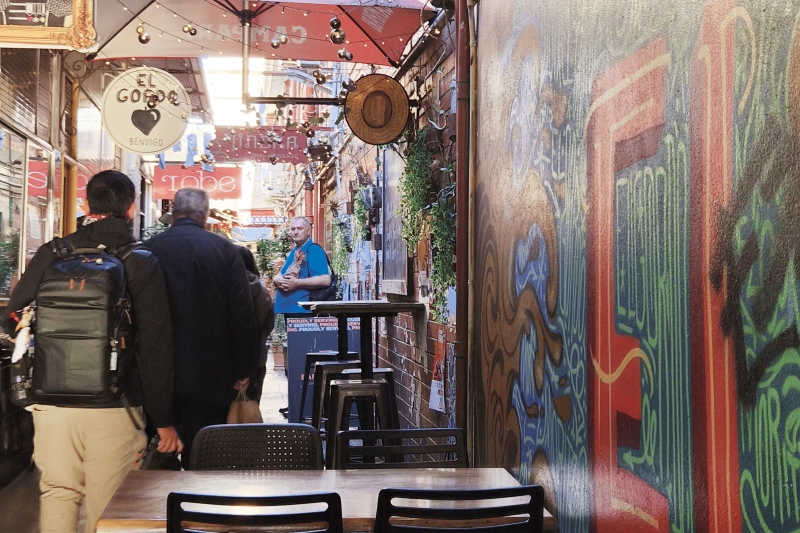
Frostier moments are when one should duck into Wine Bank on View, an intimate watering hole that inhabits the former branch of the Union Bank of Australia Ltd. Pull up by the crackling fireplace and toast with a glass of beautifully spiced mulled wine, or select a bottle from the veritable trove of Australian Shiraz labels. To fill the tummy, this spot serves up a thick, flavour-packed pumpkin soup — a nostalgic staple from many an Aussie childhood.
The Dispensary may no longer peddle medicines, but its current offerings are just as healing, if not more so. This Chancery Lane icon now deals in creative, elevated dishes that make the most of the area’s fantastic ingredients, like its uber-tender braised beef short rib that comes piled on a square of fried polenta with a garlic mayo smear. The restaurant’s charismatic owner can often be seen dipping between tables, laughing with guests and finishing teacups of pretty-yet-punchy hot buttered rum with an extra generous grating of nutmeg. Never tried the winter tipple? Let this gold-star example be your first: creamy and zingy with toasty vanilla notes from the mix of rums, just the boozy panacea for the chills.
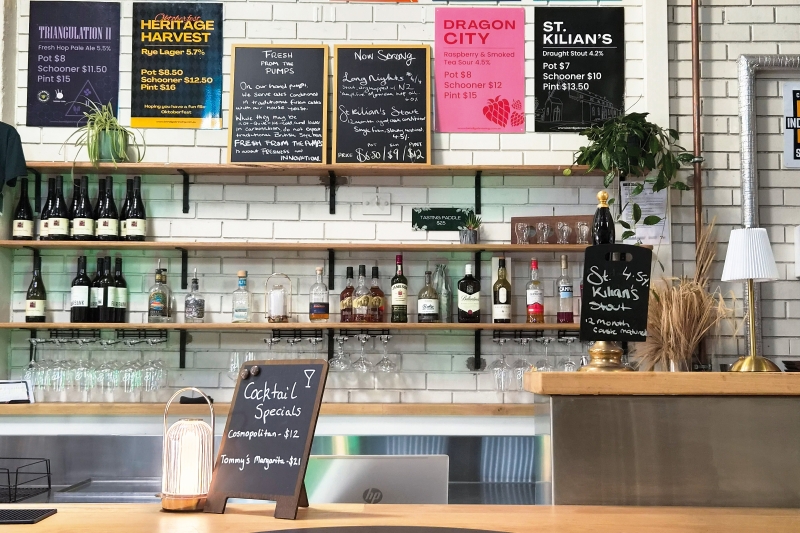
Our walk concludes at Bendigo Brewing, which specialises in a splendid selection of craft beers (created with their unique house ale yeast, Venus) and wood-fired pizzas. While the fruity Long Time Lager and umami-forward St Kilian’s stout appeal to the more classic flavour archetypes, we love the funkier suds here — the ultra-hazy and citrusy Plains; Triangulation II, a single-origin beer with the green bitterness of a raw hop; and our personal favourite, Dragon City, an electric pink pint of tart raspberry kissed by lapsang souchong smoke.
5.jpg
For an unforgettable dinner, Terrae has swiftly garnered a reputation as a top pick for modern European fine food, and its chic ambience comes with a patina as sophisticated as it is storied. Nestled on the ground floor of Hotel Ernest, a boutique accommodation with 10 suites each themed after a contemporary artist, Terrae occupies what was once the 1863 Commercial Bank building. The space has been restored to maintain much of its original architecture, including the ornamental woodwork, vault door and glass windows (Fun fact: one was punctured by a bullet used to stop a robbery and never replaced). Here, a rotating menu of dishes takes form around sustainable produce, much of which is harvested from the establishment’s own 25-acre farm just beyond Bendigo.
If you cannot find the time for a winter escape between personal scheduling and the dreaded-but-inevitable bureaucratic red tape, though, fret not — one of Bendigo’s great charms is how it is never short on attractions, no matter the time of year. Come spring, you can take in the flourishing fields of flowers and sip at scenic wineries in cool, colourful comfort. The rest of its infinitely fascinating treasures are yours to discover.
This article first appeared on Aug 3, 2026 in The Edge Malaysia.