
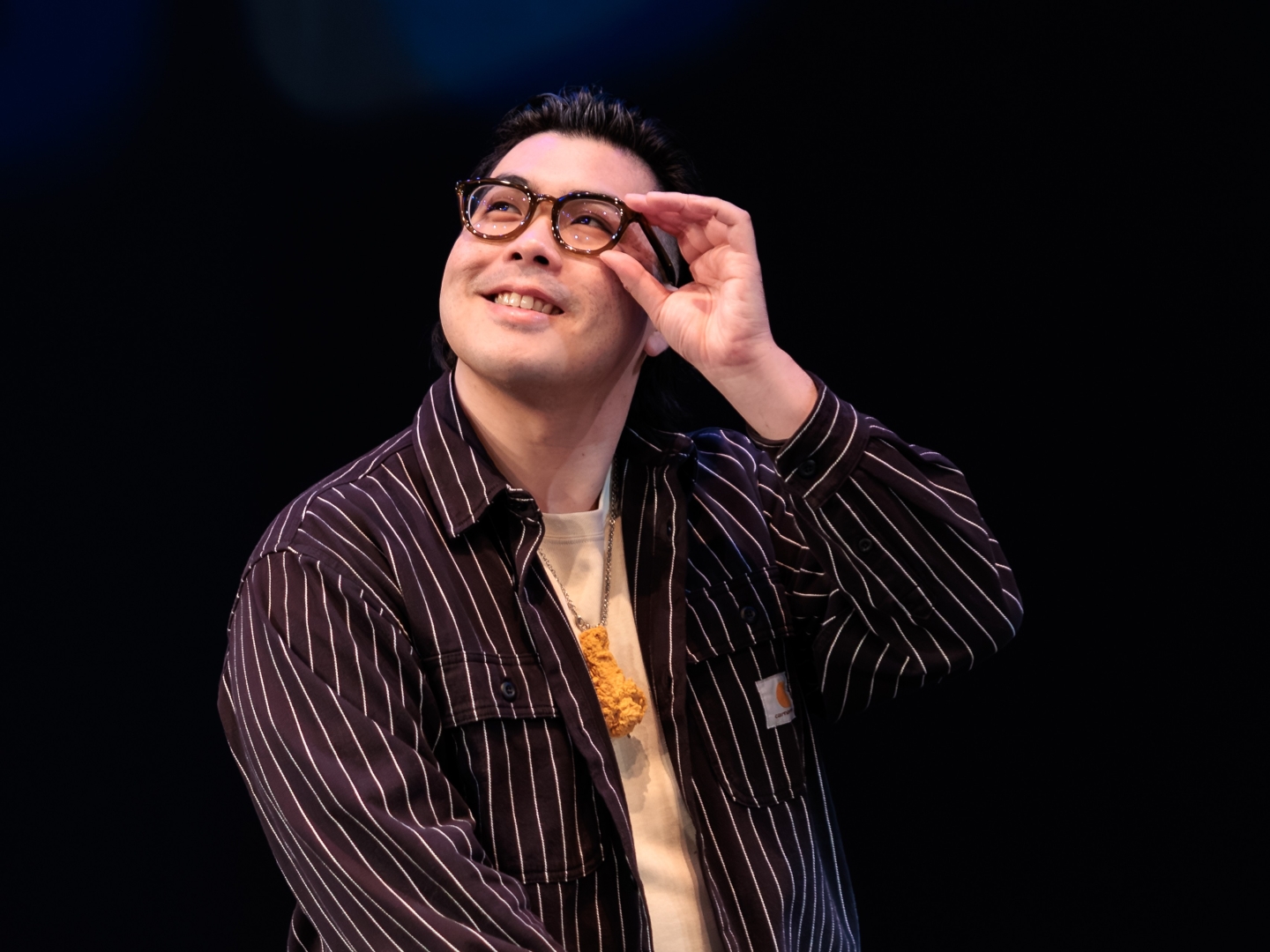
Kuah: "Back then, I would write to make people laugh, but over time, I learnt to share stories while making people laugh" (All photos: Kuah Jenhan)
"The thing is, I’m not good at writing something that’s made up.” Many comedians chase laughs; for Kuah Jenhan, they are simply the consequence of telling the truth.
For almost two decades on stage, Kuah’s long-form narration has superseded the rapid-fire punchlines found so often in mainstream club-style shows, his carefully woven stories leaving an effect that lingers long after the curtains fall.
The general structure of a comedy show is simple: the comedian presents a joke or observation, and the audience responds with laughter. In this regard, Kuah goes against the grain. “My approach is different,” he says. “You step inside my world and see what I see.”
This perspective has carried him from intimate comedy clubs to stages in Australia, Singapore, Hong Kong and London. Come August, it will bring him to the new, state-of-the-art Jeffrey Cheah Performing Arts Centre (JCPAC) in Sunway Square Mall, Subang Jaya, where he will restage Like This, Like Dad, his largest solo theatre performance so far.
Looking back, the upcoming production seems less like a culmination of a career. It represents the latest chapter in a craft he has been refining for years.
Though Kuah is known for his distinct style and approach, his earliest aspirations had little to do with stand-up. “I had always wanted to be in theatre and musicals,” he recalls. High school became his first playground to hone his writing and acting skills as he crafted skits for annual events such as Teacher’s Day. Theatre taught him to deliver plots with structure, rhythm and emotional payoff. The laughter — if it came — was only one part of the experience.
When friends started their own platform and introduced him to the concept of open mics, the budding performer found himself entering a landscape dominated by concise setups and scripts — a format that never really quite fit him. Soon after, Kuah became an anomaly in the scene because of his young age and interesting delivery technique.
A serial observer, Kuah found himself writing about people and situations that, according to him, are humorous because they are simply true. “If I’m talking about something that I experienced, it means that it has happened to someone else as well,” he explains. This, alongside the intimate atmosphere and longer, festival-like conditions of his shows, allows the crowd to truly immerse themselves in the experience and build a deeper emotional connection with the performer.
1.png
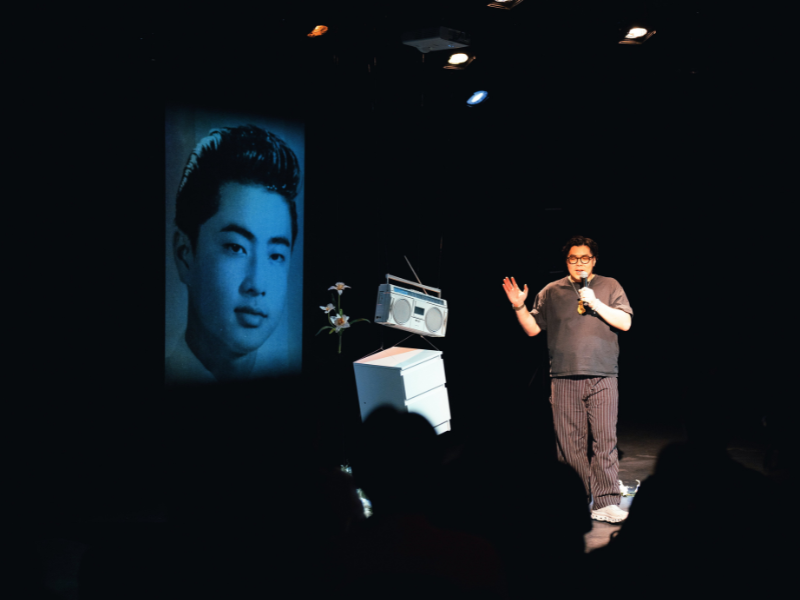
While the freedom to experiment opened up new creative possibilities, the pressure to constantly create eventually took its toll, leading to burnout and depression. Ironically, this pushed Kuah’s storytelling instinct even further. “I started to think that people no longer understood what I was trying to say.” To compensate, he tended to over-explain and all of a sudden, the shows he wrote began to have more words, transforming the sketches into acts that were more narrative-driven.
“Back then, I would write to make people laugh, but over time, I learnt to share stories while making people laugh,” he says. Although he claims he is “not as funny as I used to be”, the childlike curiosity that fuelled Kuah’s playful outlook and witty perception remains very much intact. The difference may seem subtle, but it fundamentally elevated his work.
This evolution was further influenced by an unexpected detour away from the stage — a four-year stint as creative director at The Chariot Agency. Ironically, it was in the corporate world that he earned 11 awards and additional accolades, including recognition at the MARKies Awards and Kancil Awards.
“Isn’t it fascinating? I’ve been a comedian for 20 years with no official awards to my name, but the corporate world operates differently,” he says with a laugh.
He is quick to point out, however, that the industry’s greatest lesson had little to do with creativity. Instead, it taught him discipline in his approach to work. Hyperfocus came naturally to him, but in a field defined by tight deadlines and multiple layers of approval, he learnt to juggle competing priorities and accept that work sometimes has to be delivered regardless of circumstance.
Practicality replaced idealism. “Having something to show is better than no work being done, and perfection can never be achieved anyway,” he states. More importantly, advertising taught him that storytelling was as much about communication as it was about self-expression.
2.png
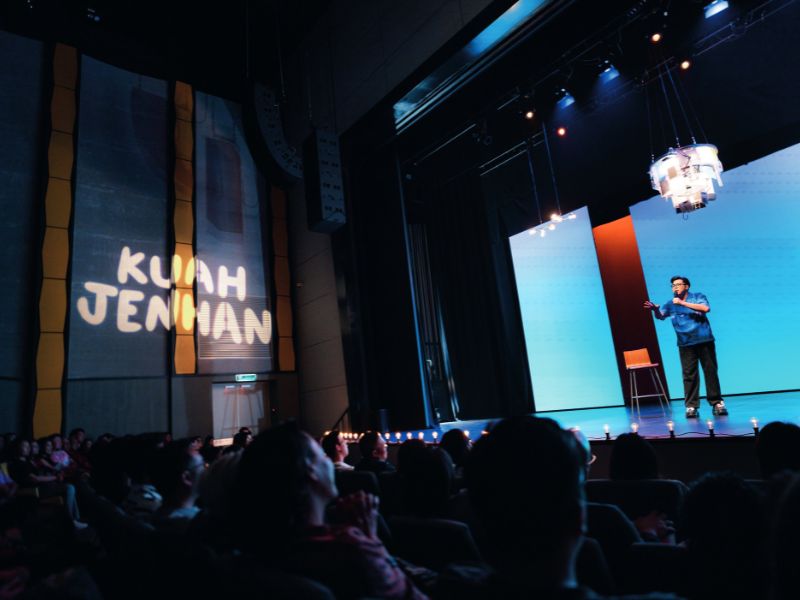
The hiatus ended in 2024 and when Kuah finally returned to comedy with Noted With Thanks, he realised he had become not only more assured as a comedian, but also a better producer.
With the upcoming one-night performance Like This, Like Dad: The Storytelling Special, he plans to take his most reviewed piece to another level. Written in 2013 as a way to process the grief of losing his father, the show has since been refined by the perspectives he has gained over the years. “When you are younger, your experience is almost always the most interesting thing,” he says. This edition includes Kuah’s observations of how other people in the story have changed and coped. Even after his father’s passing, he has found that their relationship continues to evolve, especially as he approaches the age his father was when he was conceived.
The production explores fatherhood, family, memory and the strange ways in which parents continue to shape children even in their absence. Beyond expressing Kuah’s ability to relate more to his father, the show also provides fascinating insights into how legacy is processed in an Asian household. With his youngest sister now married with two children, Kuah uses his own family as a blueprint to ponder the concept of patriarchy.
“My father never got to finish raising me, but the rest of my life happened anyway.” In this one-night recorded staging, he finally plans to close the chapter — a necessary step for the next one to begin.
Personal developments aside, a shifting landscape has also contributed to the possibilities of his work resonating even more deeply today than it might have pre-hiatus. While comedy has traditionally rewarded people with instant gratification, Kuah believes audiences today are increasingly willing to embrace something slower. Crowds are prepared to properly sit with a story and follow along, allowing humour and emotion to arise and coexist naturally.
When viewers describe him as vulnerable, Kuah does not dwell on the label. Instead, he is grateful that they feel anything at all. “Vulnerability is a nice way to put it, but I think I am just not a shy person,” he says.
Although comedy is an “agreed-upon manipulation”, Kuah remains uneasy with the idea of chasing a reaction as a showmaker. To him, if sharing his own experiences encourages others to express themselves more openly, then the story has already achieved its purpose.
This sincerity has become increasingly vital in today’s comedy landscape. Factors such as the pandemic and the rise of digital platforms have altered the scene, with venues closing and attention shifting towards local-language skits and short-form content. Yet, he sees this not as a decline of comedy, but as an evolution. “People will always continue to share their thoughts,” he remarks. “It’s just that the medium has changed.”
A similar transformation can be observed across the wider arts scene in Malaysia. Festivals and collaborative spaces that once encouraged musicians, comedians, actors and artists to intersect have become fewer, making creative communities feel more fragmented than before and expression more individualised and niche. The opportunities for cross-pollination may not be as plentiful, but the impulse to create has never disappeared. Nevertheless, Kuah is confident that the idea will make a comeback.
This optimism befits someone whose career has been anything but linear, and he hopes that remains the case. Whether on a different stage, driving video game plots or appearing on the silver screen, his ambition to perform and craft experiences still holds true. Wherever the next story is told, one suspects that the jokes will always be there — but only because they help illuminate something far more enduring.
A single comment has stayed with him over the years. “One of the nicest things I’ve heard was when someone told me, ‘Every time I come to a Kuah Jenhan show, I don’t know what to expect — and that’s why I’m here.’ That means a lot to me.”
He offers the simplest promise of all: “At the end of the day, if you come to my show, you will definitely have a good time.”
'Like This, Like Dad: The Storytelling Special' will be staged at JCPAC on Aug 22. Tickets can be purchased here.
This article first appeared on Aug 10, 2026 in The Edge Malaysia.