
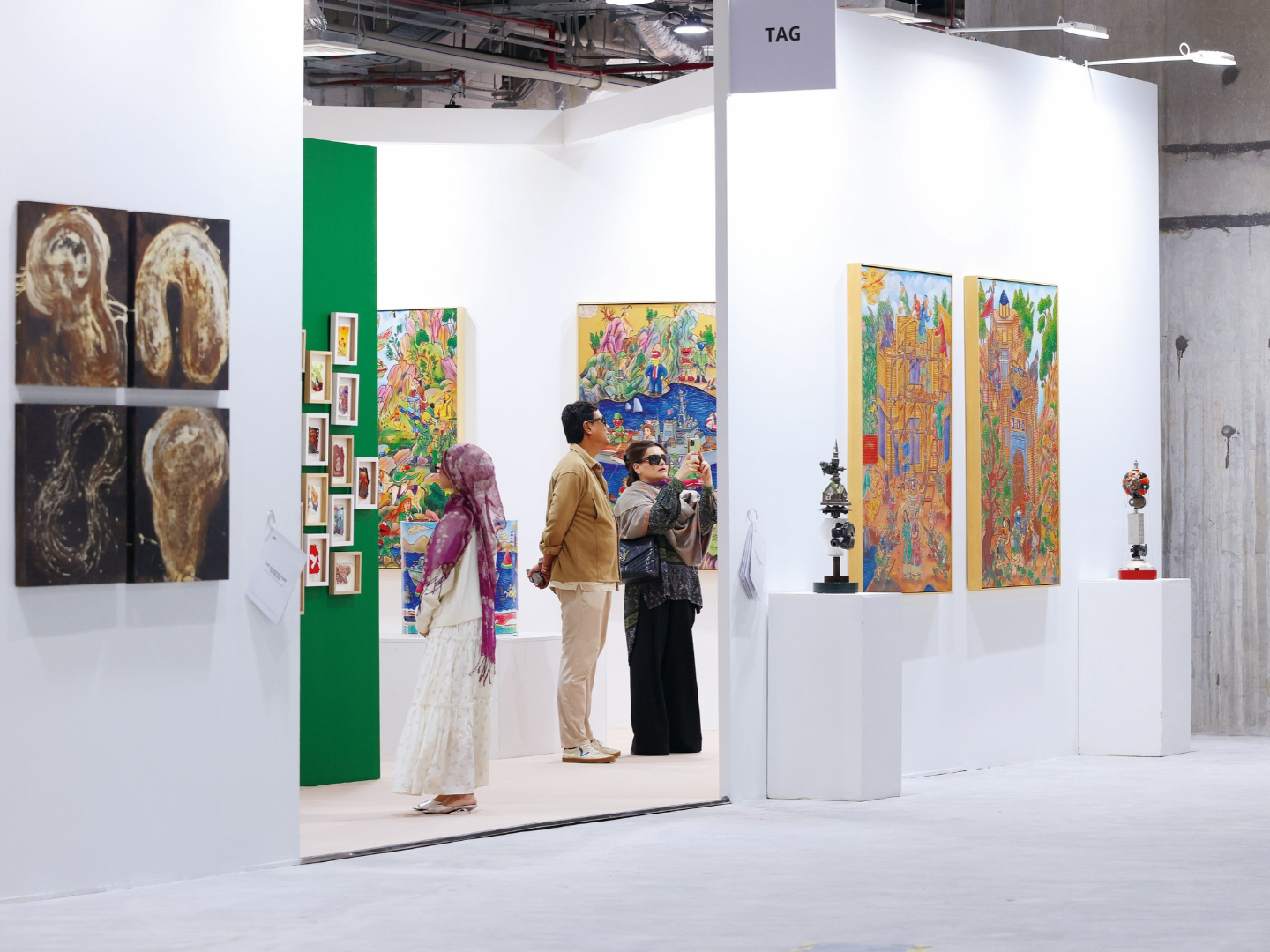
This year's Artober was held at Ombak KLCC (All photos: Low Yen Yeing/The Edge)
One suspects Fawwaz Sukri would be disappointed if his paintings allowed the eye to settle too comfortably. Innocence, after all, is the first casualty of his Invasion Series, as even the most benign figures of childhood memory find themselves caught in the crossfire of competing ideologies. In one of his pieces titled Castle, an ornate fortress rendered in the intricate style of Persian miniatures comes under siege by an unlikely army of rifle-toting American cartoon characters. These animated interlopers serve as absurd proxies for foreign aggression against a nation under threat, while Palestinian flags scattered throughout the composition puncture its Pop Art exuberance, grounding the fantastical spectacle in the grim geopolitical realities of West Asia.
“My theme mostly responds to the conflicts of our time. It’s a bit political but in a global sense,” says Fawwaz during a brief break from the bustle of CIMB Artober 2026, the bank’s yearly showcase that brings together home-grown artists and galleries while encouraging wider public engagement with the arts.
“For example, right now, we’re dealing with attacks in the Persian Gulf and tensions surrounding the Strait of Hormuz, a vital passage for global oil supplies. The US involvement in these hostilities inspired my decision to juxtapose American popular imagery with Persian aesthetics. It’s a clash between two cultures, but I want to approach it through satire because war is terrible. I hope people can relate to the message I’m trying to convey. We don’t know what the future holds. I’ve read online that WWIII might happen, but we don’t want it to come to that.”
For all its unsettling undertones, Fawwaz’s repertoire had little trouble finding an audience. His canvases exerted a peculiar gravitational pull, with visitors lingering before their riotous compositions, stepping back only to lean in again, as though trying to untangle an elaborate punchline. It was a telling scene for Artober, which has spent years narrowing the distance between contemporary expression and the uninitiated. Held over five days at Ombak KLCC, it drew seasoned curators and the casually curious alike — including those who might have wandered in with little knowledge of the collecting circuit, much less expecting to find themselves deciphering geopolitics through the mischievous lens of popular culture on an otherwise ordinary afternoon.
body_photo_-_2026-11-18t112816.599.png
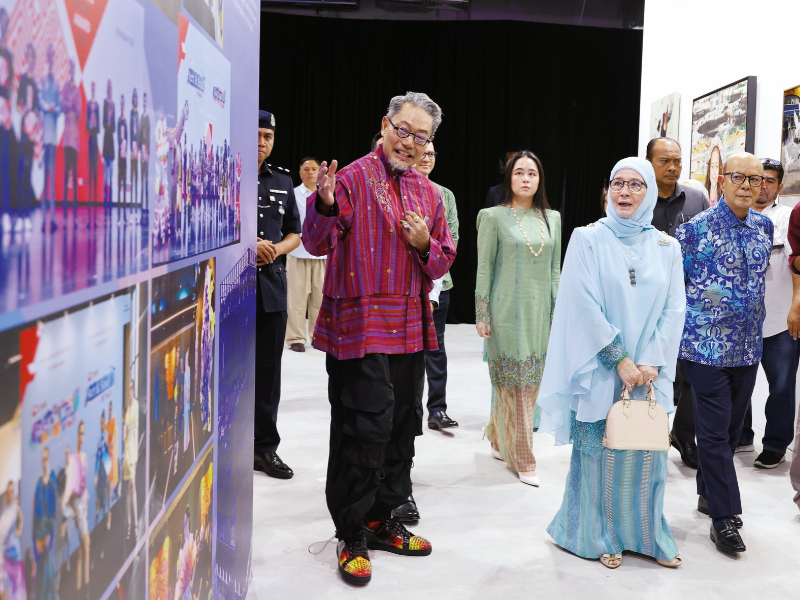
“We wanted to explore a setting that would complement the event’s evolving character and encourage people to experience art in a different context,” says Ismail of the choice to host Artober 2026 at Ombak. “Soon to be the home of Galeri Petronas, it offers a distinctive architectural backdrop where the creative discipline can intersect with other facets of urban life.
“Art also challenges us to take a stand, because remaining neutral is not always an option. Artists such as Darwisy Mustafani, Haslin Ismail, Ahmad Fuad Osman and Hisyamuddin Abdullah have used their medium to speak out against genocides and call on us to stand on the right side of humanity.”
Such narratives may now seem part and parcel of the fair, but its beginnings were considerably more modest. Conceived in 2020 during the pandemic, when cancelled exhibitions and dwindling sales left Malaysia’s art market reeling, the initiative began as a collaboration with 10 commercial galleries in need of a lifeline. Six editions later, that early intervention has evolved into a fixture, helping demystify collecting while giving emerging talents a foothold in a landscape where exposure alone seldom pays the bills. The platform has since broadened its reach to include fashion, traditional craftsmanship and the less visible trades behind the scenes, mindful that a sustainable ecosystem depends on more than transactions. Since its inception, CIMB reports the fair has raised more than RM23 million for the home-grown community.
body_photo_-_2026-11-18t112811.173.png
Stepping onto the exhibition floor in an official capacity for the first time, award-winning visual creator and photographer Eiffel Chong welcomes deep-pocketed patrons with open arms, though he reckons the real dividends have little to do with the bottom line.
“We need corporate backers who are willing to invest in culture without expecting instant financial returns. It’s not just about ROI; the benefits extend to education, cultural development and society at large. Artober is a promising avenue, but there’s no denying that Malaysia still has some catching up to do, especially when neighbours such as Singapore, Indonesia and the Philippines have stronger international networks,” he says, hoping future iterations of CIMB’s flagship programme will attract more participants from across Southeast Asia. “That’s when the real conversations can begin.”
An automotive sealant factory is hardly the first place one would go looking for creative fodder, but Chong has never been overly interested in the obvious. His latest collaboration took him into the bustling premises of Rovski, a manufacturer of adhesives and sealants, where he found himself captivated by the very details its employees considered an eyesore. “They were sort of apologising to me, saying their factory was messy. But I told them, ‘There’s so much material here! The barrels, the shapes, the patina — I love all these things.’”
Among his discoveries were metal strips discarded after adhesive strength tests, their surfaces bearing residue, handwritten codes and occasional flashes of colour. Collected by the hundreds and arranged in regimented rows, these specimens acquire an unexpected appeal, their irregularities and markings becoming objects of fascination in their own right. In another of his photographic endeavours, Chong constructs imaginary metropolises populated by Japanese TV heroes such as Ultraman and Astro Boy, drawing on nostalgia to examine the relationship between technological progress and human imagination. What a laboratory treats as expendable, he finds worth a second look.
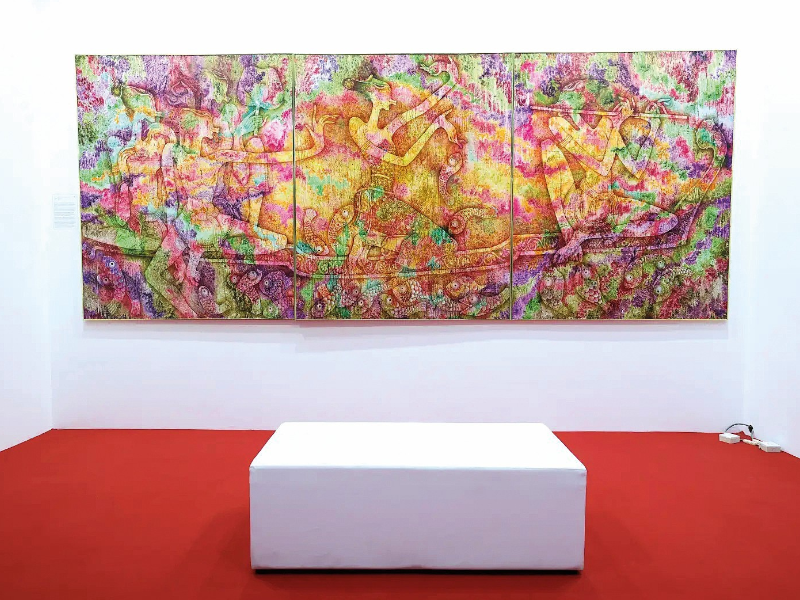
Artober embraced such individual explorations, but there was also a concerted effort to cultivate those still at the outset of their careers. At Wei-Ling Gallery’s booth, the emphasis fell squarely on the next generation through WLG Ignite, a presentation of rising names drawn from its incubator programme. Launched in 2020, the six-month mentorship scheme has given hopefuls such as Khabir Roslan, Iwadh Mahadi, Adam Abas, Lee Mok Yee, Nasrul Rokes and Wong Xiang Yi guidance from veterans in the field, allowing room for experimentation, candid critique and the occasional misstep, away from the immediate pressures of the marketplace.
body_photo_-_2026-11-18t112759.006.png
According to the gallery’s founder Lim Wei-Ling, that same duty of care must carry through to the event floor itself. Although she appreciates this year’s sharper focus on the works themselves, she maintains that curatorial rigour is essential to its credibility. “While these gatherings serve a business purpose, they shouldn’t entirely be about that,” she asserts. “Organisers must also consider activities that prioritise education, engage the crowd or address bigger issues affecting the world. It should go beyond merely displaying decorative pieces.”
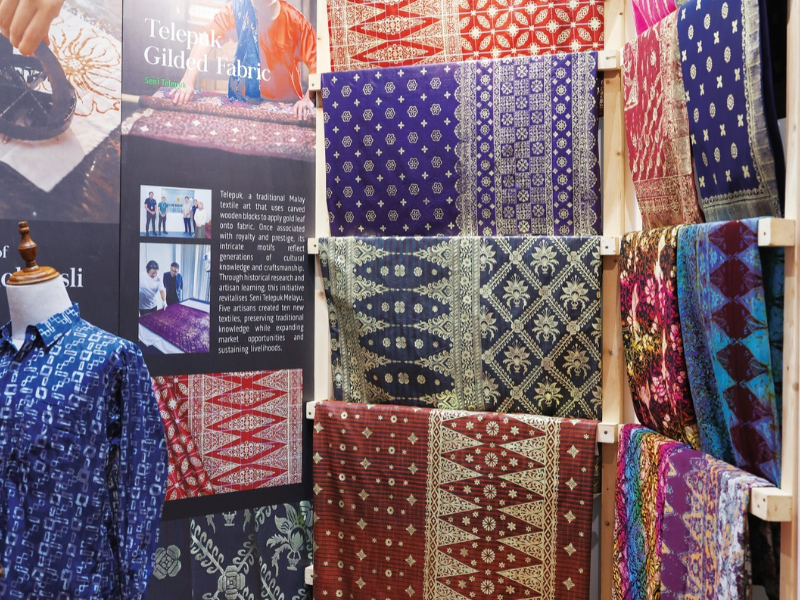
A few steps away, that exact claim found a living example. At Yayasan Hasanah’s corner, beauty came with a history lesson — and, more crucially, a reminder that the hands responsible for it cannot survive on admiration only. The foundation brought five traditional disciplines into the spotlight, from the delicate paper cutwork of wau sobek and block-printed batik to gasing leper, seni telepuk and Kelantanese shadow puppetry. Workshops and demonstrations revealed the skill and labour behind these increasingly vulnerable practices, while connecting their custodians with prospective buyers.
The mission to keep the past from slipping into obscurity has also found a cinematic outlet. Produced by Langit Terang Productions with Hasanah’s support, a five-part microdocumentary collection made its debut with a special screening of Gema: Wayang Kulit. Looking beyond the finished objects, the films examine the makers, stories and craftsmanship that sustain local heritage, covering subjects as varied as labu sayong, batik blok, Perak’s rumah bangsawan and kelingkan embroidery. The remaining episodes are scheduled for release on the organisation’s YouTube channel.
The balance of cultural preservation and economic assistance took on a humanitarian dimension elsewhere. Proceeds from an auction held by Mercy Malaysia went towards its General Humanitarian Fund, while Frienden Arts offered another perspective on inclusion. Among its nine featured painters was Branden Lim, who lives with spinal muscular atrophy and creates his vivid, surrealist paintings while lying down, using just one hand. Having held his first solo exhibition at the age of 13, he is among the young voices championed by the social enterprise, which aids those with disabilities and rare conditions to attain recognition and earn an income from their creations.
Bridging commercial drive with civic purpose, Artober is gradually suggesting what a mature arts gathering ought to look like, though it remains a vast undertaking in progress. The greater task, however, lies in converting a few days of attention into lasting gains for those who depend on the industry for their livelihoods, ensuring that Malaysia’s rich creative tapestry continues to flourish beyond the annual calendar.
This article first appeared on Nov 9, 2026 in The Edge Malaysia.