
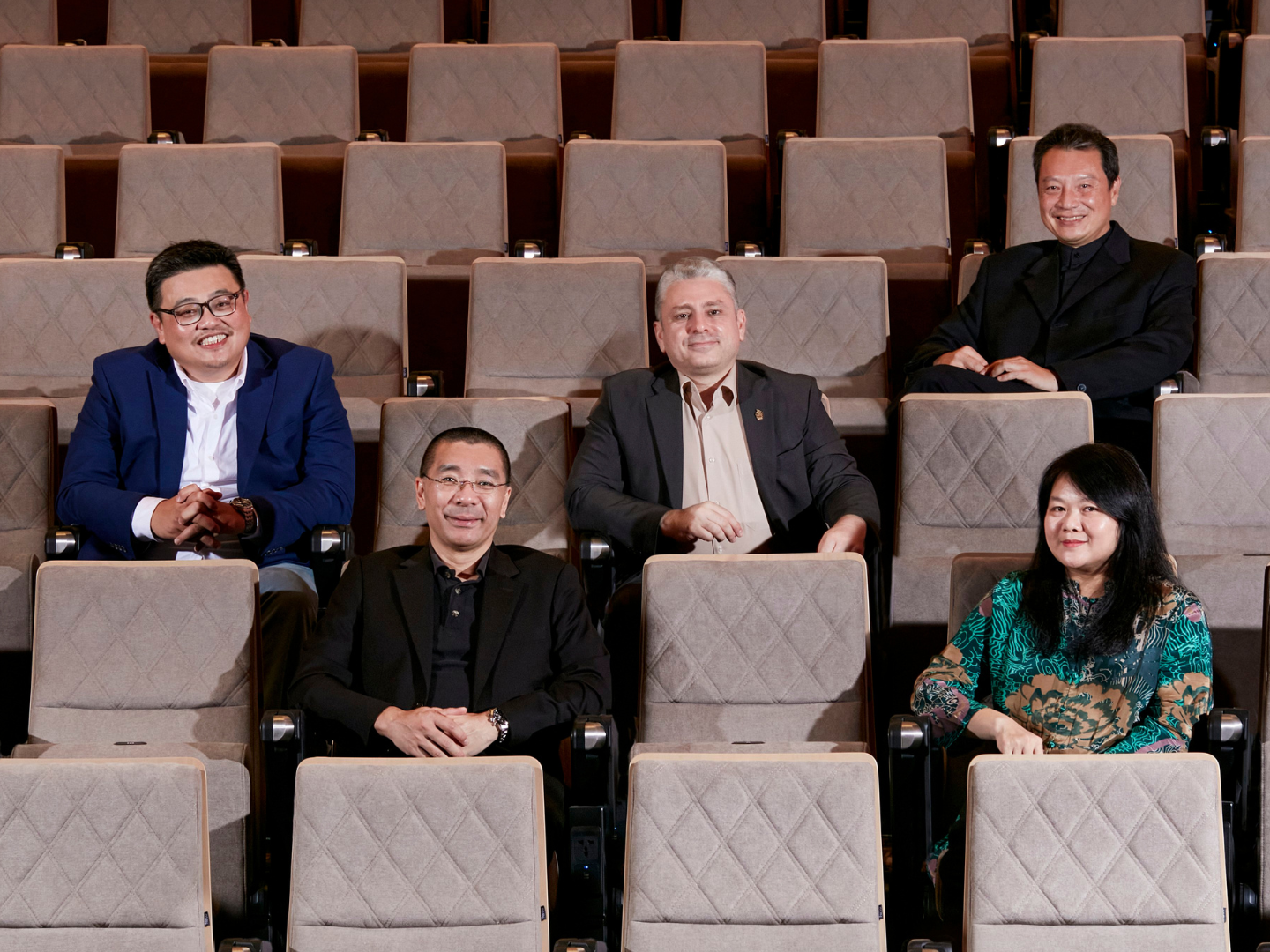
From left: We Jun Cho, Chan Ling Chee, Professor Dr Mayco Santaella, Kenneth Tan and Melissa Teoh (Photo: SooPhye/The Edge)
Each musical genre carries its own stereotype. Pop is superficial and manufactured, EDM (electronic dance music) is repetitive noise, and heavy metal is for the rebels and outcasts. As for classical music, its elaborate rules and orchestral arrangements are deemed old-fashioned. Another common perception, stemming from its association with high-profile patrons and formal etiquette, links it to the rich and elite.
“I’d like to think that we actually are a little bit past that stereotype,” says Kenneth Tan. The observation is a hopeful one, coming from the chairman of the Selangor Philharmonic Orchestra (SPO). It is quickly met with nods of agreement around the room.
We Jun Cho, commercial director of the newly minted Jeffrey Cheah Performing Arts Centre (JCPAC), reflects: “The fact of the matter is, it’s been hundreds of years and these sounds still stay in our consciousness.”
Echoing this thought is Professor Dr Mayco Santaella, dean of the Faculty of Arts and Social Sciences at Sunway University. “Once you give it a go, you start to realise how embedded classical music is in everything,” he states. “Many parts of modern culture, music and movies are largely developed from it.”
Rounding out the conversation are two other prominent figures in the local arts scene. They are Melissa Teoh, director of JCPAC, and Chan Ling Chee, founder and conductor of SPO. Together, the five represent the creative, academic and organisational forces spearheading the nation’s latest cutting-edge artistic pursuit.
The group only occupies a tiny section of the vast Proscenium Theatre. As workers put the finishing touches to the stage construction, wafts of fresh paint, footsteps and clanking of tools add to the buzz of anticipation already building ahead of the upcoming shows.
It is an apt setting for what is to come. Titled Chapter 30: Philharmonic Test Drive — Celebrating A New World, the informal concert will not only celebrate SPO’s 15th anniversary season, but also mark the first time that JCPAC is exploring its sonic limits.
This collaboration offers a glimpse into Malaysia’s latest performing arts venue, a prominent community-driven organisation, as well as the current state of the creative industry — all fruits of toil, grown with dedication and passion.
4.png
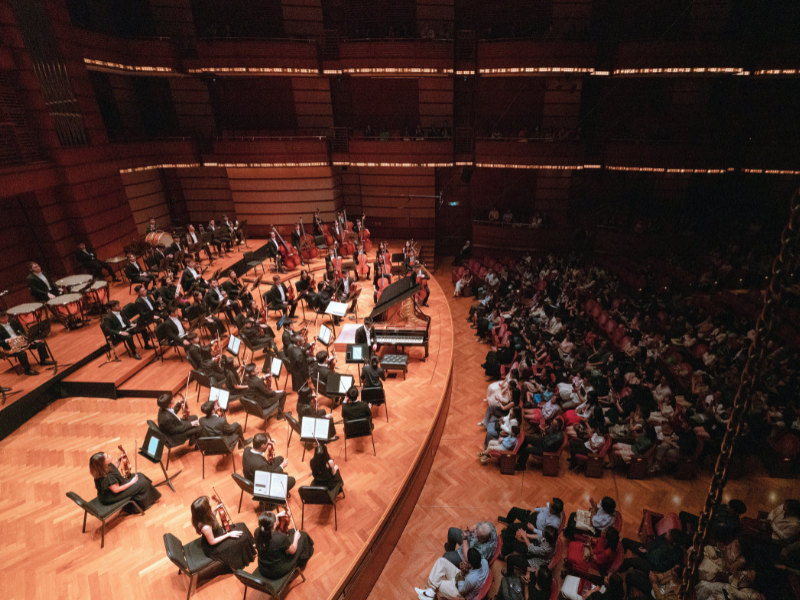
Fifteen years in concert
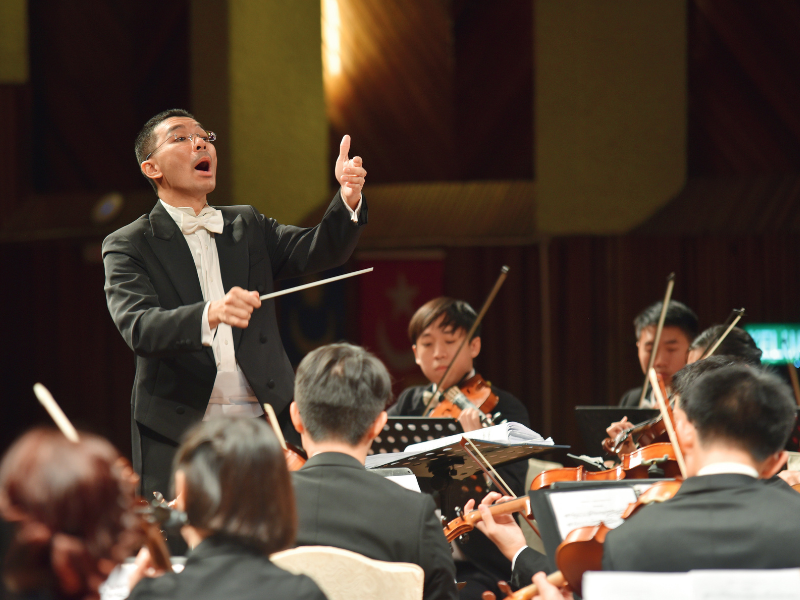
Both a conductor and musician specialising in piano and cello, Chan has played in numerous ensembles over the past 23 years.
More than 15 years ago, while on a break from performing, he unexpectedly found himself approached by a group of senior students who came to him with an idea. “They asked me, ‘Why are you sitting here doing nothing?’” he recalls. Bolstered by the pledge of teamwork, SPO was established in February 2012 with its first performance scheduled for that coming June. The tight-knit crew quickly got to work settling official documents for registration before commencing rehearsals.
“Twenty people were squeezed into my room. We did not even have our first concert yet, but seeing everyone get together had tears falling from my eyes,” he reminisces.
Tan, on the other hand, joined the organisation with his children in 2016. While the artistic side is left to Chan, most operations come under Tan’s purview. “I just wanted to play the violin. Doing other tasks is my compensation for performing,” Tan banters.
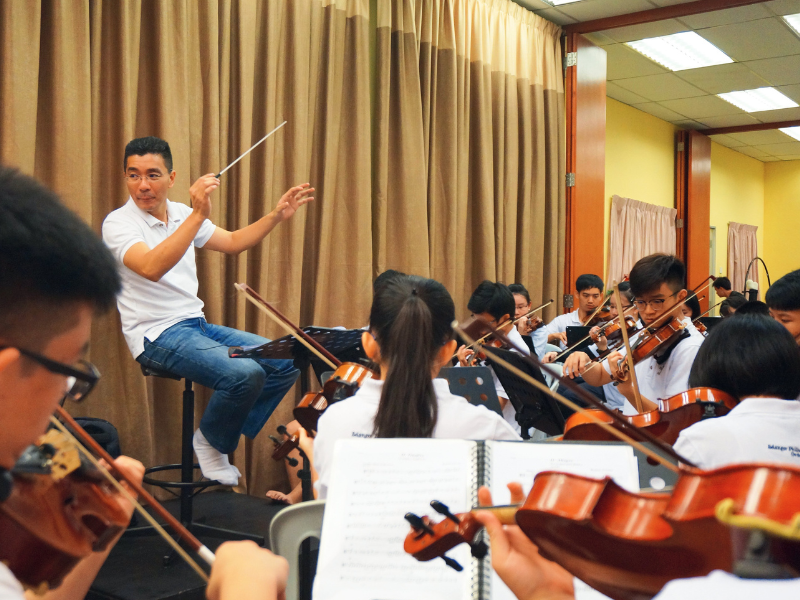
Unlike other professional chamber orchestras, SPO has an open-door policy with no audition process. Instead, the ensemble consists of mostly students or community members ranging in age from 11 to nearly 80.
“We lose, churn and gain roughly about 40% of our orchestra every year.” Tan explains that though this structure is challenging, it is fundamental to how SPO functions. The high turnover rate is mostly due to students graduating and transitioning into the next stage of their lives. However, if they choose to come back to music, the option is always there. “Only in the last 15 years have we started to see the beginnings of that full cycle, whereby a musician who may have been with us in their early teens has gone through different phases and now wants to revisit music again. We always encourage them to never stop playing,” affirms Tan.
The two are proud to admit that they seldom have guest players, except where rare instruments are involved. This constant evolution in SPO’s membership goes a long way in defining another hallmark — its character. While professional chamber orchestras have distinct tones that persist despite changes in instrumentalists and conductors, SPO’s sound transforms with every cycle of musicians, each lasting around three to five years.
These short tenures also create more opportunities for players to be part of a large orchestral ensemble. “As a musician, the chance to play with a backing of a hundred-instrument orchestra is not easy to come by,” Tan conveys. Cultivating this springboard is part of the organisation’s threefold vision.
body_photo_22.png
The next pillar proves that developing its instrumentalists extends beyond music. SPO aims to expose its performers to other responsibilities at an early stage or, in Tan’s words, “what it means to produce something big”. This involves organising logistics, marketing and even ticketing.
Lastly, where talent is nurtured, the same goes for audiences. As all art entities promote their respective forms, SPO aims to raise awareness and appreciation of classical music. For the most part, this means convincing parents that the arts is not an impossible career to pursue and can, in fact, put food on the table. “We are not really trying to change the music scene, but instead alter the culture and mentality surrounding it,” says Chan.
The remaining portion is reserved for attracting the wider public to attend shows, a task that falls to SPO’s unique character. Being community-run amplifies creative freedom, allowing the organisation to experiment with its performances. Tan teases, “The flip side of not having any constraints imposed upon us means that we can actually do some pretty adventurous and — commercially speaking — foolish stuff. So, we can have fun and get away with it.”
Flipping through SPO’s photographic archive reveals musicians donning quirky costumes that comprise goggles and bicycle helmets, for example. Memorable settings have included the ensemble playing in a swimming pool, specifically, Sunway Lagoon’s Surf Beach which, when filled with water, can generate waves of up to 2.4m high.
Whether in a drained-out pool or a freestanding hall, SPO has ventured to various spots which, although enjoyable, also highlights a deeper issue — the struggle of finding the right venue. The formula seems simple: a stage big enough to house a hundred musicians and tiered seating audience views. But locations where these two elements come together are extremely limited in Malaysia. Venue rental is one of the most expensive parts of running a show, often taking up a huge chunk of the budget. As the unit progresses further, so too does the demand for bigger and better spaces.
3.png

State of the art
“In terms of design and hardware, there is no art centre like this in Malaysia at this point in time,” Teoh declares.
Situated in Sunway Square within Sunway City Kuala Lumpur in Subang Jaya, Selangor, JCPAC is nestled among corporate towers, educational institutions and residential areas. The venue boasts a range of utilities that cater for the entire spectrum of performing arts, educational and company functions.
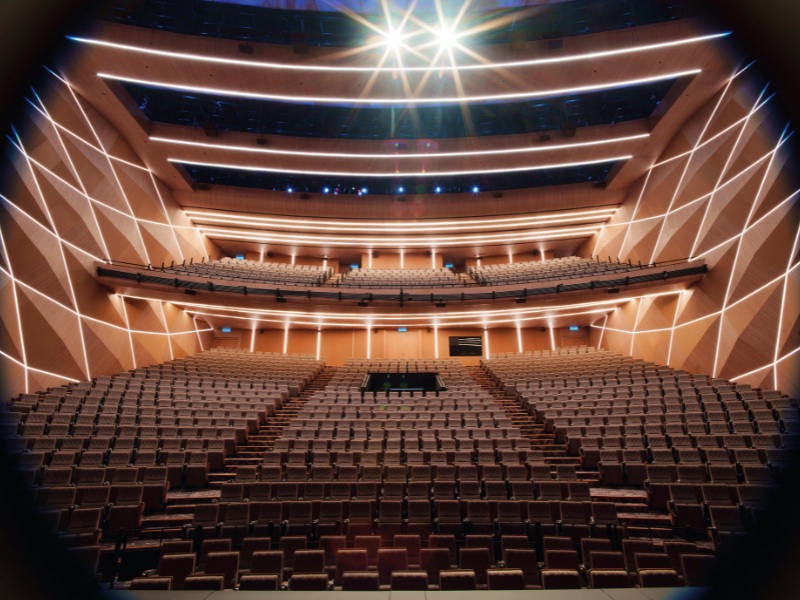
Its main auditorium is the 1,200-seat Proscenium Theatre, which comprises an orchestra pit, flexible LED screens and a full-sized fly tower to support complex scenic changes. Most notably, it also features an Active Acoustic system. The first of its kind in the country, it electronically tunes the hall’s acoustic response depending on the type of show being presented. The system creates an enveloping reverberation that results in a fixed tone transmitted towards each audience member, no matter where they are positioned.
This is also reflected in viewing perception, whereby the theatre’s architecture permits a clear line of sight from each view. The setting is intimate despite its size — conventional venues place a considerable distance of 25m to 30m between the audience and stage, whereas at JCPAC it is only 22m. The centre also offers a smaller black box, the Experimental Theatre, which can host up to 150 people.
To Cho, JCPAC’s speciality lies in its sustainable model and strategic location within a township. “These days, the town square is where everyone meets, no matter what the purpose is. There are shopping malls, hotels, universities, schools and even a hospital.”
Not to mention, Sunway City is home to an estimated population of 200,000 people who live, work or study in the area while attracting up to 42 million visitors annually. Getting to the arts venue itself is straightforward, as it is accessible via the Canopy Walk which is linked to the Bus Rapid Transit (BRT) Sunway Line.
This practicality unlocks a field of potential — rather than making audiences plan an entire evening around a single event, art can become one part of a larger day.
“Everything is interconnected,” Cho explains. This principle extends to consumption habits and behavioural patterns. Art, he argues, does not necessarily have to be consumed in a single sitting. “We think about it and engage with it piecemeal throughout the day, be it philosophy, photographs, videos or music.”
This is particularly relevant in an era when almost any published media can be accessed instantly. “Whether it is Mozart or Mendelssohn, you can hear the same tracks played by the world’s best orchestra while eating breakfast in your pyjamas, just by pressing buttons on your phone,” Tan illustrates.
What the gadgets cannot replicate is presence. Like passing a busker on the street, live performances have a stopping power and inimitable immediacy. “It is a shared moment that you don’t get anywhere else,” Teoh points out. “A lot of things that cannot be verbally articulated can be felt when you experience something together.” It is an increasingly sought-after connection, perhaps due to the lack of it in the age of the fifth estate.
For all its technological prowess, JCPAC is fundamentally framed around something rather human — the sense of gathering.
2.png
Outside the spotlight
This spirit of convergence is also central to what JCPAC aims to become. Teoh clarifies that it is more than just a venue for hire. Beyond the space itself, its long-term goal is to turn into a presenting house that curates, commissions, co-presents and produces work. “What we hope JCPAC will eventually be is an arts institution, though it will take time to grow and develop,” she says.
This process involves year-round collaborations that take place across various aspects, such as partnerships with local and international showrunners and creators. Within the next five months, 27 events have been lined up, including Puan Sri Tiara Jacquelina’s celebrated Puteri Gunung Ledang The Musical and Dama Asia’s Butterfly Lovers The Musical. The inaugural season will also include Kaleidoscope VIII: Infinite Beats, an international drumming festival by Hands Percussion and Kenny Shim’s dance work inspired by the late Yasmin Ahmad’s Sepet. International performances are yet to be announced, though word on the street has it that KL is in for a deliciously sweet treat.
These joint efforts extend to education through Sunway University. Students and emerging practitioners will soon have opportunities to work with professional productions, while future programmes and masterclasses are intended to train those considering careers in the industry. “We need to put aside the idea that a professional artistic career is just about performing, because it isn’t,” Tan declares.
Teoh puts it more plainly. Echoing the words of her former professor, she says, “Theatre is a business.” Passion may be what brings an artist into the industry, but that alone cannot sustain a career.
According to her, many creatives understand their talent, but not how to manage it. More than just facing the crowd, the modern creative economy requires acquainting oneself with the mechanisms behind production, management and marketing, alongside the wider business surrounding the cultural milieu. This way, practitioners will truly know what is needed to sustain their craft.
As the creative landscape rapidly evolves, this knowledge holds even more importance. Santaella calls attention to the rise of accessible production tools and ease with which artists can now create outside traditional institutional structures.
His response is not to resist the change, but to embrace interdisciplinarity. “It is the way forward because no industry is going to survive by itself,” he asserts. Consequently, Sunway University’s programmes have shifted from being performance-focused to incorporating back-end roles, giving students pathways to move across different sides of the house.
Though the approach mirrors the wider direction of SPO, JCPAC and the creative economy as a whole, Tan reinforces that cooperation is still essential to growth. “If we want to stay relevant, we need to bring different elements together.”
1.png
Trial run
Music, Tan says, can no longer be presented as static given the rate and levels of media saturation affecting how concerts are experienced. Typically, staging a showcase begins with the imagery before deciding what audio would augment it. Additionally, these components, although intertwined and of similar significance, tend to be composed or ideated separately.
In the case of SPO’s 30th Chapter, the flow is flipped. The performance will be accompanied by visuals from the students and staff of Sunway University’s digital film production programme, who have been tasked with enhancing the composition and narrative of the symphonic pieces through their artistic interpretations. “The point is to get media producers to think musically and for musicians to compose visually,” explains Santaella.
Under these conditions, Chapter 30: Philharmonic Test Drive — Celebrating A New World is almost like a laboratory for experimenting with what a concert can become.
The idea arose unexpectedly. Unaware of JCPAC’s impending opening, Chan held an internal competition among SPO musicians at the end of 2025, offering the winners a chance to perform a concerto. Three soloists emerged — pianist Jayden Goh, flautist Saufi Abdul Hadi and violinist Dylan Lai.
Gracing the stage will be SPO’s extension groups Selangor Philharmonic Youth Orchestra (SPYO) and Selangor Philharmonic Wind Orchestra (SPWO). The former consists of the ensemble’s junior musicians, while the latter is dedicated to woodwind, brass and percussion.
Chan specially selected the repertoire to honour SPO’s 15th milestone and test the hall’s full range of acoustic sensibilities. “I specifically asked for Samuel Barber’s Adagio for Strings, but Chan said it was too sad for an anniversary performance,” Tan quips.
Instead, the evening will open on a joyful note with Strauss’ Die Fledermaus, Op 362: Overture, which blends dancing tunes with smooth waltzes. Surprisingly, in a series of unintentional events, each soloist will actually be performing the respective composer’s first concertos (for those specific instruments). They are Piano Concerto No 1 in G Minor, Op 25 by Mendelssohn, Flute Concerto No 1 in G Major, K.313 by Mozart and Violin Concerto No 1, Op 26 by Bruch.
An interlude post-intermission will take a turn towards a non-classical repertoire and contemporary sounds. Here, the hall faces one of its more complex challenges. “The real test will occur during the slow movements where the symphony goes quiet. Plus, we’re not sure how the tones will change once the hall becomes occupied with a crowd,” Tan states.
The curation will conclude with Dvořák’s Symphony No 9 “From the New World”, Op 95, a clear reference to the showcase’s name and a fitting metaphor for what lies ahead.
Ultimately, the concert is a test of possibilities. It brings together musicians, visual artists, educators and audiences in a space designed not merely to house performances, but encourage exchange between different forms of creativity. In doing so, it reflects a unified, larger motivation to inject arts, heritage and a sense of humanistic identity into the otherwise bustling township of Sunway.
“What we all eventually do here is part and parcel of making this hub the soul of the city,” Teoh says, explaining that the aspiration indeed extends beyond a single show. It is an ambition backed by a broader investment in cultural preservation, arts education and audience development — one that could breathe new life into Malaysia’s performing arts landscape and classical music scene.
This article first appeared on Aug 24, 2026 in The Edge Malaysia.