
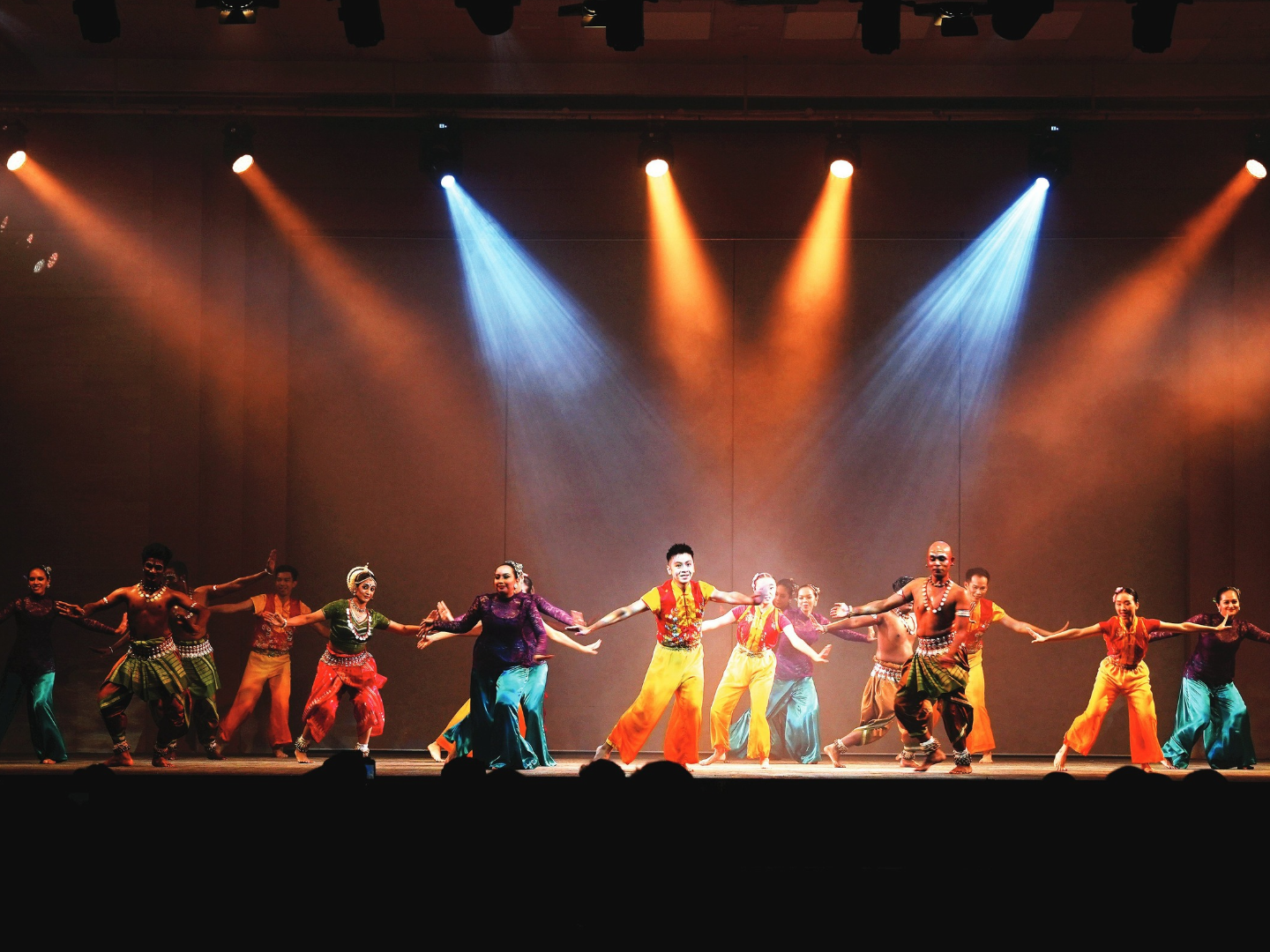
From music to costumes, Genggaman demonstrates how Malaysia’s harmonious diversity is its greatest asset (Photo: Rabby Deyan)
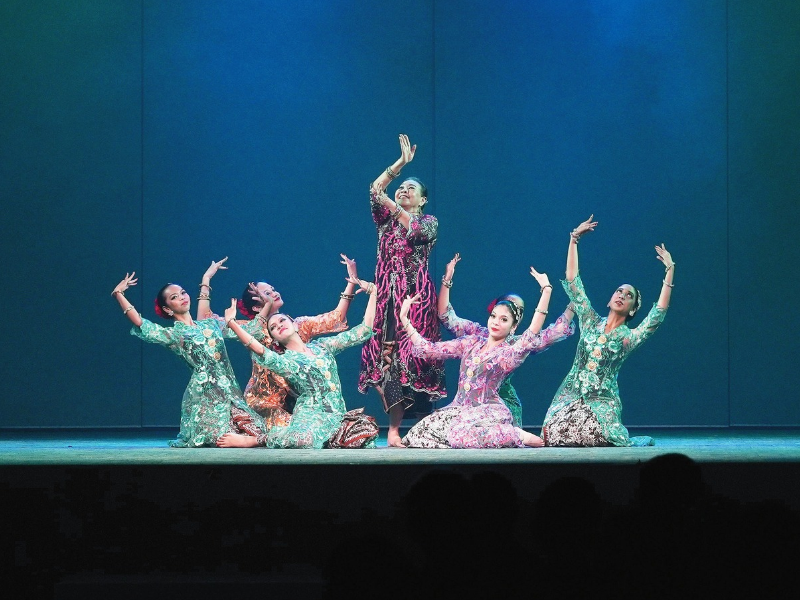
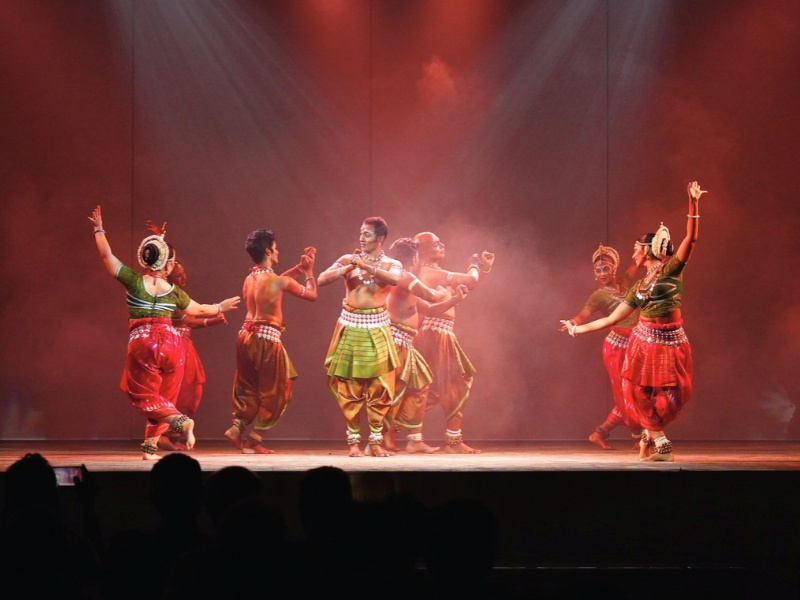
To a blaring soundtrack composed of caklempong, kompang, gendang and other instruments, the 32-person cast of Genggaman filters onto the stage in single file. At the head of the procession are the ladies of DiDance, donning bright kebayas with parasols in hand. Then comes Sutra Foundation’s Bharatanatyam and Odissi troupe, eyes ablaze and every calculated movement conveying a small portion of the bigger story. A sequence of fringed Chinese fans punctuates the entrance of Dua Space Dance Theatre’s dancers, whose deft hands can transform their accessories into gentle fluttering waves or bold streaks of colour carving through the air.
The line weaves in and out of the stage before merging into formation. As the schools blend with one another, each dance style takes a moment to shine solo. Their respective allure is apparent but no particular one outshines the others. What the audience sees is a marriage, a shared desire to work in tandem. Depicting the country’s multicultural makeup, the cast paints a picture of a utopian Malaysia united by rhythm, music and movement.
body_photo_-_2026-10-23t151130.207.png
Joining forces
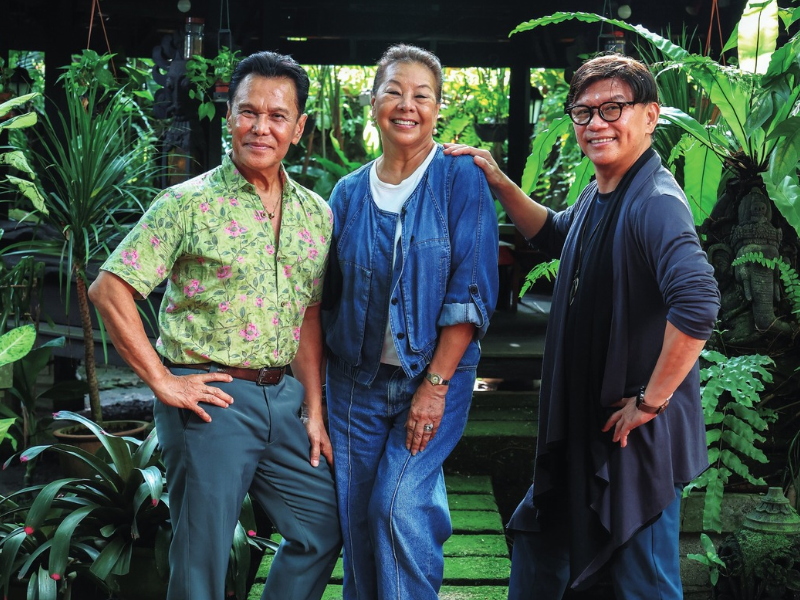
It makes sense that such a production should be the brainchild of three old friends and collaborators — Datuk Ramli Ibrahim (Sutra), Zaridah “Dida” Mallik (DiDance) and Anthony Meh (Dua Space, co-founded with Aman Yap) — each of whom represents one of the country’s core communities.
“Genggaman is very unique as it is ‘One Malaysia’,” says Zaridah. “The three of us have always worked together, and if you look at our dancers, they’re all best friends.” That camaraderie among people who seek kinship and unity regardless of their different backgrounds, cultures and languages makes Malaysian society distinct and is what the production aims to highlight.
The performance brings the dances together not to homogenise them, but to demonstrate how they borrow from one another and the role they play in our diverse cultural landscape. “They all feed into each other and show how we, the people, can blend together. What we’ve put together is very traditional but also modern, so there are many facets as well,” she adds.
Ramli elaborates on their approach. “Dua Space is looking at a Malaysian Chinese contemporary style, whereas DiDance is revisiting older music that is less used these days, exploring a new vocabulary of dance. Sutra is performing both Bharatanatyam and Odissi, and we have all always believed that modernity can exist within tradition.”
body_photo_-_2026-10-23t151108.020.png
A collective product, culture is bound to evolve and merge with time as contrasting communities intermingle. It is almost inevitable that in such situations, clashes would occur. Malaysia is no different, with deep fissures rooted in generations of sociopolitical discourse still felt in the present day. Occurring within as well as between communities, such discord distorts how the arts are practised and transmitted.
Zaridah explains how this phenomenon affects the way traditional Malay dances are perceived and taught. “The Malay people have a lot of seni in them, but we are divided. When you’re busy nitpicking the political and religious aspects — what looks too modern or is not modest enough, don’t practise the arts or do them in a different way — keeping up the standard of the actual dances becomes an afterthought. Fewer Malay parents send their children to dance classes too.”
Meanwhile, Meh is a prime example of how intercultural alliances make for a richer outlook and more productive industry. “When I was younger, I used to come watch Datuk Ramli perform, and he was the person who made it possible for me and my company to travel to India for the first time,” he says. This bond, now decades old and still going strong, sparked the idea to premiere Genggaman in Klang — an area of particular interest to the trio (at the time of writing) as it has yet to establish an official city council-led cultural centre.
“You have to understand that you cannot have a business hub if the community is not also culturally adept. Everything these days is only about business and the current index of success is money. Genggaman represents harmony and what can be achieved when the different groups of our country work together to platform the arts,” says Ramli.
Through the partnership of distinct yet complementary dances, the show hopes to recall that markedly Malaysian sense of unity and fellowship. “When we were in school, we were introduced to all kinds of dances and music,” Zaridah reminisces. “Nowadays, school is so different, and the deficiency of multicultural art in those institutions is one reason problems like bullying are on the rise. There’s a shortage of cultural receptiveness and knowledge in general society today. We as performers have to bring that keenness back — it is why the three of us are still working! Through working together, we want to show the importance of shared purpose and learning from one another.”
body_photo_-_2026-10-23t151117.673.png
Forging the future
As the average way of life becomes more digitised and our connection to the natural world is severed, the primary purpose of art is no longer to deepen understanding of the world and the inner self, but generate profit. And when the reason for producing art morphs, so does its value and prominence — an issue that has long hindered local creatives already boxed in by the lack of government support and funding.
Meh notes how this change has driven countless students to alternative paths that, while not inherently wrong or inferior, are a good example of how the finer arts no longer hold the same cachet they did decades ago. “Students graduate from university majoring in classical dance, but then are discouraged from joining dance companies. If they dance, they do back-up roles which are easier for them to earn money.” Another example of the degradation of arts in the public eye is the new generation of patrons who lack the etiquette and knowledge necessary to demonstrate the appropriate respect at theatres, orchestras and similar spaces, he adds.
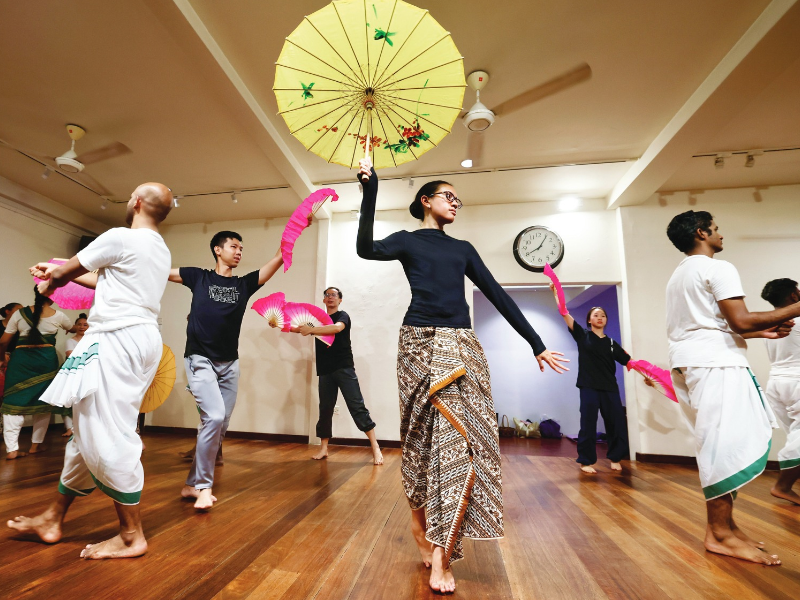
As artistic wardens, Ramli, Zaridah and Meh have taken it upon themselves to ensure their students are exceptionally trained and steeled to shoulder the labours of the creative life. This stewardship manifests among the dancers, particularly in the older ones who have assumed the responsibility of looking out for their younger, less experienced peers. For the gurus, any measure of dedication and passion for the craft is what they are most excited to see in those under their charge. Whether their pupils will go on to become teachers themselves is unknown. For now, their appetite to keep learning and show what is up their sleeves will do — it is the most critical component in an increasingly desperate need to preserve traditional expressions.
This calling is what drives dance schools across the country to collaborate and put on productions year after year, even if it is only for a couple of shows and the expenses are out of their own pockets. The stage is where students test their skills and the best medium for audiences to partake in the arts and learn more about them. Opportunity does not come knocking, so artistes must take matters into their own hands to guarantee these events do not completely fade into obscurity.
“If we were to stand by [and wait for] funding or government aid, we would never be able to produce anything. So, with or without it, we keep doing what we do,” affirms Zaridah.
body_photo_-_2026-10-23t151058.640.png
With just four more shows in Kuala Lumpur and Seremban to go, Genggaman’s reach is still relatively small. Baby steps, however, can have a larger impact down the road. Right now, the primary intention is to get more people to fall in love with what they see and for the theme of togetherness to resonate with them.
Speaking on behalf of the trio, Ramli says: “Audiences will see the dynamism of the three cultures and dance styles — Dua Space’s high-energy manifestation of Chinese dance that transitions into something more lyrical by DiDance, then contrasted again by the lively Indian genres. You’re taken on a lovely journey of beauty, culture, gestures, costumes and music. That’s what we want to open people’s eyes to.”
And with stronger public attention (and a little luck), the dream to expand this vision further across the country may not be so out of reach. “I’m already in conversation with the people at Johor opera house (the Permaisuri Zarith Sofiah Opera House),” Meh beams. “We’ve sent them all the information, so we’ll see how things play out.”
'Genggaman' is showing from Oct 23 to 25 at Sutra House, KL, and on Oct 31 at Auditorium D’Sury, JKKN Seremban. For Sutra shows, contact (019) 333 1092. For the Seremban show, visit cloudjoi.com.
This article first appeared on Oct 19, 2026 in The Edge Malaysia.