
Levy: For me, Final Achievement is Ruin means I stayed true to myself as an artist, and the only logical conclusion is my disintegration. The works speak for me in ways I verbally cannot. (Photo: Hong Cheolki)
Art has, and will always be, a means — a final resort, even — to give form to the feelings and observations that the mind cannot find adequate words for. It communicates the inner worlds and self, and is a reflection of a person’s environment. As much as it is used to convey joy, liberation and love, it also enunciates pain, suffering and tribulation.
A brief glance at American artist and fashion designer Henri Alexander Levy’s background might beget the assumption that he cannot have suffered much. In a world where the affluent bourgeoisie are so often out of touch with the rest of the world, to have such scepticism would be a valid instinct. While privilege cannot be ignored — a liberty that he himself admits afforded him the ability to pursue his career without the need to cater to mass preferences — to say that his life was shooting fish in a barrel is far from true.
Born in 1991 in Atlanta, Georgia, the US, Levy spent much of his adolescence in and out of boarding schools and battling substance addiction. Despite his family’s wealth, the real richness of childhood — physical and emotional proximity to one’s primary caregivers, a warm and stable environment — was something the young boy did not have access to. Though now sober for over half a decade, the artist openly recounts his turbulent past with the same tenderness prescribed for a fresh wound.
Through thick and thin, art was one of few consistent consolations. “I started painting at a very early age,” he says. “I would visit my grandmother who lives in Mexico City, and she would have me join a local painter with whom I would replicate Kandinsky paintings. At that time, I was already interested in and creating assemblage art too. It had a profound effect on me. Painting always came first, though.”
body_photo_52.png
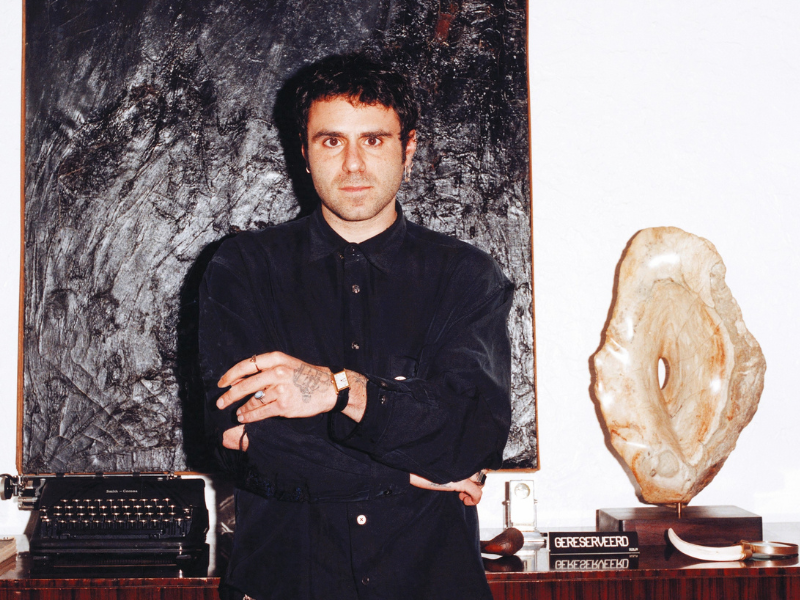
After attending a fine arts programme at the University of California, Los Angeles, where the likes of Andrea Fraser, Barbara Kruger and Rodney McMillian served as mentors, Levy expanded his artistic practice in 2012 to encapsulate the fashion label Enfants Riches Déprimés (ERD). Based in punk aesthetics and established with the intention to subvert and upset, the brand gained a cult following among the rich and famous. Courtney Love, her daughter Frances Bean Cobain, electronic music duo Daft Punk and rapper Future are among those who have collaborated with the designer and shown public support.
ERD became the initial connection point between the artist and South Korea’s leading retail conglomerate Shinsegae, which holds exclusive distribution rights for the brand in the Korean market. In May 2025, the company backed the establishment of the label’s second standalone flagship store (and the first-ever in Asia) near Dosan Park in Seoul, an area that houses other luxe designer brands. More recently, the collaboration has resulted in Levy’s latest solo exhibition Final Achievement is Ruin at Shinsegae Gallery, Seoul.
Basked in a bleached glow, the gallery’s entry corridor opens up into the first room, where a range of Levy’s most recent assemblage creations is the primary focus. It is in this introductory space that the concept of childhood and juvenescence emerges, their innocence and hopefulness clouded over by something dark and imminent. Ballet slippers hang in a wooden box, smudged and forgotten. Photographs applied to black canvas and panels of reclaimed wood — a young girl, face buried in a handkerchief; a grinning boy; a collage of tiny yearbook photos confined behind a grille; and a blonde, unsmiling child in a white frilled shirt — allude to carefreeness lost, playfulness observed in hindsight. In the middle of the floor stand seven cages or kennels, their height and width too exact for detaining human disobedience.
body_photo_51.png
Domineering paintings occupy the second room.
“I think in this space, regarding the large black-and-brown paintings and the bronze accents, the atmosphere opens up and becomes more spiritual and romantic,” he remarks.
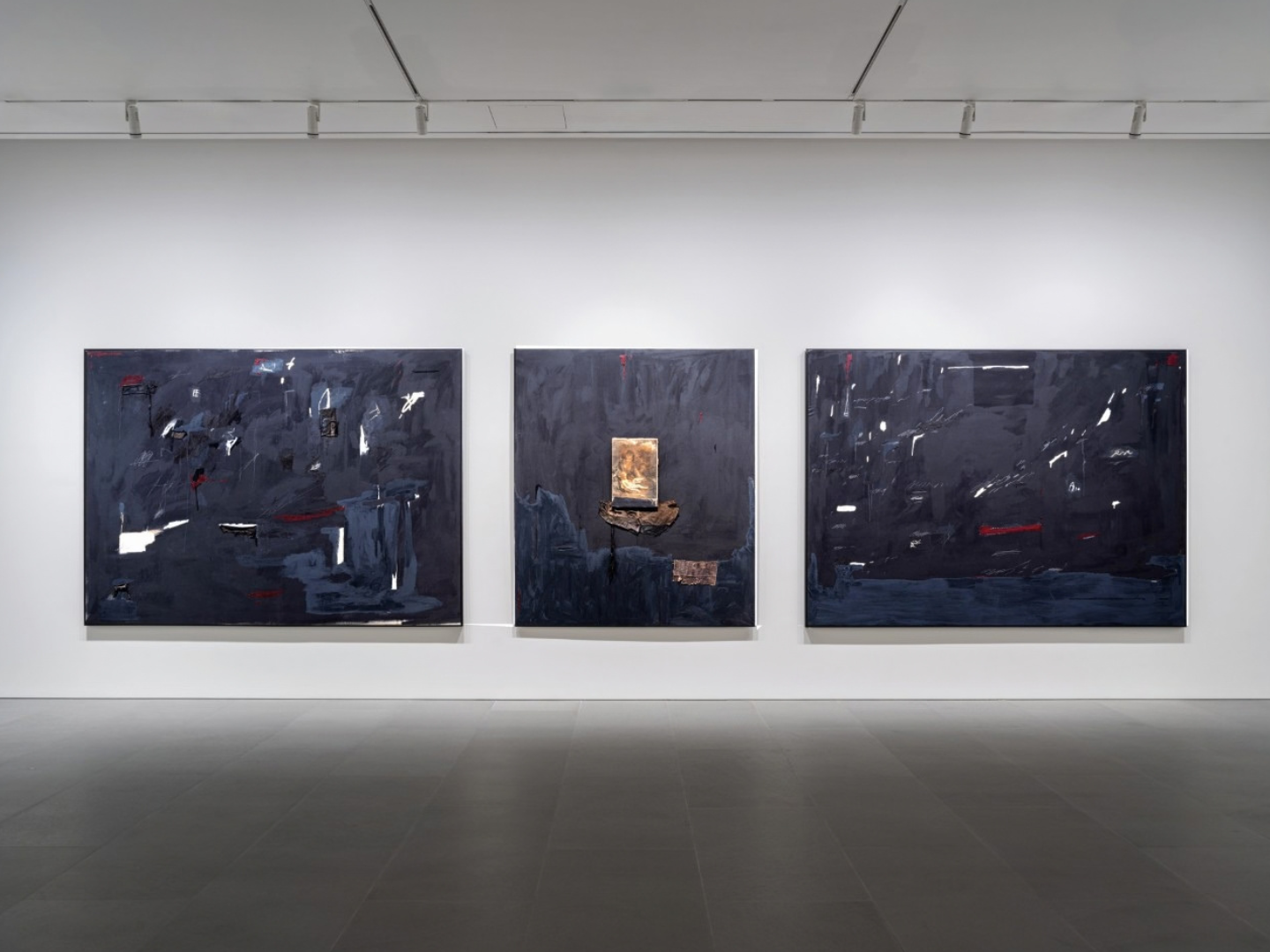
Standing before a trio of paintings, the middle comprising a small replica of Adriaen van der Werff’s The Rest on the Flight into Egypt, wherein the Virgin Mary lays her son down on a cloak, there is something extramundane to be experienced. The closer and longer you hold your gaze, the more striking the drips of bordeaux and swatches of cream become, before the textured layers of black, grey and brown underneath leap out at you. Rather than frank imagery, the artist’s limited palette is his dialogue in this second act. “I’ve been making black paintings for about three years. I feel that at this scale, they become very emotional works. There are actually many colours within the black.”
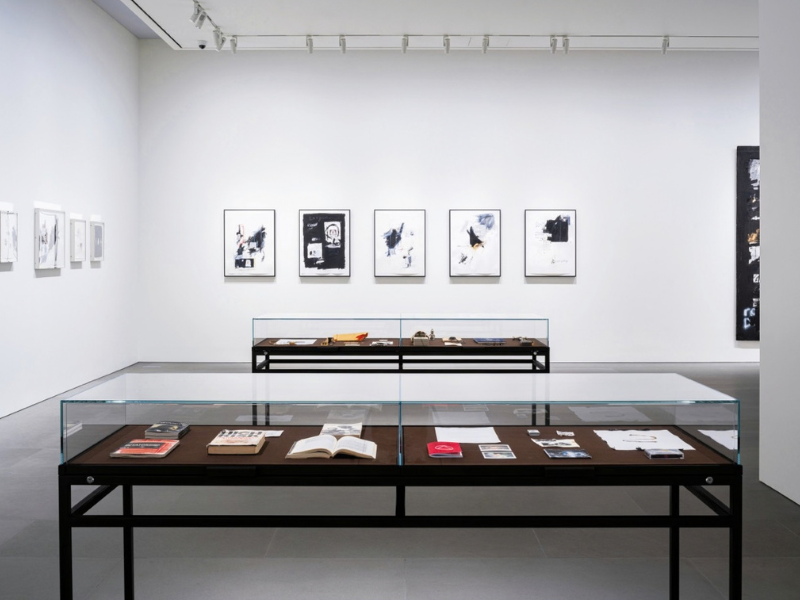
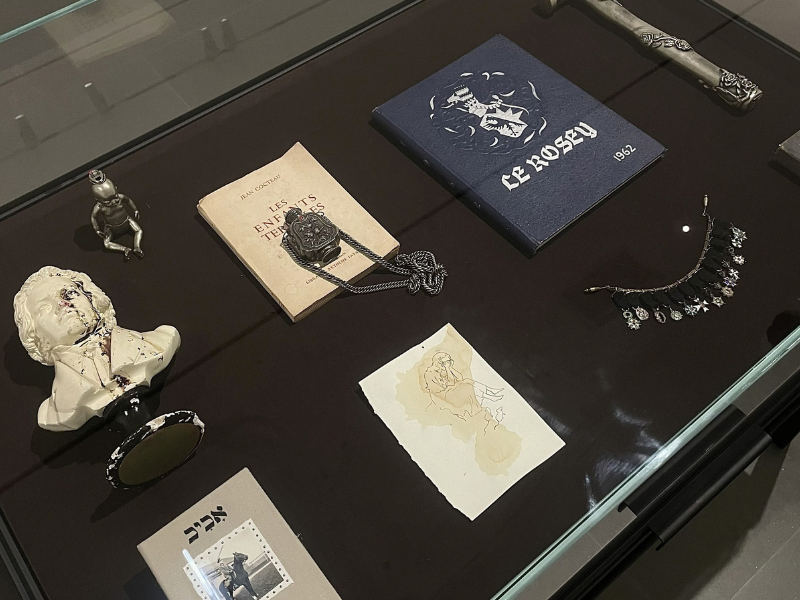
The third and final enclosure brings viewers back to the childhood self, specifically Levy himself this time. Here is where the psychology of the unresponsive infant unravels, a symptom of the endless cycle of disaffection, anxiety and withdrawnness that flows from parent to child and back again. Most of the pieces were either created while Levy was still dealing with addiction or while in and out of rehab. The darkness shows in his mediums — ink, tobacco, coffee- and tea-stained paper, haphazard smears of his own blood. Sketches and scribbles are erratic, while graphic prints stir up sensations of unease, shame, even disgust. Glass cases display Alcoholics Anonymous booklets, cassette tapes, a yellowed copy of Les Enfants Terribles by Jean Cocteau, military medals on a chain.
“War is a recurring theme in my work,” Levy says. “As an artist, I often find myself fighting my own internal conflicts. I relate to those battles and want to recontextualise them in that light.”
body_photo_53.png
From past to present, the artist’s sentiments and undying romance with art pervade. The showcase is a personal truth that, before making sense to the audience, must satisfy its maker’s inner mechanics. It is why Levy does not mind if audiences dislike or are perplexed by the intent and content behind his work, or if their understanding of it is delayed.
“The type of art and ideals that are commonly promoted have made it so that a lot of honest creativity can rarely thrive. For me, Final Achievement is Ruin means I stayed true to myself as an artist, and the only logical conclusion is my disintegration. The works speak for me in ways I verbally cannot. In regard to people coming to see the works, I hope to push their minds past what’s readily available.”
'Final Achievement is Ruin' is ongoing until Oct 17. Shinsegae Gallery, Gangnam-gu, Seoul. (shinsegae.com)
This article first appeared on Sept 14, 2025 in The Edge Malaysia.