
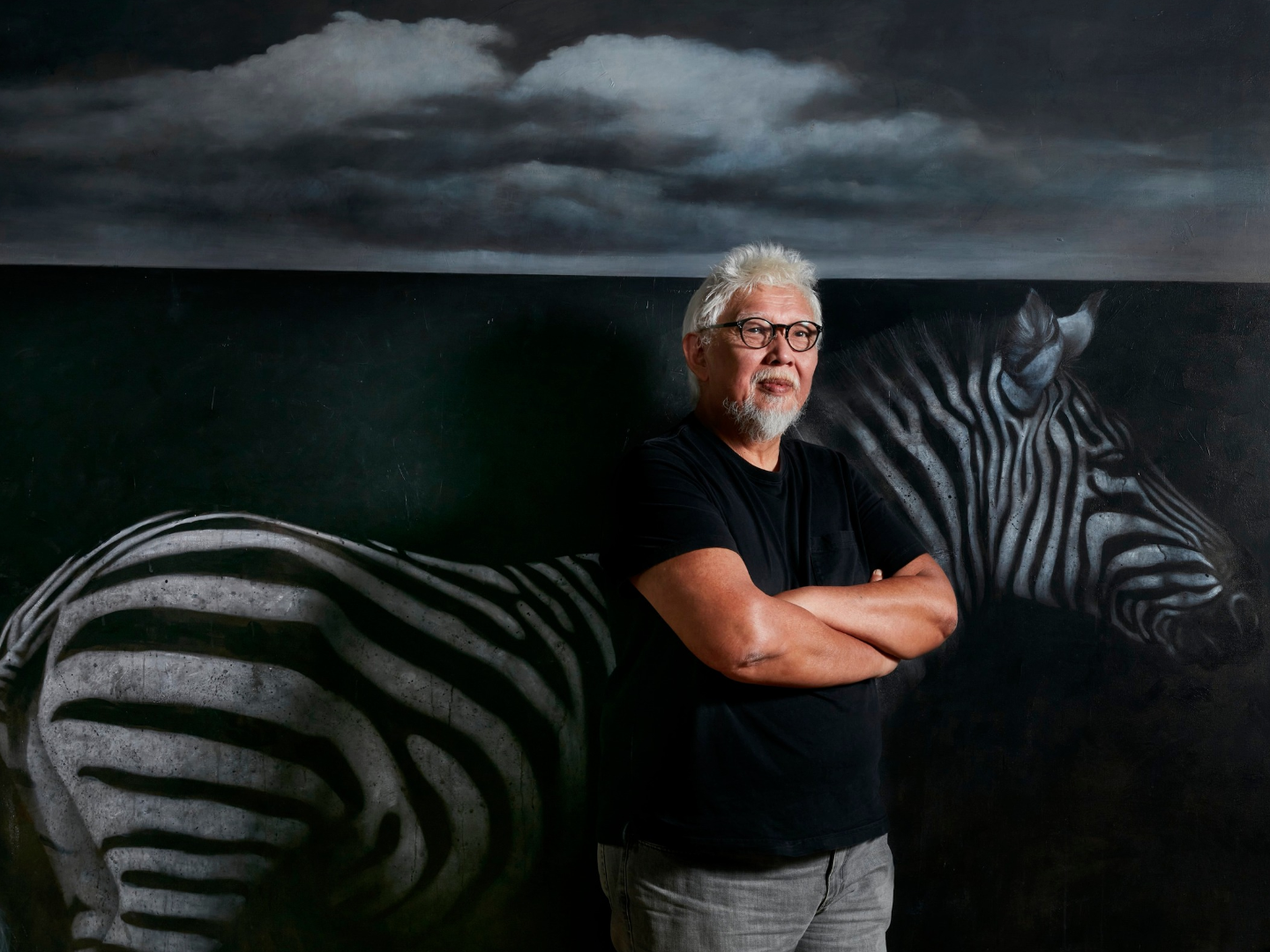
Ahmad Zakii Anwar poses next to his painting Tales From The Primordial Garden 18 (All photos: SooPhye)
Just when, riding confidently into the 1990s, Malaysian art needed another narrative, Ahmad Zakii Anwar emerged, dragging the human figure to the centre, reviving the art of nuance and shadow, establishing a thematic artistic ripple that continues to this day.
His was a practice filled with tension and an inner suggestiveness — set apart from the heavy social, religious and symbolic preoccupations that had defined the “tradition” that came before.
Tension was everywhere in Zakii — between intense intimacy and a nimble, almost audacious playfulness, as well as the tension induced by a thematic departure from “tradition”.
“I paint what I like” was the suggestion in the paintings, and the impression upon first encounter — smokers, sofas, portraits — was a respite, even a needed drag of fresh breath, from the brooding and sometimes overcrowded (if still very integral) art of the socially conscious, or of abstract theology, that served as antecedent.
It is always a good leap of faith to be taken by an artist who confesses “art consumes me”. It is a sensibility to be trusted, rooted in an artistic restlessness that almost always assures that even in a seeming sameness, there is variation and contrast, however allusive.
Here is an artist who has mastered medium — of black and white, of shadow and light, chiaroscuro, charcoal — with deft versatility; the application of charcoal with fingers lending a special sheen and texture to a drawing. “Keep the image simple for direct emotional impact,” he says.
The Johor Bahru native, who confesses that “JB had very little culture”, was trained as a graphic artist. Overcoming that “little culture” meant falling into a movie addiction, especially film noir, whose influence can be observed throughout his drawings and paintings.
This enigma of drama and mood is perhaps the most striking sensation that can be drawn from an Ahmad Zakii Anwar painting or drawing.
Popular art — comics and cartoons; photographs from Life magazine, popular and rock music — formed the foundation for his later figuration and temperament. Transmission would take place: the medium of the West transplanted into the local settings of culture, ritual and “our” faces.
6.png
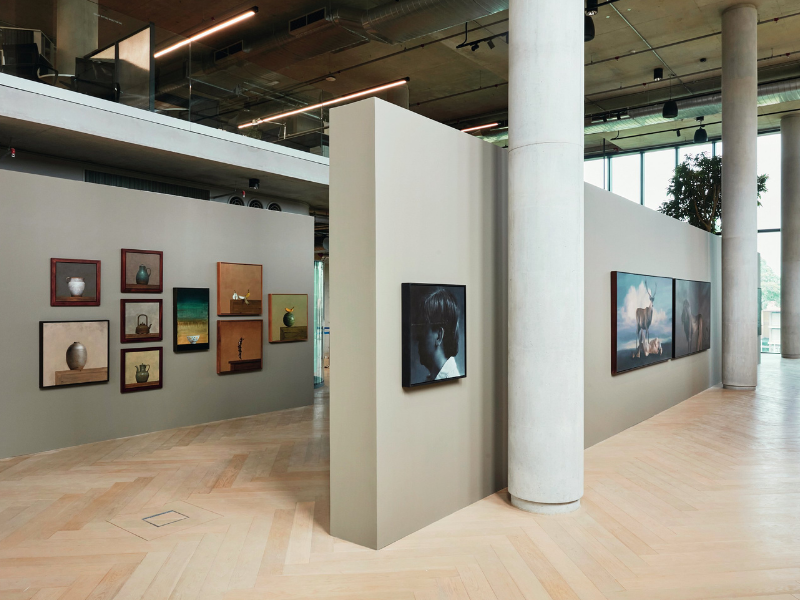
Presented by GDP and R+, Sementara takes its cue from its mellifluous Malay-word title, replete with open-ended allusions: sementara — “temporary”, “temporal”, “transient”, but also “while”, “meanwhile”. The sensation is always one of suspension, elevation and mystery.
The retrospective is a sprawling collection of 75 paintings and drawings that traverse an abundant artistic landscape. The exhibition is divided according to themes that have preoccupied the artist over decades.
At the centre is mostly the human figure, followed by still-life; dance, or rather, culture, movement, ritual; portraiture; the Smokers and Sofa series of the late 1990s; figures of faith; and the majestic animals in dark, shadowy shades, at times in full colour — beasts and sometimes mythical man-beasts.
Artists are often resistant to planting historical markers upon themselves. “It’s just a review of an artist’s life work,” says Zakii, but in taking in Sementara, the hints at history are everywhere.
Ahmad Zakii Anwar’s art was not a conscious move away from abstraction; he was simply a painter painting. Yet, the individuality of the Smokers and Sofa series heralded an artist who, simply by doing, had set himself apart.
Deliberate or not, it was also a departure from the art of lambang (symbolism), bound with all the complexities of expressing nationhood and identity. It allowed Zakii a certain liberty from historical placement; it also created quite some intellectual consternation as to where to place him.
4.png
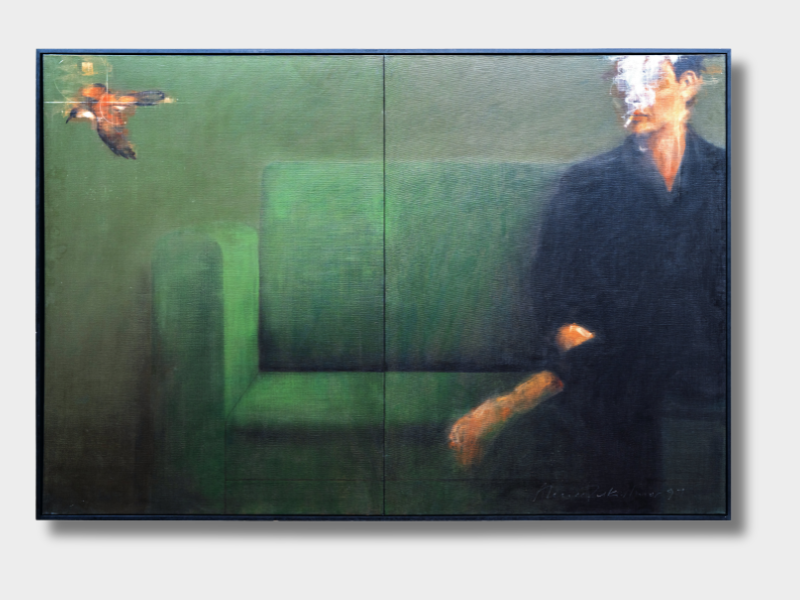
It was the Smokers series, shown at Valentine Willie Fine Art, that “launched” Ahmad Zakii Anwar. These were figures, mostly with a wisp of smoke shrouding their faces, framed in soft colour, combining witticism and existential ennui.
“My first solo was the Smokers series. I can’t say what it was that drew people to it; I think it was something of a surprise, a series of paintings about smokers. It put me on the map,” Zakii recalls.
Much more than a “series of paintings about smokers”, the series’ allure rested in its appeal to solitude, solitariness and even sadness. The series also forged an interesting collective of personages as subjects — friends, subjects off the streets, almost always male — the art-poetry of ordinary people.
“I hadn’t meant to buy a Zakii Smokers,” Steve Wong, among the earliest and most prolific Ahmad Zakii Anwar collectors, recalls. “I wanted a red sofa but it had been taken. Only the blue was available. Then I came across the painting Other Technical Aspects. It had a smoker, a sofa and a bird, and I got greedy!
“But Zakii has become one of our most important painters, and he is a good friend.”
The path towards becoming “one of our most important painters” appears, on the surface, fluid. The still lifes and many nudes that followed were attempts to test the boundaries of “stillness” itself: the still lifes invested with an arcane naughtiness and humour; the nudes with an austerity verging on the fine-pointedness of anatomical drawing.
The counterpoint was a foray into dance and movement, notably the ecstasies of Bali, depicted in such a compression of colour that they seem to replicate the density of the tropical evening light itself. The road to Kelantan and its ritual traditions, Mak Yong, in particular, led to portraiture, in which the elegiac resonance of a culture forced to vanish is concentrated in the profiles of a people of lineage putting up a last, valiant fight.
5.png
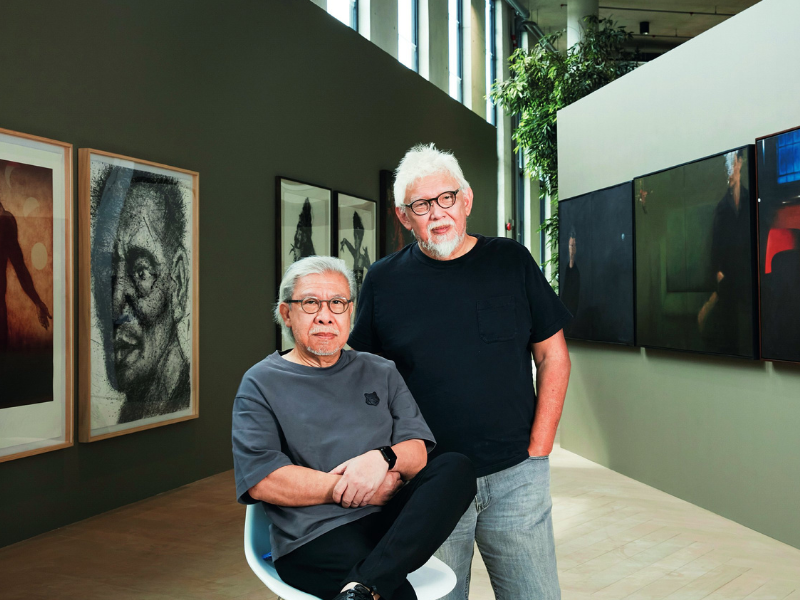
The seeming fluidity — in transition and application — belies the subtler eruptions of form that underlie so much of Zakii’s work. The figurative — initially soft, almost fleeting — in the Smokers series gains greater mass; increasingly sinewy lines and compressed, weighty curvature give rise to an impression of light that either emanates from the subject or falls upon it — the viewer struggles to tell.
The human body, for all his other ventures, has remained Zakii’s principal focus. “There’s nothing more interesting than the human figure,” he stresses. “It’s the main focus of existence.”
The near-forensic deliberation of the human body brings with it an intense existential focus. A progression can be gleaned in the paintings that evolve from the earliest expressions of human form — fully dressed in the Smokers series and early portraits — to the later, stark, bared forms in a state of undress.
Obvious and outstanding is the sense of solitariness replicated in these paintings, reflective of the manner in which they are produced — figures photographed, then replicated.
“I use photography as a reference, as I hate painting a person live,” Zakii explains. “The presence of another person when I’m painting is like an intrusion. I photograph all my models, work on them on the computer and, once the image is right, I approach the canvas.”
It is not possible to contemplate the human figure in Zakii’s work without exploring his pull towards the spiritual and its correspondence with the human body. Especially apparent in this exhibition are drawings of Hindu devotees — their rites and acts of sacrifice — depicted through the notion of the body as a temple.
The artistic lineage of figure drawing is ever present. In the treatment of the figure is deference, but also innovation. The weight of the Great Masters and later Masters is omnipresent; so are the philosophical preoccupations that settle on the eternal questions such painting brings — “What is man”, “What is nature”, “What is this body”, “What lasts, what does not”…
2.png
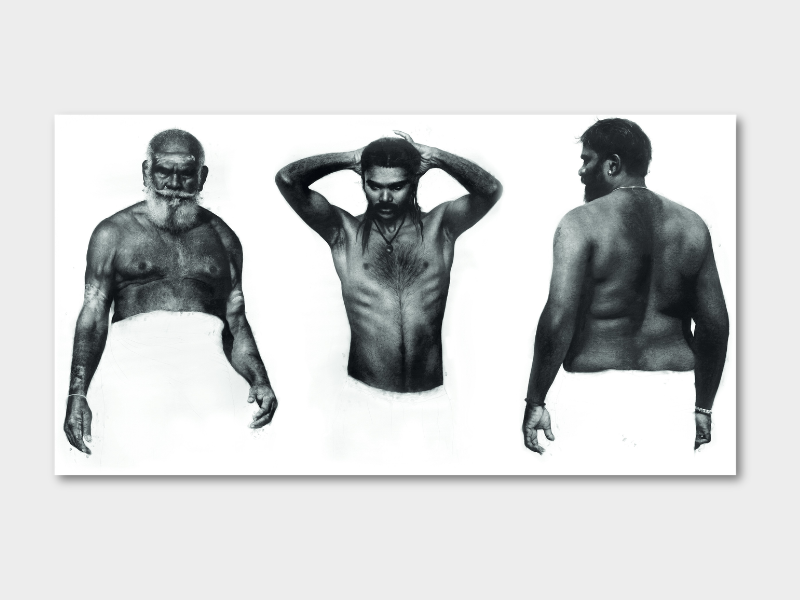
The paradox of Ahmad Zakii Anwar is that he is a painter of elevated mood and embellishment. A crude appraisal is that he is always “pleasant to the eye”. He is a painter who has commanded an ardent following, of patrons who cannot actually tell you why. This is not a criticism or a put-down, just an affirmation of this painter’s great ability to simply beguile.
The works can be stark, dark, even grim, in many instances obviously autobiographical — self-projections of the artist’s own longings. There is even an element of voyeurism. Yet, this is often uplifted by an overwhelming calm and tranquillity approaching a painting, however pained or contorted the figure may be. Or, in the words of the intense British poet Geoffrey Hill, Zakii possesses the ability to bring the viewer to a “stunned repose”.
It is where this “difficult” painter casts his perfect spell.
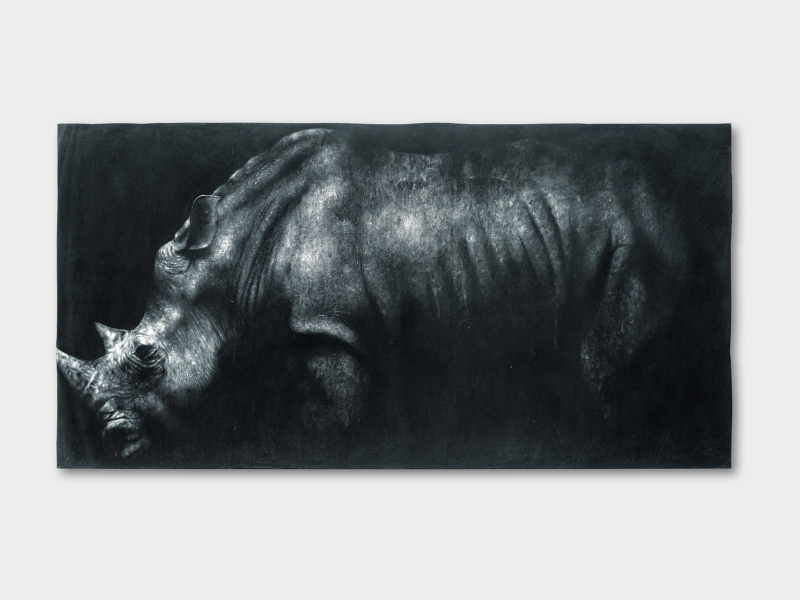
Everyone has a favourite Ahmad Zakii Anwar “category”. I have always fallen for the animals or, as I have previously described them, the “beasts”. Within the beasts, laid out in all their primordiality, is perhaps Zakii at his energetic best.
“They are projections of the animal in me,” he has said. And in their profiles, especially in Badak, featured in Sementara, there is a rawness, often eclipsed by Zakii’s sheer artistic skill but which, here, cannot remain concealed. It is where the painter’s rush — so focused in other paintings that it is possible to miss, ignore or not actually know what it is — is allowed full force. And it is captured most powerfully in the fixed gaze of the beast.
In Tales From The Primordial Garden 1, a horned bull lies at rest beside a naked figure lying prone: This is fateful surrender.
3.png
Retrospectives, when artists are accorded them, may be a scourge to the artists themselves, but they perform a crucial role in the need for re-evaluation. They also serve a historical purpose — perhaps of little consequence to the individual artist, but crucial to collective artistic memory. The act of viewing is important, too, for collectors: it offers a measure of evolving artistic sensibilities.
A previous Ahmad Zakii Anwar “survey”, at Galeri Petronas in 2008 — also featuring a substantial gathering from the Steve Wong collection — offered a broad sweep of an artist still in motion. Sementara, a far more intimate “retrospective”, instead presents an artist in some repose.
In a sense, a retrospective also brings a certain closure and induces a sense of reflection. It is typical for Zakii to say, “I don’t intellectualise much when working; so, the evolution has been a natural progression, sometimes haphazard, with forays into photography, prints, portraiture, anything that strikes my fancy.”
It is a remark of some insouciance to fall back on the technical. Yet, unlike many retrospectives, Sementara, in its presentation of Zakii’s work, does not signal the end of an ambivalence so much as inspire a new gaze: a sense of being less beguiled, of entering the world of a painter in all his seriousness and — as the title of one of his remarkable series displayed in Sementara suggests — simply “yield”.
'Sementara' will be on view at GDP Campus in Bukit Damansara, Kuala Lumpur, from Oct 11 to Jan 10, 2027. For more information, visit gdparchitects.com.
This article first appeared on Oct 5, 2026 in The Edge Malaysia.