
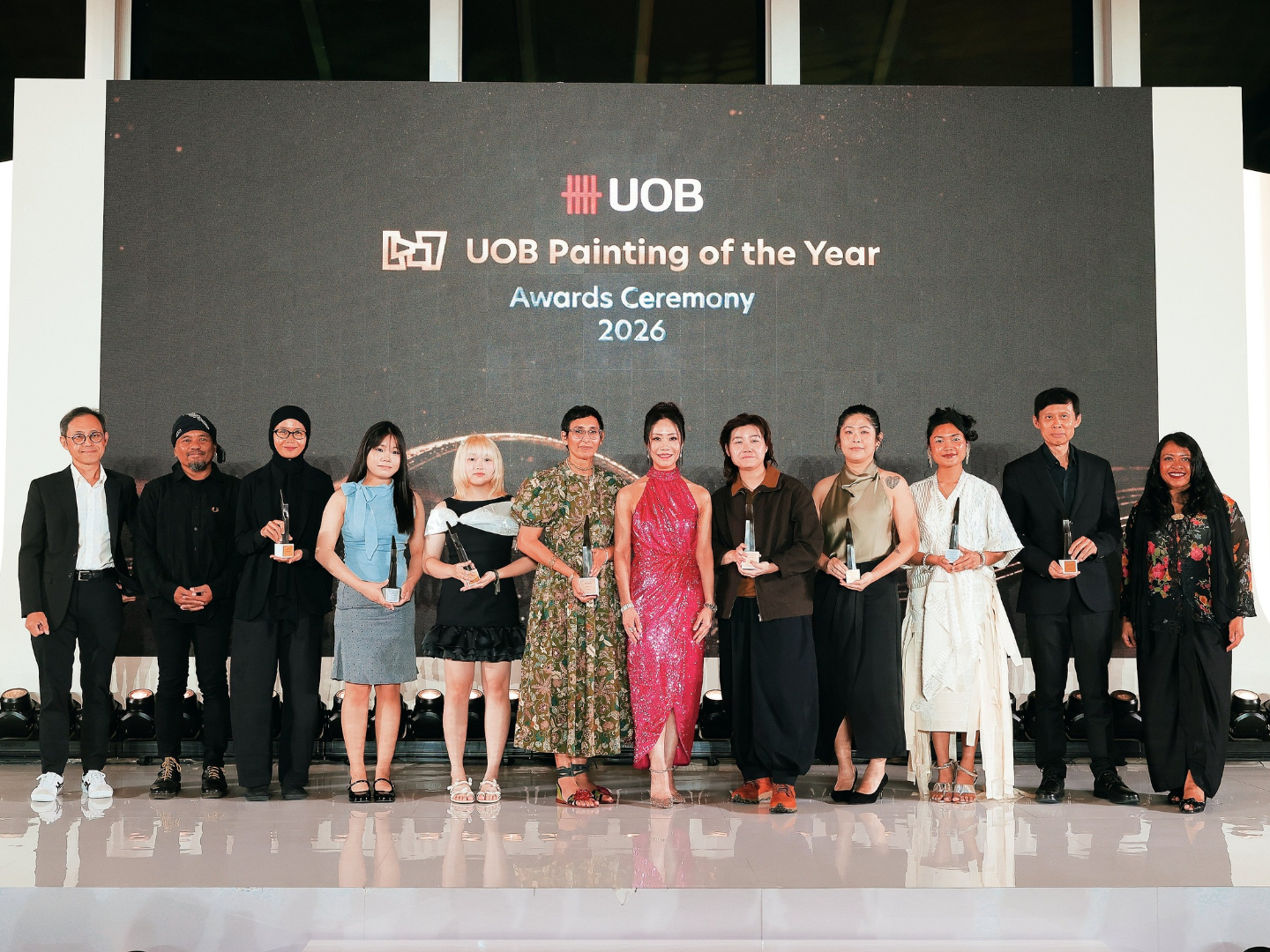
Datuk Ng Wei Wei (in pink), flanked by Harpreet Kaur (left) and Lim Tong Xin (right); Kow Leong Kiang and Heru Hikayat (far left); Intan Rafiza (far right); with the winners of the Established and Emerging Artist categories (Photo: Zahid Izzani/The Edge)
In the Romantic era of the 1840s, French novelist Henri Murger produced a series of semi-autobiographical stories depicting the alluring yet tragic nature of the bohemian lifestyle in Paris’ Latin Quarter. Titled Scènes de la vie de bohème, the collection revealed a startling contrast between artists’ aspirations and their impoverished realities, in part birthing the “struggling artist” archetype who are willing to sacrifice material comforts in order to pour themselves into their pursuits, even at the expense of financial stability.
Luckily, while the term still holds true today, there are now plenty of organisations and initiatives to support creatives by offering them a platform and, often, financial aid too. In Southeast Asia, one of the most coveted programmes is UOB’s Painting of the Year (POY) competition. Now more than 40 years old, the programme is currently held in Malaysia, Singapore, Thailand and Vietnam, aimed at cultivating the next generation of artists and aficionados in the region.
Emerging and Established Artists are scored for two accolades: Most Promising Artist of the Year, bringing attention to those seeking to further establish themselves in the industry; and Painting of the Year, which recognises professionals with a track record in the wider competition and exhibition scene. Those who receive the latter title in each participating country are automatically considered for the grand Southeast Asia Painting of the Year prize.
body_photo_-_2026-10-28t190619.180.png
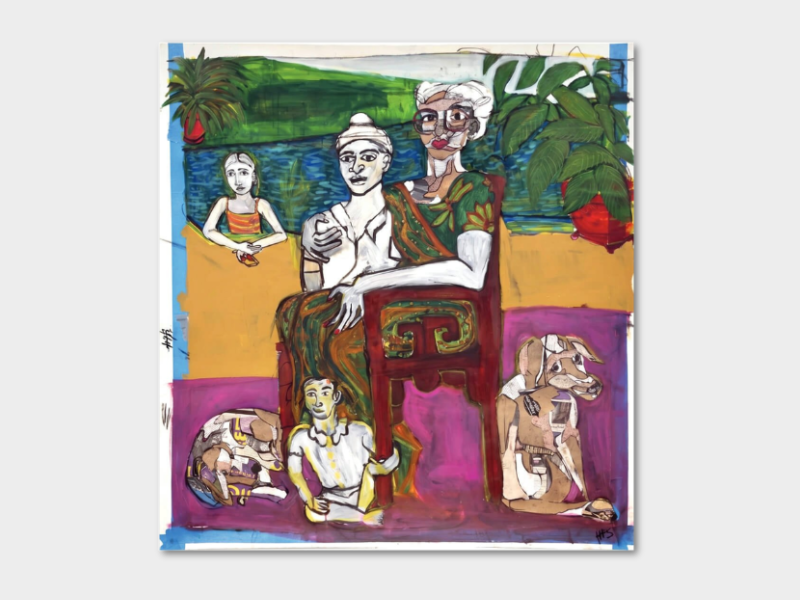
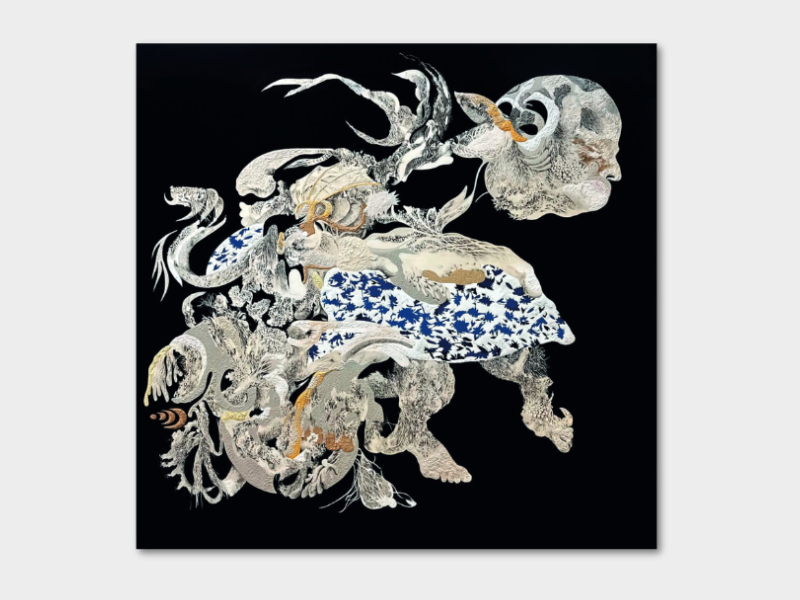
This year’s Malaysian leg culminated in the awards ceremony on Sept 25 at Sentul Pavilion, Kuala Lumpur. The 2026 judging panel included performance artist and head judge Intan Rafiza, portraitist Kow Leong Kiang and Bandung-based curator Heru Hikayat. All eight artists from both categories received trophies modelled after Anna Chiara Spellini’s Vitalità sculpture, commissioned by UOB and located in Singapore’s Boat Quay. The evening reached a crescendo with the announcement of Harpreet Kaur as Most Promising Artist of the Year for her mixed-media work, Matriarch, while Lim Tong Xin took home the Painting of the Year title with She Waited.
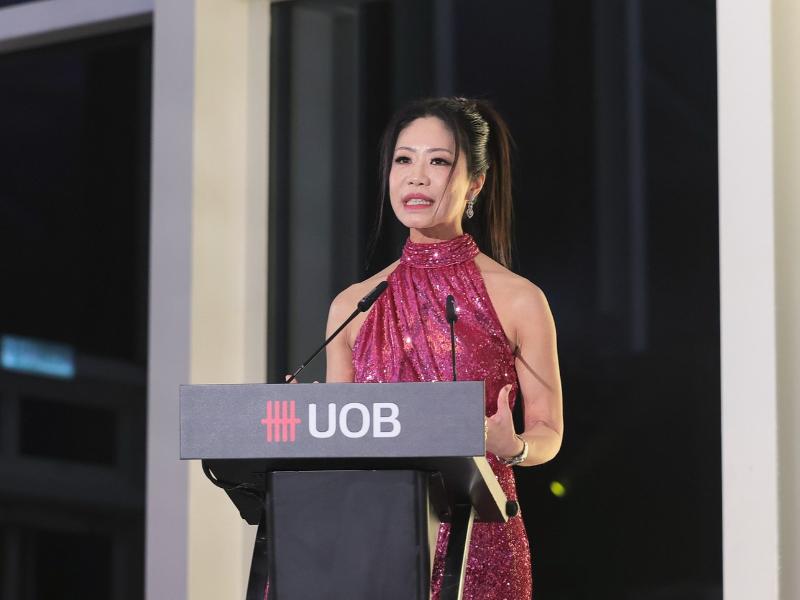
“Through UOB POY, we are proud to provide a platform for local artists to share their stories and demonstrate how art can foster understanding, spark meaningful conversations and bring communities closer together,” says UOB Malaysia CEO Datuk Ng Wei Wei.
Post-awards ceremony, the winners open up to Options about their reflections, insights, as well as what they look forward to achieving and pursuing next.
“It was quite unexpected because this was my first time submitting to UOB’s Established artist category,” states Lim. She notes that while some of her previous entries in other competitions had been met with success, as a relatively new presence in the scene, POY marked her first foray into a competition of this calibre.
Meanwhile, Harpreet’s experience until this point had largely reflected the circumstances illustrated by Murger. “I’ve never won anything in my life before, except maybe a yoga lottery. I’ve had a lot of rejections in prior competitions; so, I’m still trying to wrap my head around the win,” she says.
body_photo_-_2026-10-28t190613.472.png
Both paintings focus on familial memories, with women as core subjects. At first glance, Lim’s highlights a chimerical mass, with animal-like components woven into the assemblage — a webbed wing here, a serpent’s sinuous form there. As the eye lingers, a profile gradually emerges, along with legs and a delicately hunched silhouette. The textures melt together to evoke the artist’s grandmother in her final year of life, her frail body slowly entering an otherworldly plane. Perched on the toilet as she waits for Lim’s mother to help her bathe, she appears to metamorphose into part bodhisattva, part monstrous growth — a transformation that captures not only the tangible and emotional agony of this concluding chapter, but also the almost-divine tranquillity of moving on and letting go.
“At the time, I was thinking about my grandmother, her emotions, how she felt. There was nothing I could do except try to understand her in those very hard moments, to feel that quiet suffering. On the surface of her skin, I could see many tumours and the roughness of age. I used textures and a lot of details to represent that,” Lim explains.
Meanwhile, Harpreet’s oil painting and collage of a woman seated on a Baba Nyonya chair, surrounded by children and pet dogs with a swimming pool in the background, touches on the complex experience of growing up in a diasporic community. “A lot of these people in post-colonial nations, whether it’s Africa or Malaysia, go through a type of segregation or expulsion,” she says. Informed by her Malaysian upbringing and years living in the US, she incorporated the pool as a reference to “the civil rights movement, the ability to access joy and the right to fight for it”.
body_photo_-_2026-10-28t190625.142.png
The two artists are no strangers to stumbling blocks, with restricted access to information and a lack of funding and resources among the most serious impediments they face. Awards such as UOB’s allow artists to put down career roots while bringing their work to a wider audience.
“POY is one of the best platforms in Southeast Asia that introduce artists to a much broader audience. It’s a bridge for Malaysians to showcase their artwork on a regional and international stage,” says Lim.
Harpreet agrees. “POY is an established competition. It’s been here since 1982! It means eyes on your work, credibility. It started with real passion, and the world of finance recognising that it can support the arts and help artists achieve their dreams.” She hopes the Most Promising Artist of the Year title will open more doors, allowing her to memorialise her family’s heritage through her work. “My dad was in the army, my mum was born in British Malaya. My grandfather spoke Japanese because of the education he received during the occupation. These types of normal stories — the labourers, rubber tappers and more — should not be forgotten because they built our country and deserve to be highlighted.”
As for Lim, whose piece will be submitted for the regional final in Singapore later this month, the competition offers the chance to make meaningful connections with others in the wider Southeast Asian art scene. “I’m excited to gather with artists from other countries and share ideas. I think that will be fantastic. I’m confident in my painting but, whatever the results are, I’m happy to let things happen as they are meant to,” she smiles.
At the end of the day, what matters most is that more artwork is seen and more talent recognised. It is a reminder to creatives — regardless of age, experience or previous accomplishments — that success is perhaps closer than it seems. And the most important step towards it is the one thing both Lim and Harpreet urge all artists to remember: Keep doing the work.
This article first appeared on Oct 12, 2026 in The Edge Malaysia.