

Ramli: There is an enlightenment happening, and we cannot wait (Photo: Low Yen Yeing/The Edge)
Across cultures, languages and beliefs, the most profound tales are often those of love — evocative epics that echo the synergy between two souls, the magnetism of which compels not only the flesh but even the divine. In Hindu mythology, few sagas are as influential or inspirational as the grand romance between the gopi (milkmaid) Radha and her beloved Krishna, an avatar of Vishnu.
Within these myriad constellations of the myth’s retellings, Malaysian dance legend Datuk Ramli Ibrahim and his internationally esteemed Sutra Foundation now ignite their own glimmering spot with their latest production titled Radhe! Radhe! The Sweet Surrender. The two-act classical Indian dance performance will convey the lovers’ sweeping story, navigating their journey of longing, jealousy, tribulations and eventual joining, forming a fable many regard as the highest form of religious devotion through love.
“We have created a medieval mystico-erotic work where the god Krishna is the supreme lover and his devotee Radha becomes herself the goddess as a personification of his joy and happiness,” expresses Sutra’s artistic director. Radhe! Radhe! is the troupe’s fourth great Odissi work, following Ganjam, Amorous Delight and Jaya Ram.

While previous showcases incorporated folk performing arts, this grand staging is unique for its bold confluence of multiple indigenous arts from the culture-rich Ganjam district of Odisha in eastern India.
“My guru Debaprasad Das and the late Dr Dinanath Pathy told me to look towards Ganjam to produce classical works,” explains Ramli, who began research for Radhe! Radhe! two years ago. It was through his exploration of the region’s folk forms that he discovered a small group there which specialises in the Radha Prema Leela, a native dance-theatre tradition depicting the divine love play of Radha.
“[Debaprasad and Dinanath] believed in the concept of Tridhara (three leaves), that the classical has to reflect the folk and tribal. You’ll find Radhe! Radhe! has got that element of indigenous earthiness about it,” he says.
In line with Sutra’s Odissi portfolio, Ramli introduces a curated contemporary dimension to the classical dance while preserving the rawness of the form and tale.
“We are not trying to replicate the Radha Prema Leela, rather we are inspired by it,” divulges the dance doyen. “There are many areas, such as the bols (spoken rhythmic syllables), that have been worked into our show. The Radha Prema Leela has to be viewed in that particular village. It cannot be faithfully emulated here. But the storyline, bols, rhythmic patterns are being used in Radhe! Radhe!”
ramli_text.jpg

In using space, for example, Ramli defies the tradition of centralised positioning and situates Chandravali, the rival gopi to Radha, in a corner to draw attention away from her. On the other hand, some customs persist — the final celebratory Ras dance must always be circular, a symbol of unity and adoration.
At the core of the performance’s allure is not only the exemplification of bhakti, the concept of devotion found in Indian faiths, but specifically sringara, the feeling of love and central rasa of the play.
“The concept of rasa pertains to the emotional state. It is the highest form of human manifestation, and for an artist, it is supreme,” elucidates Ramli. “The Natyashastra, a treatise on dramaturgy created 1,700 years ago, defined rasa theory as a framework for appreciating traditional arts, be it painting, dance or music.” The ancient text sets out nine rasas, encompassing compassion, wonderment and even disgust.
“Through our dance, love is expressed in many tonalities. Anger, jealousy … all that is part of sringara. Radha wishes to possess Krishna for herself, and both of them go through the gamut. Krishna reflects her intensity and, later, melancholy — when Radha finds he has been waylaid by another woman, she feels rejected, and Krishna works to win her back.”
Between the intricacies of narrative and character, not to mention the highly detailed movements, absorbing all these nuances may seem daunting for the uninitiated.
“Classical work isn’t fully understood in one sitting. It requires the rasika, an audience who understands you,” says Ramli, drawing comparisons to Western opera and Balinese arja. That said, he insists anyone can resonate with the play: “We cannot say that rasa is not for everybody. Even people who don’t read rasa theory are still able to be sensitised by the man-made.”
photo_credit_s_magendran.jpg
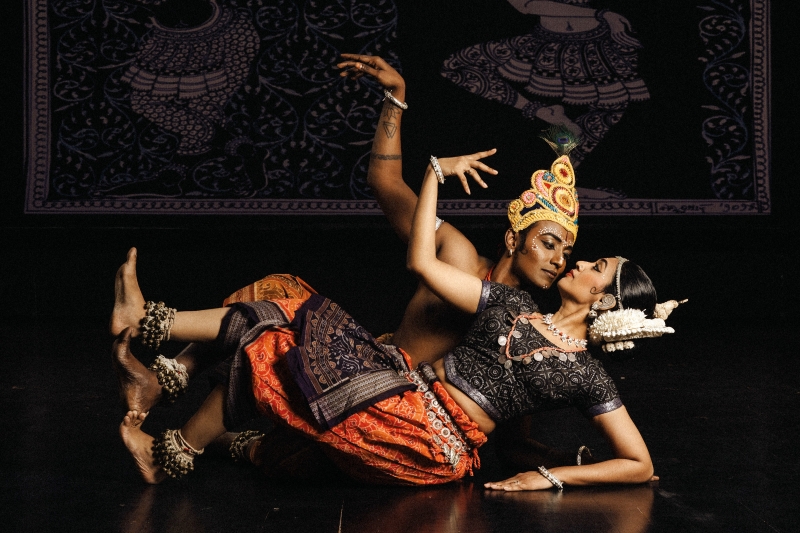
Live musical accompaniment will be played by a crew of seven artistes from Odissa — an added challenge, according to principal dancer Geethika Sree, who will embody the female protagonist. Synchronising speeds becomes the biggest issue as there is always the risk of musicians getting caught up in the moment and heightening the tempo. Rehearsals for the production have been working with sampled composites of the final product — dance recordings are sent to the musicians and beats are adjusted through constant communication. The score involved both Gajendra and a Pandit (expert in Indian classical music and singing) to incorporate the lyrical and rhythmic vocabularies of Radha Prema Leela.
Even the backdrops reflect one of Odissa’s traditional arts, Patachitra, a form of visual storytelling through cloth-based paintings. At least 20 illustrations were commissioned from master artisan Bibhu Patnaik for the show, beginning with monochromatic scenes in the first act and transitioning to coloured works, all to be projected via LED screen.
“I supplied [Patnaik] photographs of my dancers as the sakhis (confidantes) to capture how they move. Patachitra is also influenced by dance, so we wanted to include that side of it,” says Ramli.
Following the global premiere at the Temple of Fine Arts Kuala Lumpur, Radhe! Radhe! will embark on a tour of India, performing in Kolkata, Bhubaneswar and Delhi at the end of October. The schedule will be trying, but a powerful sense of collaboration and dedication to their craft binds each player.
“What I notice is, whenever the [dancers] get through a performance, they grow. It’s a trial by fire. Afterwards, you are humbled. Behind the glamour of the show is the hard work, the getting scolded — by me,” he laughs.
radha_prema_leela_performance_putabagada_ganjam_2024_photo_by_kishore_sahoo.jpg

Of course, this means the show must appeal not only to a local but international audience, especially one that will readily scrutinise your interpretation of its cultural heritage.
“Odisha is a place where, if you do something wrong, the audience will not hesitate to stand and let you know!” asserts the director. “When [Sutra] performs in India, we represent Malaysian culture. When we perform here, we represent Indian culture. We are in that twilight zone, and it’s very interesting in that we don’t wait for the bureaucrats to give us the green light.”
Ramli does not shirk from the reality of what it means to blaze a path forward in the world of art. Marketability and funding are often considered the enemies of vision and ingenuity — but popularity has never been his thing, admits the director candidly. His refusal to compromise on the quality and complexity of his art is why it has received such resounding acclaim, particularly from Indian audiences who have come to revere Sutra as a faithful steward of Odisha’s dance forms.
“A lot of us artists are charting our own path. The world is now, and we have to do what we have to do. Otherwise, time passes, and in a few years, something else might come in. There is an enlightenment happening, and we cannot wait.”
Radhe! Radhe! The Sweet Surrender will run from Oct 10 to 12 at the Temple of Fine Arts KL. For tickets, visit cloudjoi.com.
This article first appeared on Oct 6, 2025 in The Edge Malaysia.