
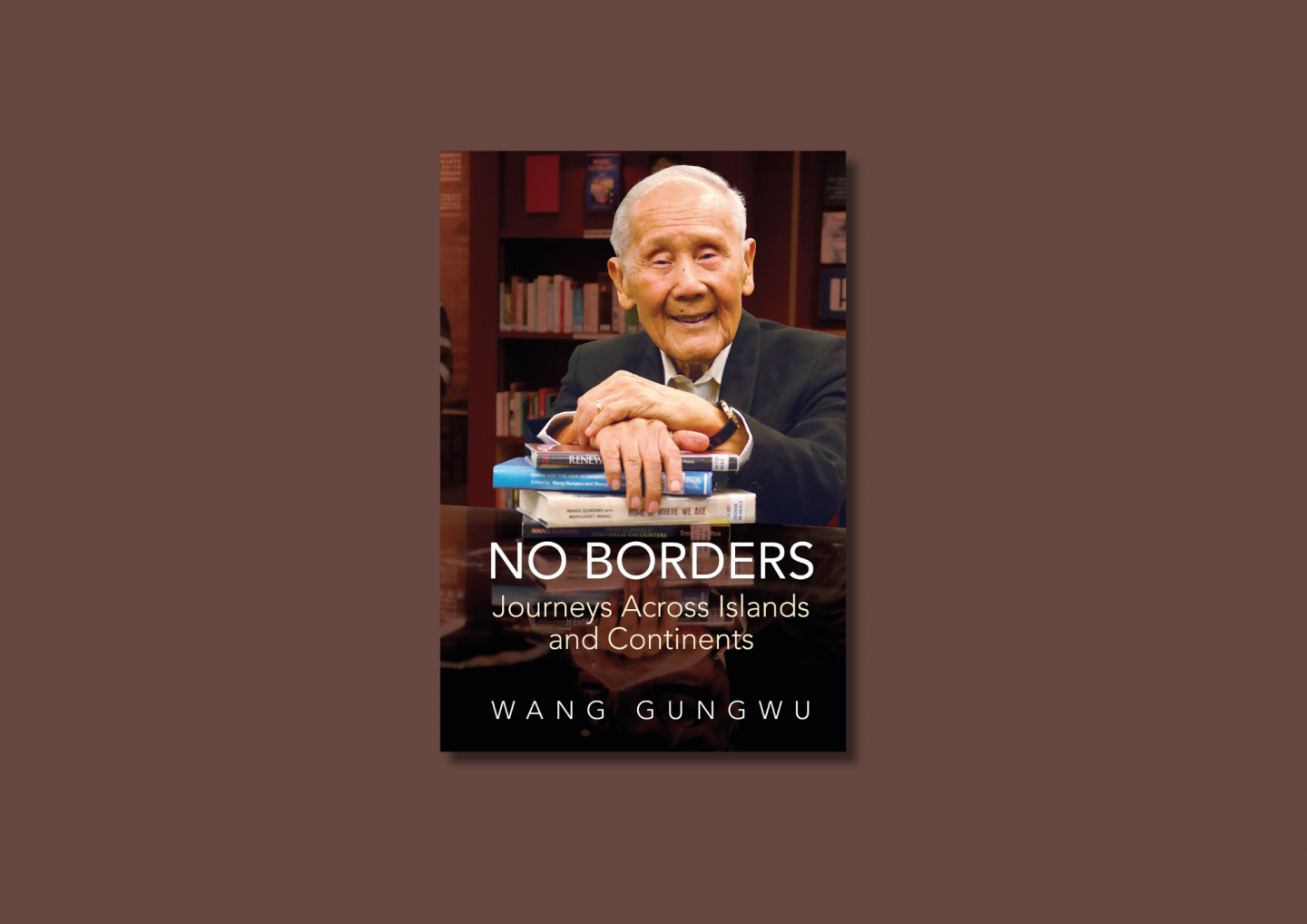
Wang witnessed Malaysia and Singapore's independence, as well as the once-in-a-lifetime changes in Hong Kong and China at close range, playing a role in shaping such events
The interplay of order and disorder has followed me all my life” is the first line of No Borders: Journeys Across Islands and Continents, the latest book by 96-year-old Professor Wang Gungwu, one of Southeast Asia’s most accomplished and influential intellectuals ever. “A sage of our time” is how Singapore’s prominent diplomat, lawyer and academic Professor Tommy Koh describes him.
This autobiography covers Wang’s very long life and the many changes of his places of residence and identity, alongside the transformations in society and nations. It is written in his elegant prose, which is accessible to the general public yet highly relevant to those who want to view history through the eyes of someone with lived experience and who is still around to share his story with us today.
Wang was born in 1930 in Surabaya, then a Dutch East Indies colony, to parents from China’s Jiangsu province (a rarity among ethnic Chinese in Southeast Asia who commonly trace their roots to the southern provinces of Guangdong and Fujian). His parents were both from relatively well-to-do and educated families, another rarity among sojourners from China at that time who were mostly illiterate labourers.
The family moved to Ipoh when he was a year old as his father, Wang Fo Wen, had been hired to teach there, with the intention of returning to China. Brought up as a Chinese citizen, he went to study in Nanjing in 1947 but was forced to leave a year later when the civil war between the nationalist Kuomintang party and the Communists began to grow more intense.
In his first memoir Home Is Not Here, published in 2018, he shares his childhood in Ipoh during the British and Japanese rule fairly extensively. Wang’s mother felt like a “total stranger” in Surabaya and Ipoh. “It is no wonder that throughout my childhood, she rarely talked about where we were, but dwelt constantly on where we should have been,” he writes.
The South China Sea featured prominently in Wang’s early life. At six years old, he travelled with his parents from Singapore to Shanghai, and to his parents’ hometowns in Jiangsu province. By the time he was forced to leave China in 1948, “my parents never spoke again of returning to where we should have been”. His father’s last job was as the principal of the famous Johor Bahru school, Foon Yew.
Like Wang’s family, it only dawned on many sojourning ethnic Chinese in Malaya after the Japanese Occupation, and especially after the Communist takeover of mainland China in 1949, that home is here, and no longer motherland China. There was no turning back. In Wang’s calm words, one can feel the tension, emotional strain and shock of those who had to lived through that period.
All of Wang’s adventures from 1949 until he relocated to Australia in 1968 are detailed in his second memoir, Home Is Where We Are (2021), a meaningful title inspired by his late wife Margaret.
body_pics_4.png
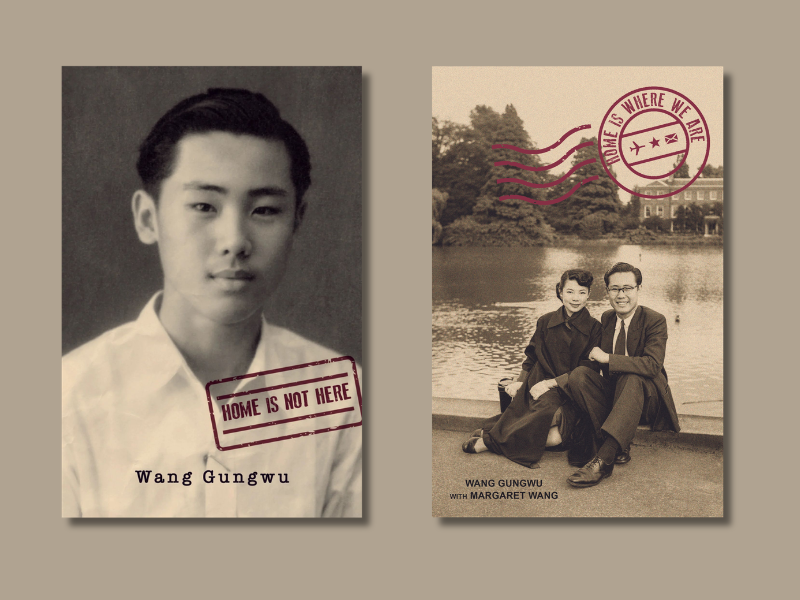
Wang was one of the earliest students of University of Malaya (UM) in Singapore, and actively participated in student politics, which was the incubator of anti-colonial ideas. He studied history and wrote authoritative research on the ancient trade that crossed the Nanhai, or what is now known as the South China Sea.
He did his PhD at the University of London’s School of Oriental and African Studies, with another path-breaking study on the Chinese Song Dynasty, which was consequential for a millennium through the redefinition of the Confucian heritage. When UM moved from Singapore to Kuala Lumpur, Wang joined its faculty in KL and rose to become the first Malayan to be appointed as a professor of history as well as the dean of the faculty of arts.
Like many concerned citizens in the 1960s, he was immersed in nation-building efforts, including growing UM into a respectable and reputable university.
After reading Home is Not Here and Home is Where We Are, I was keen to read about Wang’s life when he was at the Australian National University (ANU) my alma mater, where he spent most of his time until 1986.
His stay in Australia was initially meant to be short term but as the political environment in Malaysia after the May 13, 1969 riots was far less conducive for a non-Malay intellectual than before, he had little choice but to make Australia his permanent home. Well, almost.
Wang was highly influential in Australian academia, and was particularly instrumental in fulfilling the country’s tremendous interest in understanding China. He even chaired the high-profile Australia-China Council.
His academic work on China required him to travel extensively to the country, forcing him to relinquish his Malaysian citizenship as Malaysia at that time banned travel to China. During those Cold War days, even when one could actually travel to China with Malaysian ministerial permission, it was not easy to obtain. I personally know of several other academics who gave up their Malaysian citizenship for the same reason.
By some serendipitous circumstances, Wang, a humanities professor, was appointed vice chancellor of the University of Hong Kong (HKU) in 1986, two years after the UK agreed to return Hong Kong to China, and 11 years before the scheduled handover in 1997. Most of the HKU vice chancellors had been from the science faculties.
For some years, he was even a member of the colonial Hong Kong government’s Executive Council. That gave him a front row seat in witnessing the changing dynamics in Hong Kong prior to 1997, as well as proximity to the great transformation of China in the 1980s and 1990s.
By the time he left Hong Kong to relocate to Singapore in 1996, he was 66, and thought he was going to live a quiet retirement. What he did not anticipate was that he would have to guide the Yusuf Ishak Institute of Southeast Asia Studies (ISEAS) and Lee Kuan Yew School of Public Policy as chairman, and become director of the East Asian Institute, for an extended period of time. His eminent presence in Singapore over the last 30 years changed the intellectual landscape of the island nation for the better.
Once upon a time, Southeast Asia, Malaya, Malaysia and an independent Singapore were relatively new names, and all the changes happened when Wang was already in his adulthood. He also witnessed the once-in-a-lifetime changes in Hong Kong and China at close range. He was there and played a role in shaping some of the events, while writing about them.
After spending a long time studying, writing about and living through history, Wang said, “but I have to admit that I had begun to feel that I could no longer call myself a ‘historian’”. He now thinks like the Chinese wenren (literati), “not unlike the Ancient Greek histor (wise man or judge), who was a witness keen on learning more”.
As a young student at ANU in freezing Canberra 25 years ago, there were some months when I focused enthusiastically on reading as many of Wang’s publications as possible. I am also very fortunate to have met him and listened to his wisdom many times since 2010. At his Singapore book launch on Jan 29, Prof Tommy Koh said there are “Wang Gungwu Fan Clubs” in many cities as the prominent sinologist has helped generations of academics and thinkers to understand China and Southeast Asia, and also how the present is connected to the past, in the most interesting, creative and meaningful ways.
No Borders: Journeys Across Islands and Continents is the story of a sage of our time, being present at the creation of our nations, regions and history, and telling about the order and disorder along the way for all of us who came after him, to feel the tensions, understand the logic and also read his thus far most complete personal stories. This is certainly a must-read for everyone.
Liew Chin Tong is Malaysia’s deputy minister of finance. 'No Borders: Journeys Across Islands and Continents' is available at Kinokuniya and selected bookstores.
This article first appeared on Mar 2, 2026 in The Edge Malaysia.