

Haris’ work often features motifs not usually seen on batik that are still undeniably Malaysian — think a great hornbill or native fruits (Photo: Low Yen Yeing/The Edge)
Visual artist Haris Rashid maintains that his venture into batik-making was serendipitous. In fact, he had never really planned for a career in fine arts.
“I studied illustration for game development at The One Academy. It was a fully digital niche, although we had basic art classes in the first year,” he recounts. Halfway through his undergraduate studies, he realised that his passion lay elsewhere. Growing up with an artistic streak and an art teacher mother, he picked up the brush and poured his creativity onto canvas.
By the time Haris graduated, what had started as a hobby culminated in a sizeable body of work. He began approaching art spaces in Publika Shopping Gallery and managed to secure his first-ever solo showcase with Artemis Art Gallery. At the age of 22, his path seemed straightforward.
Then, in 2020, his mother retired as the pandemic heated up. “She’s not the sort who can stay idle,” Haris chuckles when he recalls his mission to find something to keep them occupied during the lockdowns. Remembering her past as a textile design student and brief stint as a batik producer before becoming an educator, he asked her to teach him how to make the fabric art the traditional way. Over the following weeks, Haris recorded the process and posted it on social media. Much to his surprise, the videos garnered tremendous response.
Being labelled publicly as a batik producer was something he had to come to terms with at first. “I gained a lot of followers from my content but honestly, I felt a bit of imposter syndrome from it. I had been painting for so long, just for batik to be what people know me for,” he mulls.
Local art impresario Nini Marini, whose mother happened to have taught Haris’ mum in university, was a primary influence for his shift in perspective. After reconnecting over a project, she invited him to join Citra, a group of traditional textile enthusiasts. It was through this community that he began to deeply understand batik’s vital part in Malaysian culture, his role in preserving the trade and how he could help educate others on the subject.
“As Malaysians, we don’t appreciate our batik much. It is often compared to that of our neighbouring countries and a lot of the knowledge we have on it is heavily influenced by them too. It has been part of our culture for so long and our version has its own unique beauty.”
2.png
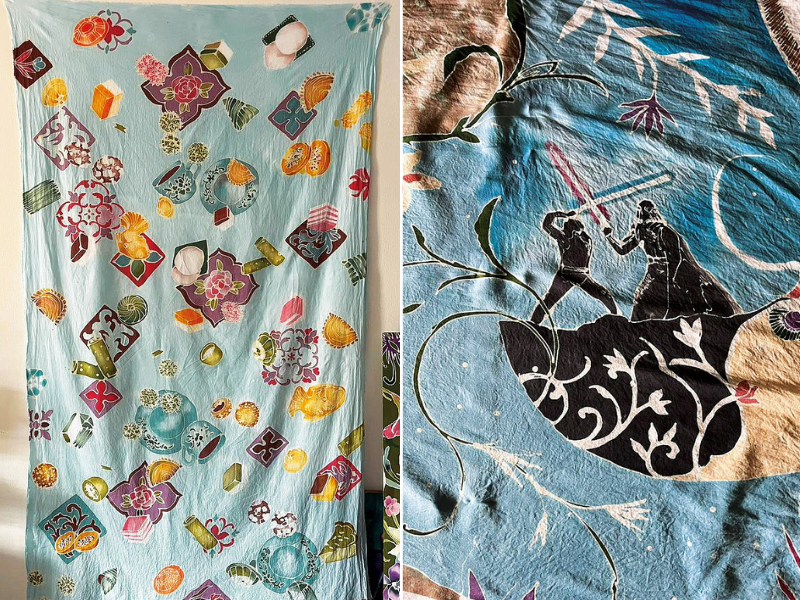
Crafting his own batik also enables Haris to stock his closet with designs he would actually wear, as much of what saturates the mainstream market does not spark that wish. Tastefully paired with contemporary clothing and accessories, the outfits he creates are colourful, bold and paint a picture of what 20th-century Malaysian wear could look like — suited for the current times, yet steeped in our distinct culture and rich past.
Incorporating traces of old traditions into our daily lives is inherently filial. For most of us, this urge is birthed from a desire to be connected to our heritage and honour the ancestors whose blood, sweat and tears gave rise to the vibrant landscape we call home. Haris had always known his mother once made and sold batik, while ancestors who hailed from Ahmedabad, India, owned a fabric store in Kelantan. Its deeper roots that go back generations were only uncovered when he began his own journey.
“My grandmother was the only one among her siblings who moved away from Kelantan. I was born in Kedah, and we did not communicate very frequently with the relatives who ran the fabric store,” he explains. His great-grandfather had travelled here from India while fleeing British conscription, eventually settling in the northeastern state and setting up shop. Much of the batik traded in the region at the time came from Indonesia, featuring the elaborate motifs associated with the Javanese variety. His son Hussein Aladdin (Haris’ granduncle) possessed a stirring passion for this particular form, even going to the archipelagic nation to study it. After he returned home, he began recreating the style, something practically unheard of back then, as Malaysian-made batik already had its own look.
The business was forced out of operation in the 1980s following an influx of cheaper options from Thailand and a shift towards modern and minimalistic aesthetics. Still, Hussein’s love of batik had made its mark and would go on to inspire generations, starting with Haris’ mother and now him. “When I went back to Kelantan to meet with my relatives, my granduncle had already passed away but his son still had some of the pieces he made. On sarong, it is traditional for the maker to sign the cloth with his or her name, and there it was — Hussein Aladdin.”
1.png

Today, Haris uses traditional techniques to detail all kinds of wondrous and fantastical imagery. However, the creations that bear the most meaning are the love letters to his forefathers and the nation they made home. On a cut of creme cotton, lines drawn with golden wax and indigo dye bring to life the copper celak (aka kajal) bottle perched on his grandmother’s vanity; Burung Petala that adorned the procession boats and carts of Kelantanese nobility; two whales that were said to have guided his great-grandmother’s family to local shores when they were lost at sea; keris and labu sayong as homage to our country’s historical crafts and artefacts; and an ornate oil lamp as a cheeky reference to Hussein Aladdin.
When not working on paintings or mural commissions, Haris is happy to take on custom batik requests. He is personally fond of proposals that challenge perceptions of what batik is and how it can be worn. “A client from Mumbai commissioned me to do her saree for her Haldi ceremony last year. She sent several metres of silk all the way from India! That’s the kind of project I enjoy making most — something that pushes boundaries.”
This article first appeared on Oct 13, 2025 in The Edge Malaysia.