
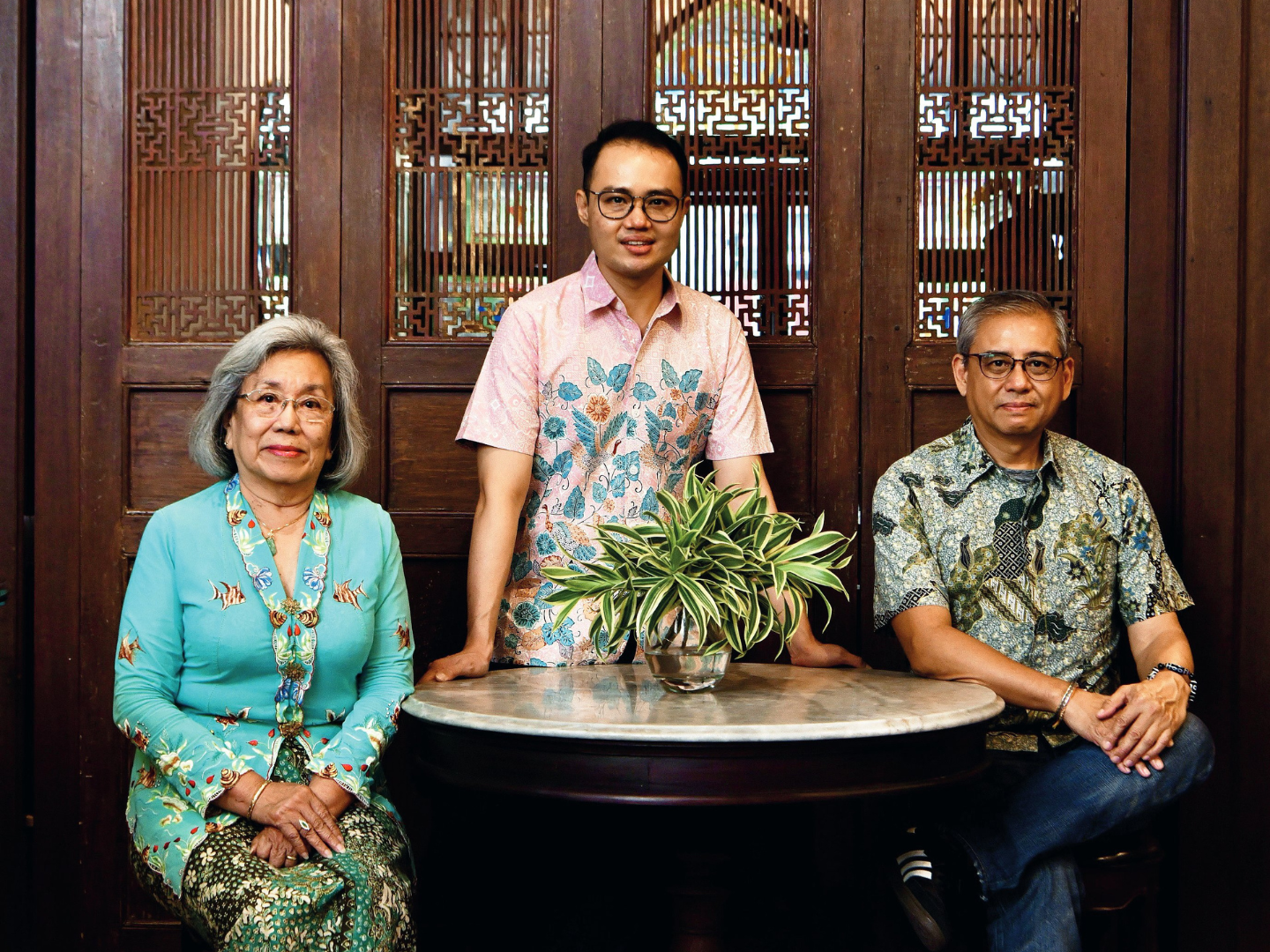
Lee flanked by Lily Yew (left) and Peter Chua, Peranakans working to uphold and preserve their culture in different ways (Photo: Sam Fong/ The Edge)
News that the Baba Nyonya can now amend their birth certificates (BC) to reflect who they are, while welcome, has not led to a rush to do so. As many ask how to go about it, there are those who wonder, “What’s in it for me?”
Lee Yuen Thien, deputy president of the Peranakan Association of Malaysia (Persatuan Peranakan Baba Nyonya Malaysia, or PPBNM), has been busy fielding the first query. As to the second, his reply is personal yet pertinent to a group of people who take distinct pride in their traditions and heritage.
“Personally, if I were applying to have Baba Nyonya listed in my BC, my questions would be: Does this recognition help preserve our culture and identity for the next generation? Does it strengthen historical truth? If the answer is yes, then it matters.
“For me, a fifth-generation Baba from Melaka who has spent years working on heritage preservation, this status is deeply symbolic. It acknowledges that we were here, we contributed, and we continue to exist — not as a footnote, but a living community.”
Baba Nyonya status is not about material benefits or privilege, Lee emphasises. It does not come with financial incentives or legal advantages. What it offers is continuity of their identity and recognition of their ethnic lineage.
Historically, Peranakans were widely referred to as the Straits Chinese, Straits-born Chinese or Baba Nyonya, he explains. After 1957, this categorisation gradually faded, and the community was subsumed under the broader racial classification of “Chinese”.
He relates how a meeting between association president Datuk Ronald Gan and Prime Minister Datuk Seri Anwar Ibrahim led to the surprisingly quick approval for what PPBNM had been advocating since the former took charge a decade ago — formal recognition of Baba Nyonya identity.
When they met at the 2024 National Unity Week celebrations in Johor, Gan told the PM about their “dilemma” and asked that they be allowed to include their status in their BCs. Anwar reportedly replied, “I don’t think that’s a problem”.
A series of meetings at Putrajaya followed and last September, the National Registration Department (JPN) of Melaka informed the association its request had been granted. PPBNM was formed in Lee’s home state in 1986, with many of the founding members coming from Bukit Rambai. Its original vision was to create an umbrella body representing Peranakan associations across the country and lobby for the rights of the community with one collective voice.
Multiple groups thrive today, including in Penang, Kuala Lumpur, Selangor, Kelantan and Terengganu. There is no definitive headcount of the Baba Nyonya population nationwide, but estimates put it at 20,000, depending on how “Peranakan” is defined.
“While we may not always agree on everything, there is broad cohesion on key issues, particularly cultural preservation,” says Lee, author of The Baba & Nyonya Renaissance.
2.png
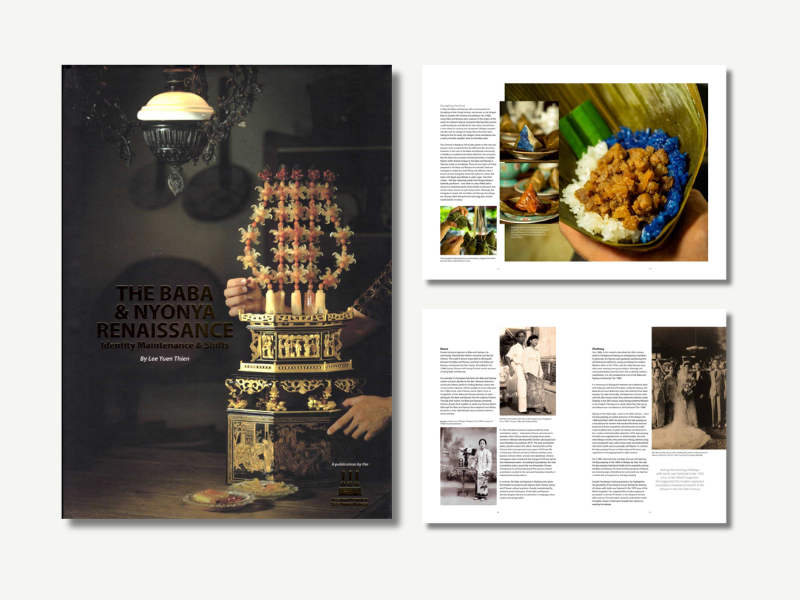
For now, there is neither an official government website outlining how to apply for said status, nor a rigid template on what to do. But PPBNM, which has close to 4,000 members, has developed a step-by-step guide to help them better understand the process, which involves documentation, family lineage, cultural evidence and community verification.
Registration started in Melaka last October before rolling out nationwide in January. The association’s role is to verify and endorse applications, ensure consistency and fairness, and protect the integrity of Baba Nyonya identity.
Proving that one is such is not about performance or costume, Lee thinks. “It is about demonstrating inherited cultural identity, family history and recognition within the community.”
If a principal applicant — the father or mother — obtains Baba Nyonya status, his/ her children automatically qualifies, subject to documentation. Each case is assessed and endorsed by PPBNM to ensure genealogical and cultural authenticity before going to JPN. After the BC has been amended, individuals can submit a separate application to update their MyKad.
A rulebook and guidelines developed jointly by both parties help ensure clarity and consistency.
The process begins by obtaining the most up-to-date BC extract from JPN and retrieving the relevant application forms. Once these preliminary documents are in order, the applicant may approach the association for a letter of endorsement.
Membership is not compulsory, but community verification is essential. “The aim is not exclusion but authenticity,” Lee emphasises. Anyone who has genuinely lived the Baba Nyonya way of life may apply, provided there is credible documentation and community support.
For non-members, information such as the names of grandparents, family or ancestral photographs, and details relating to ancestry serve as a starting point. These materials help establish context but do not, on their own, constitute proof, Lee notes.
Because Baba Nyonya is a sociocultural identity rather than a legal category, historical records rarely use the term explicitly. As such, evidence is cumulative and contextual, and may include family genealogies and association records, photos and kinship links.
“In Melaka especially, continuity of cultural practices and residence [or family origins] within recognised Peranakan enclaves, such as Heeren Street, Tengkera, Kandang, Batu Berendam and others, is often an important contextual factor.”
This involves the transmission of Peranakan identity across multiple generations (usually three or more); sustained identification as Baba or Nyonya within the family; evidence of cultural practices (language, customs, cuisine, attire, rituals); and social recognition by the Peranakan community over time.
One key challenge is that documentation is often incomplete because of war, migration, natural disasters, or the informal nature of record-keeping in earlier periods.
As at end-January, media reports showed a growing number of BC submissions to JPN, with 11 approved and no rejections to date.
Lee joined PPBNM while still at university, drawn by the strong sense that “if we do not document, organise and speak for ourselves, our history will gradually be diluted or misunderstood.
“Growing up with Baba Nyonya grandmothers on both sides, what stayed with me most was discipline, respect and humility, paired with good food, warmth and humour. What I seek to preserve is not just material culture but values — moderation, adaptability and mutual respect — because these are what allowed the community to survive for centuries.”
Many early Peranakan Chinese descended from Chinese men who settled in Malaya and married locals, often Malay or indigenous women. In Penang, later settlement patterns and stronger links to southern China led to the retention of dialects, particularly Hokkien. Melaka, being older and more deeply rooted, experienced greater linguistic and cultural Malay influence, says this ardent historian.
Lee’s great-grandfather was a silversmith by trade and he can trace his paternal lineage back to Kandang, Melaka, descended from Hakkas from Taishan. On the maternal side, his forebears came from a long-established Hakka Baba Nyonya family in Batu Berendam.
“After several generations of living in Melaka, our ancestors adapted to the local lifestyle — language, dress, food, customs and social norms — and gradually developed into the distinct hybrid identity known as Peranakan Chinese. That, essentially, is what being a Baba or Nyonya means. Not merely ancestry, but a lived culture passed down through generations.”
Traditionally, Babas and Nyonyas were descendants of early Chinese settlers who, born here, intermarried or acculturated deeply into the Nusantara while retaining elements of Chinese heritage, he continues.
“In many cases, they have Malay blood. It was never just about bloodline alone but continuity of culture, community acceptance and way of life. We inherited local lifestyles and cultural sensibilities, which shaped our identity just as strongly as ancestry. We acculturated, not assimilated, by way of language, attire and food, practices.”
One interesting example of acculturation is that on Thursday nights or malam Jumaat in his family home, meals would be pork-free and his grandmother would burn kemenyan around the whole house.
1.png
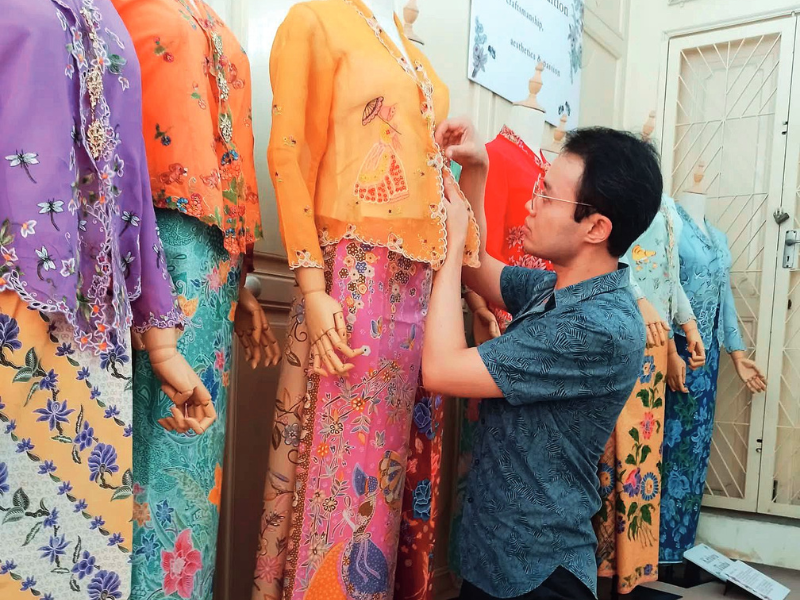
On top of his PPBNM responsibilities, Lee is manager of the Baba Nyonya Heritage Museum in Melaka. His work involves research and documentation, curation of artefacts, and educational and outreach programming. The idea is that besides objects, visitors will also encounter stories of daily life, such as domestic rituals, craftsmanship and social values.
Long-term research and sustained community engagement have led to talking-point exhibitions at the museum set up in 1985 by Chan Kim Lay, besides those highlighting the Chan family’s private collections.
One such exhibition was Timeless Tradition: Craftsmanship, Aesthetics and Passion, which showed stunning kebaya personally embroidered and crafted by Nyonya Teo Swatt Neo. Complementing the display was a documentary video chronicling the 86-year-old’s journey and lifelong dedication to the craft, spanning more than 60 years.
“Preservation alone is not enough; we must make the culture relevant. This includes engaging youth through education and storytelling, encouraging contemporary interpretations that allow continuity, and using museums and associations as living spaces to raise awareness and interest,” Lee believes.
On Jan 20, the government announced that under the National Education Blueprint 2026-2035, general education subjects covering the Federal Constitution and Malaysian history will be included in public and private university curricula. He sees this as a timely opportunity to broaden the national narrative.
“Peranakan history should not be treated as folklore alone but as part of Malaysia’s civilisational development and an icon of unity. Researchers, historians and scholars, including those within the Peranakan community, should be involved in writing it, ideally through collaborative and academically rigorous work.”
Upholding tradition through food
3.png
Among Peter Chua’s most vivid childhood memories are living in an extended family with grandma, aunts, uncles and cousins — all 24 of them under one roof. His roots run deep in Melaka but he was raised in Kuala Lumpur as his paternal grandparents moved to the city in the early 1900s, led by grandpa’s work with the Malayan Railway.
This sales and business development manager will share how his family kept their culture alive at Who are the Nyonyas and Babas? event next month.
While privilege and carefree company would have kept most youngsters outdoors and away from chores, Chua found a happy place in the kitchen, the heart of every Peranakan home, where there was always something cooking.
“I learnt to cook from my makko (father’s elder sister). I was always giving her a helping hand in the dapur and watching how she did things.” Till today, his favourite Peranakan dish is her itik sioh, which she would only prepare for ancestor worship during Chinese New Year.
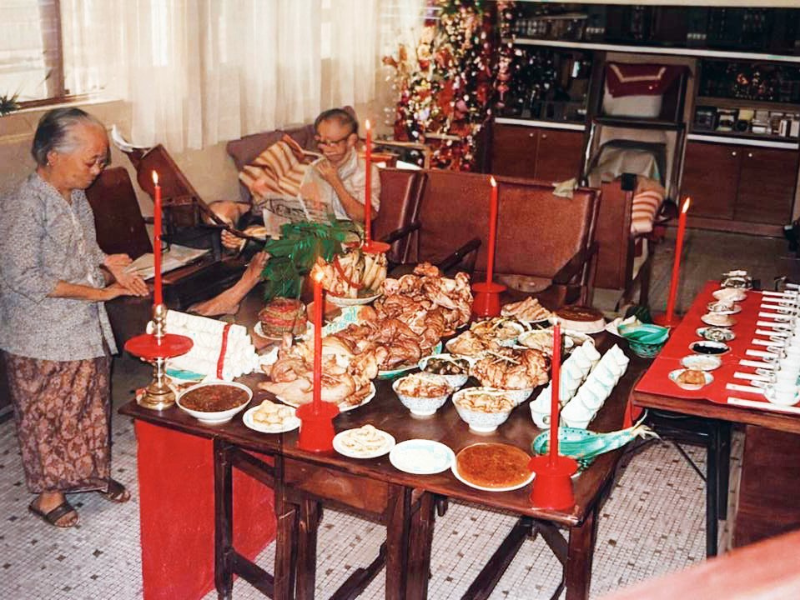
He picked up exacting recipes and dishes, and the myriad practices Baba Nyonya observe when honouring their forebears through prayer. In those days, family altars would have a spread of 12 dishes, many prepared using ingredients that hold meaning for the occasion, from festivals to Cheng Beng (All Souls’ Day).
Things have changed over the decades. Chua, the rare Baba who can whip up a full table of traditional cuisine, cannot pinpoint when exactly people started reducing the fare laid out from a dozen to eight dishes. Now, even he prepares only four when he prays.
He thinks the practice of venerating the deceased with food offerings will slowly evolve into something even simpler as most of the younger generation are not able to handle the tedious processes involved. “Besides, you need passion to learn and preserve.”
Old-timers today are realistic about adapting to change, it seems. Fellow Baba Lee Yuen Thien says an aunt remarked that even if younger ones in her family were to offer prayers with one packet of chicken rice and a cup of coffee, she would be happy.
With his culinary skills, Chua is upholding the tradition of performing ancestral prayers in his family. But it saddens him to know he will be “the last one” as his siblings and cousins are not keen to take up the mantle.
“A lot of us love aspects of our heritage like dressing up in kebaya, and the food. But when it comes to ancestor worship, [people] tend to shy away.”
Asked if he plans to change the status on his birth certificate, this active member of the Persatuan Peranakan Baba Nyonya Kuala Lumpur & Selangor, and Persatuan Peranakan Cina Malaysia says, “Still under consideration.”
Itik sioh for a festive treat
5.png
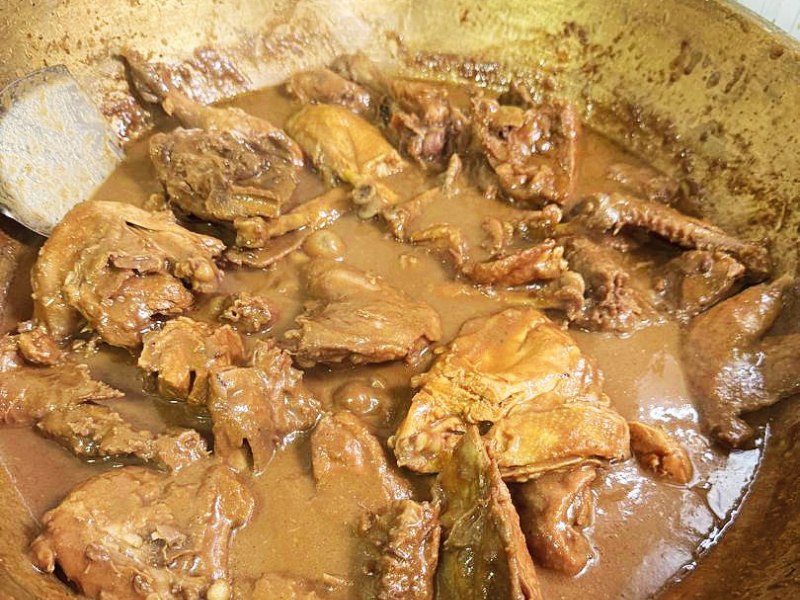
Want to serve something special when the family gathers again before the Lunar New Year ends? Try Peter Chua’s recipe for itik sioh in thick spicy tamarind juice. Those who prefer a less gamey meat can substitute chicken for duck.
Ingredients
- One whole duck, or chicken
- 500g roasted coriander powder
- 500g shallots pounded finely
- 400g sugar
- 2 tbsp salt
- 2 tbsp dark soy sauce
- 2 tbsp ground white pepper
- 300g tamarind
1. Soak the tamarind in about 350ml of water then strain into a bowl. Mix in all the other ingredients and stir well. Add the duck pieces, cover the bowl and leave to marinate overnight.
2. Transfer the duck into a saucepan and cook for 20 minutes over moderate heat. Taste and add more sugar and salt if needed.
3. Reduce the heat to low and cook until the meat is tender and the sauce thickens.
4. Remove and cool.
5. Heat a pan with some oil and fry the meat pieces till fragrant. Serve hot or cold.
Starting ’em young + debunking myths
4.png
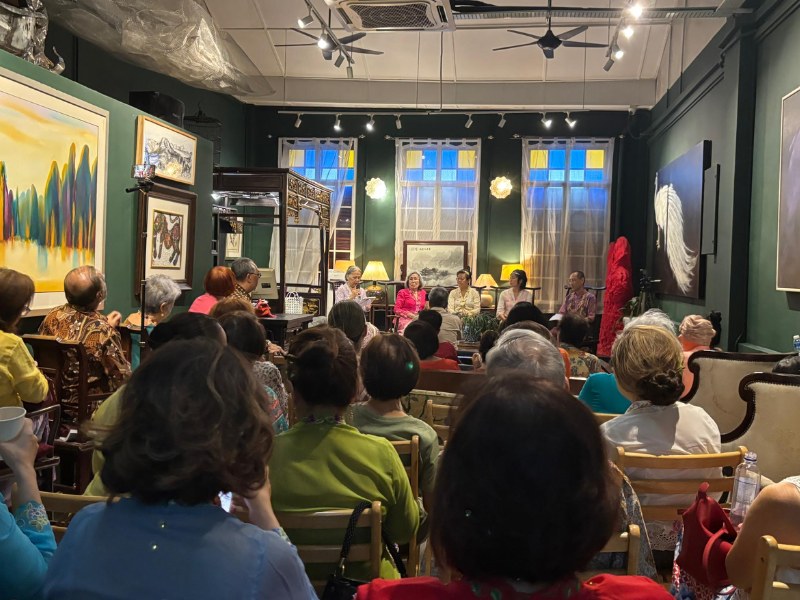
As a grandmother, Lily Yew sees no purpose in amending her birth certificate to show her Peranakan identity. Before talking about status, it more important to start teaching the children, she feels.
Educate the young ones and be a good example for them to want to emulate. Uphold, practise and preserve Baba Nyonya traditions and culture. Take a leaf out of the books of those who adapted after arriving in the Nusantara from the mid-1800s to the 1920s and did not lose touch with their roots.
Yew says what she knows to be true. Everything she has learnt about being a Nyonya stems from observing the elders in her large Penang household. Eventually, marrying into another Peranakan family was a blessing because she knew what to expect and was expected of her; there was no clash of culture and tradition.
This 78-year-old is the host of Who are the Nyonyas and Babas?, where she and guest speakers share their knowledge and experience to create awareness of the community’s history, practices and heritage. Gatherings held in Kuala Lumpur in the last two years have focused on, among other things, being Nyonya and caring for jewellery — often elaborate, treasured pieces handed down through the generations.
Yew had a sarong kebaya business which she retired from years ago, after passing her tailoring skills to granddaughter Rosalyn. Around 2005, she mentored a costume jewellery producer before moving on to deal with the trading of the real McCoy.
In 2020, she initiated a chat group with a few hometown friends to create a platform where they could share Nyonya stories and what it means to be one. When that did not crystallise, she decided to go solo with her tea event, having given talks for the Persatuan Peranakan Baba Nyonya Kuala Lumpur & Selangor.
She is now working on a book about the Peranakan garden, inspired by stories on that of her planter grandfather Yeoh Teik Swee, whose diverse orchids and fruit-laden trees reflected those typically found in wealthy Baba Nyonya residences of his time.
Yew’s focus is the plants used in Nyonya cooking, which usually thrive at the back of the home, yielding herbs and spices that flavour dishes in divine ways. Food writer Julie Wong and ethnologist Dr David Neo are involved in the project, which will also feature illustrations by her mother Yeoh Guat Cheng and daughter Yew Su Fong. Yes, there will be recipes using ingredients plucked from the kitchen garden.
With the charming confidence of the kebaya-clad ladies of her ilk, Yew wants to create awareness of the richness of her legacy, because “what is man without history and culture?” Besides, as a Baba puts it, “only with awareness will we have hope and continuity”.
Ingrained in the Peranakan lifestyle while growing up in the Straits Chinese bastion up north, Yew noticed trends changing after moving to KL in 1966. She got involved with Baba Nyonya associations only in the last two decades and, increasingly, finds that it is “so frustrating seeing people reinvent and reimagine things, such that myth becomes fact”.
Yew is not one to ignore the elephant in the room. “I’m disappointed with social media and influencers who spew rubbish without any primary source of information. What they’re doing is damaging, and the naïve and gullible believe them.”
Writers who do not conduct due diligence also irk her. Even those who should know better have fallen short, it seems. “I have nothing nice to say about how Penang has made used of Peranakan culture as a tourist attraction and ‘Disneyfied’ it. Nyonya being portrayed as joget dancing girls — so undignified.”
Her ire is understandable because Baba Nyonya were elites associated with opulent lifestyles, lavish wedding ceremonies, huge ancestral altars, ornate furniture, Nyonya ware, elaborate cuisine and sprawling mansions. Yew hopes her tea events can be a catalyst to start conversations and put a stop to those jumping on the bandwagon and claiming everything “Peranakan”.
She wants to leave a legacy that can help conserve the community’s traditions and practices. “Our culture will survive.” Convinced that education will keep things alive as the young look to the future, this busy matriarch sees no necessity to have “Baba Nyonya” stamped on her birth certificate as of now.
Lily Yew will host 'Who are the Nyonyas and Babas?', a dialogue with Lee Yuen Thien and Peter Chua at 4pm on March 7, at Warong Old China, 144 Jalan Tun H S Lee, Kuala Lumpur. A RM50 contribution includes Peranakan tea. For reservations, WhatsApp (016) 375 3868.
This article first appeared on Feb 23, 2026 in The Edge Malaysia.