

Caillois photographed with his mineral collection in Paris, 1978 (Photo: Sophie Bassouls)
Alternating bands of cerulean and cornflower blue emanate from the centre of an agate cross section, creating an ether that evokes an evil eye amulet used to protect oneself from envy and malice.
At the iris, twin snow-capped peaks meet, formed through fateful white inclusions that imitate an alpine panorama. A golden border, its hue so rich it almost glows against the calm azure, makes the crystal akin to a photograph being consumed by fire — a memory set alight at the edges, urging you to burn the image into your mind before it disappears forever. As you observe the rock, you cannot help but wonder how something that came from the soil could paint such a precise scene of an environment in which it has never existed.
This magic of minerals and gemstones has enraptured the minds of countless geologists, historians, collectors and artists over centuries. Their beauty has fuelled romance and creativity as much as conflict and bloodshed. Some dedicate entire lifetimes to the study of these materials, while others cut, facet and polish them into wearable wonders that sell for millions. A few, though, prefer to behold and cherish them in the rawest form, then convey the splendour to the rest of the world through written word.
French writer and sociologist Roger Caillois was one such individual. Most who are familiar with his name might instinctively think about his work on game theory, sociology, ludology and surrealism. He was also deeply invested in understanding the relationship between art and nature, particularly the treasures tucked away under the very earth we walk on. A dazzling career at Unesco opened his eyes to the vibrant, bountiful landscapes of Asia, Europe and the Americas, nurturing his curiosity and infatuation with earth’s riches.
Between 1952 and his untimely death in 1978, he amassed an impressive collection of specimens, which he whimsically liked to call “crossroads objects” or “fairy objects”. Arguably the most engrossing were the “picture stones” — gems that, when sliced into, reveal landscapes and geometric formations that, in his words, bear “an unexpected, improbable and yet natural resemblance which causes fascination”.
1.png

Beginning in 1959, Caillois released several essays about these rocks and roughs, with his most renowned work being the 1985 publication The Writing of Stones. In it, the author’s ruminations are humbling, meditative and inspiring — the world is not anthropocentric and humans are but a small part of a greater picture, one we have only scratched the surface of. Rocks, from simple pebbles to magnificent crystals, are one way in which our planet chronicles its eras. Observing agates, jaspers and onyx, he uncovered notes from the past, unravelling stories of a world that once was.
Following Caillois’ passing, most of his more than 1,000-piece trove has gradually come to be housed at France’s Muséum national d’histoire naturelle (MNHN), a feat made possible through the continued aid of Van Cleef & Arpels-supported L’École, School of Jewellery Arts. Now, the two institutes are celebrating the author’s mind and lifelong fascination in a new Paris exhibition, Stones and Reveries: The Poetry and Minerals of Roger Caillois.
The introspection will feature more than 200 items from the sprawling collection, with many of them going on display for the first time. These stones are meticulously curated to accompany a medley of the author’s texts, offering a glimpse into his cornucopian mind and enlightening travels through the continents. It all begins in Patagonia, believed to have sparked his enchantment with picture stones and which he explored between 1939 and 1945 while in self-imposed exile in Argentina (Caillois wanted to actively oppose Nazism from a safe location), before guiding visitors through Asia, where he immersed himself in the region’s lore, engaged with material by eminent scholars and studied the petrified world.
2.png
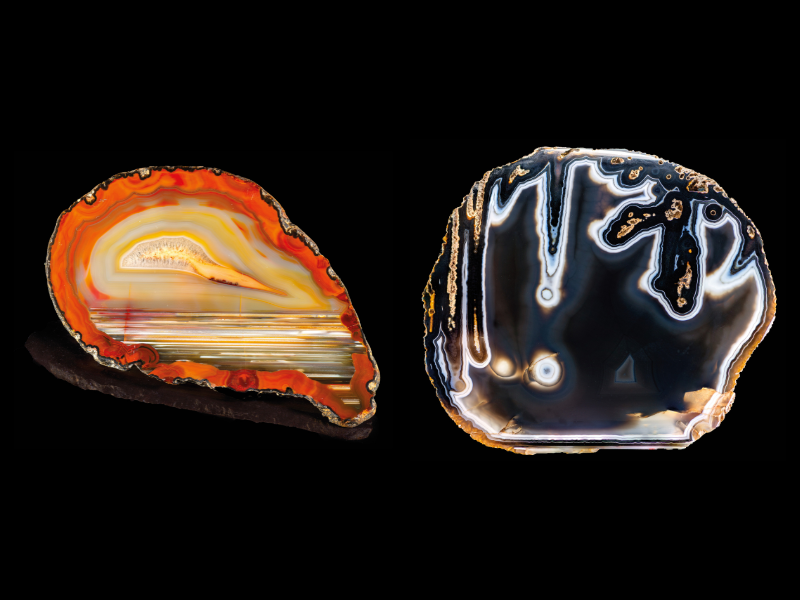
On a slab of peachy quartz, two circular impressions of eye agate give the stone a cheeky ogle, while an icy glacier floating in a pool of deep blue waters appears on a slice of agate with a contrasting quartz core. Streaks of calligraphy ink seem to drip down the face of a Brazilian onyx. A hunk of Italian limestone called a “ruin marble” resembles wooden engravings. In yet another agate, a monstrous mushroom cloud from a nuclear explosion looms over an ocean, spreading into the fiery sky.
Most noticeably, the exhibition introduces the concept of Natura pictrix, meaning “nature as a painter”, which recognises the environment’s ability to create abstractions before conceptual art and also explains the human knack for spotting patterns in our surroundings and biomimicry — the act of imitating wildlife’s designs to solve human issues. Nature’s unintentional genius has always been a source of endless inspiration, in both art and technology. The philosopher describes “messageless hieroglyphs” he beheld on the geometric brown, yellow and grey patterns of septaria as well as noir galaxies imagined amid pitch-black onyx. Vegetation frozen in dendrites and multicoloured bands of agate conjured a deluge of images. These depictions can even be paranormal and otherworldly, as he writes about the bizarre phantoms and cosmic landscapes pronounced throughout his specimens.
3.png

All this leads to the presentation’s culmination — Pierres anagogiques, the final literary work the author was engaged in before his death. The majority of the texts were rediscovered in 2023 by the showcase’s scientific curator and MNHN professor François Farges amongst archives now housed at Vichy’s municipal library, Médiathèque Valéry Larbaud. In the French only read, Caillois discusses the spiritual and mystical interpretations of stones alongside more than 150 full-page photographs of the corresponding specimens, a selection of which may be viewed up close at the exhibition. Standard and limited collector’s editions of the book can be purchased at L’Escarboucle, L’École’s official bookshop.
For a holistic journey into Caillois’ dreamy world, visitors should consider attending the related talks or embarking on a guided tour (note that these are conducted in French). Industry folk, gem collectors and jewellery enthusiasts would benefit from the roundtable discussion on his academician sword, a gem-covered blade crafted by Lyon-born jeweller Jean Vendome, while those looking to make a family jaunt out of the exhibition must not miss out on the calligram sessions and Crowns and Swords children’s workshop.
'Stones and Reveries: The Poetry and Minerals of Roger Caillois' runs until March 29, 2026, at Hôtel de Mercy-Argenteau, Paris. Open Tuesdays to Sundays. Free admission upon registration. To book and find out more, visit lecolevancleefarpels.com.
This article first appeared on Nov 10, 2025 in The Edge Malaysia.