
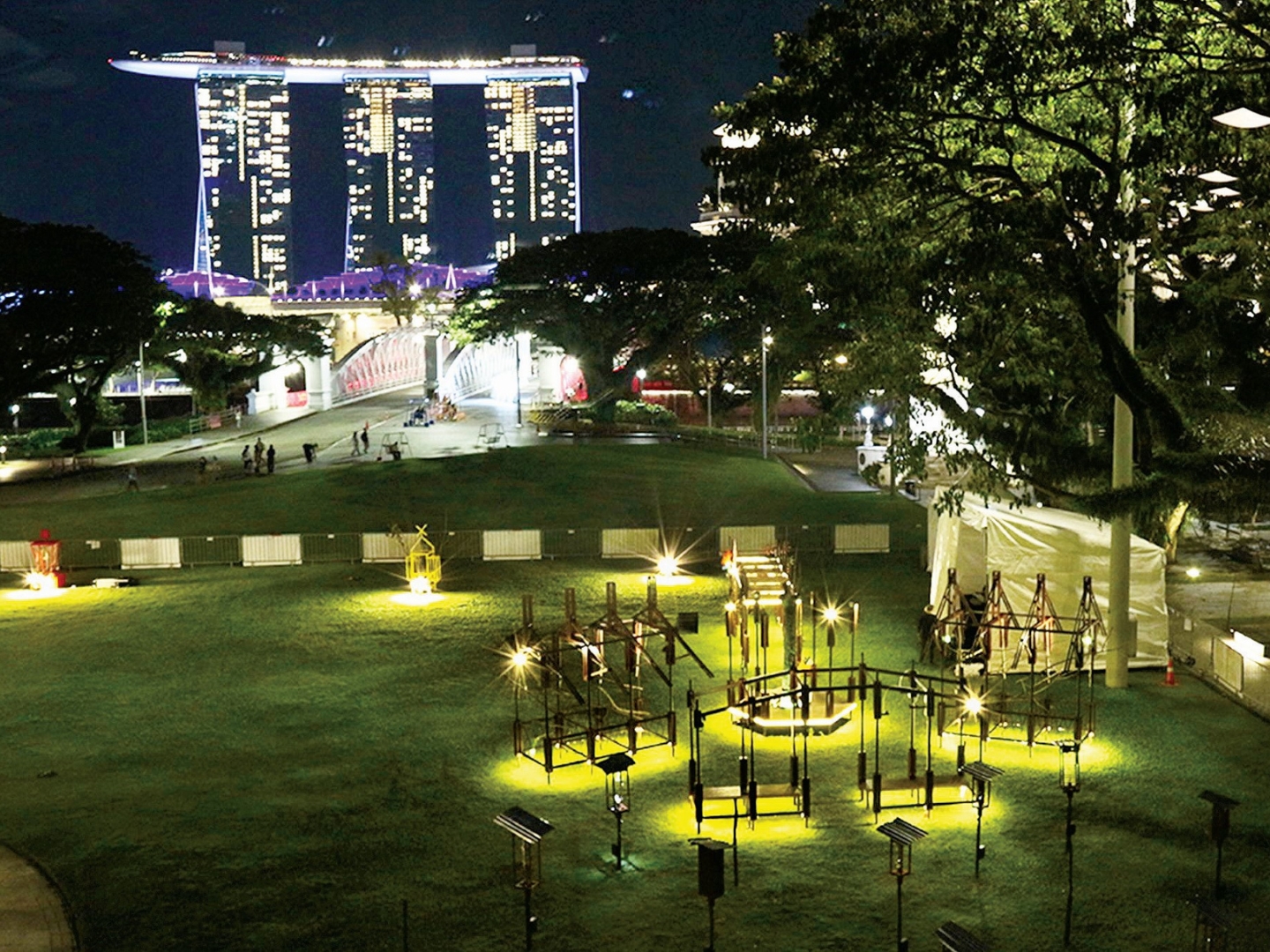
The House Between The Winds, an installation made from constructed junk, recalls Singapore’s seafaring past (All photos: Singapore International Festival of Arts)
In remembrance of the passing of Lee Kuan Yew the previous year, residents of the old district of Bedok came together in 2016 to create 25 paintings to commemorate their beloved “Mr Lee”. These artworks were styled around a significant speech he had delivered at the National Press Club in Singapore in 1996. In his “Rainbow Speech”, Lee had exhorted the nation to look outwards. “There is a glorious rainbow that beckons with a spirit of adventure. To the young and not-too-old I say, look at the horizon, find that rainbow, go ride it.”
The 25 paintings formed part of a large creation depicting him in silhouette, reflecting and affirming the presence of that redoubtable figure in public life. Bedok — one of Singapore’s historical districts — had been home to Lee when he was younger.
In a rare personal reflection, and to affirm Singapore’s rapid development since its emergence as a sovereign nation, Lee recalled, “When I was a child — one of eight — in the 1930s, it took me two hours to travel four miles by bullock cart on dirt tracks from my home in Bedok to my grandfather’s rubber estate at Chai Chee. Today, that same trip takes 10 minutes by car on paved roads …”
Remembrance and commemoration in art were significant then, it would seem, from the painterly gestures of the Bedok community.
Renewal, in the midst of an almost always tentative future for the small, prosperous island city state, has been a recurrent exhortation in Singaporean public life. The grand Lee, even as he urged the people towards a stable and secure future, never failed to remind citizens of the uncertain past from which they had emerged.
It was this call newly elected Singapore Prime Minister Lawrence Wong reprised in his recent swearing-in speech and following his much lauded address in the age of Trump tariffs. Commencing his address in Malay — the national language of Singapore — he stressed, “In these uncertain times, you understood what was at stake — our vulnerability and our future”.
the_sea_and_the_neighbourhood.jpg
“Vulnerability” might well serve as the recurrent theme for the SG60 edition of the Singapore International Festival of Arts (SIFA), organised by Arts House Ltd, with Natalie Hennedige now in her last season as director.
Encompassing six interwoven “curation strands” — New Urban Realities; Classics Reinvented; History Reimagined; We, International; State of the Arts; and PRISM 48 — the festival evokes, not so much history, but its complementary divergent, memory.
Bedok — that historical coastal district of fishermen where Lee grew up and later the collective “Rainbow” painting was showcased — was both the ideal and idealised centre for the launch of SIFA 2025 and its community-inspired reach.
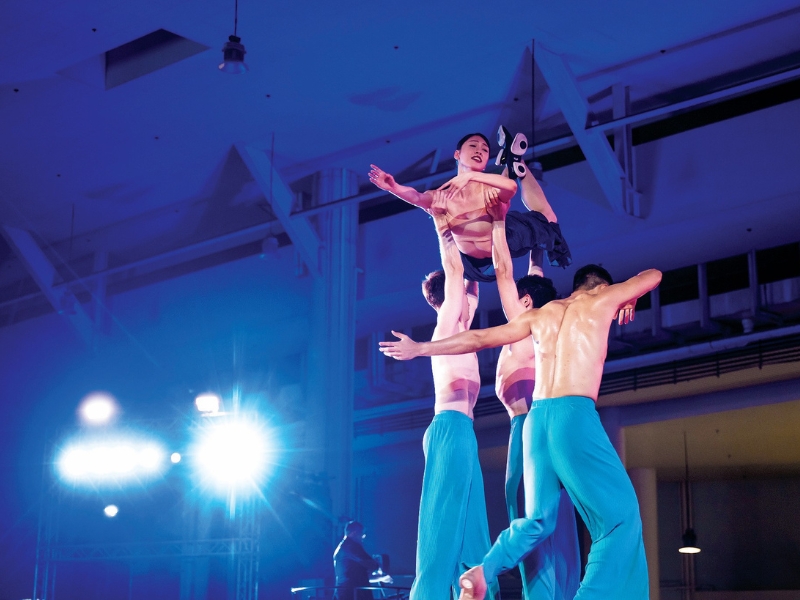
At the centre of Bedok Town Square (only recently utilised for the Singapore polls), artist Wang Ruobing’s large wood installation Beneath Tide, Running Water, inspired by Bedok’s natural coral, literally served as the stepping planks for the lush and extravagant The Sea and The Neighbourhood, featuring the Singapore Ballet, choreography by Christina Chan, music by composer Philip Tan and video by Brian Gothong Tan.
umbilical.jpg
As a landing place, the installation gathered separately rehearsed composites into full flow, the ebbs and the dips of the dancers aimed at capturing an idyllic life on the east coast. Much was packed into this act of remembrance — at times, perhaps too much — but that did little to take away from the perfect synchronicity of how all fell into place in this spectacle.
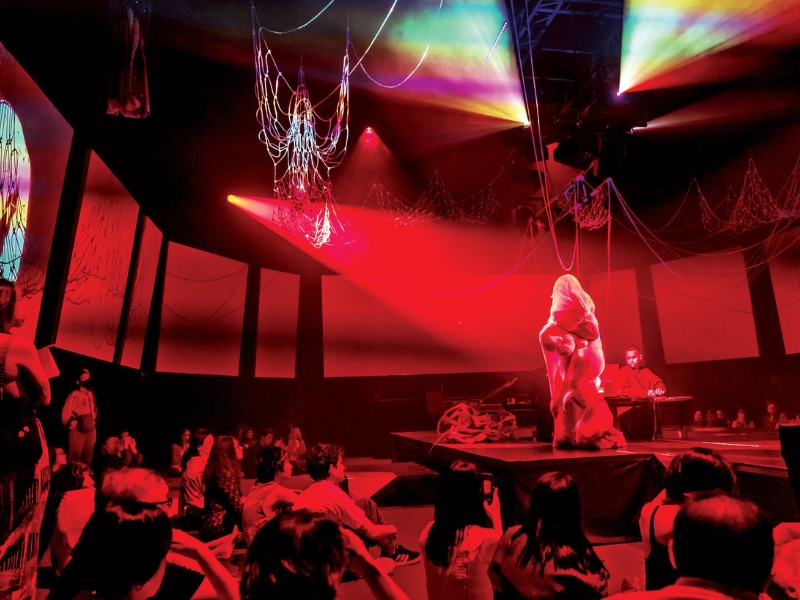
Lavish, full of everything, The Sea and The Neighbourhood contrasted considerably with the dark, stark, minimalist humming of Umbilical — a multidisciplinary work by artists Zul Mahmod, Rizman Putra, thesupersystem and Aiman Sunor Collective. Commemorating Singapore’s separation from mainland Malaysia, Umbilical featured a single, struggling figure on a platform, getting in and out of various garb, at one point resembling a tortured embryo. References to Kafka’s Metamorphosis, as noted by a fellow journalist, might have been obvious to some. To others, notions of a separate, even disparate, community — memories of that defining episode in the Singapore-Malaysia collective memory was palpable.
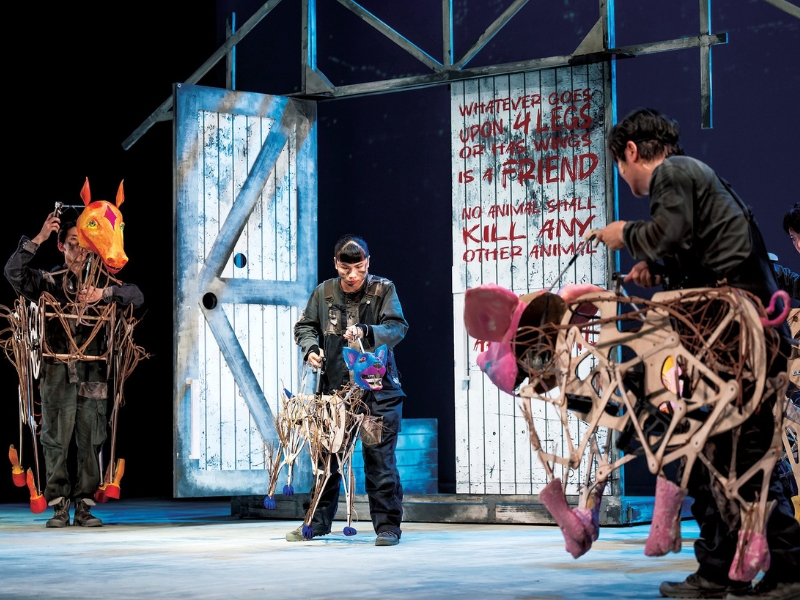
Animal Farm, which opened SIFA 2025, directed by Oliver Chong and featuring the masterful Singapore Finger Players, was a clever, if ironic, stage adaptation of George Orwell’s satirical parable. Most striking in this staging was the demonstration of great technical abilities in the wielding of the puppets brilliantly crafted by Loo Ai Ni. Where technical mastery prevailed, however, delivery, at times, fell short. The adapted script seemed often less than allusive, the characters struggled with the dip towards caricature, and so much that is redolent within parables fell instead into direct storytelling.
There were intelligent imaginings — the addition of one commandment upon another on the barn door, for instance. But the temptation to fall into predictable vernacular in script, the tendency to allow the elegiac (the death/culling of the inexhaustible Boxer) to fall into melodrama, meant that this morality tale often advanced the didacticism of the moral and less of the tease that is the story.
animal_farm.jpg
Much of the spirit of SIFA 2025 — grappling with memory, making sense of history, self reflection and the collective — was perhaps best encapsulated in a strange, if attractive, installation placed in the beautiful gardens of Empress Park, surrounded by Singapore’s grand Angsana trees.
The House Between The Winds — dominated by constructed junk — recalls the country’s seafaring past. Inspired by the artist Yang Jie’s early journeys from Clifford Pier to Pulau Kusu for commemoration, at various temples on the island and a Muslim keramat, it invokes references to Sejarah Melayu and the shadowy realm between myth and history. A woven tapestry, hand made by students from a school, creates a narrative of trade routes, crops and the foundations of a community from different historical strands. The installation is placed before a statue of Stamford Raffles, facing the Marina Bay Sands, creating a sardonic reflection of the past and future realities.
“Community” was the embrace of SIFA 2025, and its openness to memory — however variegated — may be where it is most inspired and meaningful for the people, Singaporean or otherwise. Years ago, one of the country’s leading poets, Alvin Pang, wrote an ardent and moving poem, Other Things, that concluded with the line “the correct answer to a mirror is always, yes”. Fitting.
This article first appeared on June 2, 2025 in The Edge Malaysia.