
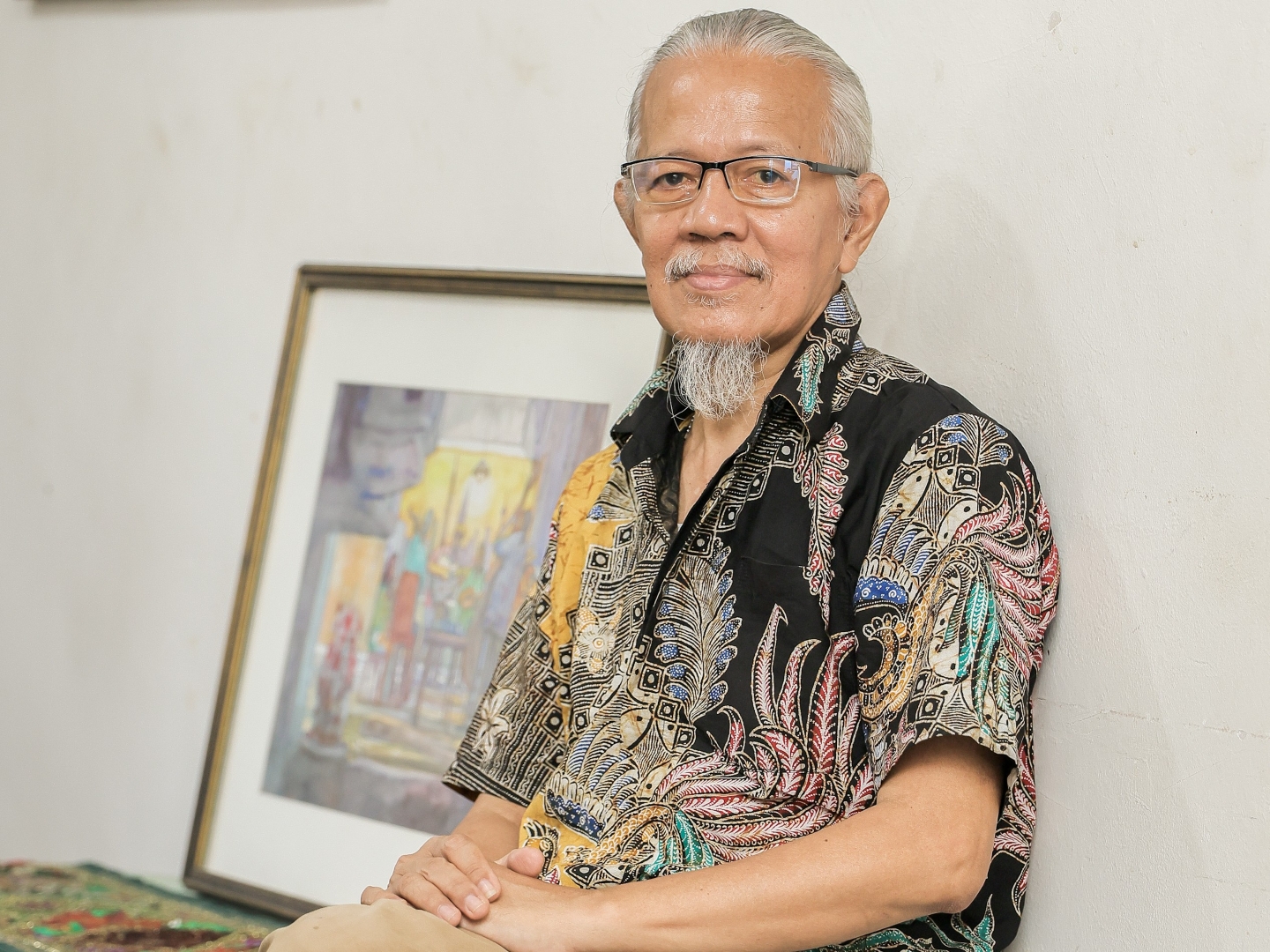
The artistic talent of Kedah-born Maamor Jantan has been cultivated since his childhood (All photos: Zahid Izzani/The Edge)
Growing up in an era when art education was not readily available or widely celebrated, home-grown watercolourist Maamor Jantan, 65, had his family to turn to for inspiration. Of the 10 siblings, four are artistically inclined. Naturally, his interest in the creative realm was nurtured at home. “I remember waking up in the morning to the sight of my brother working on his batik pieces. As a young kid, watching him so immersed in his craft left a deep impression on me,” he reminisces.
His imagination and creativity were further cultivated by cinematography and visual design. The curious and keen teenager would often visit neighbourhood theatres to catch the latest films, which not only provided him with affordable yet fascinating access to a distant world, but also served as study material in colour and composition. “I loved watching movies, but I was not particularly focused on the plot or storyline. I was very much attracted to the palette and framing for each scene,” he explains.
In primary school, Maamor would sketch random things as a means of keeping a record of his thoughts. He levelled up his skills in secondary school by trying his hand at comic drawing. “I didn’t do it for competition or anything. I was merely creating from imagination for the sake of it,” he recalls.
Sheets of paper filled with dense details and intricate doodles eventually captured the attention of his art teacher Chin Peng Weng at Sekolah Menengah Kebangsaan Tinggi Setapak in Kuala Lumpur. “She told me it was unusual for people my age to be able to come up with such complex drawings. But as I had been watching so many movies, the technique came naturally to me. Until now, I know exactly what to draw and how I want to organise and paint my subjects,” says Maamor.
It was also under his teacher’s guidance that he was exposed to watercolour, a medium he grew interested in and is recognised for today. “Mrs Chin Peng taught me the basics of watercolour painting. I was not instantly good at it, but I was glad she gave me that knowledge and introduction. While many teachers were pointing out I was not good at anything and that my future was bleak, she was encouraging me to brush up my skills and open my eyes to different possibilities.”
1.jpg
After secondary school, Maamor secured his first job as curatorial assistant at Galeri Seni UAL in KL. “The gallery became my place of learning. I had to undergo rigorous training to master the ins and outs of putting together an exhibition. My boss said, ‘Maamor, you need to memorise the names of all the artists in Malaysia as well as their works. That is your first task for this job.’ Along the way, I also got to know about Western talent and other popular genres. I was not yet an artist but I had already been amassing all this knowledge, which would eventually inform my practice. Besides curating and promoting exhibitions, I also had to build and mount the frame for each artwork. I did everything except paint,” he laughs.
The turning point that prompted him to pick up the brush again was when his good friend Raja Harman Raja Musa brought back a souvenir from a business trip to Singapore in 1984. “He got me a Rembrandt watercolour, one of the top choices favoured by fellow artists, one of whom was my idol Khalil Ibrahim. I didn’t wait long to try it out and I was personally impressed by what I created. When you are equipped with good tools and supplies, it really makes a whole lot of difference,” says Maamor.
He had long harboured a dream of becoming a professional painter but his job at the gallery kept him occupied. “Every now and then, there would be a group showcase by Angkatan Pelukis Malaysia and I thought how nice it would be to be part of them. After the gallery closed down, I took the opportunity to join the association.”
In 1986, Maamor participated in the inaugural Ekspo Warisan Seni dan Kraf Tradisi Malaysia. The event took place at Stadium Negara, a historic setting that held remarkable significance for both the country — Malaysia’s first indoor sports arena opened in 1962 — and Maamor, who finally met Khalil at the venue. While walking around with his friend Yeoh Jin Leng, Khalil chanced upon Maamor, who was hard at work completing a painting depicting a group of children playing with car tyres.
“He was really captivated by it. It was only a small one but it had all the elements of a professional-looking painting. Dare I say, it was one of my best works yet, probably better than some of my recent ones, and which defined my identity as an artist. When you are new at something, you have this strong desire to give it your all. As a result, you have a higher chance of producing a masterpiece that you yourself may never be able to replicate or top again.”
In the same year, Maamor developed his first signature work called Laman Cakcibor, which he submitted to Balai Seni Negara. “Not only was it accepted for exhibition, it was also sold to an interested party. Cakcibor, which is ‘dragonfly’ in the Perak dialect, would go on to become a series I continued to work on over the decades.”
He was then invited to join the Malaysian Watercolour Society, whose founding members included Khalil, Cheah Yew Saik, Dr Wong Seng Tong, Tew Nai Tong and Tham Siew Inn, marking the beginning of his career as a full-time artist. “It was a great honour because it is really not easy to be a part of the association.”
2.jpg
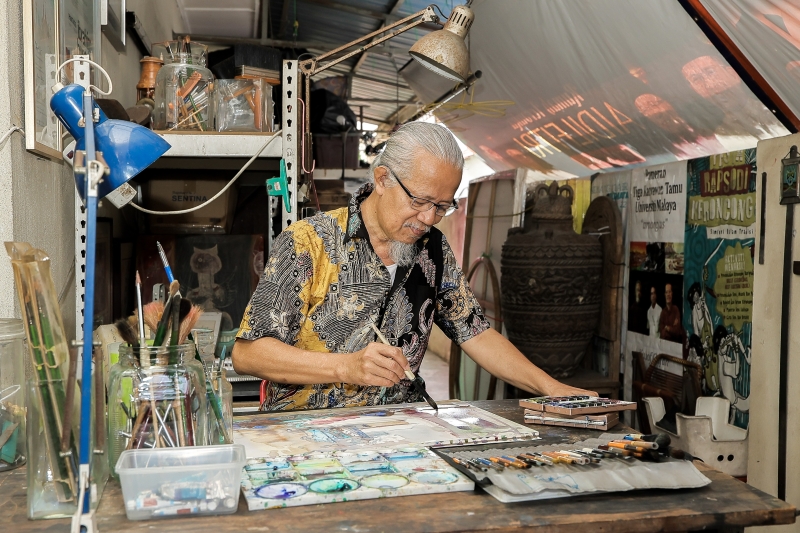
In 2010, Maamor was appointed resident artist at Universiti Malaya. The programme had been established by then vice-chancellor Royal Professor Ungku Abdul Aziz and named Datuk Ibrahim Hussein as its first resident artist from 1971 to 1979.
After a long pause, the initiative was later revived to host prominent creative figures on the local and regional scene. Together with Soh Boon Kiong, Yusof Gajah and Juhari Said, Maamor was responsible for reviving the gallery and Malaysian art landscape as a whole.
He learnt some important lessons early in his career. While he was making a name for himself in Malaysia and was widely covered and praised by the local press, he decided to tap into the international market, travelling to Indonesia to participate in an exhibition in Yogyakarta, highly regarded as the country’s cultural capital and a hub for fine art.
“Twenty years ago, they didn’t make it easy for you to showcase your talent over there, especially if you were self-taught and had no one to vouch for you. I was asked to produce 30 artworks that would be distributed to the members of the media, including critics, and I had to complete everything in less than 24 hours,” he recalls.
“To these professionals, your techniques didn’t matter. They didn’t care about how beautiful your works were. They wanted to know the content and reasoning behind each creation. Storytelling was the most important thing because it was how they evaluated your skills and passion.”
One journalist questioned Maamor’s seriousness as an artist due to the subjects and themes he chose to spotlight in his collection. “I was told that I was not paying attention to what’s happening in the world since I was only drawing dragonflies and flowers. Why was I not featuring depressing issues in my artworks?”
But he knew from the outset that he wanted to remain true to himself. He does not subscribe to the belief that an artist must adopt a trendy subject to be relevant or be the voice of the suffering just because everyone else is doing so. Attentive and discerning, he prefers to paint from first-hand experience and personal observation, using his life, emotions and interests in music and landscapes to shape his art.
“I don’t like to create something I’ve never gone through before or have limited knowledge of. Now that artificial intelligence has come into play, it’s easy to see people make art that encompasses a wide range of themes at a fast speed. Hence, it is vital for viewers to ask the creator the meaning behind their painting. Even with the help of technology, we should not lose sight of the fundamental value of art, which is storytelling,” says Maamor.
3.jpg
Born in Kulim, Kedah, to a police officer father and housewife mother, he shares what it was like growing up in different addresses as the family would move from one place to another because of his father’s postings. His early years were mainly spent in the countryside — hushed surroundings, scenic views and slow pace of life were part of his childhood. And so was the strong sense of community fostered by living in a close-knit environment with several other families.
“At the police quarters, everyone was always doing some kind of activity together, so there was no room for me to be alone. Night-time was when I could really savour the stillness and indulge in solitude. Those remaining hours before bed were very precious. It’s when I usually reflected and meditated. Even as a child, my mind was occupied and I was constantly thinking about a lot of things. My upbringing was a major influence on my artistic journey,” he says.
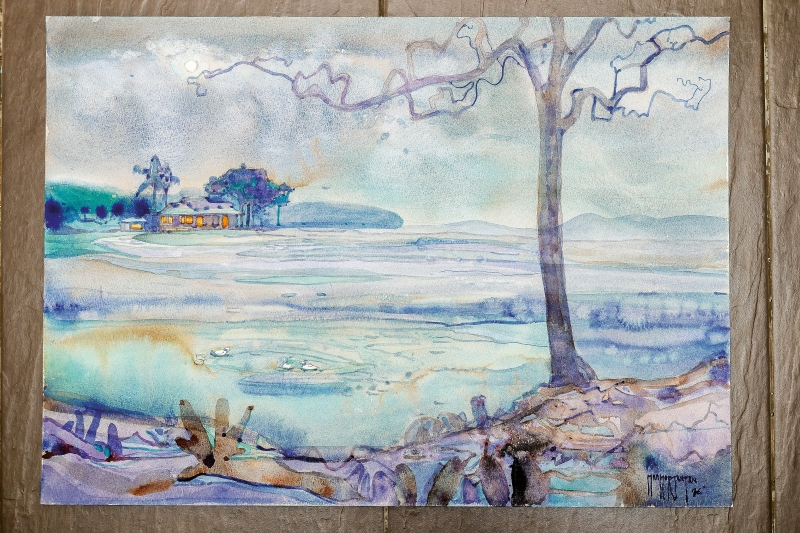
In an upcoming solo exhibition that will take place at Galeri Karya in Janda Baik, Pahang, from Aug 22 to Sept 20, Maamor will present Interaksi Alam, a contemplative collection that dives into the relationship between human beings and their surroundings. “The emotions I’m trying to convey are not exactly sadness, but perhaps the melancholy one feels towards the state of the environment that has been touched and spoilt by humans. I’ve never explored this theme. This will be the first time I will show these paintings to the public.”
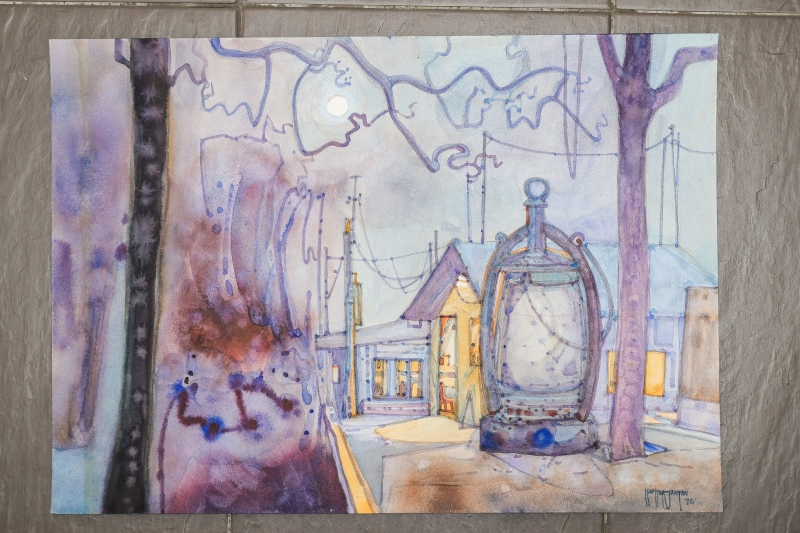
In contrast to his signature works that are livelier and packed with details, Maamor incorporates a softer palette and forgoes small elements, leaving only what is necessary to emphasise the focal point of each piece. For instance, Lampu Gelap turns the spotlight on the kerosene lamp, once a primary source of light for many households but which has now been abandoned in favour of electric and solar-powered options. Meanwhile, Pantai dan Hati and Keindahan Nuansa take viewers on a more peaceful pathway. The former depicts a man admiring the stunning view of the sea with a mountain standing tall in the distance while the latter captures a panoramic view of a scenic village.
Featuring 24 artworks, each measuring 38x53cm, the mini showcase is designed to raise awareness of what it means to live in harmony with nature and the importance of preserving the past and protecting our ecosystem.
'Interaksi Alam' will be on display at Galeri Karya in Janda Baik, Pahang, from Aug 22 to Sept 20. Friday to Sunday. Admission is free.
This article first appeared on Aug 17, 2026 in The Edge Malaysia.