
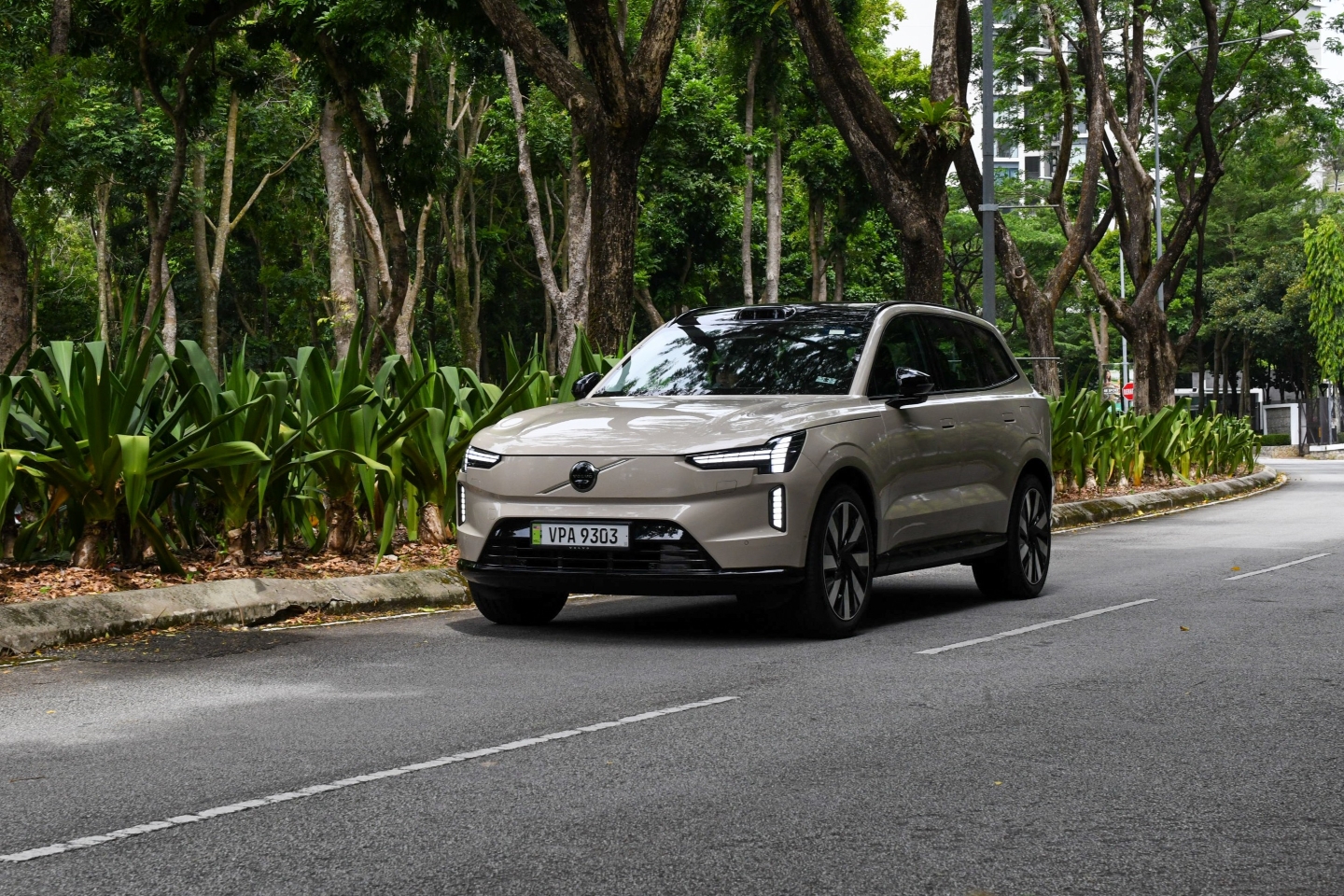
When it comes to clean, minimalist yet impactful and purposeful design, no one does it better than the Scandinavians (All photos: Low Yen Yeing/ The Edge)
During a winter excursion to Gothenburg, Sweden, two years ago, a select group of Malaysian journalists was among the first to test drive the Volvo C40 Recharge. The car marked a significant milestone for the brand as its inaugural pure electric vehicle (EV) built from the ground up, heralding Volvo’s era of emission-free mobility and bringing it a step closer towards its intrepid ambition of becoming a climate-neutral company by 2040.
While in Sweden, we were also granted a glimpse of the EX90, which had debuted in Stockholm just two months prior. Positioned as Volvo’s flagship seven-seater fully-electric SUV, the EX90 was poised to spearhead the brand’s rapid electrification drive. This strategy includes the introduction of a new EV model each year, gradually phasing out internal combustion engines from its portfolio, with the ultimate aim of transforming the company into an entirely electric car manufacturer by 2030.
Designed to be the safest Volvo yet, the EX90 introduces a suite of new technologies, making it the marque’s first model to incorporate Lidar (Light Detection and Ranging), be fully software-driven and built with hardware in anticipation of fully autonomous driving. While impressive, these systems required fine-tuning, which unfortunately caused a delay in production and only began in the middle of last year.
In any case, it recently made its Malaysian debut in April and first impressions of the new Sand Dune colourway were much more favourable compared with the Crystal White model showcased at the Swedish headquarters. The SUV also claimed the title of World Luxury Car at the World Car Awards the same month, and for good reason.
20250619_pro_volvo_ex90_15_lyy.jpg
When it comes to clean, minimalist yet impactful and purposeful design, no one does it better than the Scandinavians. The exterior of the EX90 is said to take inspiration from the elongated lines of luxury yachts, resulting in a sleek, sculpted body with a rounded and lowered front. Windows and door handles sit flush while frameless wing mirrors (also heated, by the way, for those foggy mornings) make looking back look good. These design features work together to achieve a drag coefficient of 0.29, making the family car incredibly aerodynamic, which helps in optimising the 623km (WLTP) driving range.
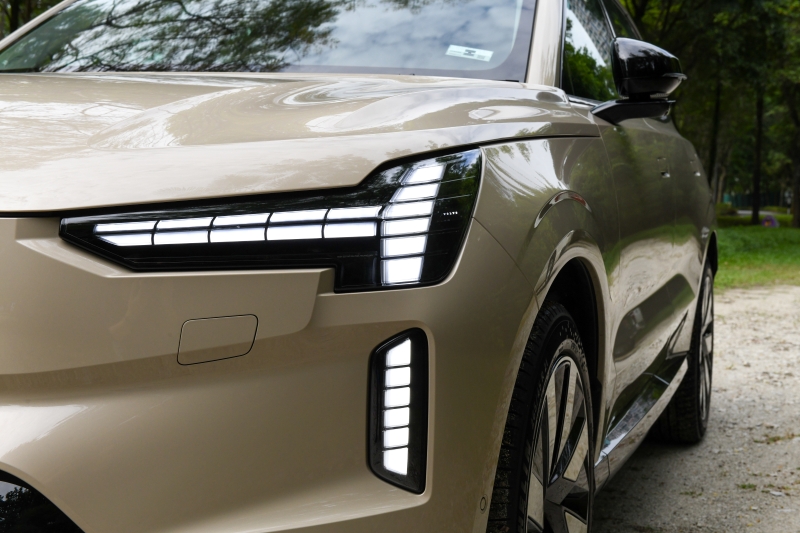
The closed-off front grille is flanked by LED headlights dubbed the Ultimate Thor Hammer, which perform a neat trick as you approach the car with the key fob. The daytime running lights blink to life with a delightful welcome sequence that frequently prompts second glances from onlookers. But these headlamps are not just for show. The standard package maintains great visibility in low light and automatically switches between high and low beams as other cars approach to prevent dazzling.
However, the High-Definition Pixel headlights are a game changer for night driving. If you have to navigate poorly lit areas on a regular basis — endless roadworks and faulty street lights seem to be the norm these days — these advanced headlamps have over a million pixels to illuminate the entire street for the cautious convoy behind you while adapting its projection to avoid blinding oncoming road users, be it cars, motorbikes or pedestrians.
The interior of the EX90 is built to resemble a Scandinavian living room, featuring natural, recycled and renewable materials to create a calm and clean environment that exudes sustainable luxury. For a warm and relaxed ambience, the elegant wood trim on the dash is gently backlit with LED lights that mimic the natural glow of the sun — nothing lurid here!
20250619_pro_volvo_ex90_25_lyy.jpg

Upon entering the cabin, one would immediately notice the complete lack of analog instruments, save for a single rotary dial on the centre console for basic media controls. All interior functions, from air conditioning and navigation to battery management and even access to the glove compartment, are consolidated under a core system controlled by a 14.5in centre screen. But unlike most infotainment clusters we have encountered in the past, with their labyrinthine subfolders within subfolders, the EX90’s user interface, with Google and 5G connectivity built in, is astonishingly simple. It leaves us to wonder, could it always have been this easy?
Volvo claims that the overall user experience was designed on the principle of avoiding information overload. The display positions key controls within reach and in an intuitive way, so you can easily keep your eyes on the road. Want to turn on one-pedal driving? The icon is just there. Need to pull up a 360° view of your surroundings? Right here. The placement of the functions can be customised to suit your preferences too.
The theatre-style, orthopaedic-designed seats ensure business-class comfort, with a massage function for the driver and front passenger as well as a convertible child booster seat on the second row for growing families.
20250619_pro_volvo_ex90_34_lyy.jpg
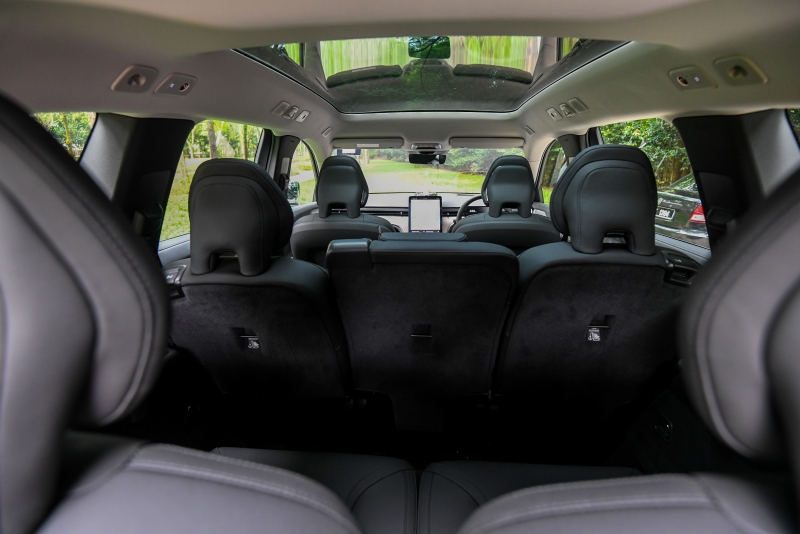
As far as practicality goes, the EX90 can accommodate up to seven people, but two in each row feels less snug. Proper headrests, air-conditioning vents and speakers prove that the comfort of passengers in the far back was not an afterthought, though legroom is still too compact for a regular adult. Those in the front and middle-seat will just have to shift a little to find a sweet spot that everyone is happy with. Thankfully, these chairs can be moved independently.
One of our primary concerns was the panoramic sunroof spanning the entire width of the car. While the idea might seem favourable for those living in temperate climates, keeping occupants in a glasshouse with year-round tropical sun exposure makes less sense. Although the air-con does a good job keeping the car cool, the energy used to do so adds up. Volvo says the roof is laminated to strengthen security and tinted with an infrared coating that reduces UV radiation, but the midday rays still penetrate right through. It is safer, in the long run, to invest in a shade.
When it comes to the auditory experience, the EX90’s cabin is the quietest of any Volvo to date, thanks to improved sound insulation and a vibration-absorbing chassis. They create the perfect environment for ferrying worn-out children after school or blasting your favourite tunes on the Bowers & Wilkins High Fidelity sound system on road trips. There are 25 speakers throughout the cabin, including in the front headrests for immersive Dolby Atmos music.
Malaysia only carries the Ultra Twin variant, nomenclature for the model with the highest powertrain and trim specifications. With performance all-wheel drive, the car unlocks a maximum of 380kW or 517hp of power and 910Nm of torque, propelling the 2.7-tonne behemoth from standstill to 100kph in 4.9 seconds. All this muscle comes from a 111kWh lithium-ion nickel-rich NMC battery that can be replenished from 10% to 80% in 30 minutes with a 250kW DC fast charger. However, a standard 11kW AC home charging station would take up to 10 hours, so plugging it in after dinner will do the trick.
20250619_pro_volvo_ex90_7_lyy.jpg
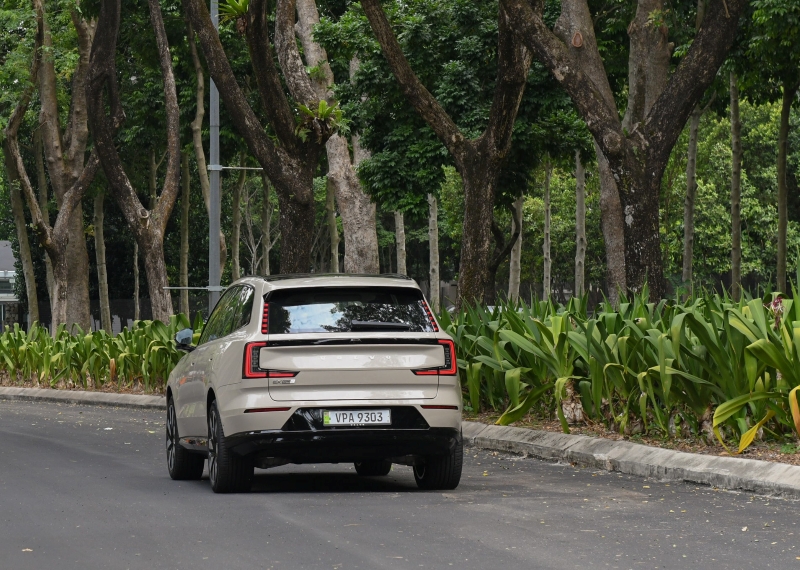
Despite its large size, the EX90 is surprisingly easy to drive, with a smooth and swift pickup and small turning radius for those tight U-turns. Manoeuvring cramped basements may trigger its sensitive sensors, but they do not assault you with blaring sounds. In fact, the Park Assist System even shows the distance between your car and an obstacle in centimetres so you can make informed readjustments.
As always, safety is Volvo’s number one priority. There are cameras and radars all around, forming an invisible shield over the EX90 and working together to respond and react when needed. The Lidar uses infrared light waves to collect information about the vehicle’s surroundings and can identify the distance to objects, whether day or night.
This invisible shield works inwards as well, with special sensors that gauge eye gaze concentration. It sends the driver a nudge when they appear distracted or drowsy. If they remain unresponsive, the EX90 is designed to safely stop and call for help. And if a forgotten occupant (or furry friend) is detected after the car is locked, a series of alerts will be triggered and climate control turns back on to maintain a safe environment.
There are some minor peeves that one should take into consideration, such as the lack of overhead hand grips and steering wheel buttons not being backlit, hence needing the driver to rely on muscle memory for the controls at night. But the Volvo EX90 still scores high marks overall. Priced at RM442,888 on-the-road without insurance, it is a top contender in the seven-seater SUV segment and one you should definitely consider if you are on the lookout for an EV.
This article first appeared on July 7, 2025 in The Edge Malaysia.