
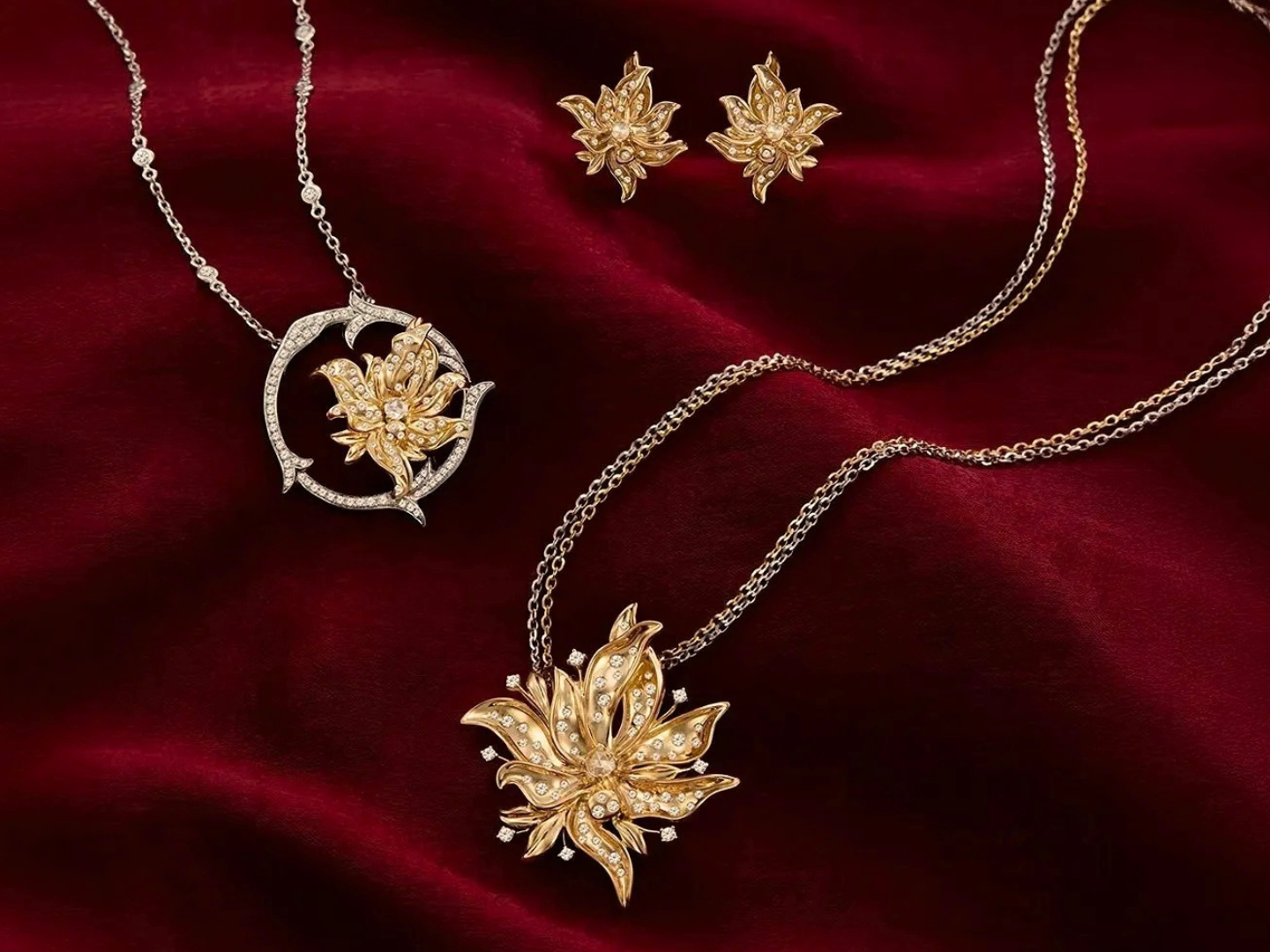
The Kenanga necklaces and earrings (All photos: Suen)
If true the basil a drum could be,
And mushrooms sprout upon the door;
If true thy love for me should be,
Snip me a garment from the clouds or more.— Azah Aziz, 'Malay Textiles and Costumes: Form and Style'
From the arts to science, nature’s textures, colours, shapes and symmetry are often studied and imitated in contemporary lifestyles. From a beautifying standpoint, botanical motifs are evergreen in interiors, décor and style.
This enduring relationship between environment and dress was spotlighted by the late textile historian Azah Aziz. Her book Malay Textiles and Costumes: Form and Style contained several chapters and pantun delineating the earth’s wonders and their prominence in Malaysia’s cultural heritage. Her own collection of fabrics and garments included several rare specimens such as one-of-a-kind limar songket that only a couple of living artisans still know how to produce. The art of adorning oneself also intrigued her, and her trove included vintage jewellery and accessories.
In honour of Azah’s legacy and in collaboration with her daughter Tan Sri Zeti Aziz (who helped translate Malay Textiles and Costumes and now oversees her mother’s sartorial estate), home-grown jeweller Suen recently released a fine jewellery collection inspired by the textiles and emblems she held dear.
body_photo_-_2026-11-03t212016.857.png
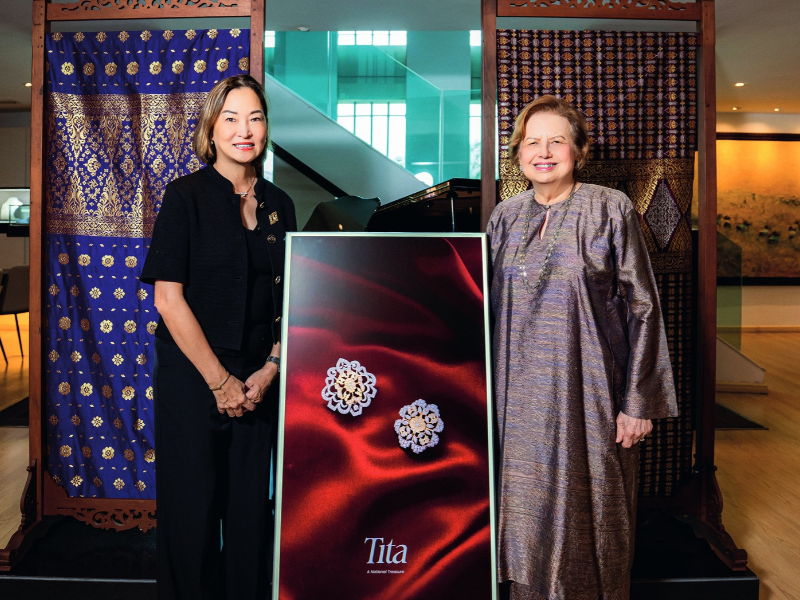
Titled Tita after the author’s nickname, the 33-piece oeuvre is fashioned from 18-carat gold and diamonds. References range from almost instantly discernible to more subtle, achieving a level of wearability central to Suen’s design philosophy. “I’m always looking for inspiration and it’s wonderful any time we can bring in something cultural to our repertoire. We went through the book and decided to divide the collection into four categories. Each textile has distinct motifs and inspirations that were translated onto the fabrics, and we extracted those elements and converted them into the Tita designs,” says the brand’s founder Lee Sze Suen.
For Zeti, commemorating the art forms her mother dedicated her life to was the most exciting aspect of the collaboration initiated by Lee, with whom she has been friends since the 1990s. “The inspirations seen in the collection are the same as the ones in the textiles. All these references come from nature and the wider universe too — you see stars, flowers and more. Aesthetic value is key to the fabric artisans and the people who cherish what they make, and Suen has captured and translated that beauty into some very creative designs,” she says.
A nod to batik, the country’s most recognisable cultural fabric, was a must. The jeweller decided its homage should manifest through brooches emulating the sinuous lines traditionally hand-drawn with canting and wax. Delicate yet sculptural, they feature petal-like forms emanating from yellow gold centres before transitioning to white gold outer tiers. Covered in diamonds, they carry enough punch to be worn alone on a lapel or scarf, as well as clustered together for greater visual impact.
body_photo_-_2026-11-03t212000.388.png
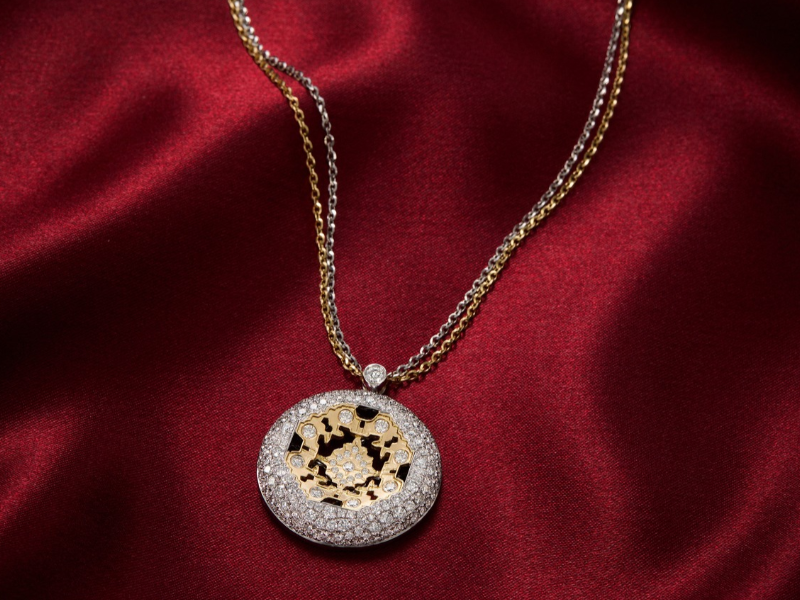
Rendered in yellow and white gold and generously set with diamonds, the lattice-like construction of songket gets its moment in the sun on the Tampuk Pedada pendant and matching brooch. The textile itself is crafted by weaving wisps of gold or silver through a plain base, resulting in a shimmering cloth surface. The bedazzled finery emulates its layered nature, starting with a four-pointed star at the heart that fans out into geometric edges imitating raw hems where the fine separate threads are most obvious.
The Bunga Pecah Lapan suite — comprising earrings, a pendant and bangle — is a more nuanced take on the same material, focusing on the eponymous symbol. Each radiating form is made up of eight rhombus panels textured to evoke the criss-cross grid of interworked fibres. Solo brilliant diamonds perch at the core, providing an understated sparkle that allows the angular shape to shine. “This pattern is also called the eight petal rosette or bintang, which means star,” says Lee, who lists the design as one of her favourites from the collection. “It’s well known and often used in songket, and has a groundedness to it.”
body_photo_-_2026-11-03t212011.030.png
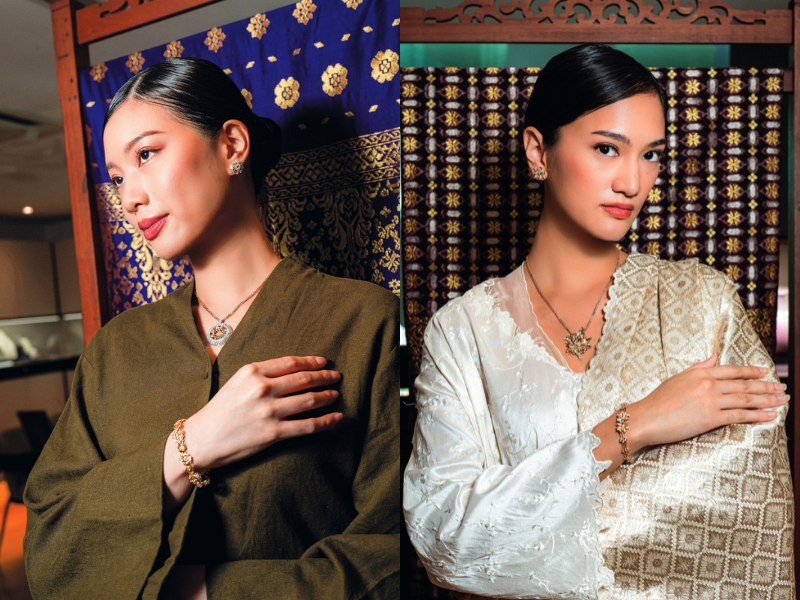
Little bushels of quatrefoil buds amid winding vines define the Bunga Cangkuk pieces. Bigger versions of the design make for a pair of statement stud earrings, while a chain of smaller ones serve as the links of a chunky bracelet. The inspiration here is tekat, or Malay gold-thread embroidery, where thick needles are used to bring metallic floral or geometric patterns to life on velvet fabric.
Naturally, the real flowers behind the staple motifs also take centre stage. A prime example are two necklaces from the Kenanga series. On a white and yellow gold double chain, the larger pendant features the fragrant ylang ylang on its own, a sprinkling of gems across its curving petals. Its sibling may have a slightly smaller blossom, but is complemented by a diamond-encrusted Sulur Bayung circle in reference to the curling young shoots commonly reproduced in Malay decorative carvings.
body_photo_-_2026-11-03t211953.241.png
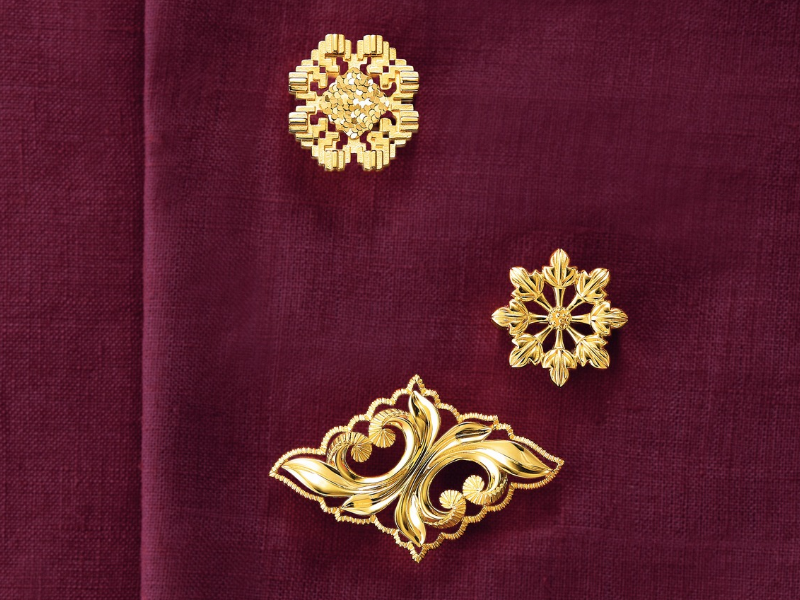
As an extension of the collaboration between jeweller and historian, the Tita collection also encompasses six Heritage Brooches, which are available exclusively at the newly reopened Merdeka Textile Museum, where Azah’s collection is now on display. Crafted from gold-plated sterling silver, they are a more accessible option suitable for casual everyday wear. From magnolias and bamboo shoots to kuntum seri (referencing floral arrangements created for celebrations) and benang emas (the gold threads in songket and tekat), the clips are perfect for adding to an existing cultural wardrobe or as a starting point for one.
In all conservation efforts, deepening the public’s emotional connection to a subject matters just as much as factual education. Accessories with the power to spark conversations, that allow wearers to carry a piece of their heritage with them, are a fabulous way to further a cause. Zeti notes: “When people know the stories and meanings behind something, they will feel more protective of it. These motifs and textiles have been repeated and produced over generations. Today, many of them are at risk of going extinct because people are not aware of their value. That’s why it is important to undertake initiatives such as the Tita collection and exhibition at the Textile Museum, to underline the craftsmanship that generates such distinct beauty.”
This article first appeared on Oct 26, 2026 in The Edge Malaysia.