
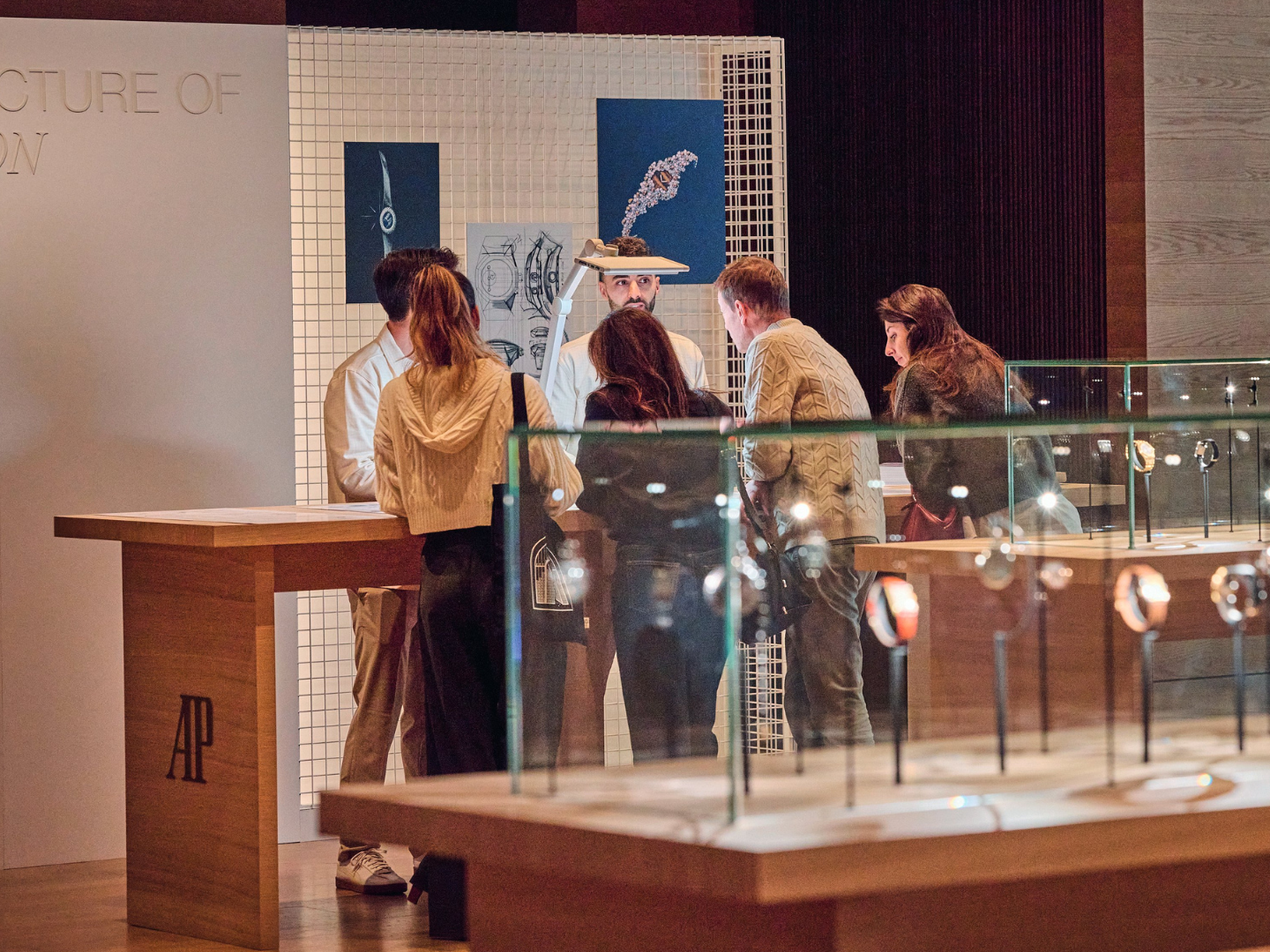
Watch enthusiasts at the AP Social Club visit one of the many dedicated stations in the workshop (All photos: Audemars Piguet)
A pair of trousers has very few mysteries left. Yet stitched almost imperceptibly into its anatomy is a small tailoring oddity: a narrow slit beside the front pocket that serves no obvious purpose and is barely wide enough to admit one or two idle fingers. If it was never intended for coins or passing curiosities, what could possibly justify its existence?
Giulio Papi, Audemars Piguet’s director of watch conception, reached into his chinos and withdrew what appeared to be a round prototype, cool to the touch and reassuringly weighted. He rotated it slowly, light skimming the curve of its polished edge, before offering a gentle correction to anyone tempted to call it nostalgia. “Pocket watches used to sit in this kind of slim recess to protect them from dust and impact,” he said. “But this modern horological feat I’m about to show you will bridge 150 years of our heritage and the next century.”
2.png
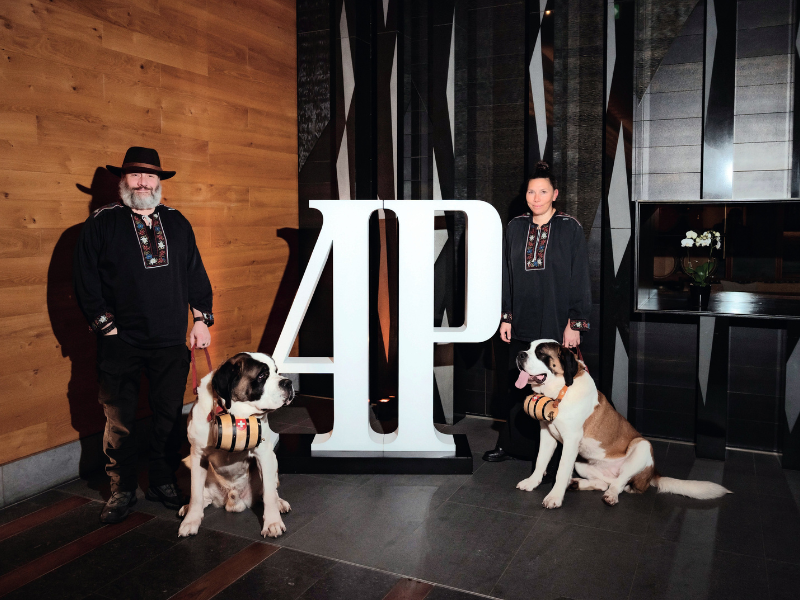
The watchmaker, who was raised in La Chaux-de-Fonds and co-founded Renaud & Papi in 1986 as an independent atelier dedicated to advancing high complications, was addressing a group of journalists at the 2026 Audemars Piguet Social Club, the brand’s invitation-only salon that introduces novelties outside the traditional trade fair circuit. Previous instalments had taken this peripatetic gathering to cities such as Milan, where a “Crystal Sky” Royal Oak Perpetual Calendar created with musician and collector John Mayer debuted in 2024, coinciding with the opening of a new AP House in a converted garage on Via Bagutta, tucked within the city’s historic fashion district.
This year, the event unfolded in Andermatt, a former military garrison that had been transformed into a year-round alpine destination, perched in the Urseren Valley of central Switzerland. Encircled by snow-laden peaks and the deep stillness of midwinter, the mountainous valley lent the occasion a natural sense of remove from everyday life, allowing the focus to settle squarely on complexity and craft. It was fitting, then, that Papi was unveiling what would prove to be the most ambitious undertaking in the maison’s history yet.
body_pics_4.png

The object in question was the limited-edition 150 Heritage Pocket Watch, and it was by no means a ceremonial anniversary trinket. It is built on the bedrock of Calibre 1000, which arrived in the 2023 RD#4 “Universelle” wristwatch. Rather than transplanting that design, Audemars Piguet re-engineered it for the pocket watch, removing the automatic winding system to produce a wholly hand-wound movement known as Calibre 1150. Comprising 1,099 components, it beats at 3Hz and has a guaranteed 60-hour power reserve.
This sesquicentennial triumph extends well beyond its structural lineage. In total, it consists of 47 functions, including 30 complications, a tally that encompasses the movement itself and what is mounted on the hinged caseback. Among its defining features are familiar pillars of high watchmaking: grande sonnerie as well as petite sonnerie; minute repeater enhanced by the maison’s Supersonnerie acoustic technology; flying tourbillon; semi-Gregorian perpetual calendar and a split-second flyback chronograph. On paper, the spec sheet warrants a moment’s pause; in execution, however, these elements are anything but stacked. Intricately orchestrated, the calendar indications are relocated to dedicated apertures, preserving clarity and ensuring the chronograph counters remain immediately legible rather than visually congested.
Such compositional discipline becomes even more evident when the case is flipped. Rather than concealing its reverse, the 150 Heritage integrates a Universal Calendar within the inner cover — an independent device uniting solar, lunar and lunisolar cycles in a continuous display. Separate from Calibre 1150’s timekeeping train, it yields 18 readings across eight complications, including seasonal markers and nine cultural celebrations drawn from global traditions. Some are solar, such as Christmas — said to be rooted in Sol Invictus — and Saint John’s Day, which reflects Inti Raymi. Others follow the moon, including Ramadan, while several are lunisolar, among them Diwali, Rosh Hashanah, Pesach, Vesak, Easter and Chinese New Year. All are programmable via a single bidirectional wheel spanning the years 1900 to 2099 — proof that even humanity’s most elaborate attempts to fathom time, occasionally, can be advanced with a twist of the thumb.
4.png
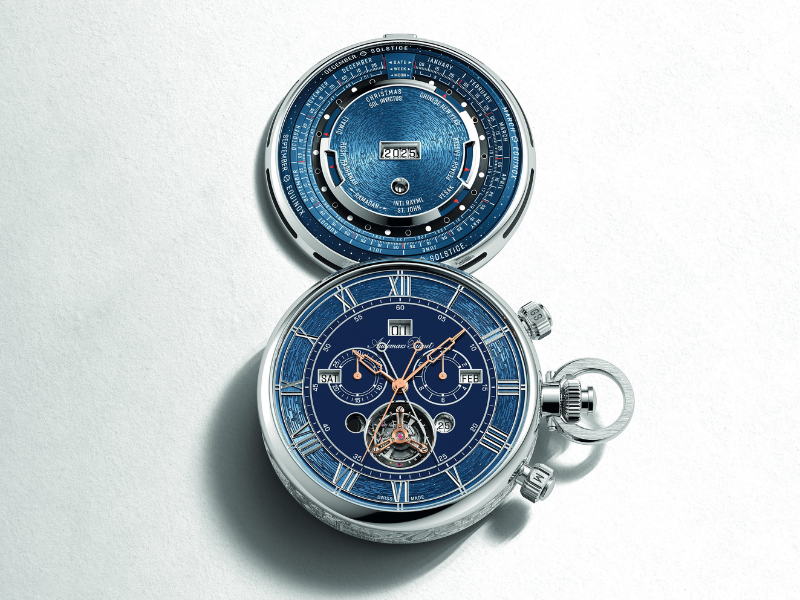
For all its computational prowess, the ticker fundamentally rests on human touch — specifically, the artisans preserving the rare métiers d’art that characterise haute horlogerie. Audemars Piguet entrusted the finishing to master artisans, beginning with a platinum case entirely hand-engraved. By concentrating the chronograph pushers and crowns along a limited section of the case flank, the remaining surface becomes a canvas for commemorative scenes such as the portraits of the founders and the emblem for the 150th anniversary. The dial continues that dialogue between astronomy and artistry, crafted in 18-carat white gold and finished in blue translucent grand feu enamel, built up through successive firings to achieve depth and luminosity.
“The calendar is a big invention that took us almost 20 months to complete. It’s essentially a mechanical computer,” asserts Papi, noting that the system still requires direct user input to operate. “More importantly, it honours the astronomers and early scientists who first looked at the sky, the mathematicians who divided time and the watchmakers who made it visible. The 150 Heritage embodies human ingenuity and talent, reflecting a longstanding tradition of craftsmanship across civilisations.”
Oak to joy
If one looks past the polite rhetoric of community and celebration, the AP Social Club reveals something more pointed about luxury watchmaking: an exercise in narrative control. Rather than competing for attention in an industry chorus, Audemars Piguet convenes its own stage and scripts the terms of engagement. Visibility, in the conventional sense, is hardly the objective. Its emblematic Royal Oak is already one of the most recognisable silhouettes in contemporary horology, a design so culturally embedded that it functions as shorthand for success. What renders the club consequential is not just the merchandise but the way meaning is cultivated around it.
The brand’s novelties are contextualised within a wider conversation on aesthetic direction, competitive standing and longevity. Each reference is presented as part of an ongoing progression — be it calibre engineering, case construction or material research — rather than an isolated launch. The exhibition consolidates product, philosophy and projection into one coordinated moment, ensuring that interpretation begins by the maison’s rules rather than in the speculative aftershock of release.
A recalibration is also underway. For years, observers have questioned whether Audemars Piguet risks over-identification with what some construe as a de facto mono-collection, an ecosystem dominated by the octagonal bezel and Tapisserie dial. The Social Club becomes a counterargument to that critique. By foregrounding a wider spectrum of complications across its portfolio, the Swiss stalwart demonstrates scope in practical ways. Even if commercial demand continues to favour established icons, the presentation underscores technical range and creative plurality. It counters the notion that the manufacture’s identity is anchored to a sole blueprint.
1.png
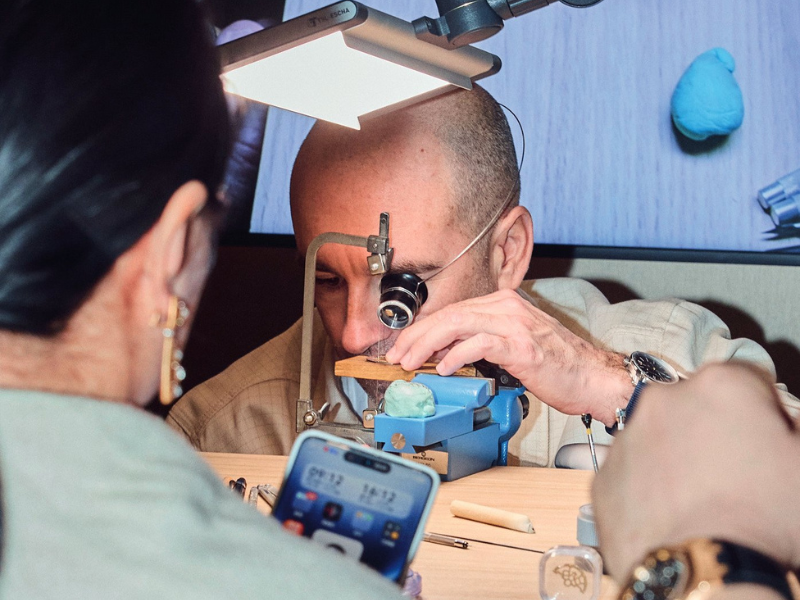
CEO Ilaria Resta echoes the view. “We are extremely inclusive. There are no men’s or women’s watches. We care about people, and they decide whatever passion they have,” she explains. Drawing on capabilities developed in-house at its Le Brassus and Le Locle manufacturing facilities, the company aligns its technological authority with a broader objective: accessibility. She casts this as “opening up the industry to as many people as possible and breaking down barriers to knowledge to welcome all enthusiasts and connoisseurs, whether they’re customers or not”.
In practice, this results in a distinct format. The showcase at Andermatt is structured around dedicated stations, each driven by a specific field — Energy, Hairspring, Gemmology or Openworking — where savoir faire is presented first, with the finished watch emerging as a logical outcome. Resta describes it as “a didactic flow”. The priority is on comprehension before consumption, framing craftsmanship as premise and the timepieces as its consequence.
One area that drew sustained interest was the aperture-based section of the Neo Frame Jumping Hour, where crowds formed almost continuously. Inspired by the Streamline Moderne movement — the late Art Deco current shaped by ocean liners and trains — the piece transposes that aerodynamic clarity into a compact rectangular case measuring 32.6mm by 34mm. Fashioned out of 18-carat pink gold, it is defined by eight vertical gadroons along each flank that taper into pointed lugs, the motif extending to the caseback, crown and oscillating weight. At its core sits Calibre 7122, the manufacture’s first self-winding jumping hour movement, conceived entirely in-house and based on Calibre 7121. Time is portrayed through two pink gold-framed apertures set within a black PVD-treated sapphire crystal: a jumping hour above and trailing minutes below.
3.png
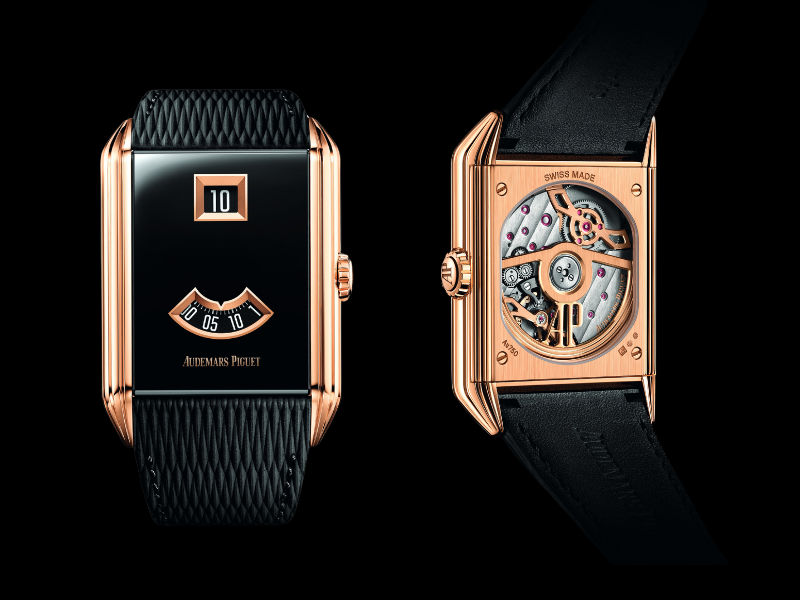
Its pared-back façade belies a far more complex interior. Unlike its 1920s predecessor, which relied on metal dials, this reinterpretation replaces the material with sapphire while maintaining 20m water resistance. Because the crystal is exposed at 12 o’clock and 6 o’clock without a conventional bezel to secure it, the dial plate is bonded directly to the sapphire and then screwed into the case — a technique developed specifically for this model. A newly designed crown refines winding ergonomics, while a black calfskin strap, embossed with a motif created in-house, integrates seamlessly between the lugs. More than a stylistic departure, the Neo Frame signals a renewed commitment to alternative time display, almost brutalist in spirit, expanding the maison’s mechanical vocabulary beyond its most recognisable codes.
Inevitably, comparisons have surfaced with the revival of a historic guichet showstopper from a French house last year. The Neo Frame, nonetheless, is not so much an archival homage — there is a difference between looking back with precision and using history as a springboard. The claim that Audemars Piguet is reacting to a passing fascination with jumping hours overlooks both context and chronology. Crafting a proprietary self-winding calibre with instantaneous hour change requires extensive development — power distribution, disc weight calibration, shock resistance and spatial constraints must be resolved well before a case design is finalised. Neither the mechanism nor its housing could plausibly have been assembled in response to a single year’s market enthusiasm.
Equally, windowed time indication is not foreign to Audemars Piguet’s oeuvre. Early 20th-century jumping hour pieces and the wandering hour Star Wheel evoked a recurring interest in unconventional displays long before the latest resurgence. The alignment with present tastes may be convenient, but the groundwork was laid well in advance.
That narrative continued beyond the vitrines. Apart from announcing the headline models, the workshop component deepened the AP Social Club experience in more instructive ways, tying the conceptual to the tactile. Sébastian Vivas, the brand’s heritage and museum director, appeared — briefly and memorably — in an Albert Einstein wig and moustache to reflect on different perceptions of time, a session that, despite its levity, captured horology as both physics and craft. Elsewhere, attendees were invited to try hand-bevelling — which quickly revealed the patience and muscle memory required to achieve clean interior angles — and to experiment with the handheld texturing tool used to craft frosted-gold finish.
body_pics_3.png

This emphasis on process culminated in Audemars Piguet’s first-semester collection, which comprises 22 releases. Alongside the headliners, the Royal Oak and Code 11.59 Perpetual Calendar Openworked returned in fresh iterations powered by Calibre 7139, the skeletonised evolution of the crown-adjusted Calibre 7138 last year. The movement consolidates all calendar corrections into the crown and displays the perpetual calendar in European format — the day at 9 o’clock, date at 12 o’clock and month at 3 o’clock — with week indication, moonphase, leap year and 24-hour indicators completing the layout. In these versions, the architecture is fully visible through a sapphire dial and caseback. The Code 11.59 model appears in white gold with a black ceramic midcase on an alligator strap, while the Royal Oak pairs titanium with a bezel and caseback in Bulk Metallic Glass (BMG). A full-ceramic Royal Oak Selfwinding Perpetual Calendar in “Bleu Nuit, Nuage 50” continues with the Calibre 7138, set within a matching case and bracelet.
Rare is the watch that enters a room and immediately commands the floor. As stone dials go, the Royal Oak Selfwinding Malachite, available in 37mm and 41mm, is about as unapologetic as it gets, trotting a sizing duo that makes a persuasive case for his and hers. The swirling green comes alive against the strict geometry of its stablemates, exuding richness without excess. Building on the turquoise editions released in 2023, this rendition pairs polished malachite with 18-carat yellow gold, applied indices and luminescent hands. For those inclined towards making statements in miniature, the Royal Oak Mini in 23mm offers a more jewel-like proposition, distilling the signature bezel into something closer to a bangle that is less boardroom, more champagne bar.
This article first appeared on March 2, 2026 in The Edge Malaysia.