
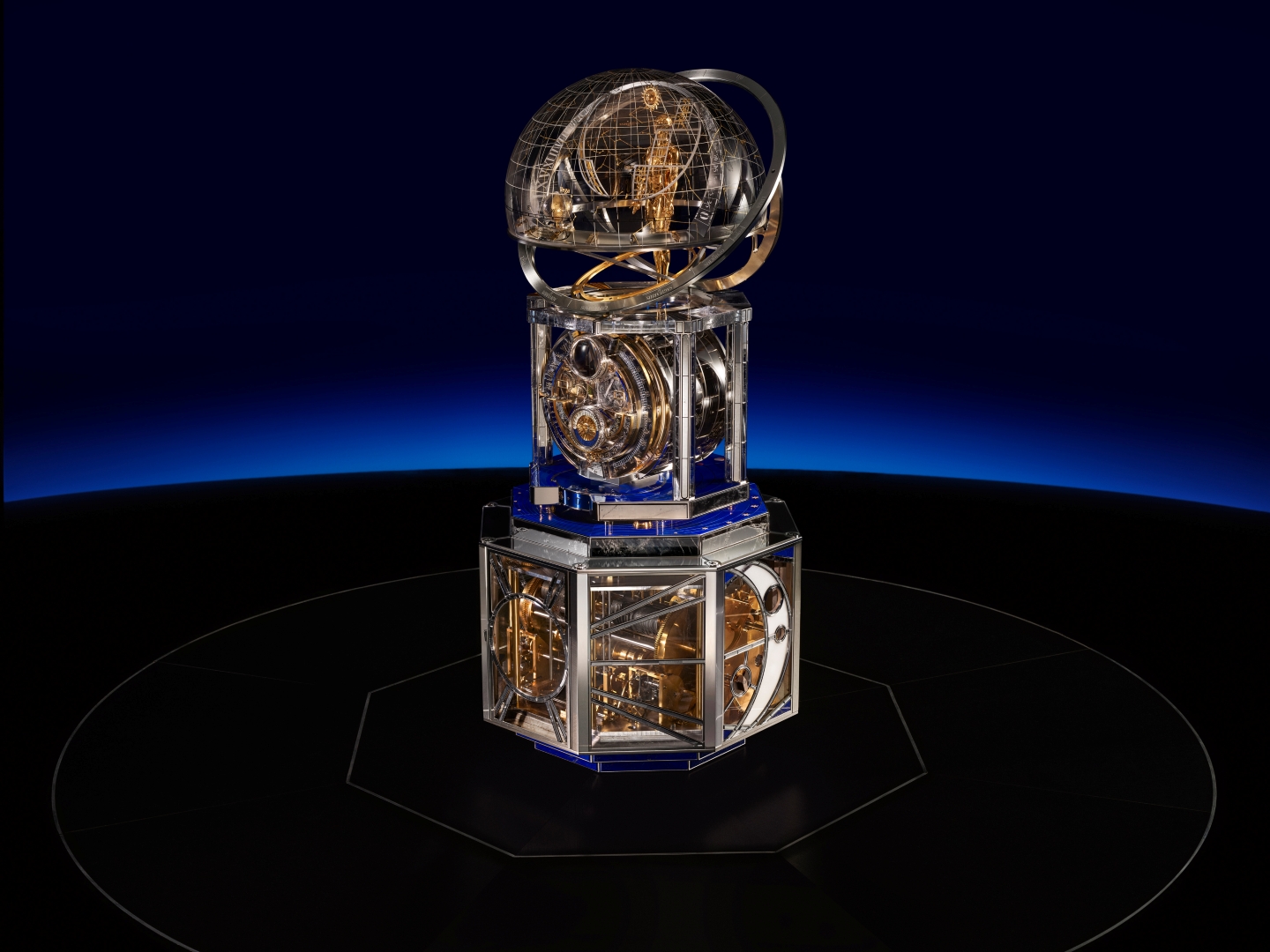
La Quête du Temps is an unprecedented work of mechanical artistry that unites the worlds of watchmakers, artisans, designers, engineers and astronomers (All photos: Vacheron Constantin)
Founded in Geneva on Sept 17, 1755, Vacheron Constantin’s foundations were built during a period of intellectual and social dynamism. The Age of Enlightenment saw a thirst for knowledge and an explosion of ideas and breakthroughs in science, philosophy, astronomy and horology.
The spirit of discovery and human ingenuity is reflected in the maison’s latest creation: La Quête du Temps, which translates as “the quest of time”. A project that took seven years to complete, the astronomical clock comprises 6,293 mechanical components, 23 watchmaking complications and 15 filed patent applications. It stands 1.1m tall and weighs about 250kg.
La Quête du Temps is an unprecedented work of mechanical artistry that unites the worlds of watchmakers, artisans, designers, engineers and astronomers. They include master automata builder François Junod, CEO and creative director of clockmaking house L'Epee 1839 Arnaud Nicolas and Vacheron Constantin’s own senior designer of Les Cabinotier Alexia Steunou and special development project manager Luc de Siebenthal.
The monumental structure is defined by three integrated sections: the base, astronomical clock and dome.
vac_lqdt_packshot_focus_5.jpg
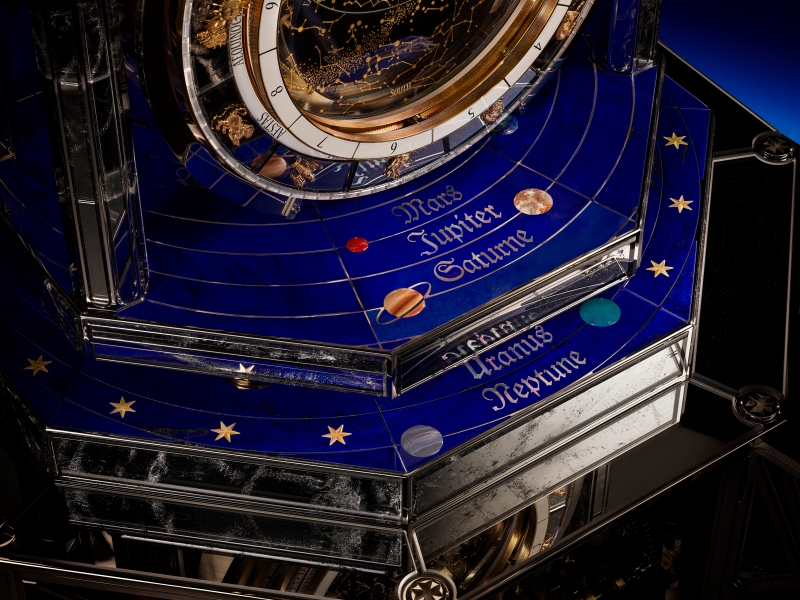
Rendered in rock crystal and quartzite, the base houses its elaborate mechanics and instruments, and is decorated with a geometric motif of the sun and moon. Supporting the second tier is a two-level plinth that depicts the solar system against a background of lapis lazuli. The planets are presented through outstanding stone marquetry and the sprinkling of stars is set with mother-of-pearl.
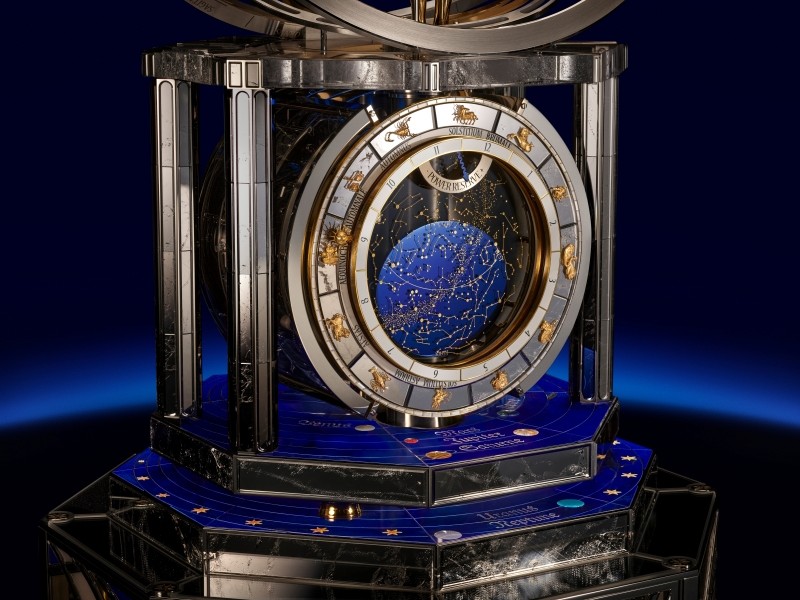
Moving up, the astronomical clock features two dials. A series of arcs, curves and concentric circles enliven the front, with Vacheron Constantin’s signature retrograde displays taking centre stage. A tourbillon is encased under a magnifying glass at 12 o’clock, drawing attention with its whirring Maltese Cross-shaped cage. A 24-hour display balances it out at 6 o’clock with a stunning hand-guillochéd sun. To keep this decorative element from rotating, it is mounted with a new weighted ball-bearing system, for which a patent is pending.
On the reverse, gold zodiac appliques surround a celestial vault of the Northern Hemisphere. The dial tracks the movement of the constellations in real time, making a full rotation in one sidereal day (23 hours, 56 minutes and 4 seconds).
vac_lqdt_packshot_focus_2.jpg
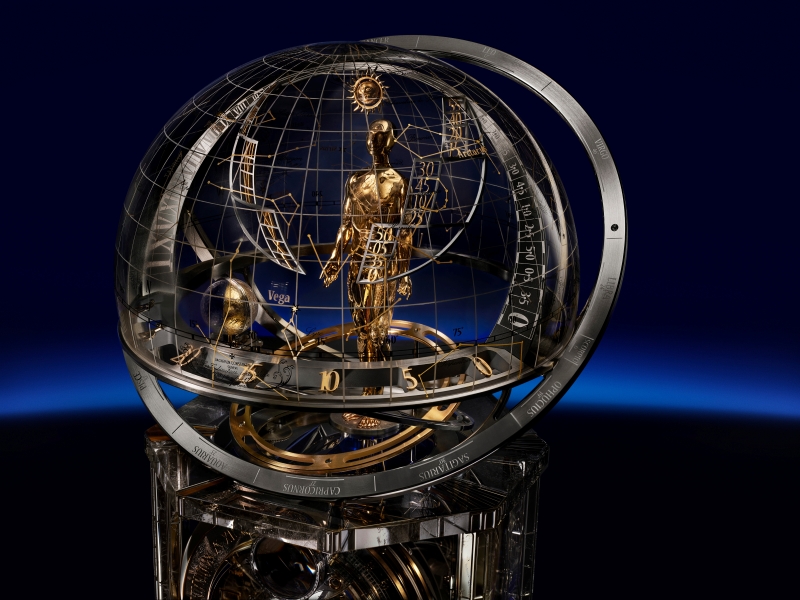
At the apex is the automaton. The gilded Astronomer is positioned beneath a borosilicate glass dome decorated with constellations that reflect how the sky would have appeared at 10am in Geneva on Vacheron Constantin’s founding day. The exact chart was identified with the help of astronomers from the Geneva Observatory. Through this collaboration, they also discovered that during the precie moment, four planets — Venus, Mars, Jupiter and Saturn — were visible above the city, including a rare conjunction between the Sun and Jupiter.
When activated, the automaton performs three sequences, inviting viewers to observe the cosmos and the stars within its periphery before indicating the time with its arms. The numerals on the floating hour and minute scales are arranged at random rather than sequentially, yielding 144 different movements in total. French musician and artist Woodkid had a hand in composing the melody — courtesy of a metallophone and Wah-Wah tubes — that accompanies each sequence.
The 3D retrograde moon is another highlight of this section. Precise to 110 years, the moon phase indicator runs on a 29.5-day cycle. To maintain accuracy, a barrel is hidden within the sphere, which is linked to both the Astronomer automaton and the clock, making it an entirely new watchmaking complication.
vac_lqdt_packshot_focus_3.jpg
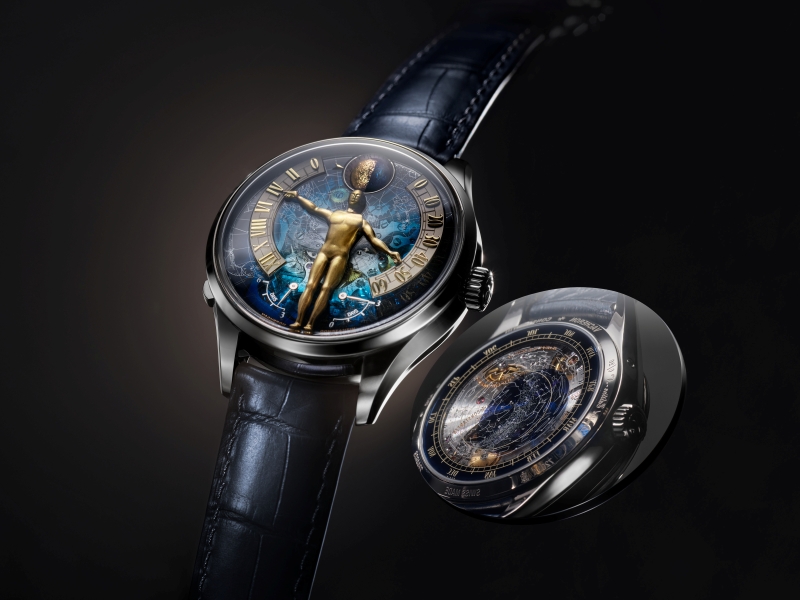
A double-sided wristwatch, Métiers d’Art – Tribute to the Quest of Time, has also been released in conjunction with the maison’s anniversary. It is powered by the new manually wound manufacture movement Calibre 3670, for which four patents have been filed.
Drawing from La Quête du Temps, the watch features its own Astronomer whose arms glide along two retrograde displays. There are two modes, “active” and “standby”. In the former, the arms function like hands on a standard watch dial while in the latter, the time runs invisibly in the background while the arms remain in neutral until the pusher at 10 o’clock is manually activated.
The figure is set against a background depicting the constellations as seen from Geneva on the day of the maison’s founding. A spherical 3D precision moon display shows the exact age of the lunar planet in relation to its phase. This can be manually adjusted at any time without damaging or disrupting the watch.
On the other side, a sky chart showcases the sidereal day and tracks the constellations in real time with an accuracy of a one-day variation in 9,310 years. Presented in a 43mm white gold case, this exceptional number is offered in a limited edition of 20 pieces.
vac_mda_7200a-00g-h103_stilllife.jpg
Representing a milestone in Vacheron Constantin’s partnership with the Louvre, La Quête du Temps acts as the centrepiece of the Mécaniques d'Art exhibition at the museum in Paris.
It will be showcased alongside 12 notable works from the Louvre’s collection, including The Pendule La Création du Monde, an astronomical clock presented to Louis XV in 1754; an automaton in the form of a peacock, made in copper alloy and dating from 962 or 972; and a polyhedron table clock created in 1662 by Pierre Sevin.
La Quête du Temps runs at the Louvre from Sept 17 until Nov 12.