
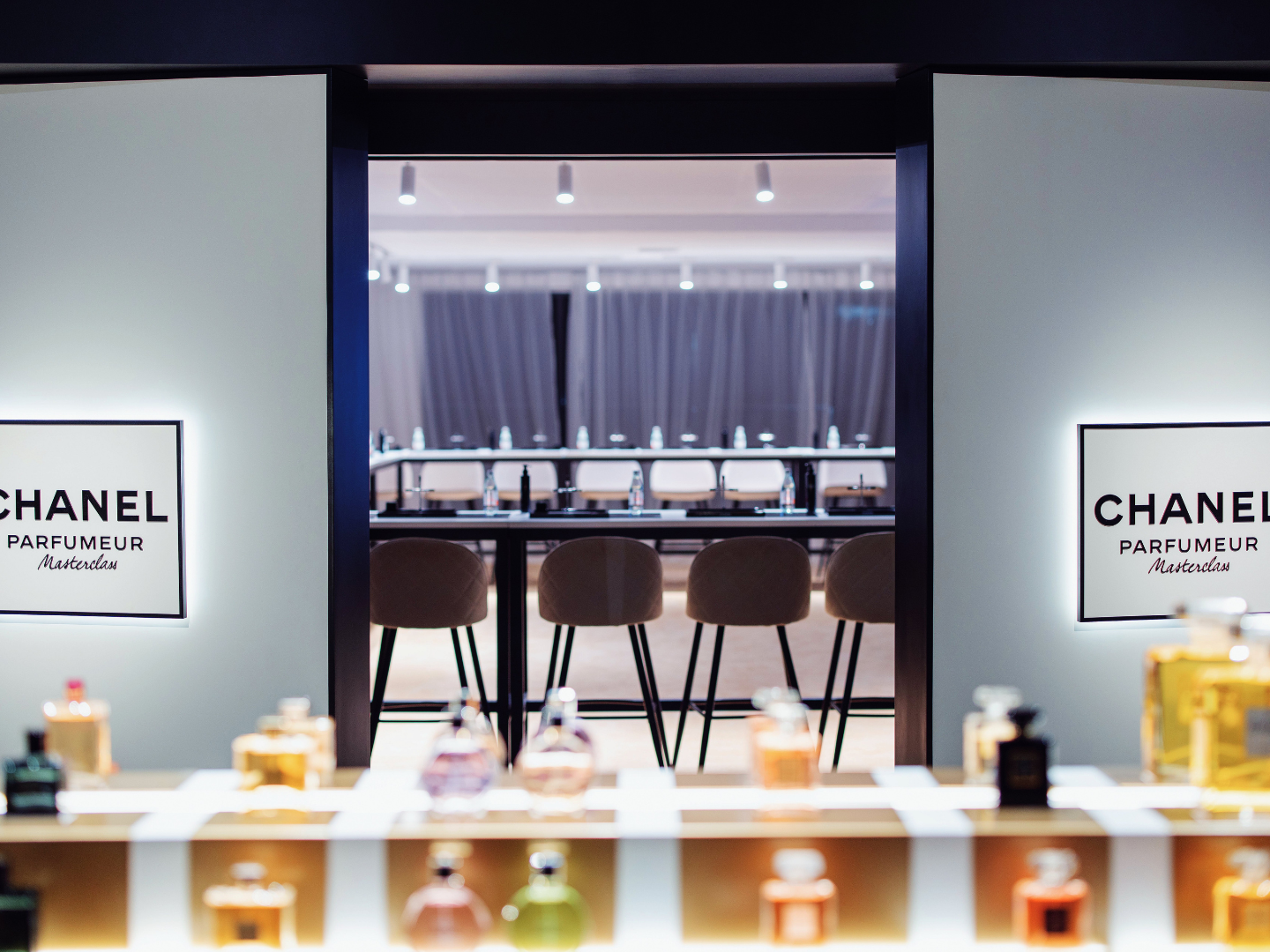
The inviting setup in One Bangsar beckons with an array of bottles (All photos: Chanel)
In late spring, before the sun has fully committed to rising over the mounts of Grasse in France, the roses in Joseph Mul’s fields near Pégomas are already listening. The 50-acre estate sits serenely off a country road that threads through the Siagne Valley with no signage or fanfare, just the suggestion of the pre-Alps to the northeast and an errant Mediterranean breeze carrying — if the morning is kind — the first faint breath of Rosa centifolia (cabbage rose), prized for its honeyed notes.
Piano melodies drift low across the terrains, dissolving into the air the way smell does — not out of romance, though it is difficult to avoid in a place heady with flora and folklore, but out of necessity. The Mul family, which has farmed this land across five generations since the 1900s and grown flowers exclusively for Chanel’s signature No 5, discovered that reverberations ripple through stem and leaf, keeping rust and fungus at bay. Here, science wears the disguise of a sonata.
“This,” says our trainer for the day, setting a blotter before us, “is where it begins.”
Alas, we are not in Pégomas, though by the end of our perfumery masterclass, we might as well be among the French pickers culling frilled blossoms by the calyx before dawn, gathering petals into burlap sacks like offerings after a wedding procession. A single inhale catapults the room into a Provençal reverie, blissfully removed from the incontestable reality of inboxes awaiting us on a working Friday morning.
2.png
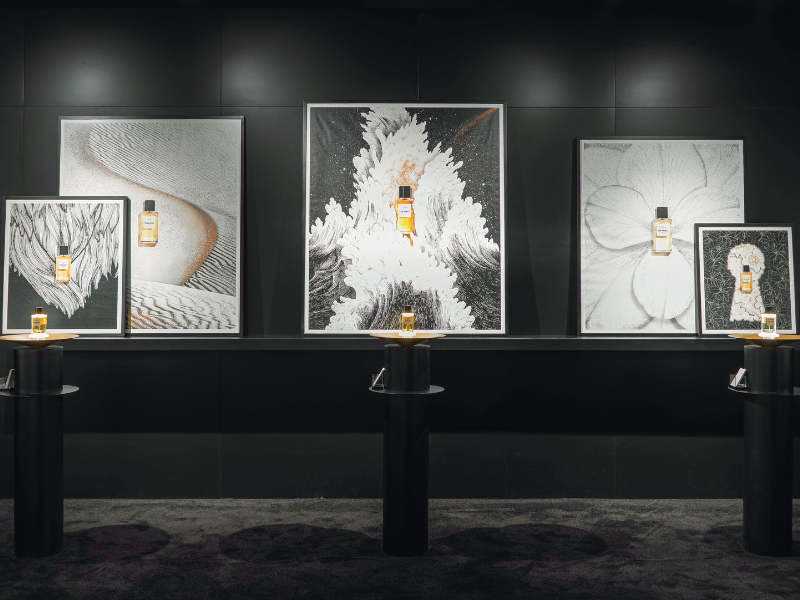
Humans have been conditioned to reach for language the moment sensation arrives, to pin a thing down before we have fully felt it. Chanel’s olfactory experience at One Bangsar in Kuala Lumpur, however, asks the opposite: Surrender first to impression, and only later to words. This, too, is biologically by design. Of all the senses, smell alone bypasses reason entirely, reaching directly for the part of us that safeguards our oldest and dearest recollections: a mother’s embrace, a particular quality of light in a space we will never enter again, or, for Gabrielle “Coco” Chanel, true romance. A fragrance remembers them for us.
Of all the men in the French fashion designer’s life, none captured her heart more completely than Arthur “Boy” Capel, the elegant British polo player who championed her creative ambitions before anyone else did. They shared a decade together before he died in a road accident in December 1919, at just 38. Gabrielle never truly recovered from the loss, instead translating his nonchalance and ease of moving through the world into a blueprint for a new kind of femininity: women in tweed, flat shoes and silhouettes borrowed freely from the male wardrobe, yet made entirely their own.
Later, it fell to Olivier Polge, the maison’s fourth in-house perfumer, to do what the namesake founder never quite could: give Capel a scent. Boy Chanel, part of the Les Exclusifs collection, was conceived as “the mark of a man on the skin of a woman”. Its foundation is a fougère accord, that crisp, woodland structure of fern and oakmoss long claimed by the science of aromatics as its most classically masculine. Polge shaped it, as Gabrielle once tailored menswear to her own body, into something that belonged to no single gender but felt unmistakably Chanel. It is, in the end, a love letter composed in a bouquet of lavender, sandalwood and the gentle persistence of longing.
This fidelity to feeling is not merely poetic. No house has worked harder to ensure that what begins in the earth arrives intact in the bottle; that the distance between the blooming hills of verdant Grasse and a dresser somewhere in the world is one of form only, never essence. “La fleur au flacon,” Polge often says. The phrase, meaning “the flower in the bottle”, contains everything our masterclass seeks to impart.
1.png

The alchemy of scent, we learn, is an art of memory. A jasmine is never only jasmine; it is a dried corsage pressed between letters; hotel soap in the Riviera that evokes the joyful spirit of the 1920s Côte d’Azur; the powdery collar of a grandmother leaving for dinner. Even among the participants in the class, the difference between ambery and woody is, depending on who you ask, either everything or nothing at all. In one session, bergamot was identified, with great conviction, as “clean laundry”. Honestly, who would argue otherwise?
Perhaps the most revealing ritual of all is Le Quart d’Heure Alchimique, Chanel’s complimentary in-store fragrance consultation, though “consultation” feels far too clinical for something so disarmingly intimate. Seated before a screen with headphones draped lightly around the neck, one is presented with a series of images — rows of windswept irises, a figure suspended mid-dive above an azure sea, golden necklaces glinting against tweed skirts — each accompanied by its own carefully composed soundscape. The instruction is simple: notice what resonates; not what ought to, nor the version you would like to project. The resulting choice is almost never the one anticipated.
chanelfragrancemasterclass-05_09394-photobyallisamazing-hdr_1.jpg
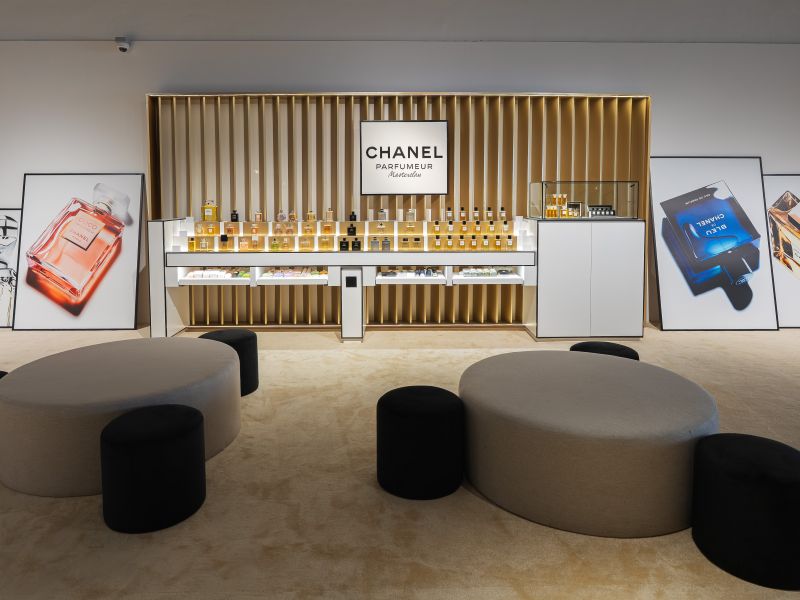
Arriving with tidy preferences already in mind — woody, citrusy, opinionated — we gravitate instinctively towards the cheery visual of yellow lemons, only to find ourselves matched not with the expected feminine, ambery warmth of Coco Mademoiselle, but the effervescent Chance Eau Fraîche, bright with citron and jasmine over a grounding base of teak wood. It is, apparently, deeply possible to want to smell like a fruit left on a sunlit windowsill, proving once again that aspiration and instinct are two very different things.
A fragrance chosen well, ultimately, is an admission of who you have always been. There is a peculiar humility in realising how little we know, and genuine surprise in discovering which notes the hand and nose reach for when left to their own devices.
The Chanel Parfumeur Masterclass is running until June 7 at One Bangsar, 63, Jalan Ara, KL. Book your slot here.
This article first appeared on May 18, 2026 in The Edge Malaysia.