
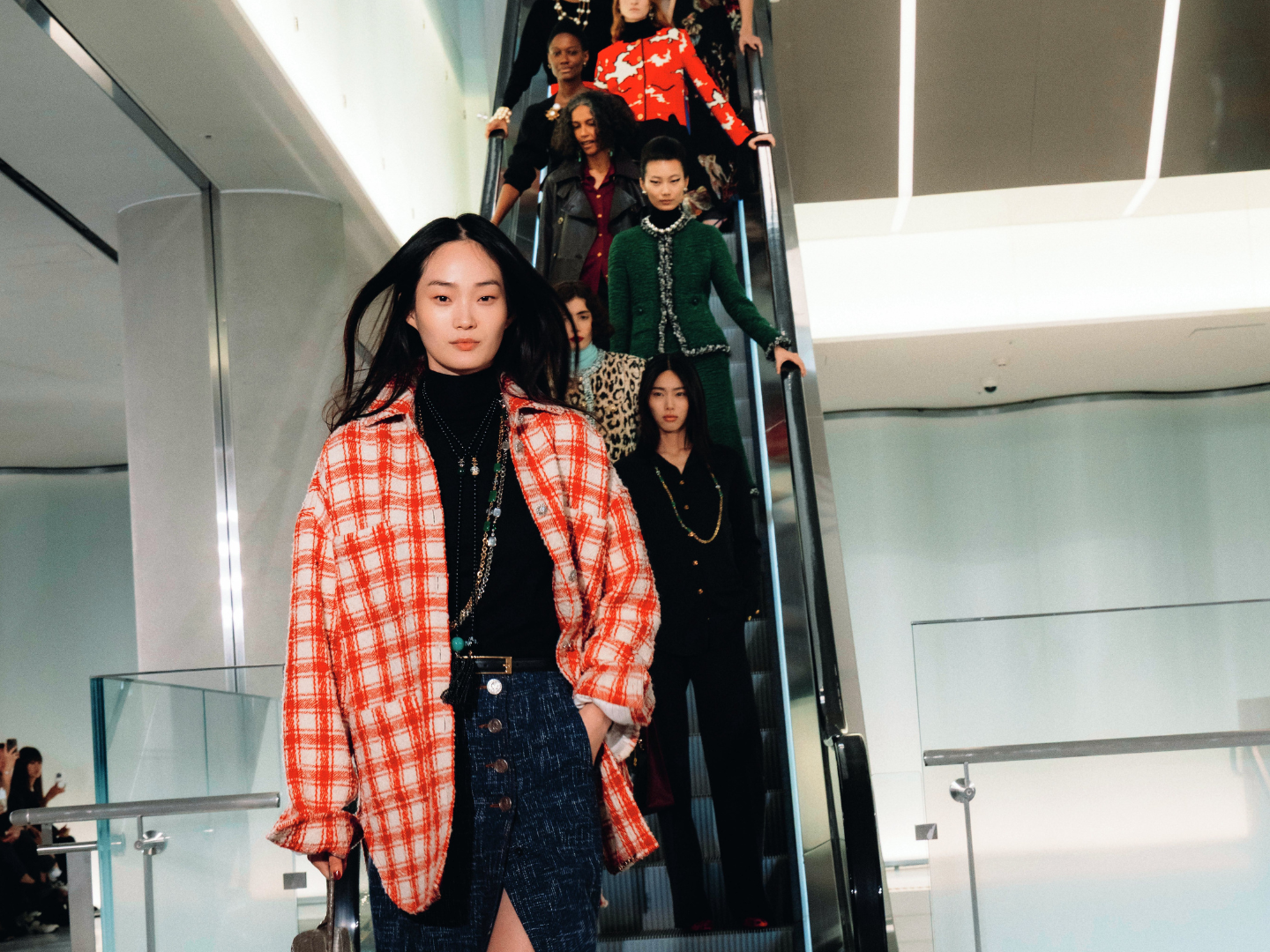
Models dressed in Chanel's 2026 Métiers d’Art collection strut through the Centre Pompidou Hanwha (Photo: Chanel)
There is no denying the white-hot buzz Seoul is emanating round the clock right now. K-culture is at an all-time high, from music, movies, food and drink to being the ever-evolving epicentre of a globally dominant beauty and cosmetics industry. And while those who have successfully summited Mount Kilimanjaro would know the slowly-does-it Kiswahili chant of pole, pole, the South Korean capital’s mantra, on the other hand, is ppalli-ppalli (fast, fast). And yet, beneath the city’s frenetic veneer is an almost Zen-like core, distilled from centuries of Buddhism, which arrived on the Korean peninsula during the Three Kingdoms Period, slowly earning its place alongside the country’s indigenous musok or shamanistic practices. It is this duality, this sharp juxtaposition of contrasts, which underscored the recent outing organised by Chanel for the replica show of Matthieu Blazy’s first Métiers d’Art collection.
What was initially unveiled amid the gritty glamour of the abandoned Bowery subway station in New York City last October, the 2026 Métiers d’Art collection practically transformed itself from pumping Big Apple energy into a serene artistic paean as it travelled from the Americas to Asia for a repeat performance. Chanel also enjoyed the rare privilege of commandeering the entirety of a gleaming new art museum (the Centre Pompidou Hanwha only opened to the public a week later) as the backdrop against which to display the maison’s Métiers d’Art.
For those unfamiliar with the term, it refers to the complementary and exceedingly exacting skills and accoutrements of high fashion, which include but are not limited to featherwork, embroidery, goldsmithing and millinery. The 146-year-old Lemarié, for example, is one of the world’s most renowned names for decorative feathers and flowers. Then, there is Lesage, the premier embroidery and tweed house, as well as shoemaker Massaro, whose provenance dates back to 1894 and is forever embedded in the annals of fashion history for creating Chanel’s signature two-tone footwear. The brand has been steadily acquiring these specialised ateliers one by one in its bid to preserve heritage craftsmanship as well as elevate the exceptional savoir-faire Paris is famous for.
All these specialised ateliers have since been brought together at le19M, a dedicated creative hub near the French capital, whose name is a mishmash of Mademoiselle Gabrielle “Coco” Chanel’s favourite number (her birthdate was Aug 19) while the “M” represents mode (fashion), mains (hands), métiers d’art (crafts) and maisons (houses).
2.png
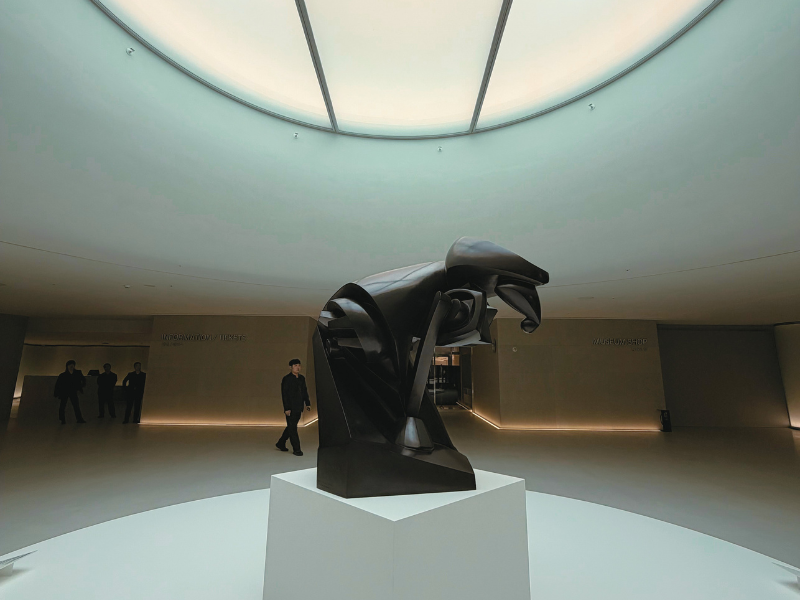
Just as le19M serves as a bridge — literally (geographically, it is located between Paris’ 19th arrondissement and the town of Aubervilliers) and technically (between atelier and runway) — likewise the Centre Pompidou Hanwha served to link South Korea and France as well as Europe and Asia, together with the international art community. Located in the financial district of Yeouido and in Jean-Michel Wilmotte’s “box of light” structure (the Frenchman is also the talent behind the Grand Palais Éphémère in Paris and the Ullens Center for Contemporary Art in Beijing) that spans over 10,000 sq m across four levels, the museum, though not officially open, was already filled with works of art drawn from the Centre Pompidou in Paris’ modern and contemporary collections.
The stage for the Seoul show was confined to the museum’s two main galleries. In that space of 1,500 sq m each, and surrounded by a wealth of Cubist works from names as illustrious as Pablo Picasso and Georges Braque, the setting could not have been more different from a New York subway station. And yet, the same spirit and sense of eclecticism — conveyed by the personalities Blazy envisioned — blurred the lines between fiction and reality.
4.png
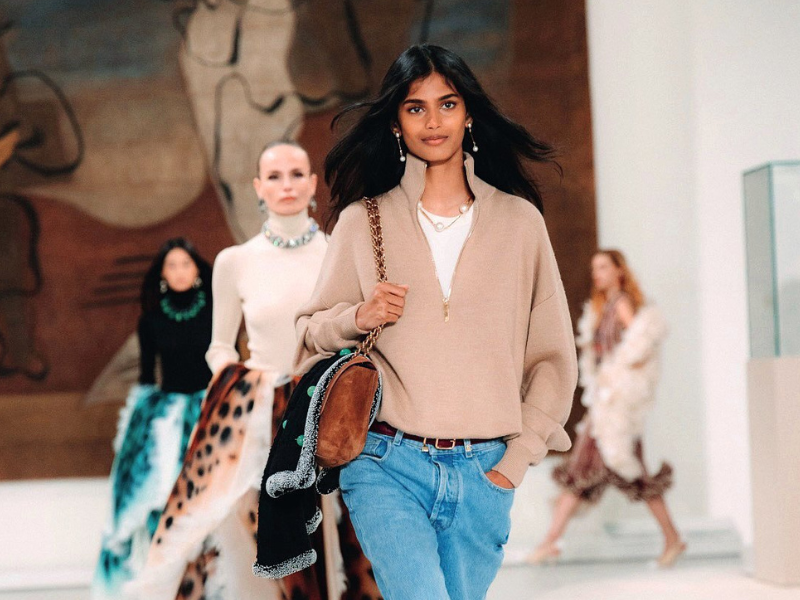
In front of an audience that included South Korean superstars G-Dragon and Jennie of Blackpink, as well as actresses Marion Cotillard and Tilda Swinton, the sensational Indian model Bhavitha Mandava reprised her New York role, playing out Blazy’s version of the Student in the now-iconic beige wool and silk sweater with blue jeans look.
What followed was a show-stopping parade of unforgettable ensembles, each one a testament to the artisans of le19M. There were the Tourist (wearing a silk and cotton, fully sequined “I Love NY” top), the Socialite (in a floaty ball gown skirt jauntily paired with a turtleneck) and even the Dog-Walker (Blazy’s own beloved pooch John John — said to be named after John F Kennedy Jr — was immortalised in custom motifs on a quilted handbag), encapsulating the many feminine characters one might chance upon or meet in public, be it a subway station or an art space.
There was also a strong cinematic aesthetic present throughout, as evinced by looks that referenced Hollywood films, such as the 1931 Tonight or Never (which, interestingly, Coco Chanel herself designed the costumes for) as well as the clearly character-driven Superman-inspired cashmere sweater but with the house’s signature double-C logo embedded within the recognisable pentagonal yellow stylised shield with a red border.
1.png
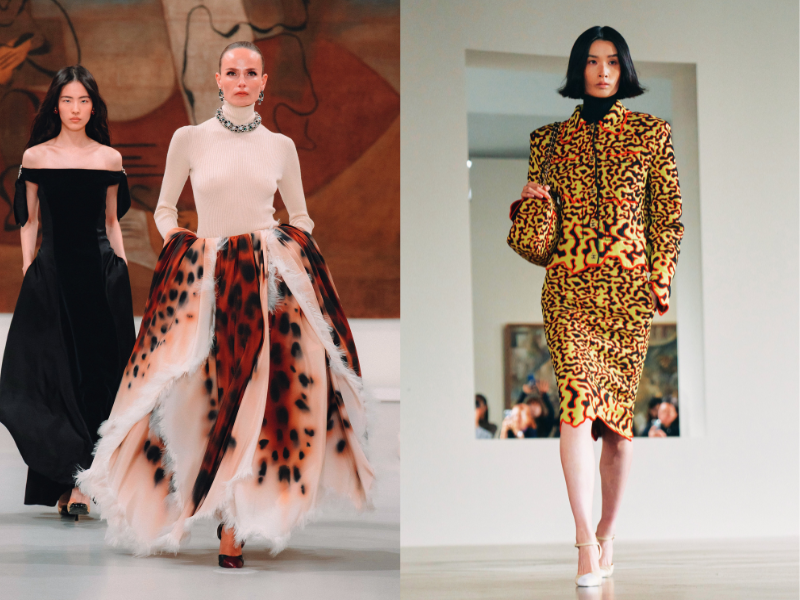
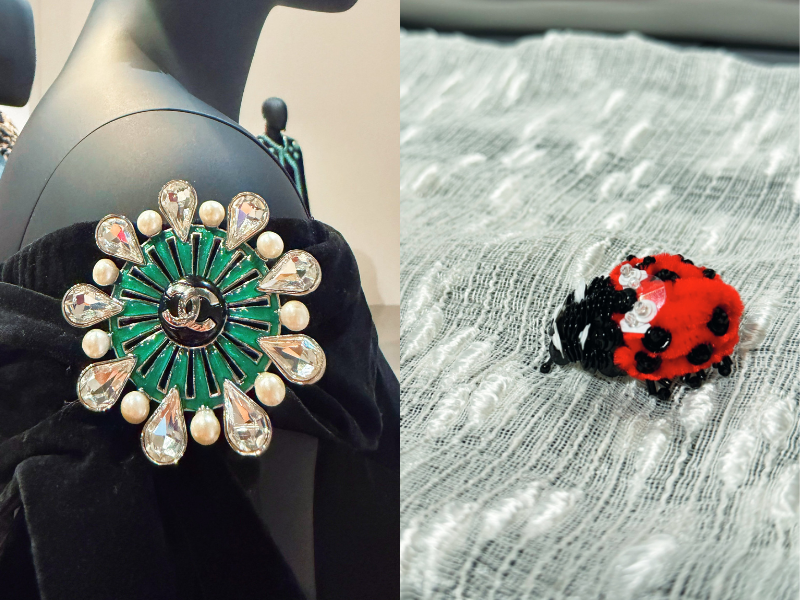
The fantastical flowers and plumed fringes were courtesy of Lemarié (who has been making Chanel’s emblematic 16-petal camellias and hand-assembling the corolla since the 1960s) while the specially commissioned and visibly exquisite leopard print tweed (Animalia! In tweed!) was by Lesage, who used a hand-weaving loom to interlace warp and weft threads of diverse sizes, colours and textures to evoke the irregularities of the animal’s pelt. The delicate little ladybirds on a white skirt suit were the sublime artistry of Atelier Montex. It was reported that each required over 10 hours of work, painstakingly embroidered using rhodoid discs, red chenille, sequins and beads and the help of the Lunéville crochet hook.
Accessories-wise, models wore leopard fascinators and headbands created by Maison Michel’s deft team of hatters while the stunning accessories and gleaming minaudieres were, naturally, by the iconic goldsmith and fashion parurier, Goossens.
body_pics.png
Despite the exquisiteness of the clothes’ details, there was also a great sense of wearability. This was evident in the way the fabrics moved as the models walked confidently and — in true big city style — very fast-paced. The overarching takeaway was that the collection was a sartorial love letter dedicated to the thoroughly modern woman of today: someone with a million things to do and a million places to go and yet has a matter-of-fact “let’s get on with life but look good while doing so” attitude. In short, real-world verve versus ceremonial stiffness.
Although the 2026 Métiers d’Art collection has proven to be an undeniable triumph for Blazy, it is perhaps a musing by Mademoiselle Chanel herself that captures the New York to Seoul zeitgeist perfectly. “Fashion is not something that exists in dresses only. Fashion is in the sky, in the street; fashion has to do with ideas, the way we live, what is happening.”
By him, for her
The Chanel woman, as interpreted by Matthieu Blazy, is strong — in spirit, mind, soul and body
3.png
In a way, it is like déjà vu. Chanel enthusiasts have long been aware that Mademoiselle once dallied with Hollywood. In 1931, at the behest of United Artists honcho Samuel Goldwyn, she even travelled to Los Angeles, the US, to consider creating costumes for the divas of the day — which she did — such as Gloria Swanson in Tonight or Never (1931), Barbara Weeks in Palmy Days, as well as Ina Claire, Madge Evans and Joan Blondell, all of whom starred in The Greeks Had a Word for Them (1932). It is this same cinematic spirit that runs through Matthieu Blazy’s 2026 Métiers d’Art collection like an undercurrent.
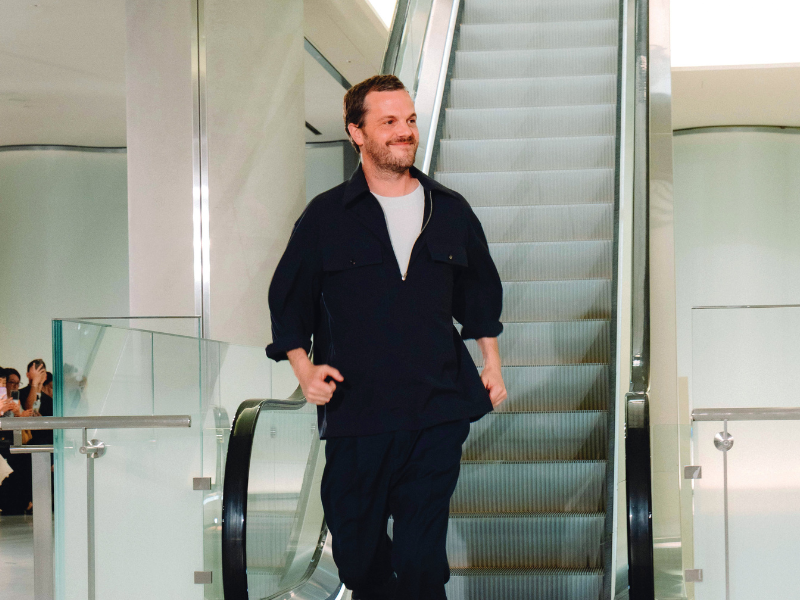
Despite the plentiful nods to the celluloid screen within the 81-strong looks, Blazy did not design with solely screen goddesses in mind. Far from it. “I have the idée that women have a choice to be whatever they want, whenever they want,” he says during a special walk-through of the collection immediately after the Seoul showcase. “A woman can be a mother, on the go with her kids at school; she can be the leader of a big company; she can also be lazy at home — she has that right; she can be a superhero; she can go to the opera with her husband or her girlfriend… the life of a woman is not defined by her outfits. It is way more than this.”
With this philosophy in place, Blazy set about adopting a non-linear approach as to how he wished to incorporate the pillars of the show: the treasure houses that are Chanel’s métiers d’art maisons and keepers of its savoir-faire; the indomitable spirit of Coco Chanel herself and of the modern woman.
“When we did the show in the New York metro, I liked the idea. It had all these women, these characters. After all, life and freedom is all about meeting new people, and being amazed by who you could bump into around the corner. So when it came to doing this show again, it was evident I would like to bring it to [South] Korea. Not that I want to compare New York with Seoul, although both have similar energy, [but] there is something very magnetic that is happening here.”
Asked to expand on that comment, Blazy says, “The first is the [South] Korean culture. By which I mean it is a culture that has become global. We all know it: K-pop, incredible chefs, incredible food, incredible movies... I immediately thought Seoul would be the perfect background for this collection. Second, it was also interesting to show the clothes in this new museum. I particularly like the fact [the first exhibition] is all about Cubism, which represents many a woman or a man.”
Taking a small assembly of journalists through the various looks, he explains how the pluralism of everyday life is uplifted and celebrated. “With these looks, she can run to the office, do the shopping… that kind of thing.” Blazy also shares his intrigue with animal prints. “It is not part of what people usually know about Chanel. But when I went into the archives, I quickly realised that she wore a lot of animal prints, quite possibly being among the first to do so in the 1920s. Then I was also very happy to invite superheroes in. What I like about the collection is that there is no one specific time or era. You have the people of today. You have people from the 1970s, people from the Art Deco period,” he explains, referencing the diverse styles and sources of inspiration captured among the collection’s creations. “Just like today, it is a kind of melting pot.”
Reiterating the special position Métiers d’Art occupies in the Chanel universe, Blazy sums it up succinctly. “It is a ready-to-wear collection but where the tool is the hand,” he states. “We work with all the craftspeople in Paris [whose workshops] Chanel has bought over time. We have Lemarié, Lesage, Montex… and it is very interesting, for me as a designer, to be able to talk with them. Lesage, for example, has deep traditions in embroidery but with Montex, it is way more progressive in its approach. And there is Lemarié, who can do feathers but also, at the same time, pleating. They have so much know-how. When I am standing in front of them, I am humble. I listen,” he wisecracks.
Several Americana archetypes are also present in the 2026 Métiers d’Art conversation, including Jackie Kennedy, Superman, the ubiquitous New York dog-walker, Central Park squirrels, Tony the Tiger and even Al Capone. He points out a few looks he is partial to, citing a woman who goes to the opera then maybe takes the subway home after, as well as those whose aesthetics veer towards the positively doll-like. “They are very cute. In the studio, we call it the ‘cupcake’. You can be a businesswoman but you also have the right to be pretty. Being cute is also a decision,” he smiles.
“You know, Chanel didn’t really like doing movie costumes so much,” Blazy adds. “She didn’t find the freedom she was looking for. On her way back to Europe, she stopped in New York and went downtown. What she witnessed there, in my opinion, changed fashion forever. She saw women wearing fake Chanel — or clothes that imitated the style of Chanel. Instead of [seeing it on the] bourgeoisie or in the salons of Paris, she saw it on women on the move, wearing clothes for real life. So, when she reached Paris, she did a strong gesture,” he says, referring to Chanel’s repositioning of the armholes in her suits to allow greater flexibility and freedom of movement, while fabric was more generously used in skirt-making so as never to constrain a woman’s walk. “I see this as the birth of streetwear,” Blazy proclaims enthusiastically. “In the end, it is more than fashion. It is about being a person who has ‘it’. This is very important. Chanel is not just camellias. It also represents liberation, freedom and movement. After all, at Chanel, the women, they dress for themselves!”
This article first appeared on June 22, 2026 in The Edge Malaysia.