
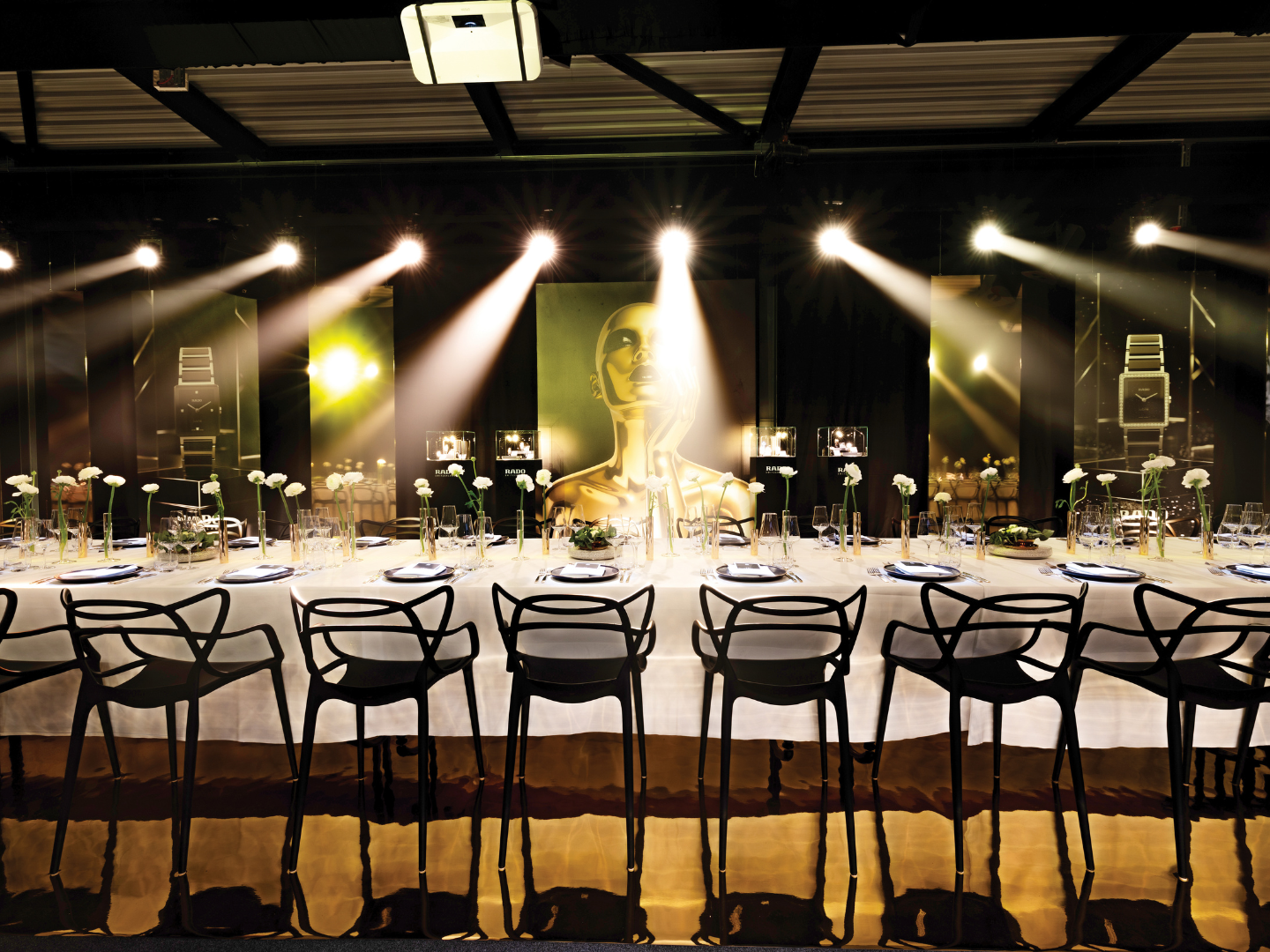
A black-and-gold evening gala mirrors the 40th anniversary edition of the Integral (All photos: Rado)
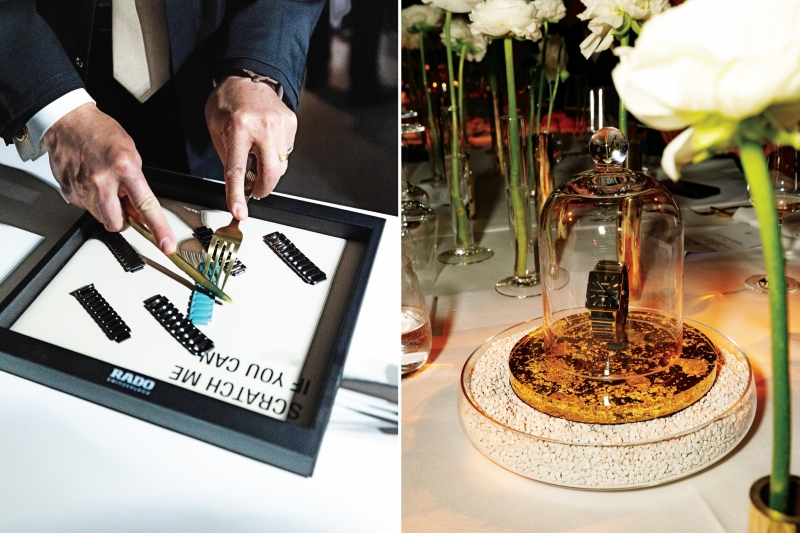
The first Rado DiaStar Original debuted on the world stage in 1962 looking impervious and faintly smug. At horology fairs, where viewing rituals tend towards the polite and microscopic, visitors queued up for the unusual privilege of trying to damage the “absolutely scratch-resistant” piece. They, of course, failed. Keys, coins and fingernails were deployed in vain against a surface made from a substance called hardmetal, which declined even the courtesy of a mark. The composite — consisting of tungsten carbide and a metal binder — was notoriously difficult to machine into anything more adventurous than a flat plane. Yet what it established, more durably than any case, was Rado’s reputation as the Master of Materials.
In fact, it had taken the greater part of a century to get there. In 1917, the Schlup brothers — Fritz, Ernst and Werner — converted their parents’ home in Lengnau, Switzerland, into a watch factory. They were movement men at heart: precision engineers whose stock-in-trade was the tiny, intricate mechanics that made other people’s timepieces tick. None of them could have reasonably foreseen the company they named after the Esperanto word for “wheel” would one day borrow its innovation from the domain of aeronautics.
But the instinct had always been there. The DiaStar had demonstrated a willingness to move beyond the prevailing conventions of the era, bringing hardmetal to the wrist and establishing durability as the starting point. In the decades that followed, the research team in Lengnau continued to push far and wide, developing treatments that gave a case the appearance of gold without its vulnerabilities, while refining the binding and sintering techniques that would later form the foundation for high-tech ceramics. By 1986, the logic had its natural conclusion in the form of the Rado Integral.
5.png
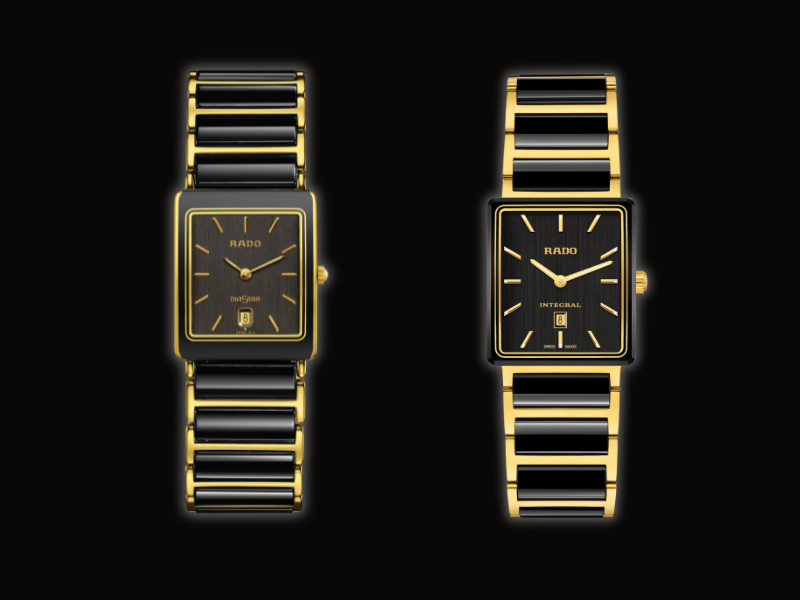
Alas, the public’s response was not, on the whole, effusive. In the 1980s, when gold, steel and brass carried centuries of precedent — as well as the unspoken authority that came with it — ceramics, by contrast, belonged in the kitchen or a particularly ambitious bathroom. That Rado was proposing to fashion an entire watch from it struck many as either very brave or misguided, given how few had seriously attempted such a thing. The notion of producing anything wearable from a substance so hard it could only be cut with diamond tools was considered, in the parlance of the time, close to impossible. Unsurprisingly, the maison appeared untroubled, eventually codifying the attitude in a motto: “If we can imagine it, we can make it. And if we can make it, we will.”
If the origin or naming of Integral seems uncertain, it is only because it once was. The watch launched as the DiaStar Anatom — the suffix borrowed from its ergonomic predecessor — but neither half of the name captured what was genuinely new: the seamless dissolution of any boundary between case and bracelet. Even the sapphire crystal, curved and bonded directly to the body through a patented system, reinforced that impression of unity, softening the overall profile while remaining, paradoxically, among the hardest compounds used in modern horology. By 1988, the only possible verdict for an aesthetic so complete, resolved and continuous had made itself known: Integral.
Wrist assured
There is a particular irony inherent in most luxury watches. You spend a considerable sum on something beautiful, only for daily life — coat zips, doorframes or even the unforgiving edge of a seat belt — to intervene. The horological trade has made peace with this, largely by recasting deterioration as desirability. Scratches acquire the dignity of patina, which then assumes its status as character.
Ceramic pieces, however, do not subscribe to this narrative. They gather none of the usual signs of use, nor the archive of small indignities etched into the surface. Even after a decade of wear, they remain, with unnerving fidelity, more or less as they did on the day of purchase. This can be deeply reassuring or profoundly unsettling, depending on your relationship with the belief that objects should confess their age.
After 40 years, that immunity to decline has only deepened to a point of pride for Rado. Just last month, in the historic lakeside canton of Neuchâtel, the maison commemorated four decades of the Integral with a dedicated anniversary release, alongside a broader collection of nine references.
1.png
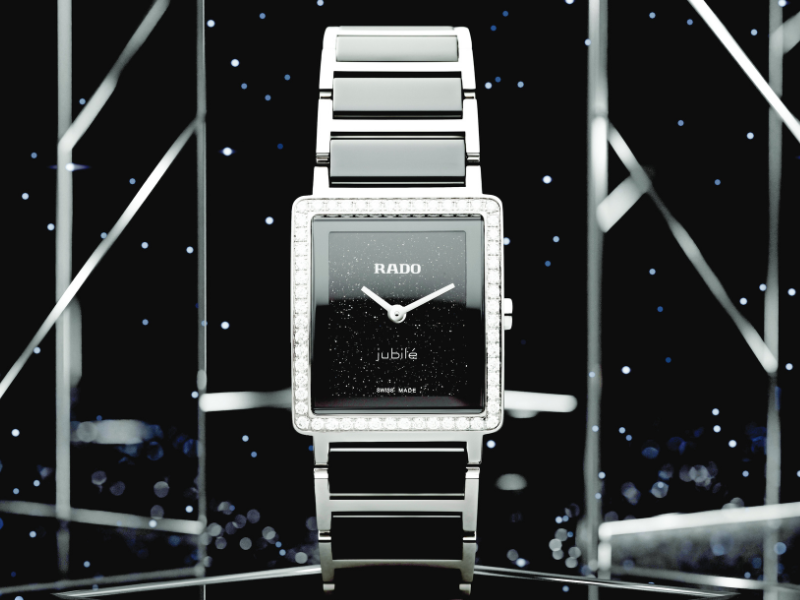
The 2026 iteration is a faithful reimagining of the 1986 forebear: slightly larger to suit contemporary expectations, no less comfortable, and now equipped with the R279 calibre quartz movement featuring PreciDrive technology for exceptional accuracy. Its signature architecture — a slim, rectilinear case and integrated bracelet — remains intact, while extending into a wider range of interpretations, including a bejewelled Jubilé variant. Far from being mere decorative flourish, the 56 Top Wesselton diamonds encircling this glittering marvel serve to heighten the Integral’s geometric clarity as well as calibrated interplay of shimmer and shadow.
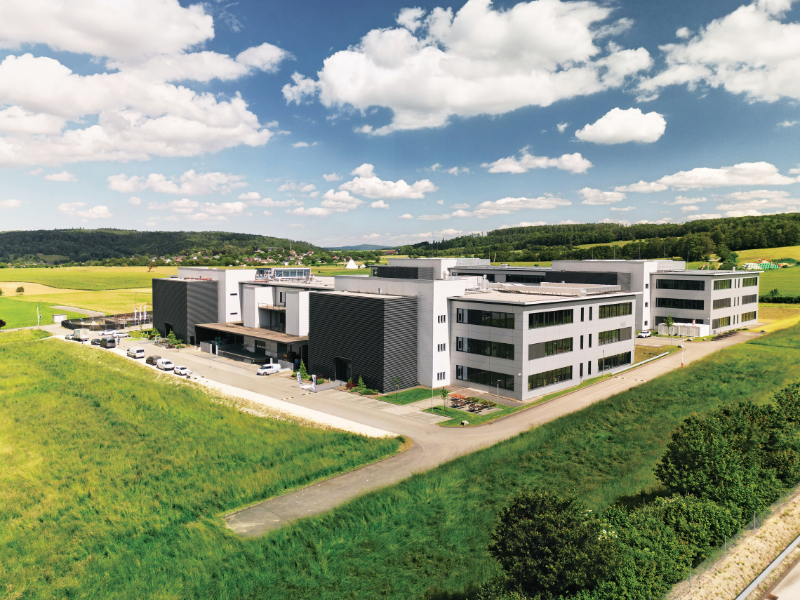
Well aware that retrospectives can easily become a pretext for nostalgia, Rado anchored instead its celebrations at the High-Tech Ceramic Lab at Comadur in Boncourt, where the unyielding material was first coaxed into existence. CEO Adrian Bosshard guided guests through the inner workings behind its creation, past live demonstrations and a gallery-style presentation that positioned ceramic as equal parts engineering and art. A molecular gastronomy dinner came next, after which the gala culminated in a performance by South Korean magician Eden Choi of Britain’s Got Talent fame. The “Golden Buzzer” illusionist and levitation artist ensured that a good time was, quite literally, on the cards, before using sleight of hand to usher in, at last, the Integral emerging from beneath a cloche.
“For decades, our engineers and designers have surpassed existing limits of watchmaking. Hardness alone was no longer enough. We envisioned a material that would combine strength with lightness, resistance with sensual tactility, one that feels like a second skin that will keep its brilliance for a lifetime. Long after its debut, the new Integral stands as the true successor to one of our greatest technical breakthroughs, honouring the legacy of its unmistakable design, strength and eternal beauty, while shining confidently into the future,” Bosshard said during his address, neatly distilling the spirit of the evening.
rodo_integral_40th_anni.jpg
Hot property
A Rado watch is often admired, but rarely obsessed over — that is the honest truth. However, it only takes a visit to Comadur — Swatch Group’s ceramics specialist in Boncourt, which also supplies sister brands such as Breguet, Blancpain and Omega — for that perception to collapse completely.
To understand why, one must first dismantle its associations with pottery or brittle domestic ware. While everyday ceramics derive from naturally occurring substances such as clay, minerals and other geological compounds, high-tech ones begin as ultra-pure zirconium oxide powder engineered to precise particle dimensions, delivering extraordinary uniformity at every stage. Without that degree of control, the final yield cannot attain the density and resilience required for contemporary timepieces.
Manufacturing allows little margin for error. The powder is shaped through tightly regulated methods before undergoing sintering, a firing procedure at roughly 1,450°C that radically alters its internal make-up. So extreme is the heat that components shrink by around 25% as their structure compacts and densifies. The outcome is notably formidable — measuring around 1,250 on the Vickers scale — yet lightweight, hypoallergenic and highly tolerant to abrasions. In practical terms, a ceramic Rado can appear virtually unchanged even years after a steel counterpart has accumulated the sort of nicks and scuffs enthusiasts so often romanticise as “character”.
2.png
There is an unexpected secret buried in all that industrial severity: ceramic also takes colour beautifully. Getting there, however, is an altogether more complicated affair. Imparting hue into high-tech ceramic involves far more than adding pigment to a mixture — every shade must endure the same punishing temperatures and stringent conditions that give the composite its durability without fading, shifting or compromising performance. Rado’s engineers describe it as a pursuit with no fixed endpoint, with each variation posing its own technical hurdles.
Gradually, that painstaking but rewarding undertaking broadened the brand’s palette, from the distinctive Le Corbusier colourways and the True Great Gardens of the World series to the bold expressions seen throughout True Square Open Heart models. The real snag lies not in any one troublesome shade but in preserving cohesion among separately produced parts — case, bezel, crown and bracelet links — where even slight deviations can prove demanding to reconcile. Resolving that took years, turning what seems almost instinctive into one of science’s most stubborn puzzles. Now encompassing 20 colour options, the growing selection suggests that at Comadur, these creations are no longer seen as purely functional but serve as a medium for experimentation.
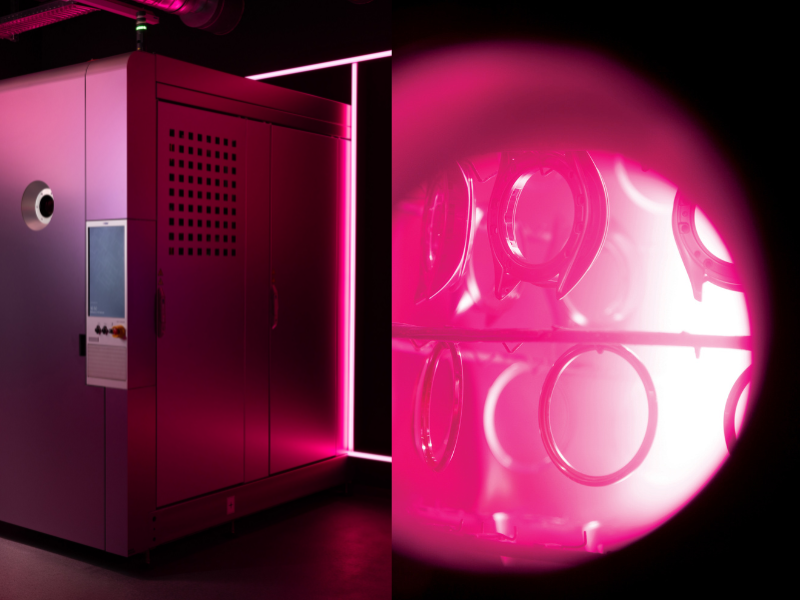
Just when ceramic seems to have revealed the extent of its possibilities, another bewildering development manifests: Plasma High-Tech Ceramic, a treatment reserved exclusively for Rado. If traditional versions already feel like an exercise in material wizardry, this particular incarnation edges closer to alchemy. It starts as polished white components before entering a specialised plasma reactor where temperatures surge to an almost incomprehensible 20,000°C — nearly four times hotter than the sun’s surface and far beyond estimates of Earth’s core. There, carbon is infused into the outer layer, reconfiguring its molecular composition and producing a rich metallic sheen without the inclusion of any actual metal — an effect most vividly captured on some of the lustrous Captain Cooks. The result is a finish that looks cool to the eye but feels almost impossible to the mind.
4.png
Plasma is hardly the final chapter in Rado’s ongoing evolution. Bosshard elaborates on the notion: “At Rado, we have always believed that boundaries exist largely to be overcome. Once people strap on our watches, many are reluctant to return to other familiar alternatives. Of course, you may point out that other brands in the Swatch Group also work with ceramic but there is no rivalry between us. We operate in the interests of the wider group in mind, which means technologies are shared, while each brand dictates its own vision and direction. For us, the work is never finished. Restless curiosity is what led us to Ceramos, and it remains what drives us forward.”
The in-house invention may be the most convincing embodiment of that philosophy. Made up of roughly 90% high-tech ceramic and 10% metal alloy, Ceramos offers the same tenacity to withstand rigours of constant use, all while staying lighter than hardmetal. More significantly, advances in injection technology have enabled it to be moulded with precision, opening the door to visual registers ranging from warm rose gold to rich yellow gold tones.
For all its talk on longevity, plasma reactors and proprietary tech, Rado’s real project may have been something more meaningful all along: not to build watches that endure the passage of time but to reconsider how it should leave its mark in the first place.
Bosshard reflected on this, leaving a final thought that felt especially apt. “Even in moments of uncertainty, watches continue to matter because they are emotional keepsakes that bring people pleasure. That, more than anything, is what gives me confidence about the future.”
This article first appeared on May 25, 2026 in The Edge Malaysia.