
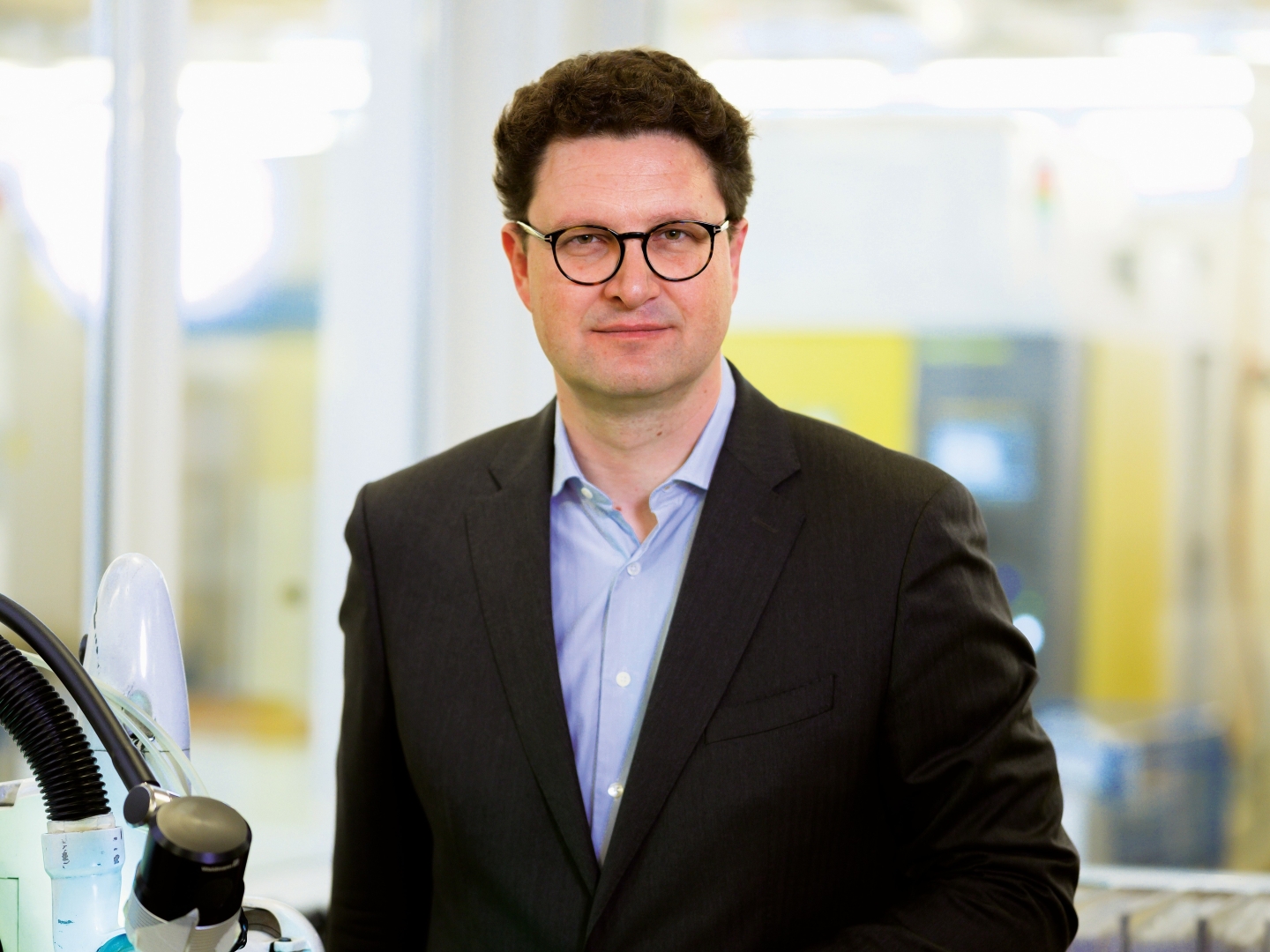
Pascal Béchu was appointed CEO of Arnold & Son and Angelus in May 2026 (Photo: Arnold & Son)
To the casual observer, Citizen is a ubiquitous name; in reality, however, the Japanese conglomerate presides over a diverse empire of watchmakers. While its eponymous flagship and the American heritage icon Bulova define its accessible, entry-level foundation, the portfolio ascends into affordable luxury with Swiss labels such as Frederique Constant and Alpina. At the pinnacle of the pyramid sit Arnold & Son and Angelus — high horology maisons brought into the fold through the acquisition of Swiss manufacture La Joux-Perret, which supplies workhorse movements to brands both inside and beyond the group.
Visiting Kuala Lumpur to showcase Arnold & Son and Angelus’ latest novelties, CEO Pascal Béchu shares that having two companies under his purview might sound like a recipe for confusion, but the boundaries remain distinct. “It’s quite refreshing to be able to work on both universes, I would say. It’s interesting because they have completely different histories and DNA. There is a lot of synergy between the two in terms of activation and even distribution.
“Even though it’s not an obligation, it’s true that a number of our retailers carry both brands because they complement each other,” he says, citing Sincere Fine Watches as a perfect example.
Natural treasure
Named after John Arnold, Arnold & Son left its mark on history by pioneering marine chronometers that allowed the British Royal Navy to accurately navigate the globe. The English watchmaker was a true titan of classical horology, patenting the detent escapement, bimetallic balance and helical balance spring, and famously coining the term “chronometer” alongside his close friend and contemporary, Abraham-Louis Breguet. After his son, John Roger, continued the family business into the mid-19th century, the brand lay dormant for generations until it was revived in 1995 as a Swiss luxury maison.
Modern Arnold & Son timepieces embody a triad of principles — astronomy, chronometry and world time, though the house’s latest cohort of releases explores only the first two. Elegance and craftsmanship serve as unifying themes, with an emphasis on slim profiles, ornamental stones and innovative finishing techniques.
1.png
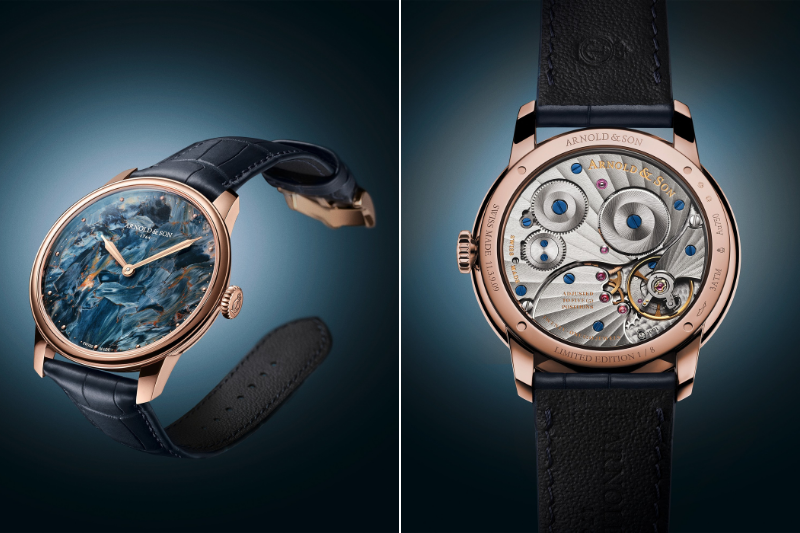
At Watches and Wonders Geneva, the brand expanded its chronometry pillar through the HM Pietersite, part of a collection characterised by pure lines, an ultra-thin profile, a large dial canvas and the painstakingly decorated A&S1001 calibre. Encased within its 39.5mm frame is a variety of chalcedony often nicknamed the “stone of storms”.
“Discovered in the 1960s in Namibia, Africa, pietersite is a rare stone not widely used in watchmaking. It has beautiful shades of blue, with white, and sometimes brown, veins. For us, it’s a reminder of the wild seas off the south coast of England that connect us to our history with marine chronometry and navigation,” Béchu says, noting that every limited timepiece — 18 and 28 units in red gold and stainless steel respectively — will look unique.
The Ultrathin Tourbillon Onyx is another addition under the same principle. Limited to just eight pieces in 5N red gold or platinum, the 41.5mm watch cradles a flawless, mirror polished disc of the jet-black agate. While the in-house A&S8300 manual-winding calibre — among the thinnest on the market today at just 2.97mm — keeps wearers entranced with the flying tourbillon, attention must be paid to the concave subdial, where onyx is given a matt satin finish for the first time.
“It’s a very complicated process that we’ve been working on for over a year with our dial manufacturer. It uses a special micro-blasting technique with super small particles,” Béchu says.
2.png
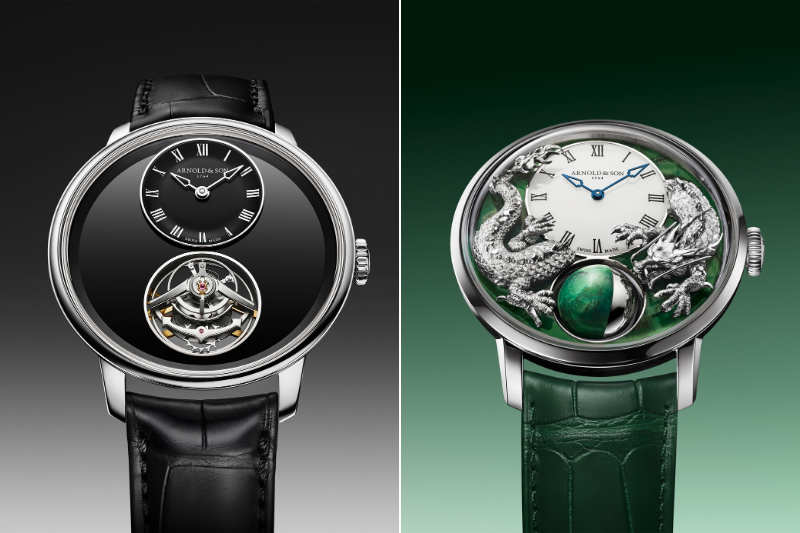
Expanding the astronomy cornerstone is the 44mm Luna Magna Platinum Dragon Verdite, limited to only eight references. Featuring the largest rotating moon ever created in relief for a wristwatch, this new model is enriched by the mythical creature, sculpted in white gold, coiling across a rich verdite dial. The design deftly channels the Chinese parable of the Dragon and the Pearl of Wisdom, turning the lunar instrument — accurate to a staggering 112 years — into the very source of the legend’s power.
“When you think of a fine green stone, you usually think of malachite,” Béchu notes. “But malachite has big veins and we thought that it would disturb the other elements on top. So, we went for verdite, which is rarer and has a very harmonious colour with fewer veins.”
Together, these novelties highlight not only Arnold & Son’s ability to frame complex stories within a small space but also the prowess of its craftspeople in working with difficult materials and pushing the boundaries of metiers d’art.
Sound as a bell
Founded in 1891 in Le Locle, Switzerland, by brothers Albert and Gustav Stolz, who were later joined by their younger sibling Charles, Angelus, meanwhile, is known for its contributions to the evolution of modern horology, specifically in chronographs, repeaters and movements with long power reserves.
“The brand’s first patent at the end of the 19th century was for a chronograph,” Béchu says, bringing up the Chronographe Télémètre, which won a Grand Prix d’Horlogerie de Genève award last year. “These strengths are part of our identity. But what people don’t necessarily know is that the second and third patents were for repeaters.
“The complication has been in the legacy and history of the brand since its very beginning. In 1958, we launched the Tinkler, the first quarter-repeater wristwatch that was automatic and waterproof.”
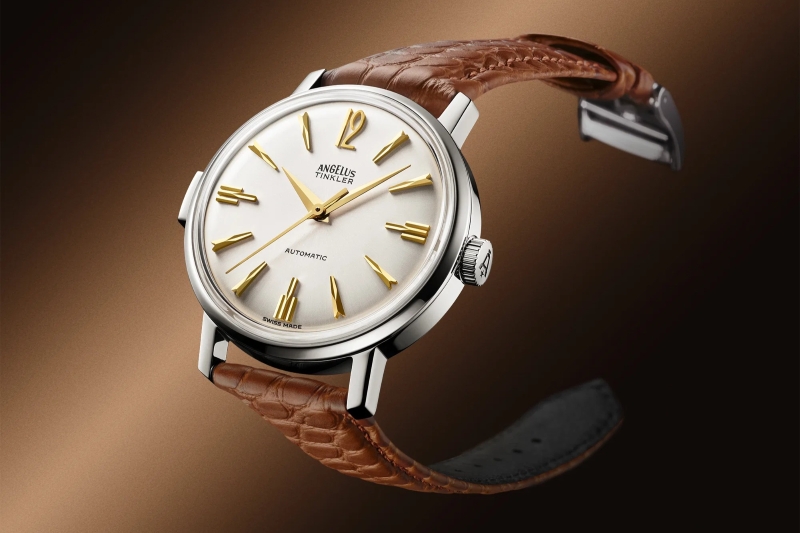
This year, Angelus is paying tribute to that pioneering model with a reissue that retains all its hallmarks and charm. Clean and understated, the 38mm timepiece features a subtly domed white sunburst dial with gilded hour markers, each sharply finished, endowing the watch with a suave look. Driven by the new Angelus A600 calibre, the Tinkler 1958 comes to life when the pusher at 9 o’clock is activated. Each hour is marked by a clear strike on the first gong, followed by a double strike on two gongs to signal each quarter.
3.jpg
Béchu offers a bit of history: “The chronograph is based on a movement developed in the 1990s by a company called THA. It was founded by a group of talented young watchmakers, including François-Paul Journe, Vianney Halter and Denis Flageollet. They were making movements for other brands and this was for Cartier’s Tortue Monopoussoir. In the late 1990s, the three decided to split to start their own brands.”
That was the impetus for the establishment of FP Journe, De Bethune and Halter’s eponymous maison.
“Our manufacture eventually acquired the rights to the movement and is now producing it internally. So, it’s a piece with an outstanding legacy,” he continues.
Providing a 70-hour power reserve, the Angelus A600 is meticulously finished, from the snailed main plate and palladium-plated bridges adorned with Côtes de Genève to a tungsten sunburst oscillating weight.
You will need to take the brand’s word for it, though, as a closed caseback is necessary to amplify the watch’s chimes. Embossed on it is the maison’s historic “A” monogram, which serves as a subtle nod to its heritage, quietly recalling a name originally inspired by the tolling of church bells.
This slim reference is available in two versions: 15 pieces in yellow gold and 25 in steel. But fret not if you are unable to get your hands on either. Béchu is happy to announce that this is simply the start of a new chapter of repeaters to come.
This article first appeared on June 15, 2026 in The Edge Malaysia.