
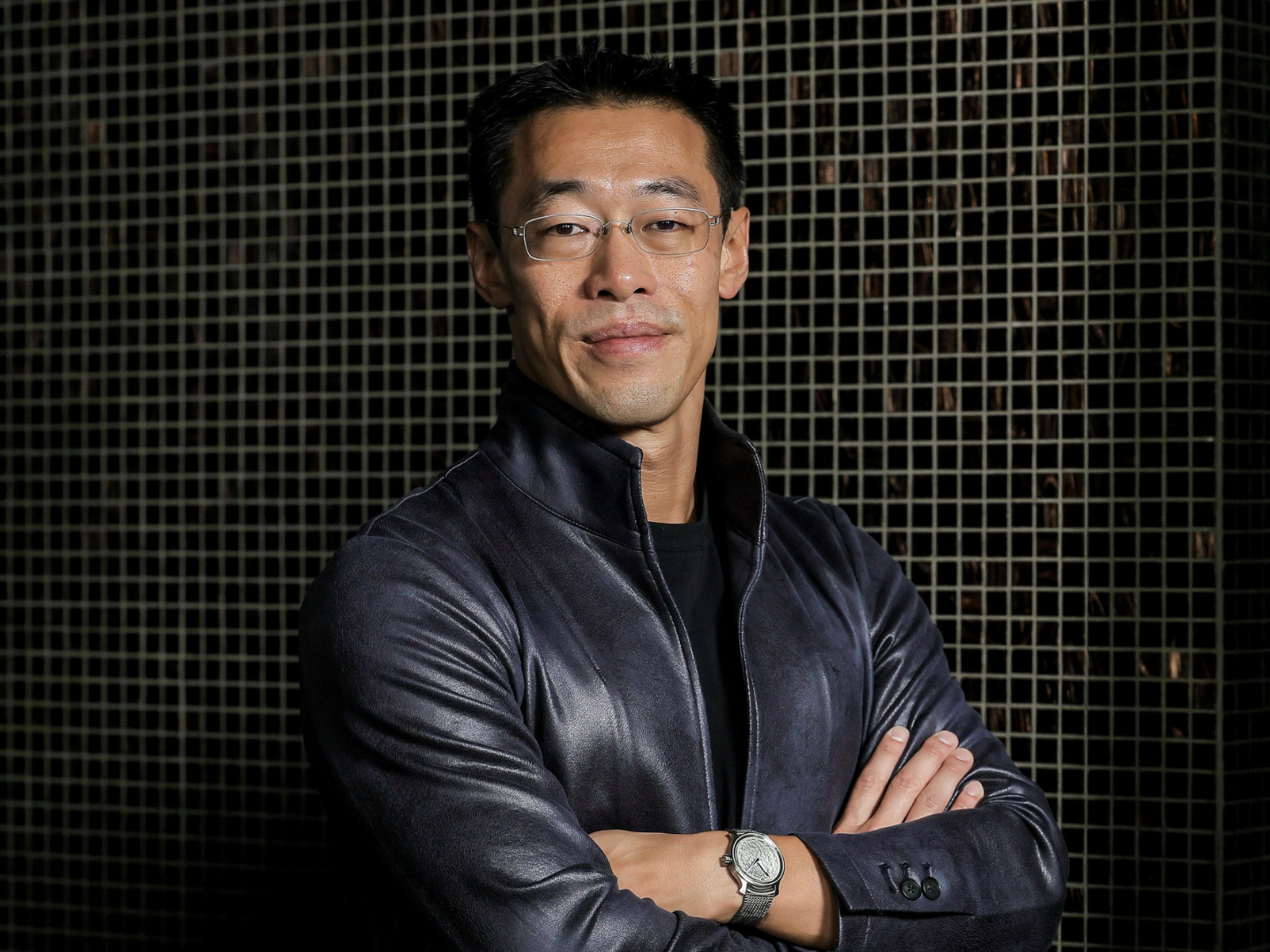
Ming Thein pairs the Ming 37.06 Royal Selangor with a Polymesh bracelet (Photo: Zahid Izzani/ The Edge)
It all started with a simple favour. Last November, while attending Dubai Watch Week, Horologer Ming co-founder Ming Thein was approached by a client with an unusual request: Could he carry a camera back to Kuala Lumpur and hand it over to Datuk Yong Yoon Li, the managing director of Royal Selangor? The friend, who lives in Saudi Arabia, wanted the pewter house to reskin his Leica.
“I’ve known Yoon Li for quite some time, but we lost touch for a bit,” Ming Thein recalls. “So I said, ‘Yeah, that’s fine. It’s been a while, so we should catch up anyway.’”
Back home, the errand eventually led to a long lunch, during which he proposed an idea. “I asked, ‘Since you’re making this cover for our friend’s camera, could you do something similar for a watch dial?’ He said, ‘I don’t see why not.’ And it just took off from there.”
Royal Selangor has sustained the heritage of Malaysian pewter craftsmanship for over 140 years. It is an art deeply tied to the nation’s rise as the world’s premier tin producer during the 19th-century colonial boom. Made of nearly 97% pure tin and fortified with small amounts of copper and antimony, the maker’s cast pewter is inherently resistant to tarnish and corrosion, developing a soft, mellow patina over time, resulting in an enduring, low-maintenance material perfectly suited for daily life and tactile wear.
Anyone who has toured the visitor centre in Setapak will have seen that casting pewter remains a deeply manual process. Even with modern manufacturing, much of the craft, from filing to polishing and decoration, is still carried out by artisans, some of whom are carrying on a multigenerational family legacy.
The initial concept for the Ming 37.06 Royal Selangor called for a hand-hammered dial, but the natural variations of the technique proved too erratic for the strict tolerances required. “When you hammer something, it bends. Put that in a watch and it basically jams the hands and cannon pinion.
“So we hammered a master, which was then 3D laser-scanned and CNC-ed (Computer Numerical Control). We have to be consistent. All the dials are identical because we needed to keep the diameter tolerance within 50 microns and thickness tolerance within 25 microns,” Ming Thein explains.
2.png
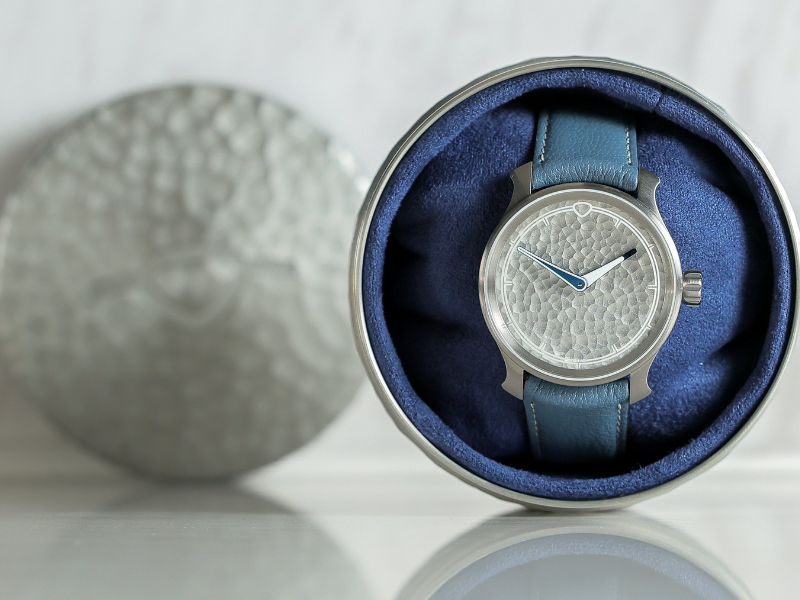
In essence, a CNC machine will carve out every pewter plate for the 88-piece limited edition. Royal Selangor oversees this phase entirely, leaving the final assembly to Ming, marking the first time a collection in its expansive line-up is put together on Malaysian soil.
The collaboration adopts Ming’s 37-series grade 2 titanium case, chosen primarily for its wide dial opening, which puts the full dimpled texture of the hammered pewter on display. Leveraging an existing architecture also played a part in speeding up time to market. “Internally, the construction is adaptable because we developed it that way. They’re unisex. We don’t gender our watches. It measures 38mm. Visually it looks larger, but wears smaller. I would consider this our entry-level case family, so it’s also more accessible to Malaysians, but the level of finishing is very high,” he says.
Beating within is the custom Sellita SW300.M1 automatic movement, offering 50 hours of power reserve. Through the sapphire caseback, skeletonised rhodium-plated bridges, brushed surfacing and an anthracite baseplate create a dynamic monochromatic view. Every timepiece arrives paired with a blue-grey goat leather strap — complementing the alloy’s cool tones — crafted by Jean Rousseau, complete with curved quick-release spring bars and a flying-blade tuck buckle.
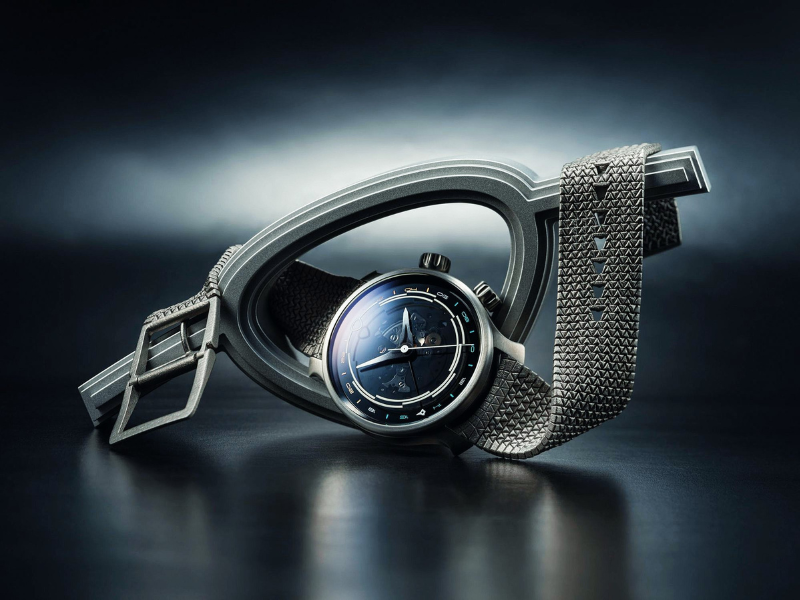
That said, we highly recommend wearing it on Ming’s Polymesh bracelet. Beyond extending the chromatic visual path of the pewter dial and titanium case around the wrist, it drapes with the uncanny weightless grace of silk. Fashioned from 3D-printed grade 5 titanium, the bracelet underwent eight geometric iterations over a gruelling four-month development period. Ming Thein humorously notes that he ended up purchasing four 3D printers simply to keep pace with the relentless flow of new ideas.
Rounding out the ensemble is a hammered pewter presentation box, designed by Ming and expertly executed by the artisans at Royal Selangor.
5.png
Steady growth
For those new to Ming, descriptions like “design-led”, “unconventional” and “innovative” offer an accurate glimpse into the independent brand’s inventive approach to watchmaking. Since its establishment in 2017, it has navigated the ebb and flow of an industry steeped in tradition, heritage and regulation.
They occupy an intriguing niche, one that Ming Thein himself is still finding the words to describe. “We don’t make our own gears and pinions, but there are things that we do that other independents don’t. For example, the white emission luminous formula we produced. Things like the Polymesh bracelet. There’s a lot of stuff that nobody in the industry has done,” he explains.
“Figuring out that position is a very important part of our 10th anniversary next year. We’re not conventional and I think that’s reflected in both the consistency of our design language over the 90-plus models we’ve released until this point and also the fact that we continue to innovate in all areas.”
In less than a decade, Ming has established a remarkably agile evolutionary path, spanning several design “generations”. Each iteration serves as a proving ground to expand the brand’s visual language while continuously pushing creative and technical boundaries, be it watch architecture, material science or light interaction.
“The first generation, which starts with ‘1’, was basically us finding our identity. We experimented with things, suppliers, trying to figure out what works visually and from a production standpoint. The second was us gaining confidence, characterised by what I want to think of as a maximalist approach. So we’ve got flying lugs, a lot of dial and movement details. I want to say it’s like science fiction plus plus. The second series also coincided with me moving from paper to CAD (computer aided design),” says Ming Thein.
“The third takes us back to more monolithic, simple forms, so we distilled the essence of our design language into something nuanced and detailed. We have very solid forms, clean lines. Minimalism is the overall aesthetic here. It’s something where maybe the initial impact isn’t as great, but it’s a design which you can live with for a long period of time,” he notes, adding that the collaboration with Royal Selangor was a natural fit for this series.
1.png
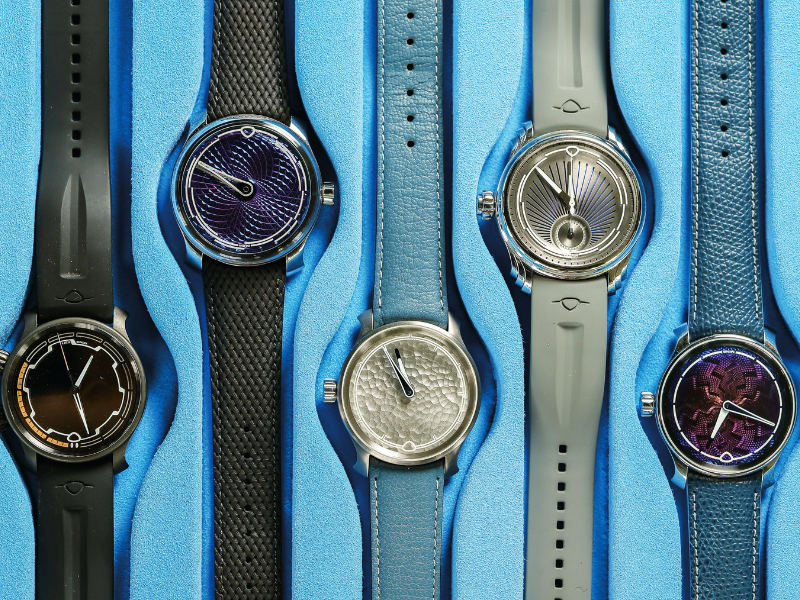
The fourth generation never saw the light of day as extended development delays during the pandemic meant that the design would feel visually dated by the time the watches were ready for production. “Also, given the relative importance of Asia as a market, dropping the fourth was not a bad idea,” he quips. The fifth generation, which debuted not too long ago, is defined by a modern take on Art Deco.
With the sixth series in progress, Ming Thein admits it gets harder to conceptualise every time. “It’s not the case of replacing one generation with the other. They just have different identities.
“I think the first generation was short because it was us reaching maturity. The second was longer because it had a clear identity. The third is longer still because it’s timeless. The fifth generation is if you want something a little jazzier. The third and fifth can run in parallel and the sixth is basically where you go from there. So, what I see is that the third, fifth and sixth generations will continue running.”
As some cohorts phase out, long-term servicing and component availability naturally become key considerations for collectors. To that, Ming Thein says not to worry. “We have first generation watches coming back and being serviced. When we put the production order in, we get more components because we know we’ll need them. While we don’t replace serial numbers, if you need hands, dials, moving parts — we have that.
“I think to be a legitimate brand, you need to be able to support your historical stuff. Customers need to be given that confidence. I mean, honestly, I wouldn’t buy something if I didn’t know if it could be serviced.”
However, ensuring dedicated support for decades to come requires substantial investment in service infrastructure, spare parts inventory, watchmaker training and global logistics. This partly accounts for the price adjustments over the years, an essential move to deliver the level of after-sales service and client care expected at the price point.
4.png
The devil’s in the details
A relentless pursuit of excellence has been Ming’s driving force from day one. Founded alongside five fellow collectors, the brand experienced growing pains, which centred largely on finding manufacturing partners who could consistently deliver to its exacting standards.
“When we started, we were basically trying to be a little bit better than the average microbrand. We designed our components from scratch, had them made but threw them all away because our quality expectations versus those of the suppliers were so different. So to do what we wanted, we had to partner with the best people in the industry, even outside it,” Ming Thein explains. From individually finished stepped lugs to CNC-machined buckles and custom-curved straps, no detail is too small to escape meticulous attention.
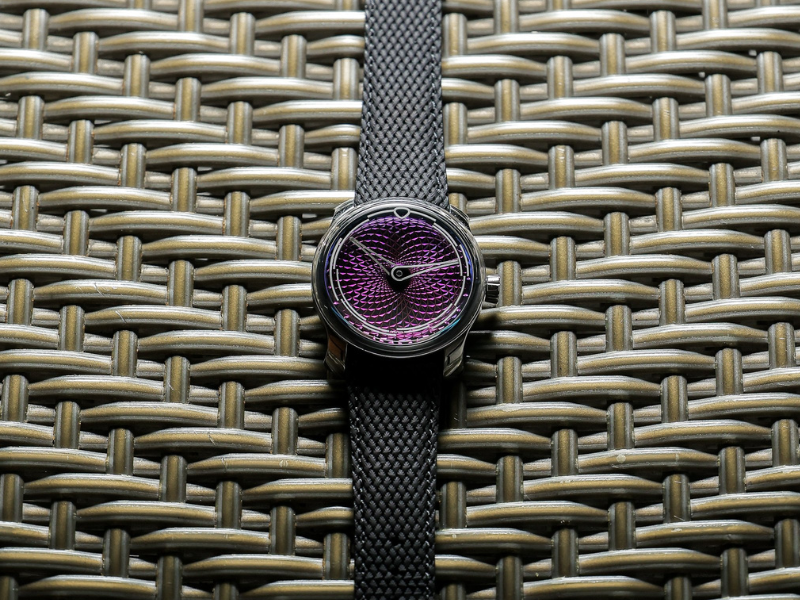
After securing multiple accolades at the prestigious Grand Prix d’Horlogerie de Genève (GPHG), the brand now finds that its reputation and gumption speak for themselves. Two of its submissions for the awards this year revolve around timepieces with a colour-shifting dial. The 29.06 Peepshow was submitted under Time Only while the Ming x JN Shapiro 37.06 Lighting is vying for a spot in the Petite Aiguille category. While the GPHG shortlist will not be announced until September, both releases have already drawn overwhelming acclaim from the collector community.
The Peepshow captivates by replacing traditional hour and minute hands with a pair of linearly polarised sapphire discs. When the hands are aligned, light passes through and the iridescent dial is revealed. At a 90° offset, the discs block light to turn it completely black. As the hands advance, the display dynamically cycles between rich colour, reflection and darkness.
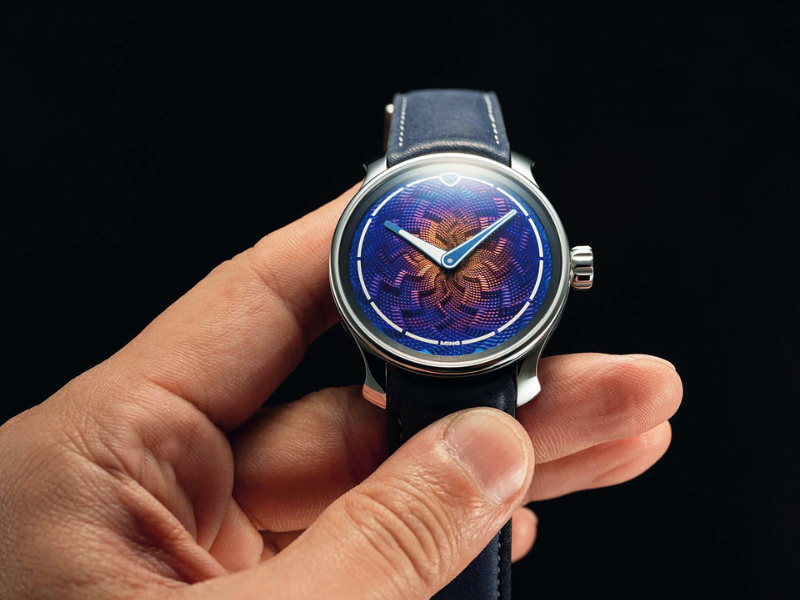
As for the Lightning collaboration with JN Shapiro, Ming Thein personally heat-treats each dial. “Most of the time, titanium can be heated to a uniform temperature to get a uniform colour. When titanium turns colour, an oxide layer forms. Depending on which specific formulation of the oxide, the colour is different,” he says.
“The challenge with something like this is that if you want to do a gradient, you can apply voltage with the positive and negative terminal on either side. But you can’t do it radially. So the only way to achieve the radial temperature gradient is to manually torch it. The difference between the gold you see in the middle and the blue on the outside is only about 50°C, but we’re using a 1,600°C blowtorch.”
Every dial is individually engine-turned by hand on a traditional rose-engine lathe using a lightning guilloché pattern. This is performed at close friend and collaborator Josh Shapiro’s workshop in Los Angeles, California, before the dials are delivered to Ming Thein. “Between the guilloché and the torching, the success rate is about one in three.”
3.png
Coming of age
Graduating with a physics degree from the University of Oxford at the tender age of 16 before transitioning to the corporate sector, Ming Thein left a career in private equity and a senior executive role at McDonald’s to pursue photography. The polymath never anticipated that his diverse passions would converge so seamlessly in horology. Looking back at his journey, he calls it “chaotic, unpredictable, unexpected and challenging”.
“I think we’re all guilty to some degree of only allowing people to see what we want them to see. They don’t see the difficult bits. Even I try not to remember. Personally, I’ve always felt very much like an outsider. I went to university at a young age. I came out into the corporate world not really knowing what I wanted to do, but had to get a job, so I did,” he says candidly.
“For the most part, it’s about trying to express myself in a tangible way. One thing I really didn’t enjoy in corporate is that there’s no tangible output. As a photographer, I make pictures. I don’t call myself a watchmaker because I’m not. But I guess as a designer, the watches are the output. What gives me satisfaction is solving these tangible challenges, trying to make something different and seeing it come to life.”
As Ming prepares to celebrate its 10th anniversary next year, the pipeline remains strictly under wraps, although its co-founder promises that what lies ahead will be nothing short of mind-blowing.
Having personally handled engineering, design, photography and, until recently, press relations, Ming Thein readily admits it is time to relinquish some of those duties. “At the start, I did anything and everything. But now, there are bits of the business I genuinely don’t touch because I have a team and I trust them. For me to be able to do the cutting-edge stuff, I need to free up that capacity.”
As the milestone draws near, he hopes the company can continue to innovate. “We’re actively applying for patents for some of our releases. I think that speaks to how original what we make is. I just hope people can see that.”
Here’s to the next decade.
This article first appeared on Aug 3, 2026 in The Edge Malaysia.