

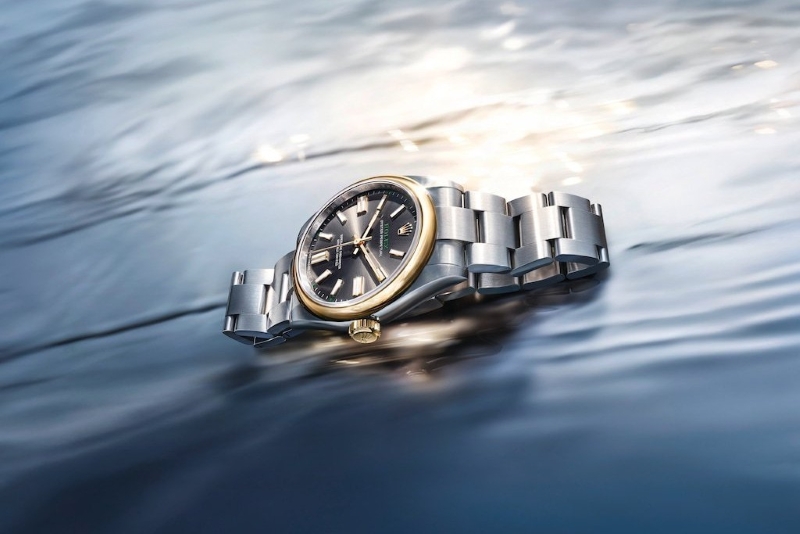
Oyster Perpetual 41 in yellow Rolesor headlines the anniversary timepieces (Photo: Rolex)
The vision came first. Driven by an intuitive belief, Rolex founder Hans Wilsdorf was convinced that at a time when pocket watches were the norm, the wristwatch was perfectly suited to the modern lifestyle emerging in the early 20th century. Back then, wrist-worn models were still in their infancy — imprecise, fragile and vulnerable to the elements — and society viewed them as jewellery and fashionable accessories rather than reliable timekeepers. However, Wilsdorf not only possessed the foresight to prepare for the future, but also the ability to shape it through innovation.
There were three major challenges he sought to overcome: precision, waterproofness and self-winding. At the turn of the 20th century, as the world accelerated on every front, chronometric precision became an absolute necessity. The rapid expansion of railways, automotive travel and aviation, coupled with the advent of radio telecommunications, was narrowing distances and ushering in a new era of global connectivity.
The brand’s quest for precision achieved its first major triumph in 1910, when a wristwatch received a chronometric certificate from the Official Watch Rating Centre in Bienne, Switzerland, putting it on equal footing with pocket watches. But the ultimate validation came four years later. The Kew Observatory in Great Britain, then the highest global authority on timekeeping accuracy, awarded a Rolex watch a “Class A” precision certificate. Until then, the honour had been the exclusive domain of large marine chronometers, subjected to rigorous 45-day trials. Rolex had officially demonstrated that a wristwatch could hold its own against the world’s finest timekeepers.
1.jpg

The next goal was to build an impenetrable defence. In 1926, the Oyster marked a breakthrough in horology. It was an ingenious case made completely waterproof and dustproof thanks to a system of screwing down the bezel, caseback and winding crown against the middle case. Hermetically sealed, it provided optimal protection for the movement within, allowing wearers to keep it on when washing their hands or bathing, while at work in a dusty workshop or when perspiring during a game on the court. It was put to the test in 1927, when British swimmer Mercedes Gleitze spent more than 10 hours in the bitter cold waters of the English Channel while wearing an Oyster. The watch emerged entirely unscathed.
After years of research, technical teams at Rolex’s Bienne movement manufacturer unlocked a mechanism that provided the Oyster with a constant stream of power, eliminating the need for manual winding. In 1931, the brand patented this revolutionary self-winding system with a free rotor and dubbed it the “Perpetual”. Driven simply by the natural motion of the wrist, the watch could now power itself indefinitely. The Perpetual rotor offered further advantages, such as greater rate regularity and enhanced precision of the movement due to the constant charging of the mainspring. With these three pillars, the archetype of the modern watch was born.
This framework paved the way for a diverse collection of specialised timepieces, including the Oyster Perpetual Explorer, Oyster Perpetual Milgauss, Oyster Perpetual GMT-Master, Oyster Perpetual Submariner, Oyster Perpetual Cosmograph Daytona and Oyster Perpetual Yacht-Master. Tailored to conquer distinct environments, they introduced vital functionalities such as pressure and magnetic resistance, graduated bezels, chronographs and dual time zone tracking. As they proved their worth over time, these models evolved into industry standards, with several earning permanent status as icons of modern watchmaking.
2.jpg
Crowning glory
It has been a century since the Oyster was introduced to the world, yet Rolex remains steadfast in its pledge made in 1926: to provide a reliable, precise and waterproof timepiece capable of accompanying its wearer in all his day-to-day activities. That promise is constantly renewed through a mindset of continuous improvement, with the Oyster playing host to a suite of groundbreaking developments over time.
To mark its milestone anniversary, the Oyster Perpetual range is enriched with new models that embody the brand’s spirit of inventiveness. Headlining the novelties is the Oyster Perpetual 41, presented in yellow Rolesor where a yellow gold bezel and winding crown are paired with an Oystersteel case and bracelet. The two-tone aesthetic harks back to early Oyster references while a number of commemorative details honour the centenary.
“This watch includes a number of details evoking the Oyster’s centenary: the winding crown features the number 100 in relief, while a “100 years” inscription appears at 6 o’clock, supplanting the usual “Swiss Made” marking. The brand’s signature green hue also graces the slate dial, adorning its moniker and the square markers outlining the minute track.
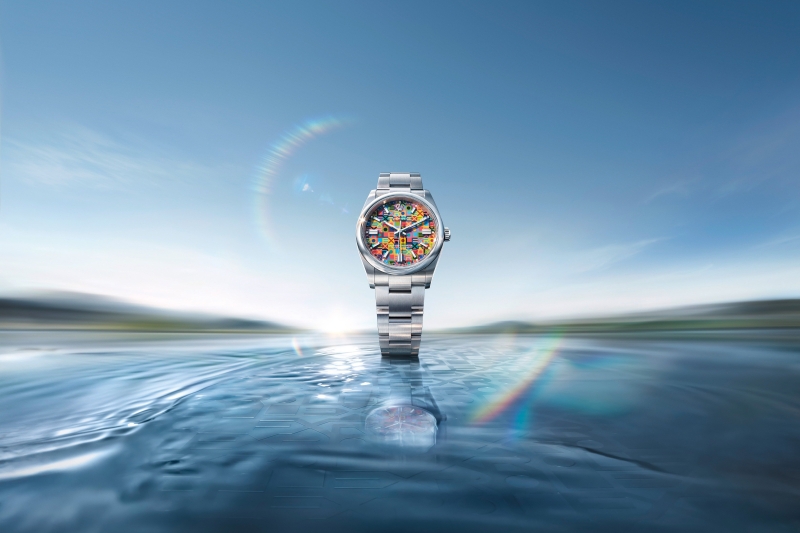
On the other hand, the new Oyster Perpetual 36 features a vibrant, highly graphic Jubilee motif dial — a thoroughly modern reinterpretation of the classic design that was introduced in the late 1970s. The letters of the name “Rolex” are displayed in a contrasting interplay of no fewer than 10 colours, which presents a sizeable challenge as each shade is applied one after the other. The utmost precision is required to ensure that all the shapes and letters making up the motif are positioned perfectly, resulting in a playful but cohesive dial.
3.jpg
Both timepieces are driven by Calibre 3230, a self-winding mechanical movement entirely developed and manufactured in-house that delivers a substantial power reserve of about 70 hours. A distillation of the brand’s finest technological achievements, it incorporates the patented Chronergy escapement. Crafted from nickel-phosphorus, this system is highly resistant to magnetic interference and combines exceptional energy efficiency with uncompromised reliability. By radically re-engineering the geometry of the pallet fork and escape wheel, the movement maximises energy transfer to the balance wheel, directly contributing to its extended power reserve.
The regulating organ is further elevated by a blue Parachrom hairspring. Manufactured from an exclusive paramagnetic alloy consisting of niobium and zirconium, it remains completely unaffected by strong magnetic fields. To safeguard the movement against the rigours of daily wear, it is fitted with high-performance Paraflex shock absorbers, a patented system that significantly improves shock resistance.
Rolex is also expanding its repertoire of precious alloys with Jubilee Gold — a unique blend that glows with harmonious tones of gentle yellow, warm grey and soft pink. Conceived, developed and produced in-house, the new 18-carat Jubilee Gold debuts on the Oyster Perpetual Day-Date 40. Light green aventurine — a natural stone from the quartz family — endows the exceptional timepiece with a cheerful yet refined touch of colour, complemented by the brilliant sparkle of 10 baguette-cut diamonds. It is fitted with a fluted bezel and paired with a President bracelet featuring a concealed Crownclasp.
4.jpg
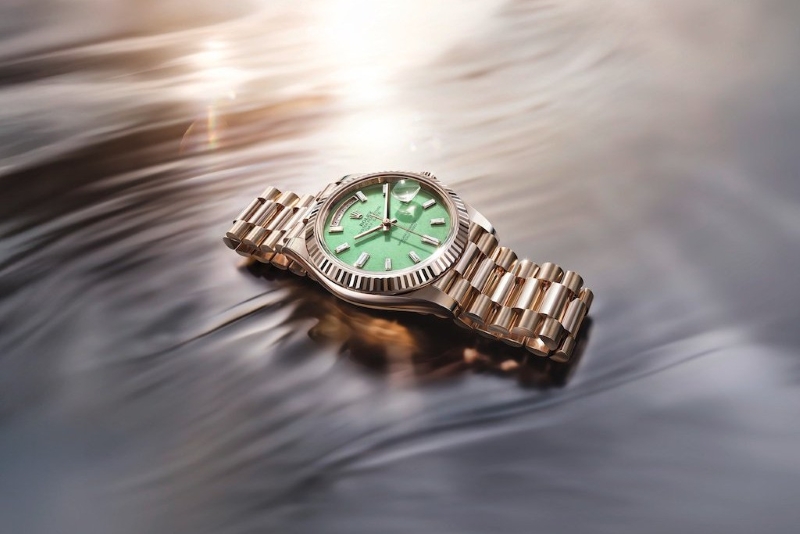
The timepiece is equipped with Calibre 3255, enabling it to display the day, date, hours, minutes and seconds. A major innovation launched in 1956, Oyster Perpetual Day-Date 40 was the first calendar wristwatch to indicate, in addition to the date, the day of the week spelt out in full in an arc-shaped window at 12 o’clock. The day of the week is available in a choice of 26 languages and as the brand’s most prestigious model, it has only ever been made from precious metals.
These timepieces are covered by the Superlative Chronometer certification, an exclusive designation issued to each watch leaving the Rolex workshops. This year, the in-house certification expanded its rigorous standards by introducing three new testing criteria: magnetism resistance, reliability and sustainability. Integrated directly into the design and manufacturing phases, these benchmarks require hundreds of performance-focused checks and validations. This update enhances the core framework established in 2015, which continues to govern precision, waterproofness, self-winding and power reserve.
Ultimately, the Oyster Perpetual range remains the definitive bridge between Rolex’s storied past and its innovative future. Motivated by a continuous drive for improvement and bolstered by skills fully mastered in-house, Rolex continues, one hundred years on, to open up new realms of possibility By pairing cutting-edge watchmaking, materials science, dial making artistry and performance, the Oyster Perpetual ensures that its legendary legacy never fades and that it maintains a fresh and contemporary appeal for generations to come.