

Relive the first steps on the moon, wandering across a recreation of the lunar surface inspired by the Apollo missions at the Omega Museum (All photos: Omega)
There is a particular pleasure in visiting an exhibition that curators will never advertise: on occasion, the people are more interesting than the objects on display. This realisation dawned gradually during a visit to the Omega Museum in Switzerland’s bilingual city of Biel/Bienne, about 90 minutes from Zurich by train. Over the course of several hours, certain behaviours repeated themselves often enough to reveal three distinct tribes.
The first hovers over vitrines of early pocket watches, contemplating escapements and the finer points of calibre evolution with concentrated stillness and opinions their obliging companions may not entirely share. The second moves with purpose: efficient, methodical, and likely having completed the Einstein House or Klingende Sammlung (a temple to brass instruments where you can give the alphorn used for rounding up cattle a toot) en route, working through the region’s cultural inventory with the brisk satisfaction of crossing items off a grocery list.
And then, there’s everybody else: the James Bond fans.
The point is, whatever their motivation or proclivities, this pilgrimage site caters as readily to the horological purist as it does to the 007 faithful, drawn by the maison’s long-running association with cinema’s most famous secret agent. But more on this martini-soaked franchise, built on one man’s rakish charisma and tongue-in-cheek one liners, later.
Nick of time
4.png
To understand how Omega came to warrant an entire institution devoted to its past, it helps to remember that its polished corridors today began with far humbler ambitions. When the management erected a public archive in 1983, it was venturing into uncharted territory — no watchmaker had previously established a dedicated repository for preserving and presenting its heritage. From that initiative emerged the world’s oldest watch-brand museum.
But as the catalogue of distinctions and milestones grew, so too did the challenge of documenting it. A major refurbishment in 2010 brought renewed energy to the edifice, reorganising its layout around a more coherent flow and improving engagement. Even then, its ever-growing list of achievements was being told from a space shared with the company canteen, a surprisingly humble setting for a technological stalwart whose triumphs stretched from Olympic podiums to the deepest reaches of the sea.
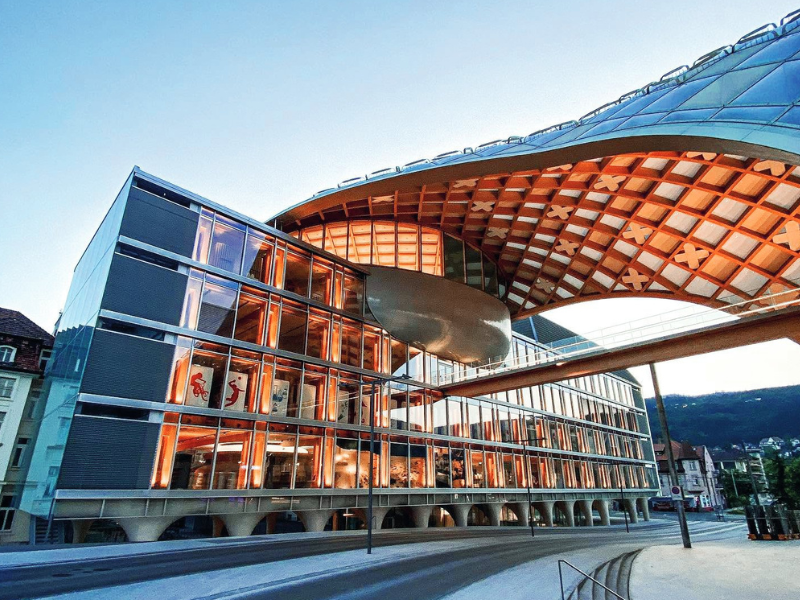
The transformation culminated in 2019 with the move to Cité du Temps (“City of Time”), a striking landmark designed by Japanese starchitect and Pritzker Prize laureate Shigeru Ban. Constructed from timber sourced exclusively from Swiss forests, predominantly spruce, it stands on Nicolas G Hayek Street — a fitting address given that the shrewd businessman founded the Swatch Group, Omega’s parent company, and played a pivotal role in steering the industry through the throes of the Quartz Crisis. Omega occupies the second level of this five-storey facility, while the Planet Swatch Museum — home to some 6,000 iconic and avant-garde timepieces — resides directly above.
The disarming airiness of this “contemporary pavilion” makes an immediate impression. Natural light pours through broad expanses of glass, illuminating an intricate wooden framework that rises overhead with almost cathedral-like grace. Cité du Temps forms one part of a trio conceived by Ban for the Swatch campus, a serpentine 240m-long ensemble with a curved silhouette distinguished by a façade of 2,800 honeycomb elements. Although the development is united by a shared material palette and commitment to sustainability, each composition maintains a distinct personality. Linked by an aerial pedestrian bridge, the adjacent Swatch headquarters breaks with the conventions of a clinical office tower, playful and organic in character; while the Omega manufacture just around the bend remains austere and rectilinear, its crisp geometry echoing the engineering exactitude demanded within.
5.png
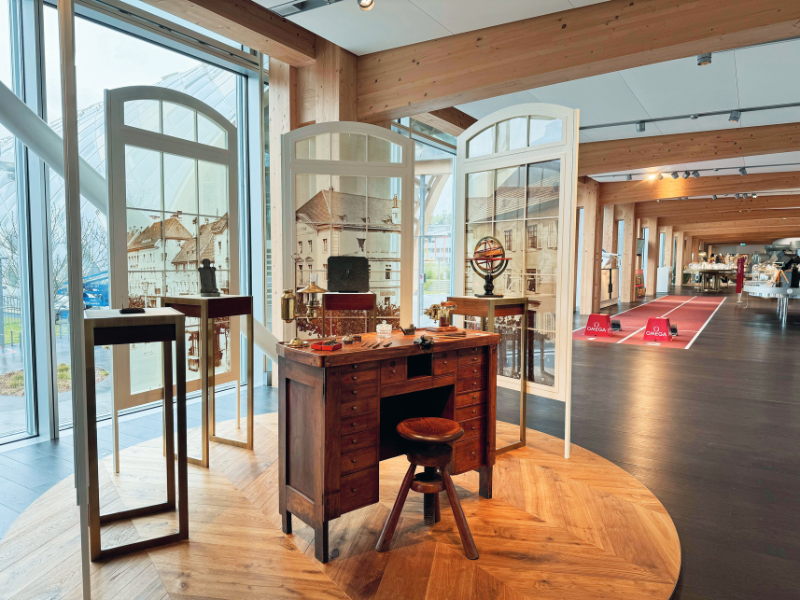
For all the attention lavished on the architecture, impressive though it is, the complex is merely an overture to what lies beyond the museum doors. Having crossed a world map embedded with time zones and passed through a circular screening room where a short film traces humanity’s attempts to measure time — from sundials and water clocks to marine chronometers — visitors enter the galleries proper. Those seeking additional context can pick up an audio guide, although the displays are sufficiently intuitive that even the uninitiated should have little trouble finding their bearings.
Among its most affecting artefacts is the original workbench of founder Louis Brandt, the young watchmaker who, in the 19th century, laid the foundations for what would become one of Switzerland’s most recognisable names in horology. Its placement near the entrance feels apt, though the exhibition’s designer, Steiner Sarnen Schweiz — the studio behind Maison Cailler’s acclaimed chocolate museum in Broc — would resist the notion of a fixed route. The presentation is intended to be explored according to curiosity instead of chronology.
Rather than consigning guests to a procession of touchscreens and digital gimmicks, Omega’s spirit of exploration favours participation over observation. A 9m sprint track invites aspiring athletes to test their reflexes against the same timing technology the brand has deployed as official timekeeper of the Olympics, complete with starting blocks, electronic starter’s pistol and a photo-finish printout of one’s heroic dash generated by the Scan’O’Vision Myria system, capable of recording up to 10,000 digital images a second. Elsewhere, they can relive the first steps on the moon, wandering across a recreation of the lunar surface inspired by the Apollo missions, before discovering the split-second precision required to time a bobsleigh hurtling down an icy track.
Measured greatness
6.png
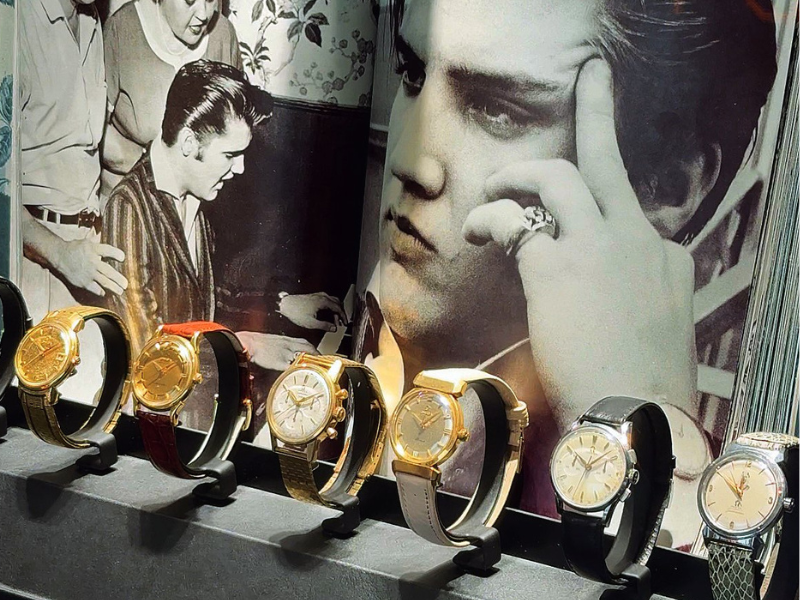
Elvis Presley, John F Kennedy, Amelia Earhart and Dame Ellen MacArthur. These names could easily top the ideal list in any debate over the classic dinner party question: “Who would you invite?” The more surprising link, however, is that all four were acquainted with Omega, whether as ambassadors or aficionados, at various points across its illustrious 178-year legacy.
The museum gives these connections tangible form through a series of treasury windows — jewel-box displays dedicated to particularly notable figures and moments. One such vignette recounts a tale that could only belong to the King of Rock and Roll. In 1960, after returning from military service, Presley was given an 18-carat white-gold Omega bearing Tiffany & Co on the dial, its bezel ablaze with 44 diamonds, to commemorate the sale of his 75 millionth record. Lesser owners might have locked it away. Instead, Presley traded it to an enthusiast for a jewelled Hamilton. Decades later, after disappearing into private hands and re-emerging on the auction circuit, the fabled piece finally found its way to Biel, elevated from a celebrity keepsake to a relic of the brand’s mythology.
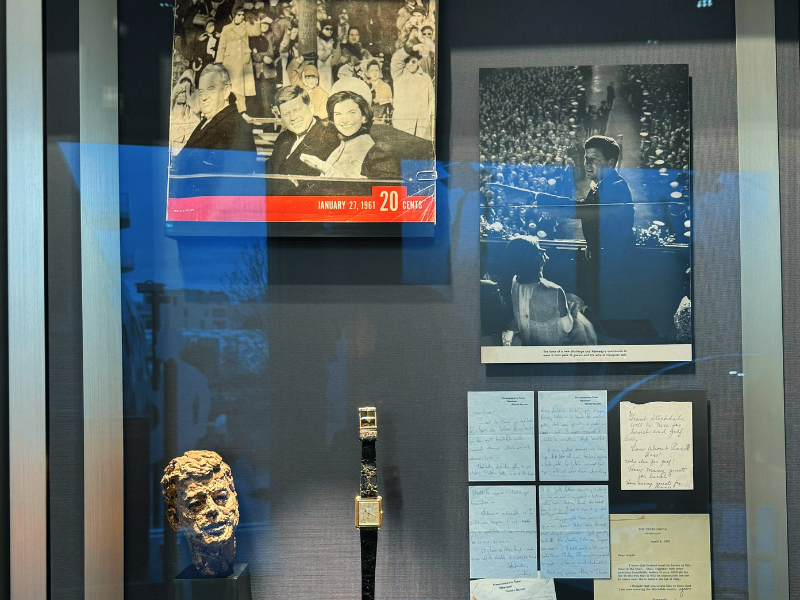
Some heroes capture headlines. Others inhabit the pages of history. Scarcely any 20th-century leaders loomed larger than Kennedy, whose magnetism conjured something rarer than fame — the enduring aura of “Camelot” that still defines his political dynasty today. Before the American electorate had rendered its verdict in the 1960 election, his close friend and future envoy Grant Stockdale gifted him a rectangular Ultra Thin Ref OT3980, audaciously engraved with the inscription “President of the United States John F Kennedy” on the caseback. At a time when JFK was locked in a fiercely contested race against Richard Nixon, the meaningful token served as a symbol of confidence in the outcome. The wager eventually proved prescient.
The 35th president prized it so highly that garments ordered from the venerable Parisian shirtmaker Charvet founded in 1838 — under the pseudonym “John Tierney” — were tailored with a wider, looser left cuff to keep his Omega in view. The museum pairs this historical memento with a note from First Lady Jacqueline, praising its elegance.
7.png
From the White House, the trail leads to other frontiers, notably aviation and sailing. Earhart — celebrated in her day as America’s premier “Aviatrix”, the term then used for female pilots — occupies a place of honour among the exhibition’s trailblazers. When she embarked on her ill-fated attempt to circumnavigate the globe in 1937, her Lockheed Electra carried a dashboard-mounted Omega chronograph. Her disappearance, together with navigator Fred Noonan, over the Pacific would become one of aeronautics’ most enduring mysteries. Meanwhile, MacArthur fronted the chapter on maritime exploration with a record-breaking solo memorialised through the Seamaster. That 71-day voyage also uncovered a lesser-known fact: long before the maison became synonymous with diving, it had formed deep ties to competitive sailing through regatta timers, ocean races and its role as timekeeping partner of the America’s Cup.
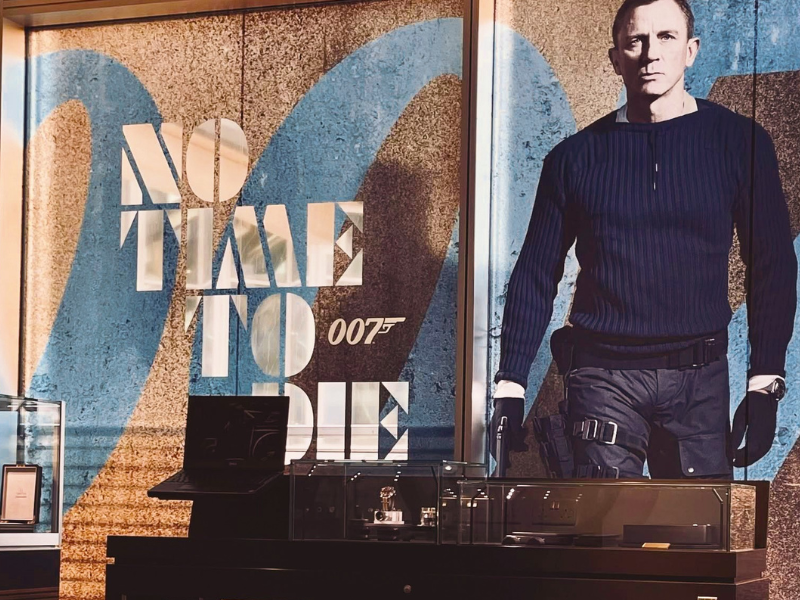
Of course, mention the Seamaster at length and one inevitably runs into Bond, whose relationship with the house remains deeply embedded in popular culture, making it difficult to think of one without the other. The partnership began in earnest in 1995 with GoldenEye, when costume designer Lindy Hemming selected the Seamaster Professional Diver 300M for Pierce Brosnan on the grounds that a Royal Navy commander would hardly be wearing anything else.
Daniel Craig’s tenure only reinforced the affiliation, not least through the now-infamous scene from Casino Royale in which he emerged from the sea sporting a pair of light-blue swimmers, inadvertently creating one of the most scrutinised moments in modern menswear. Since then, Omega has accompanied the Queen’s loyal spy through nine films, appearing in no fewer than a dozen incarnations and, with the help of cinematic licence, serving variously as a bomb detonator, grappling hook and laser-equipped cutting tool. Few time-tellers have enjoyed such longevity — or saved the world quite so often.
8.png
The museum leaves its most theatrical gesture for last. The final act unfolds beneath a giant Co-Axial escapement and an outsized Speedmaster before one is ushered into a round chamber, where a 360° projection transforms gears, springs and escapements into a blockbuster finale of sorts.
Omega’s identity may be written through explorers, statesmen and cultural luminaries, but the narrative ultimately returns to its true protagonist: the science and ingenuity that made those stories possible in the first place. Legends may wear the watches, but it takes masters to make them.
Record makers
Mechanical marvels that found their way onto famous wrists
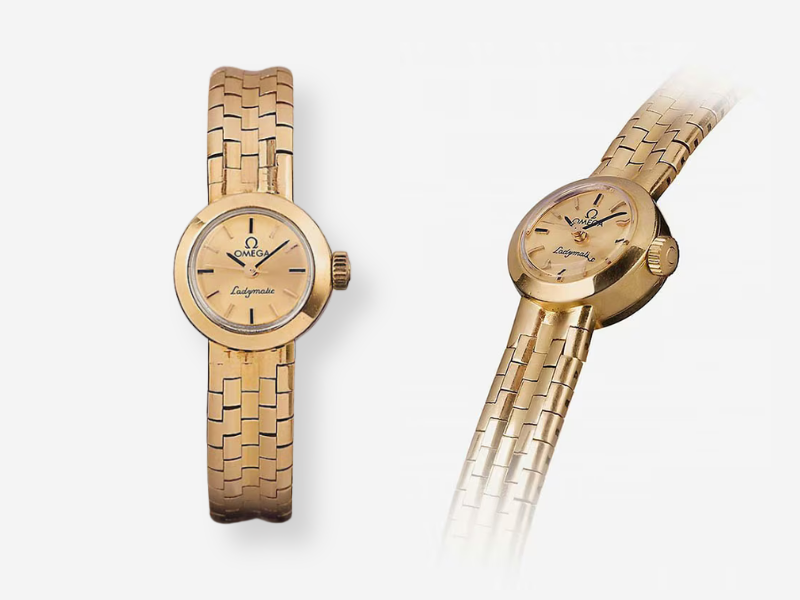
Ladymatic 1955
The Ladymatic was among the first automatic wristwatches produced specifically for women, housing the diminutive 16 RA SC-455 calibre, then the world’s smallest rotor equipped with self-winding movement, measuring just 1.196cm³. It was an era when many ladies’ options favoured ornamentation over technical substance. The model enjoyed a renaissance in 2010 as the De Ville Ladymatic, counting Nicole Kidman and Cindy Crawford among its most prominent admirers.
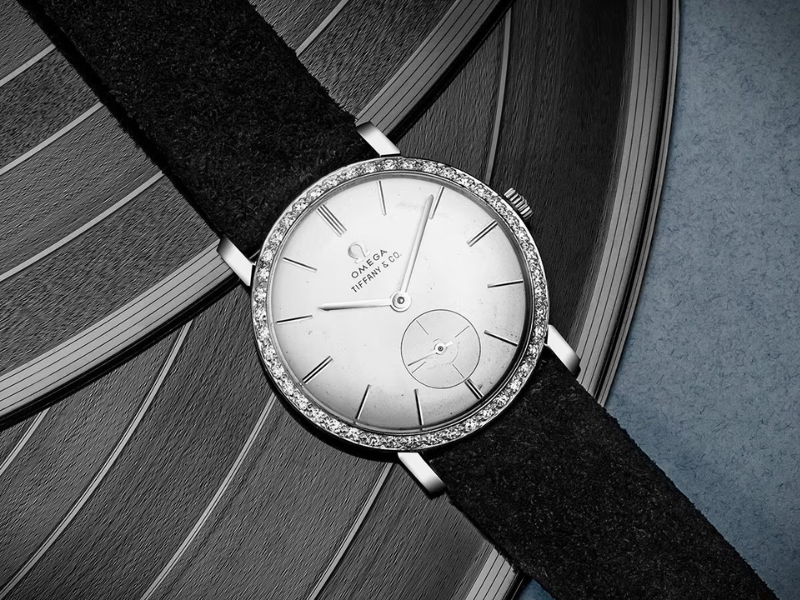
Elvis Presley x 18-carat white gold Omega with Tiffany Dial
When this piece resurfaced in 2018, it came from the nephew of the man who had acquired it directly from the singer decades earlier. No one could have predicted that a casual swap — a Hamilton for the King’s — would later fetch US$1.8 million and set a world auction record for the maison. This thank you-gift by RCA Records to Presley also shows the unusual double-signed dials in the mid-20th century.
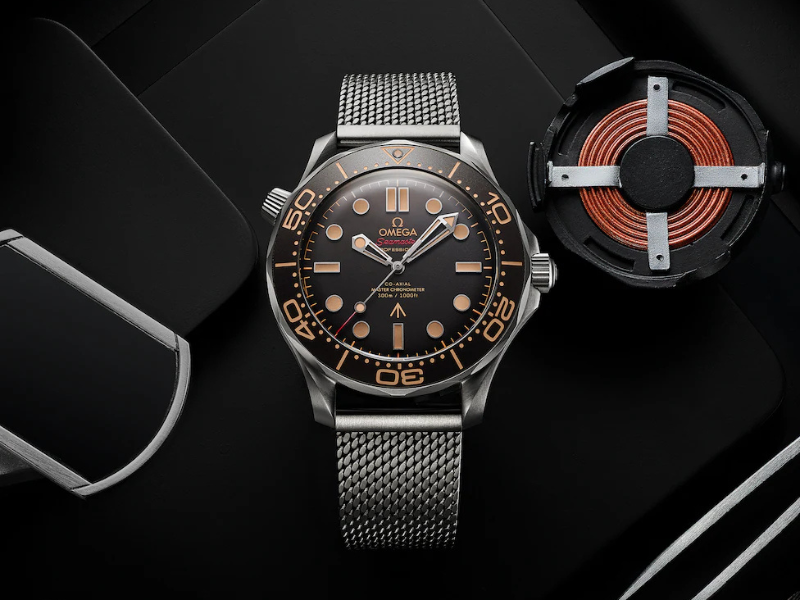
Seamaster Diver 300M 007 Edition
For No Time To Die (2021), the 25th James Bond film and Daniel Craig’s final outing as 007, the brand pulled out all the stops. Envisioned with significant input from the actor himself, this multitasker is powered by the Co-Axial Master Chronometer Calibre 8806 and offered some of the industry’s highest levels of anti magnetic resistance. A useful and appropriate quality, when Q had equipped it with a powerful electromagnetic pulse capable of disabling electronic systems.
This article first appeared on June 15, 2026 in The Edge Malaysia.