
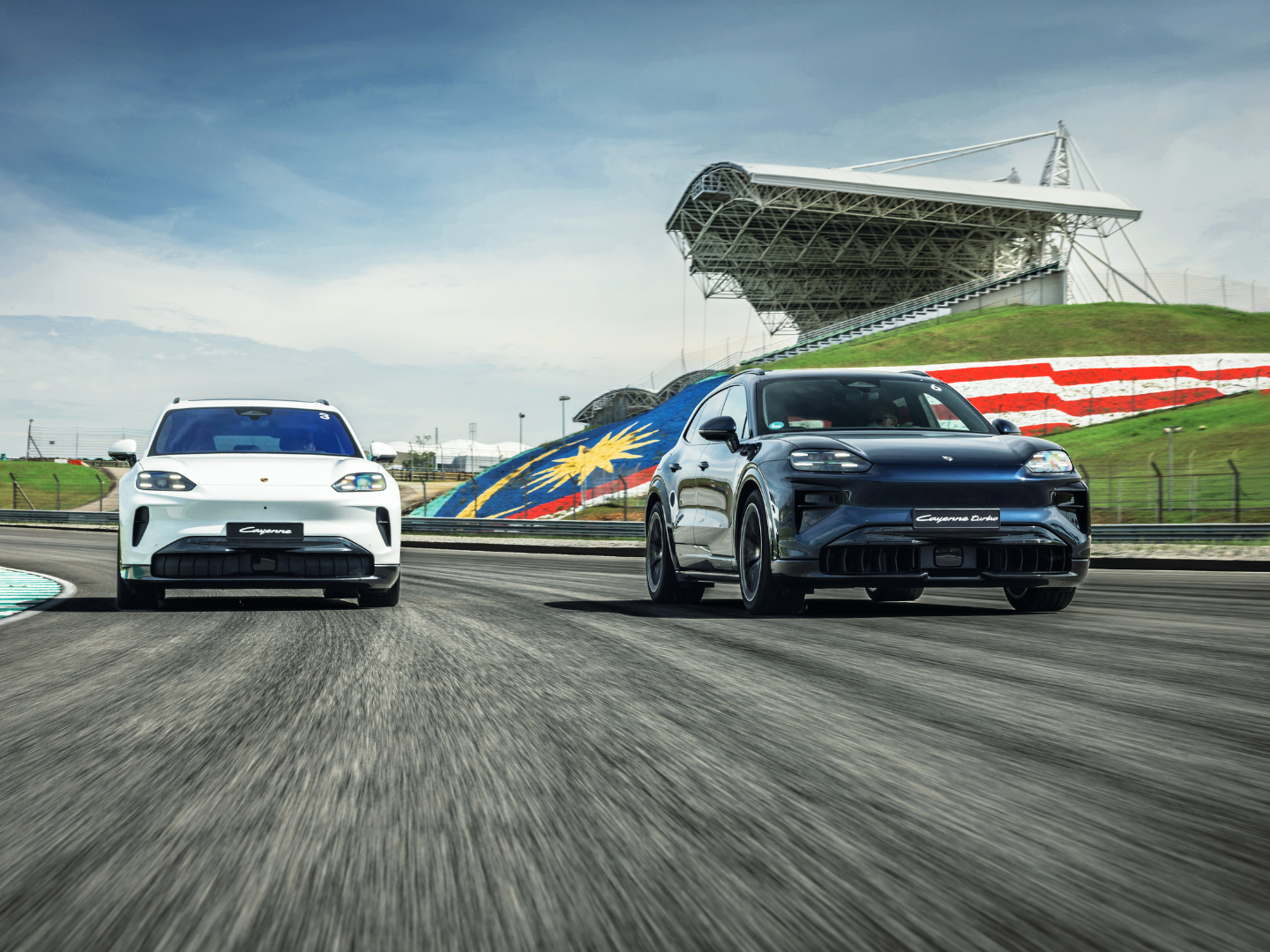
The Cayenne joins the Taycan and Macan as the newest addition to Porsche’s EV family (All photos: Porsche Malaysia)
In the tranquil countryside of Germany, Hemmingen sits among rolling hills and fairytale forests. While quaint, the town is located at the epicentre of German automotive engineering and, in 1997, became home to a top-secret operation. The classified Project “Colorado” took place in a facility with no company sign — office windows were mirrored and grounds surrounded by fences. Everything was hidden from prying eyes until 2003, when Porsche finally unveiled its covert op.
The release of the Porsche Cayenne, as hot as the pepper it is named after, ignited heated conversations and mixed reactions. Many were doubtful of the new SUV, fearing mechanical issues and a dilution of the marque’s sports car heritage. Instead, the automobile became a massive commercial hit, attracting an entirely new audience and providing a financial foundation for the company’s future developments.
By 2007, more than 100,000 units had been sold, taking it past the 911 as Porsche’s bestseller. Any lingering doubts were silenced in 2017, when the second-generation variant made it into the Guinness World Records for towing a 285,000kg Airbus A380 over a distance of 42m.
More than two decades later, electrification has reshaped the automotive landscape, driving the benchmark for innovation even higher. In an era where batteries, software and sustainability take the wheel, this latest instalment marks a significant milestone for the nameplate. The 2026 Porsche Cayenne Electric boasts cutting-edge sports and technological performance that elevates everyday driving.
2.png

Offered as the Cayenne Electric, Cayenne S Electric and Cayenne Turbo Electric, the fully-electric SUV features a 113kWh high-voltage battery paired with an 800-volt architecture, enabling charging speeds of up to 400kW. Under optimal conditions, power can be replenished from 10% to 80% in less than 16 minutes, while a quick 10-minute stop can add more than 300km of driving range. Those who favour sportier styling may opt for the Coupé, which has a sleeker, sloping 911-inspired roofline.
Forget range anxiety, often cited as a barrier to electric vehicle adoption. Depending on the model, the Cayenne Electric is capable of travelling up to 669km on a single charge. For a vehicle designed for active and family-friendly lifestyles, these figures place the SUV among the most capable of its kind currently on the market.
Performance has always been the beating heart of the stallion. Leading the lineup is the Turbo, with a galloping 1,156PS and 1,500Nm of torque. Engaging Launch Control activates an overboost function that can achieve an acceleration of zero to 100kph in 2.5 seconds. The car rockets forward, with top speed curbed at 260kph. These statistics are impressive considering it weighs the equivalent of an average-sized Asian elephant.
On top of this, the engineering beneath the bodywork gives the vehicle off-road capabilities that make driving through rough terrain feel effortless. With adaptive air suspension, ride height can be adjusted to maintain position and avoid obstacles. Porsche Active Suspension Management, a system that continuously modifies damping force, ensures stability on uneven ground. Users can also choose between multiple driving programmes with pre-set configurations. An off-road package boasts a lower front section that increases the approach angle.
Agility is improved with rear-axle steering, which reduces turning radius at low speeds, assisting with U-turns, parking and tight manoeuvres. At higher speeds, the wheelbase is virtually lengthened, which comes in handy for highway lane changes and sweeping bends common on Malaysian expressways.
1.png
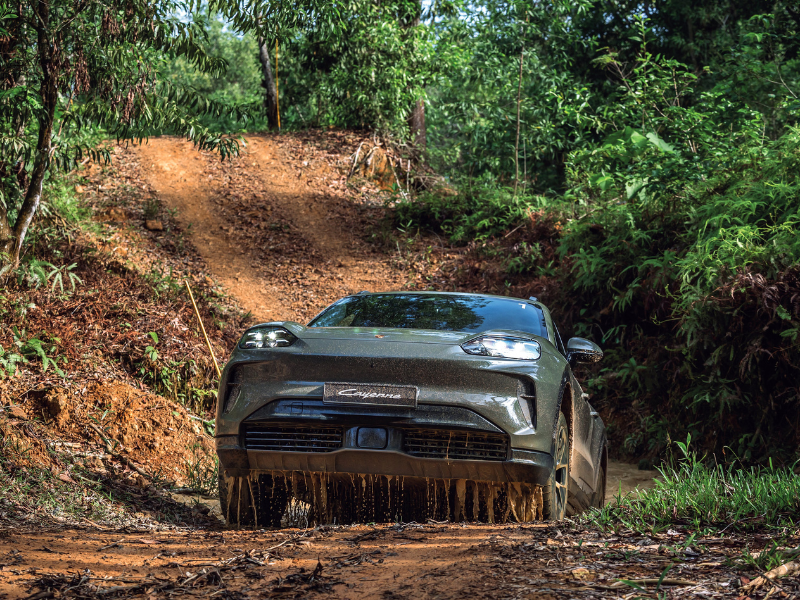
What’s more, the Porsche Active Ride (available in selected versions) independently manages each wheel. Replacing traditional stabiliser bars, dampers are controlled by electric hydraulic pumps and paired with single-chamber air springs that counteract body movements. Under heavy acceleration or braking, selected drive modes prevent the vehicle from squatting or diving, while the “active tilt” setting allows it to lean into corners like a motorcycle.
It sounds complex, and real-world results are just as mind-blowing. Despite being fitted with regular road tyres, the machine can navigate steep hills, uneven slopes or bodies of water at the push of a button. The driver need only sit back and steer. Plus, hardly any vibrations can be felt from inside the cabin. The same effect is achieved when the car goes over bumps or hits potholes.
This enhanced experience extends to the interior through a highly customisable layout. Seats can be personalised, while massage, heat and ventilation functions have been upgraded to help with circulation, fatigue and posture especially on long journeys. Additionally, the cabin can be transformed into a mobile gaming console for those looking to pass time while parked or during charging stops.
The dashboard is the largest ever in a Porsche, anchored by the unique Flow Display, named after the way it “flows” around the panel. It integrates seamlessly with the centre console, which has a hand rest to accommodate scrolling on the curved screen. While designing this feature, the team envisioned Brad Pitt coolly shifting the gears of a Harley-Davidson and strove to replicate the feeling of this movement. Some buttons and switches are still haptic, preserving the tactile quality many drivers appreciate.
These nuances reflect the automaker’s commitment to balance as it embraces the ever-changing motor industry without abandoning the qualities that catapulted it to success. Fast, versatile and unmistakably Porsche, the Cayenne Electric demonstrates that evolution and heritage can move forward together.
This article first appeared on July 6, 2026 in The Edge Malaysia.