
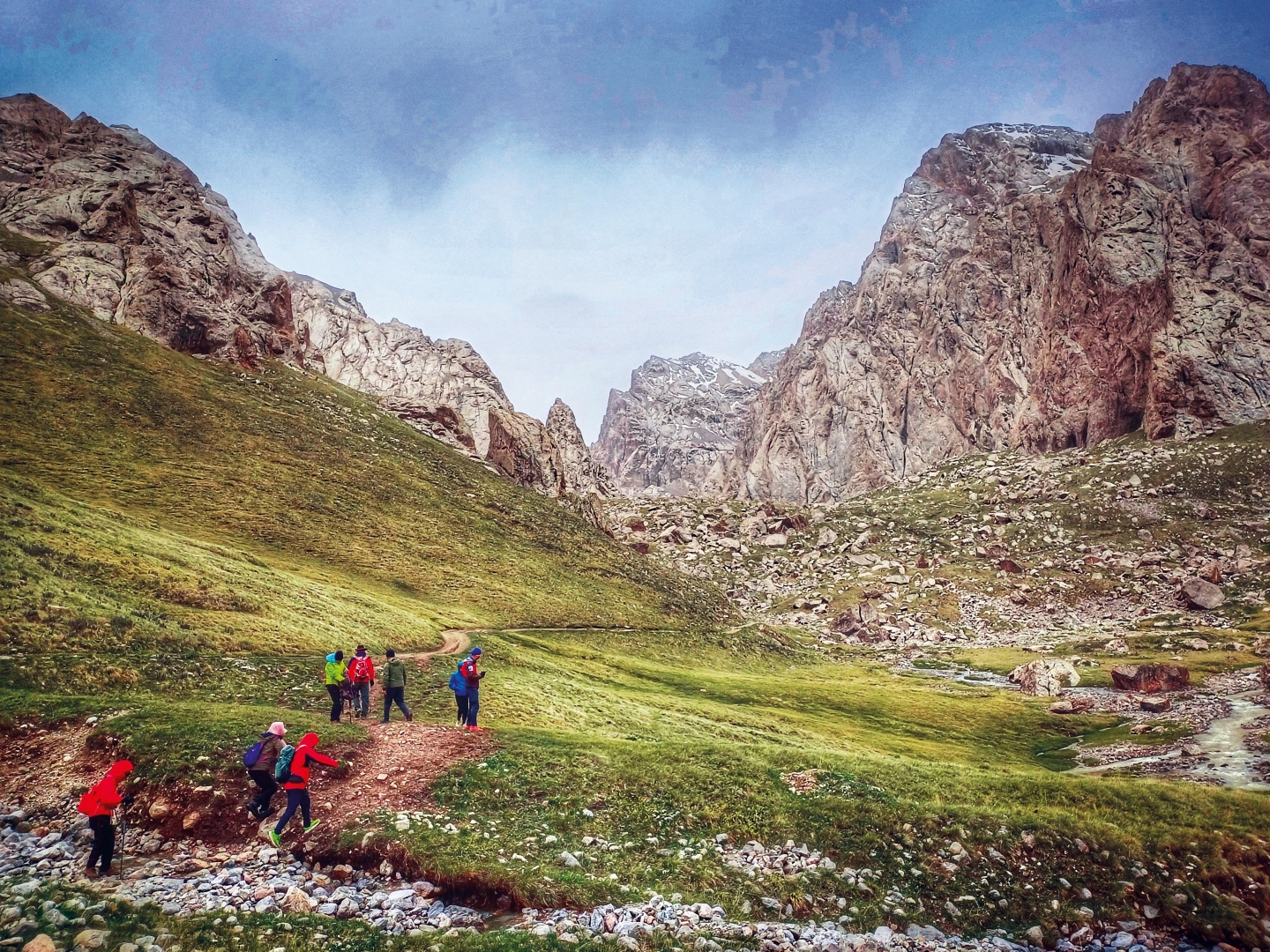
Hikers climb a section of rubble to view Köl-Suu Lake behind (All photos: Lee Yu Kit)
By the signboard, it was 150km to Köl-Suu, not so far, yet it would take most of the day to get there. We were just outside Naryn city, and the smooth tarmac quickly degenerated into an unsealed gravel track as the van turned off the highway.
It was like that for the rest of the way, getting worse as we drove farther. Gaping holes in the road could have quickly put an end to our journey. In places, the road dipped into streams and, sometimes, driving on the grassy parallel track was quicker.
The country initially was beautiful, but thinly populated, if at all. There were hardly any other vehicles. The occasional one would raise a small dust storm in passing.
Grasslands rolled out like a green carpet over the undulating terrain, with snowy peaks lining the horizon. Flocks of sheep, grazing cattle and roaming horses littered the countryside and, occasionally, a shepherd on horseback could be seen.
The road climbed a twisty section onto a plateau, where the lush pasture became sparser, the land drier, more monotonous and emptier, with fewer livestock.
1.jpg
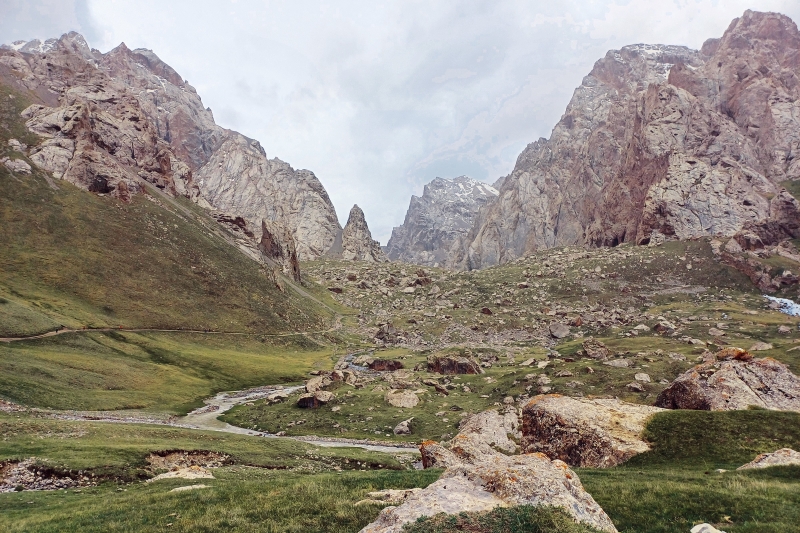
We stopped at a military checkpoint to have our papers examined, as we were entering a border area, for which a permit had to be applied earlier. In the bleak landscape, it was cold and windy in the shade. A few soldiers manned the plain white building beside it. Peeking inside the darkened windows, I only made out a bunk bed and some clothes hanging on a line, and wondered about the lives of soldiers posted here.
We were a group of a dozen hikers; Kyrgyzstan had offered some wonderful hiking and awesome scenery. We fell silent inside the van as we proceeded, the country unvarying and empty. “About 30 minutes more,” our guide said, breaking the silence as the van rumbled slowly, raising a cloud of dust in its wake.
As we drove deeper, the occasional yak appeared, accompanied by darting movements that were improbably chubby-looking cat sized marmots, diving into their burrows, or racing away as the van trundled by.
The valley
As we entered the valley, the aspect transformed: from the monotony of the undulating grasslands, Kok Kiya was a breathtaking sweep of glacial waters, braiding and branching into dozens of channels over a gravelly bed. The valley was broad, surrounded by undulating hills, behind which rose a range of jagged, snow-covered mountains. These were the majestic Kakshaal Too Mountain range, part of the Tian Shan ranges between China and Kyrgyzstan.
Clusters of yurts stood on the grassy plains beside the river. After so long without any sign of human habitation, it was like a breath of fresh air. It was late afternoon, and there was a bite in the air as we stepped out of the van, which had stopped beside several yurts, our accommodation for the night.
Friendly, shaggy dogs greeted us. A very late lunch or a heavy tea, awaited us inside the dining room, where a meal of kuurdak — a traditional dish of mutton with potatoes — was served as soon as we were seated. After the long, dusty journey, the fresh, cold air and hot meal were very welcome.
2.jpg
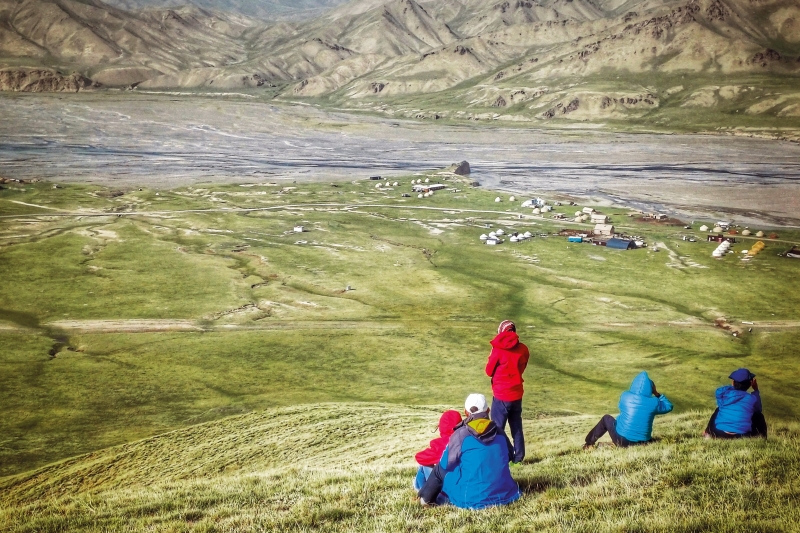
The altitude was 3,300m above sea level. It was a remote, hidden corner of Kyrgyzstan, precious as a secret concealed by distance and isolation and revealed as a reward for undertaking the long journey.
The air was thin and the wind was strong as I trudged slowly up the hill behind the yurt camp after the meal. As I ascended, the valley revealed itself in its beauty and vastness. The wind grew ever stronger. At that height, each step upwards required effort, and yet was richly rewarded with an increasingly expansive view of this corner of the planet, the elements of space, water, air and mountain combined in timeless beauty.
The climb was an exercise in acclimatisation to the altitude for tomorrow’s journey to the hidden Köl-Suu Lake.
The yurts set up on the grass were unexpectedly spacious with a few wooden beds within. Later in the night, an attendant came in to light the wooden stove, which was too small to provide much warmth, but being sheltered from the gusty wind outside made a big difference.
The beast
The air was as crisp as a newly folded sheet the next morning. Fortified by a breakfast of fried eggs and sausages, we faced a decision. The hike to Köl-Suu Lake, at an elevation some 200m higher, was a round trip of 15km.
The hike would take more time than we could spare for the trip to Naryn City that day, given the time it had taken for the inward journey. One option was to ride horses, but we did not favour the idea considering the rugged terrain. The alternative was to take The Beast.
Most, if not all, yurt camps had an AWD vehicle for this reason: transport to near the base of Köl-Suu Lake for the final ascent. I christened ours “The Beast” — a fitting name for the imposing vehicle that stood conspicuously behind the camp.
3.jpg
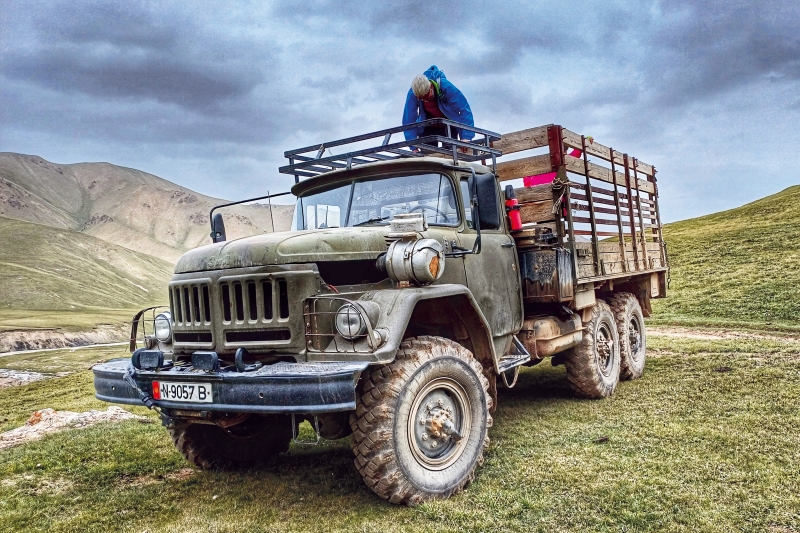
It had clearly once served a military purpose: a Soviet-era ZIL-131 military truck, a six-wheel-drive vehicle with chunky tyres that looked more suited to an earth mover than a lorry. It featured a cab with a flatbed behind.
The Beast came to life with a roar and a plume of blue smoke. It was steered by a sturdy, cheerful man with thinning white hair and a large chest. He seemed to be the manager of the camp.
Standing on the flatbed provided a vantage point compared to being on foot. The Beast passed a couple of neighbouring yurt camps before descending to the river, with its broad, rippling waters. Tyres bit into gravel and the vehicle shuddered as it forded the shallow river, the grey glacial waters swirling, and reforming, as we passed.
Yaks and horses grazed on grassy slopes. We passed several other yurt camps and forded the river a few times. The grey, sawtooth mountains loomed large, their sides covered in a mantle of snow, the barren rock looking as implacable as fractured armour.
When The Beast could go no further, the driver dismounted and gestured to the mountains, a short distance away. We clambered down, slung on daypacks, tightened hiking boots and started to walk.
The sheer beauty and silence hung like a mantle as we hiked. Up close, the granite rock was cold and unyielding as ice, formidable as steel. We were treading along a horse path, passing a small clearing with the remains of a fire and the impression of camps in the ground. For all its pristine appearance, people had painstakingly hauled aluminium hulled boats up here and onto the shore of Köl-Suu Lake, which is 3,514m above sea level. An earthquake in the 1980s caused the waters of the Kurumduk River to be impounded in a natural dam, forming what is widely considered to be one of the most beautiful alpine lakes in Kyrgyzstan.
Cresting the top of the dam, I saw Köl-Suu Lake before me, an apparition nestled in the bosom of the soaring rock walls of the surrounding mountains. The appearance of the lake changes greatly, from blue to green to the greyish-green that morning. Underground caves sometimes cause the level of the lake to vary, hence its name, which means “incoming water”.
4.jpg
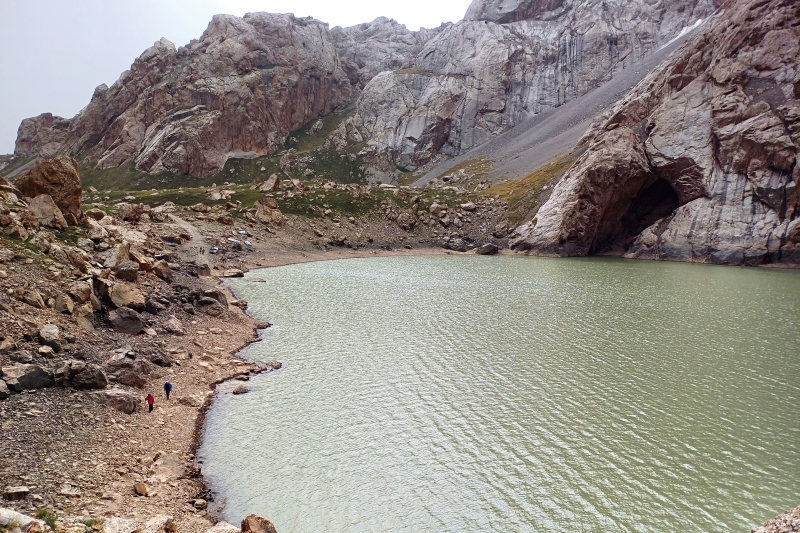
A few boats lay on the rocky shore, but there was no one else around. We had the almost-surreal beauty of the lake to ourselves, its placid waters reflecting the sky, the dam behind us blocking out the world, as if we stood on the threshold of a mystery.
With some of the others, I climbed to a vantage point above the lake, huffing and puffing in the thin air. The lake was not large, about 9km in length. It extended to beyond where we could see, in the depths of the rocky gorge.
The sense of isolation in this cold valley, with the lake hemmed in by sheer rock walls, was complete. We stood in silence, reduced to breath and heartbeat, the wind whispering along the water’s surface. The world beyond the dam felt impossibly distant.
Surrounded by stone and sky, I felt as if we had slipped through a crack in the world and found something eternal — untouched, unspoken and achingly sublime. Reluctantly, we turned back the way we came, carrying with us the silence of the hidden lake.
This article first appeared on July 20, 2026 in The Edge Malaysia.