
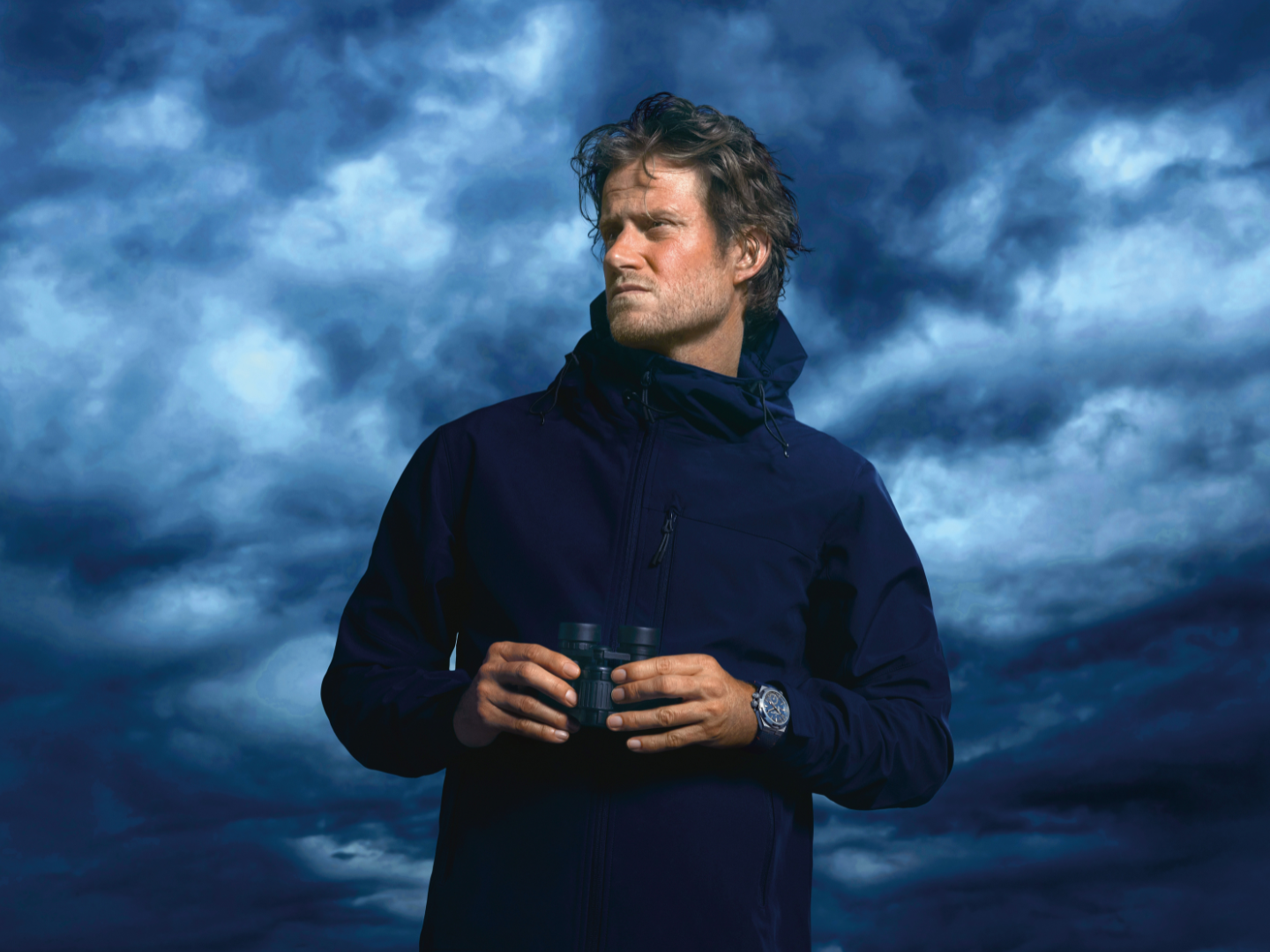
Richards wears the Overseas Dual Time Cardinal Points in blue, which he favours as his daily companion (Photo: Vacheron Constantin)
At 25,000ft on Everest, sleep is a distant privilege reserved for the world below. In the spring of 2019, Cory Richards sat on a narrow ledge hacked from ice, suspended above a vast darkness while the route ahead grew treacherous. With dawn still buried behind the horizon and little else to occupy him, he occasionally glanced at the Vacheron Constantin Overseas Dual Time prototype on his wrist. One indication marked the hour on the slope; the other pointed home. That second display became a psychological tether, proof that ordinary existence carried on beyond the inhospitable height and isolation. Somewhere, people were huddling beneath warm sheets, waking in familiar rooms or beginning another unremarkable day.
It was the American climber and National Geographic photographer’s third expedition to the “roof of the world”, following two successful ascents, including one without supplemental oxygen. Although worsening conditions forced him to abandon the forbidding North-East Ridge before reaching the top, the watch — exterior scratched and strap frayed — would prove to have a more enduring afterlife. Its dark-grey grained dial and lightweight titanium case established an aesthetic language that Vacheron Constantin revisited in 2021 through two limited-edition Overseas “Everest” models: a chronograph and dual time.
Seven years and several latitudes removed from that perilous chapter on the Himalayan colossus, the 45-year-old Richards is now seated amid the tropical calm of the Four Seasons Resort Langkawi in Kedah, the Andaman Sea glinting in the distance as he lends his perspective to the new Overseas Dual Time Cardinal Points.
“This is considerably more comfortable than my ‘usual office’,” he says, chuckling in front of a gathering of regional press.
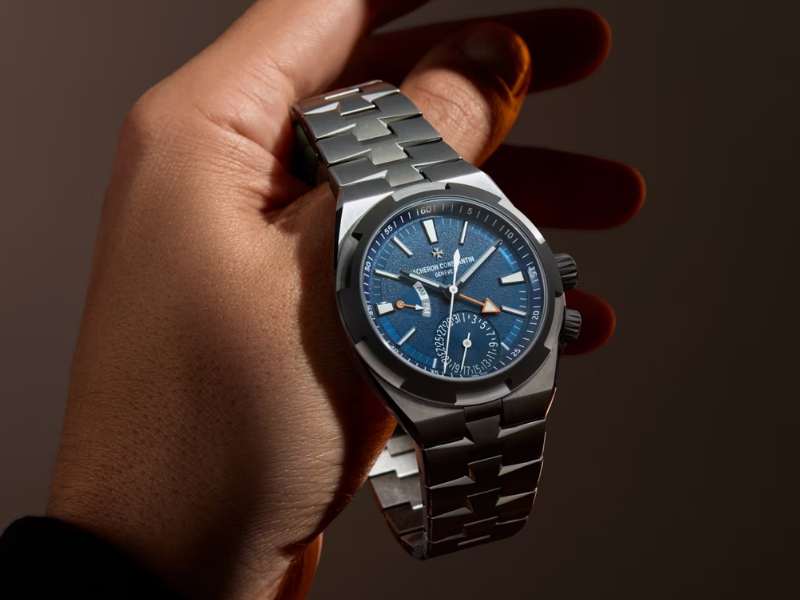
Presented in four dial colours, the collection assigns each shade a compass bearing and corresponding terrain: white looks North towards frozen expanses; brown faces South across continents and vast plains; green points West to dense forests and tropical jungles; and blue reaches East, where ocean meets sky. Powered by the self-winding Calibre 5110 DT/3, each model combines a traveller’s essentials — dual time, day/night indicator and date — while meeting the standards of the Geneva Hallmark, a certification that testifies to the movement’s precision and hand finishing. The 41mm case, integrated bracelet and interchangeable three-blade folding clasp are fashioned from titanium, prized for its lightness and strength.
1.png

“A watch reminds us that time truly is precious, though none of us knows how much we have. When I look at one of the Cardinal Points, it urges me to look further and stay inquisitive without necessarily seeking an answer. The latter implies a conclusion but curiosity is simply a desire to find out more. It’s playful and fulfilling because ultimately, fun lies in continuing to wonder.”
That appetite for open-ended discovery has kept Richards in Vacheron Constantin’s orbit for nearly a decade. Their association began in 2016 with an unexpectedly modern overture: a direct message from the maison proposing a collaboration. His initial caution was understandable — brand alliances, he notes, seldom amount to sustained commitment. What persuaded him was the manufacture’s long-standing affinity to craftsmanship and exploration, expressed through a history of travel and technical resilience. Here was a house eager to reframe the traditional imagery of endurance, treating the unknown as an intellectual, creative and physical endeavour.
“I believe the greatest refinement is simplicity. In unforgiving environments, I don’t need that many complications; dual time is plenty. What matters is something that can withstand the rigours of the journey while keeping me grounded. I adore that brevity in design. It is the most elegant and special.
“A great watch doesn’t dictate where you need to be; it reveals where you are. The question everyone asks is, ‘What time is it?’ — never, ‘What time will it be?’ It brings you back to the present. And the irony is that once we become fully absorbed in it, we become less conscious of its limits.”
To fathom why a man who measures risk for a living wears his scars so openly, it helps to know how few parts of his life, repeatedly knocked off course, had gone according to design.
2.png
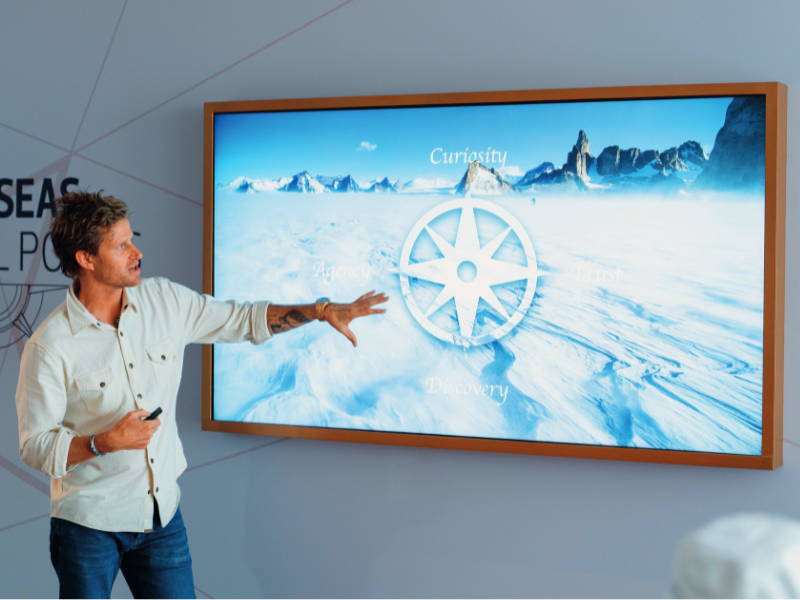
Wander wall
Before climbing gave Richards a profession, adventure was a family project. Growing up in Utah, with the Wasatch Range practically in his backyard, he was raised by parents who believed the outdoors was pivotal to the development of their two boys. Yet the younger son never quite settled into the expectations others appeared to inhabit so easily. Adolescence brought a persistent sense of dislocation and deepening estrangement from home, eventually drawing him towards the mountains — the one place that asked him to be nothing other than himself.
As skill hardened into vocation, an escalating taste for higher stakes beckoned the daredevil towards the farthest edges of the map. Success secured sponsorships, international commissions and the means to travel, though it also complicated his sense of purpose. The pursuit itself began to feel myopic, even self-regarding, beside the communities, histories and private realities encountered along the way. Photography offered an opportunity of widening the frame, shifting attention from the figure at the centre towards the human stories unfolding around him.
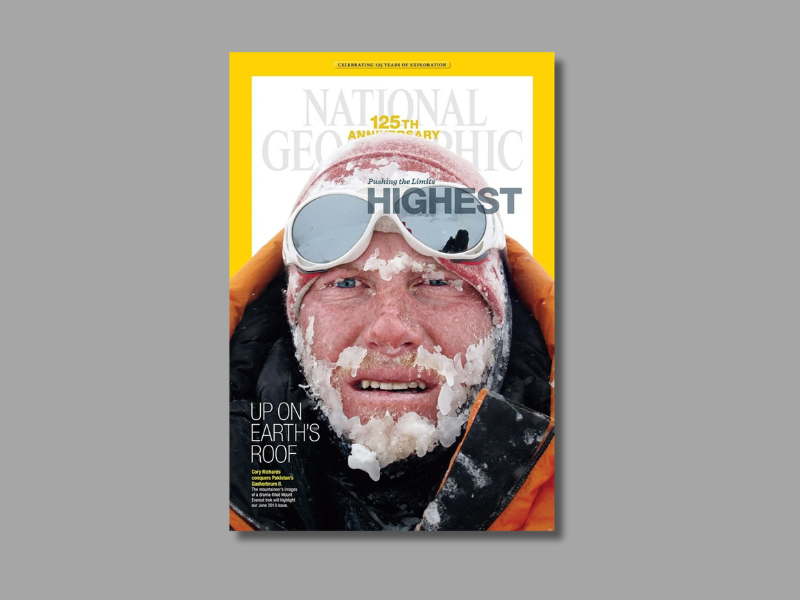
That tension came to a head in the winter of 2010/2011, when two veteran alpinists extended an invitation to attempt Gasherbrum II, an 8,051m monolith in Pakistan’s Karakoram that had never been scaled in winter. On Feb 2, 2011, all three men crested the peak, making Richards the first American to achieve such a feat. The euphoria, alas, was extinguished almost at once. A crack sounded overhead, then the freight-train roar of an avalanche. Swept by a downslope force, Richards was finally deposited, by some mercy, face-up in the snow, where his companions — miraculously spared — managed to dig him free. Still dazed, tears freezing against his skin and beard matted with ice, he reached for his camera, turned the lens upon himself and released the shutter. The face it captured — grimacing, hollowed and wreathed in frost — would launch his career as a National Geographic photographer.
The portrait fixed Richards in the public imagination as a man returned from the brink, but survival scarcely dulled his attraction to Earth’s harsher reaches. What ensued traced an almost cartographic scatter. In the former Himalayan kingdom of Mustang, he joined archaeologists probing cliff-hewn chambers near Nepal’s border with Tibet, scouring ancient manuscripts, murals and human remains before a 20ft fall left him with an injured back. Franz Josef Land whisked him to the Russian Arctic, where polar bears roamed a landscape stripped of snow due to global warming. Most punishing was an assignment that began in the Angolan highlands and consumed nearly four months, taking him 1,200 miles down a largely unexplored river catchment feeding the Okavango Delta. Along the way, he documented an ecosystem long insulated by war and newly exposed to settlement, extraction and competing claims on its water.
3.png
Mountain, tundra and floodplain passed before his lens, each demanding its own degree of nerve and surrender. The avalanche left him with post-traumatic stress, compounding an already volatile inner life marred by emotional despair, abuse and self-destructive impulses. Conquering Everest — known in Tibetan as Chomolungma, or “Goddess Mother of the Earth” — evoked profound satisfaction, but with it came another sobering thought: what happens after attaining the thing you have spent years believing would complete you?
“It taught me nothing outside myself was ever going to be truly satiating,” Richards explains. “Nothing external could satisfy that need for wholeness or completion because that work has to happen within. I had arrived at the highest point on the planet and realised it had not done what I thought it might. There was nowhere higher left to go, nor anywhere else to escape to in the hope of finding myself. In many ways, the summit became a kind of rock bottom because the only direction available was inward.”
Richards still climbs, though no longer driven by milestones or the validation once attached to them. The affirmation he sought through conquest has now taken a tangible form in Seconds, the circular lifestyle company he is building with Taylor Shupe, co-founder of cult sock label Stance. At its Oceanside facility in California, discarded textiles and industrial waste are remade into premium apparel and objects, largely by women who were formerly incarcerated or otherwise justice-impacted. The name carries a double promise: renewal for cast-off materials and a fresh start for those too often defined by their pasts.
“The fears I faced on my missions were real, but now I’m more afraid of failing to live up to my potential or not being accepted in my totality,” he says. “We all have secrets, dark corners and shadows. The more we release ourselves from the shame that keeps them hidden, and see love reflected back, the more their power diminishes. That, too, is what Seconds is about.
“The readiness to step into the entirety of oneself is perhaps the most courageous thing we can do. Saying no, turning back on a venture when something feels wrong, or walking away from what no longer serves us — whether a relationship or an identity we have outgrown — are all acts of courage.”
Cardinal rules
Asked to name a favourite among the four cardinal points, Richards inevitably chooses east — the Central Asian Plateau, Tibet, Nepal and India, whose ranges first gave his ambitions coordinates and underwrote much of his portfolio. He considers the compass a kind of trick: travel far enough north and the path begins curving south; persist eastwards and west eventually comes into view. It is a loop that always circles back to where you started; a return, in the end, to the self.
“East represents mystery as well as spirituality, and it is where I found my fullest expression and voice. In Tibetan Buddhism, mountains are spiritual presences — deities in themselves or dwelling places of gods — and often sites of pilgrimage. Everything is impermanent, always in flux. The highest points on the planet define the edge of the knowable; a threshold between the tangible and intangible.”
That sense of timelessness, by extension, informs the way he now perceives timepieces, their meaning shifting with the circumstances in which they are worn. At extreme elevation, the Overseas Dual Time acquired the emotional weight of home and the promise of return; these days, Richards favours the rose gold Overseas with a blue dial as his daily companion, removing it only to alternate between the matching bracelet and rubber strap.
body_pics_3.png
The mountaineer’s preference for the mechanical over the mediated also means he has no inclination to replace it with a wearable that tracks, prompts and anticipates his every movement — another symptom, perhaps, of a world increasingly reluctant to leave anything unresolved. Getting lost, once an unavoidable part of exploring somewhere unfamiliar, has become something many would rather prevent altogether.
“I think it’s not that we’ve lost that ability but the willingness to do so. Comfort can sometimes be a cessation of growth. We stagnate and become calcified in our thinking. Spending time in extreme locations has absolutely changed the way I view and appreciate time because you’re always in closer proximity to mortality. You become acutely aware of how brief it is, which makes you want to keep doing better — an idea co-founder François Constantin always championed. That same commitment to growth is one reason I remain so dedicated to the maison: it has continued to evolve alongside me.”
That awareness has reshaped the yardstick by which Richards decides what makes life worthwhile. To him, what matters is whether one’s presence has improved the circumstances of others, however modestly, and created room for them to exist without concealment or apology.
“My hope is to leave great art and a record of service behind; a legacy built on love and compassion, where people have felt seen and accepted for who they are.”
This article first appeared on July 27, 2026 in The Edge Malaysia.