

CPro Solutions chief operating office Aiman Mohd Ibrahim (Photo: Sam Fong/The Edge)
These days, making a payment for goods and services is as simple as scanning a QR code or waving a card. As technology advances, it is difficult to predict how transactions will be conducted in the future. With electronic spending becoming the norm, one initiative hopes to ensure that the younger generation will not be left behind.
Bank Simpanan Nasional’s (BSN) Cashless School Program allows students, teachers and staff to make electronic payments in school. Convenience aside, the project aims to boost early financial literacy and enhance safety by eliminating physical cash.
Powering this programme is CPro Solutions, an IT company helmed by Aiman Mohd Ibrahim and set up by his parents. The 31-year-old had been working in Germany but returned to Malaysia 18 months ago, pivoting his career and carrying on the family endeavour.
Coming from a household of overseas graduates, studying abroad had always been a benchmark for Aiman.
“It was in my plan to venture out of the country, but not to Germany,” he says.
Still, when an opportunity to enrol in the German-Malaysian Institute came along, he grabbed it, unaware of the decade-long journey he would soon embark upon.
“I’ve always loved anything to do with technology. I like that it brings convenience, even if it saves just one or two seconds,” Aiman shares.
1.jpg
His interest led him to choose automotive engineering as his first passion. Unfortunately, having to learn a new language and assimilate into a different environment had him reassessing his situation. Eventually, he settled upon something that felt well aligned — mechatronic engineering, a combination of mechanical engineering, electronics, robotics and programming.
At the beginning of his professional path, Aiman worked as a software engineer in Munich, building servers and databases. The consulting group that employed him was part of an insurance company. He found that being part of a large corporation exposed him to operational skills such as structured frameworks that drive productivity and efficacy.
Aiman recalls his enthusiasm after coming across a Buy Now, Pay Later system with no added interest. This planted a new motivation in him.
“Digital payments increase accessibility, but they can also inconvenience those who do not know how to use it,” he says.
Thus began his venture into fintech, which many might say was long overdue.
CPro Solutions is the fruit of his parents’ labour. Both are armed with doctorates — his mother is a computer engineer and his father an electrical engineer-slash-physicist. At the turn of the millennium, the couple was among the pioneers involved in developing the Mastercard chip.
Adapting to changing times and rising competition, they branched out into the business of software. The company builds all solutions and payment gateways — secure processes that take place when making an e-commerce purchase — in-house. From a customer’s perspective, it appears as a checkout interface to input payment details and authorise transactions.
“Maybe for the user it seems simple, but the engine behind it is very complex,” shares Aiman.
2.jpg
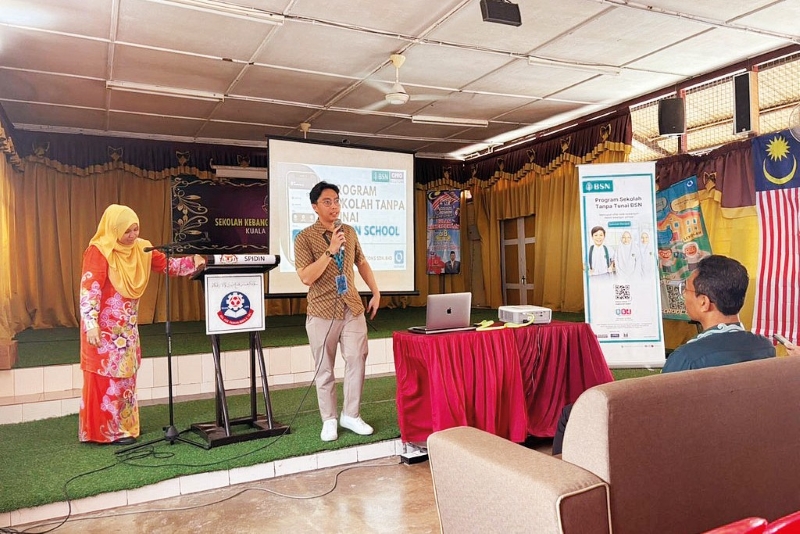
This technology has been reshaped for a new landscape — Malaysian schools. The partnership between BSN and CPro Solutions had been struck before the pandemic, with the first phase of the Cashless School Program being introduced in 2020. At that point, it was only implemented in secondary schools, like a debit card that could also be used at merchants outside of school.
In 2024, the target demographic was expanded to include primary school students. This proved to be a formidable undertaking as the team had to develop an entirely new system that was regulated and approved by the authorities.
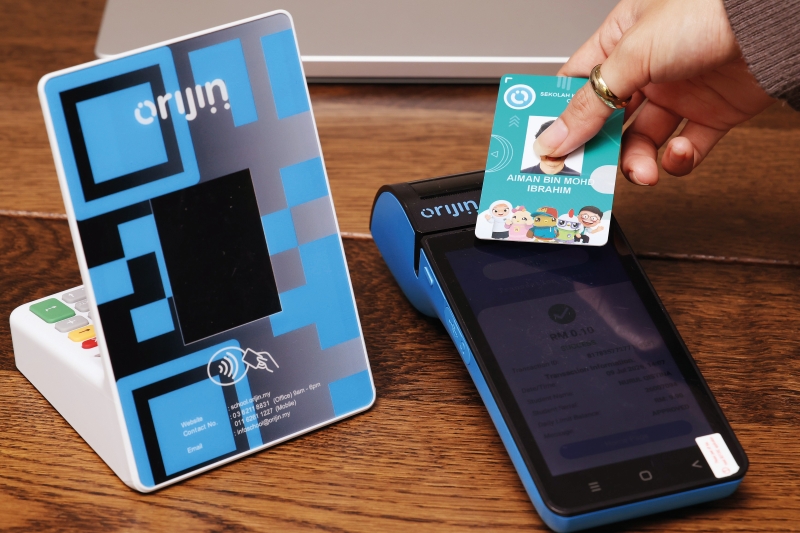
The outcome is a dedicated e-wallet system as well as a card etched with the student’s photo, school emblem and an adorable illustration of local animation characters, Didi & Friends. The card is eligible for purchase within school grounds, including at the bookshop, canteen and kedai koperasi (cooperative store). Participation is free but there is a one-time fee of RM10 for each card issued.
Besides budgeting, the programme cultivates more transparency between guardians and children. The application enables adults to seamlessly transfer funds, set spending limits and monitor expenditure. Possessing their own card also plants a sense of responsibility and accountability among students.
The range of services provided by the Cashless School Program is not restricted to payments. The card also includes an attendance-taking feature, whereby tapping the terminal digitally records the student’s presence.
3.jpg

Every project faces its share of obstacles, especially if it is being deployed nationwide. In Aiman’s case, his biggest concern is ensuring that the product works and is reliable.
“The challenge to me was, could the children spend?” He posits this question in regard to heavy user traffic, particularly during recess.
“We have around 9,000 kids onboarded, who go to recess almost at the same time. So in that 20 minutes, a lot of transactions are happening at once.”
To meet this demand, CPro Solutions migrated from physical on-premise servers to cloud — in particular, Amazon Web Services (AWS), which is a reliable and scalable enough infrastructure to support multiple transactions, especially during peak hours.
This shift was one of many made to accommodate the growth of the programme and CPro Solutions’ vision to make technology more accessible. Aiman also implements other strategies from his past experiences to foster a balanced environment that is both healthy and high performing. There are now proper guidelines and departments dedicated to each part of the process. Employees are also granted flexibility to implement their tasks. For instance, a sales executive has the freedom to craft a pitch with the provided materials.
Starting with five in Kuala Terengganu, the programme is now available in 40 primary schools and 214 secondary schools.
“The schools want to be digitalised. Not only in the city, but in rural areas too,” Aiman affirms.
As the two partners continue to build an inclusive digital ecosystem, they hope to reach 500 schools at the end of the year, with plans to scale across boarding institutions and outlying regions.
This article first appeared on July 27, 2026 in The Edge Malaysia.