
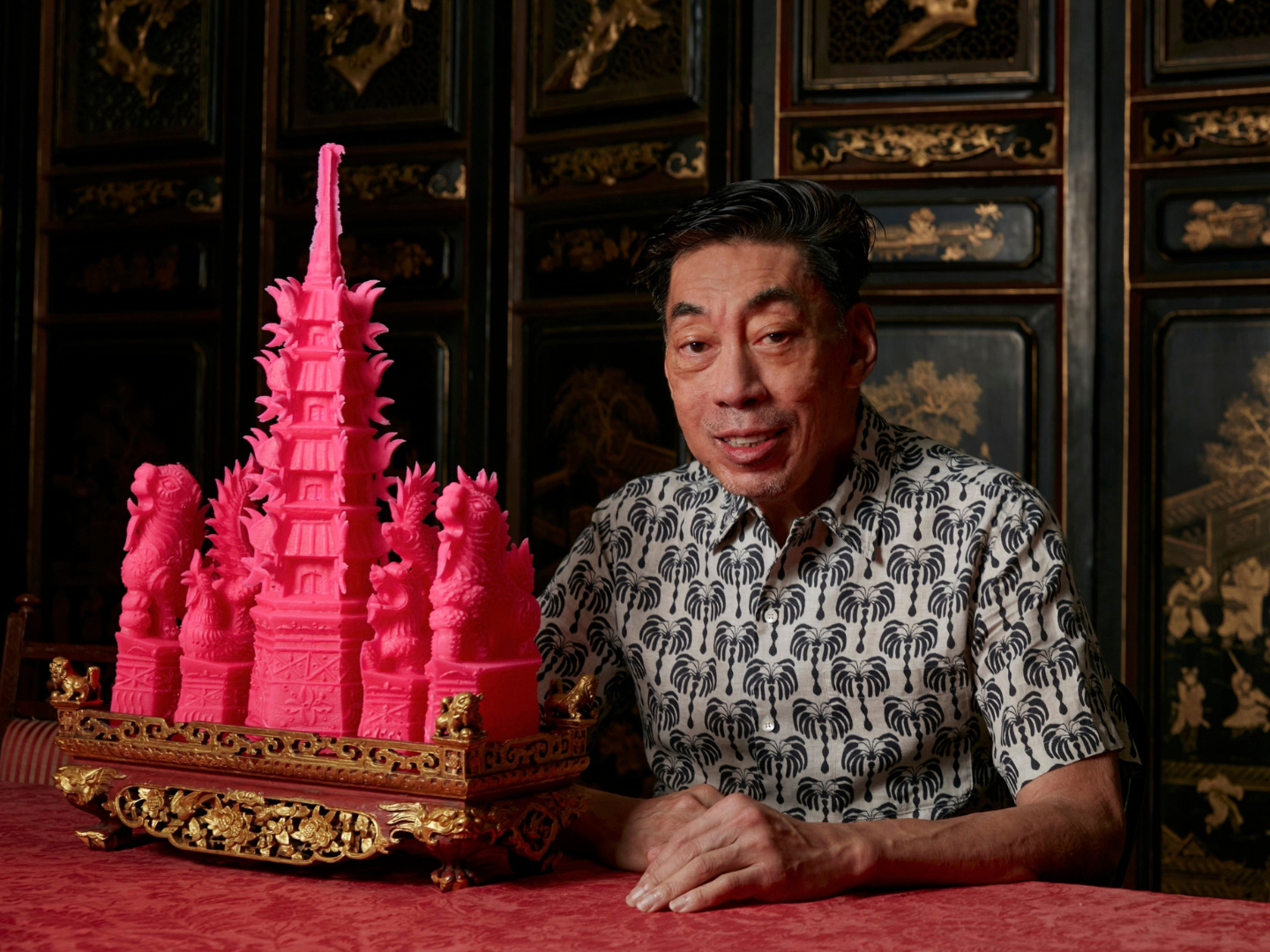
Ong next to a stunning 'ngor siew' sugar art offering (All photos: SooPhye)
The atomised societies of today can best be summed up in a few sad points and keywords: isolation, separation, selfishness and the severance of collective group ties and a palpable sense of community. This increasingly individualistic way of life has led to the slow crumbling of the symbolic pillars inherent in communal activities, and all the rites and observances that provide structure and meaning to life, all of which allow us to mark — and make sense of — time.
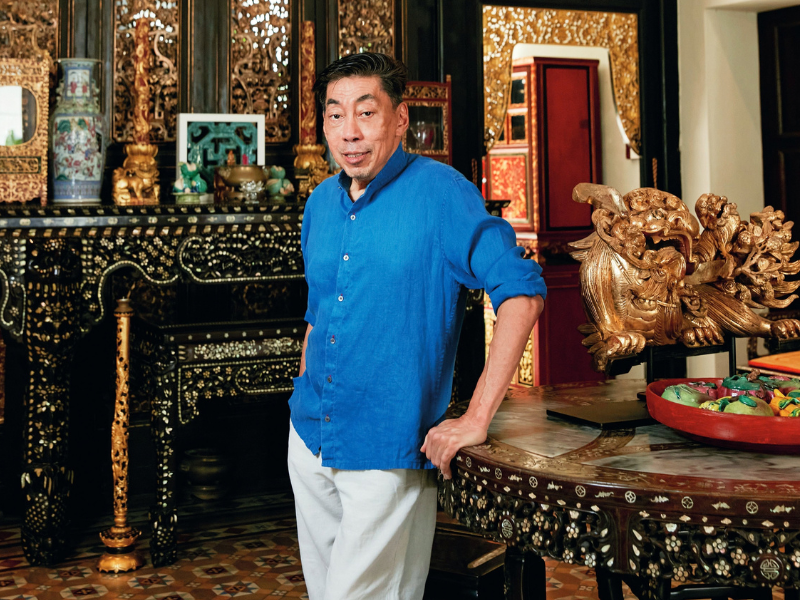
For Chris Ong, the intangible power of ritual to bind people together is precious. The proud Penangite and investment banker-turned-hotel impresario — and whose George Town Heritage Hotels group, comprising in-demand names like Seven Terraces, Jawi Peranakan Mansion, Argus Residences and Muntri Mews, continues to be the flag-bearer of inimitable and quintessentially Penang heritage-inspired hospitality — had left the island of his birth in 1977 to pursue his tertiary education at the University of Melbourne, Australia.
This was followed by a 20-year career in banking and then his first foray into hospitality and restoration by way of the conversion of a 17th-century colonial Dutch East India Company director’s mansion into what is now the Galle Fort Hotel in Sri Lanka. “By the time I returned 30 years later, Penang still felt familiar… except for a sense of emptiness,” he says over dinner at his stunning heritage George Town home. “In fact, the inner city felt dead, even. Many of the residents had moved out while businesses and small enterprises moved in. In a single generation, George Town had become a ghost town or, rather, a zombie that remained alive but devoid of soul.”
_36a0927a.jpg
Ode to ancestors
Tormented by a belief that intangible heritage could be permanently lost — unlike tangible heritage that could still be restored, rebuilt and reimagined — Ong began a journey of introspection.
“We have to examine who we are as a community and what our identity is. Modern lifestyles, an apathy to religion, globalisation and a focus on the individual have led to the demise of the old system of beliefs,” he laments. “Within one generation, the oral history about past cultural rituals has disappeared to a large extent.”
Feeling the need to deep-dive into the memory bank of his roots and rekindle the rituals he observed and practised as a child and young adult, Ong set about remembering. “And by remembering, I decided to document it all so that those who are interested or simply curious could have a point of reference.”
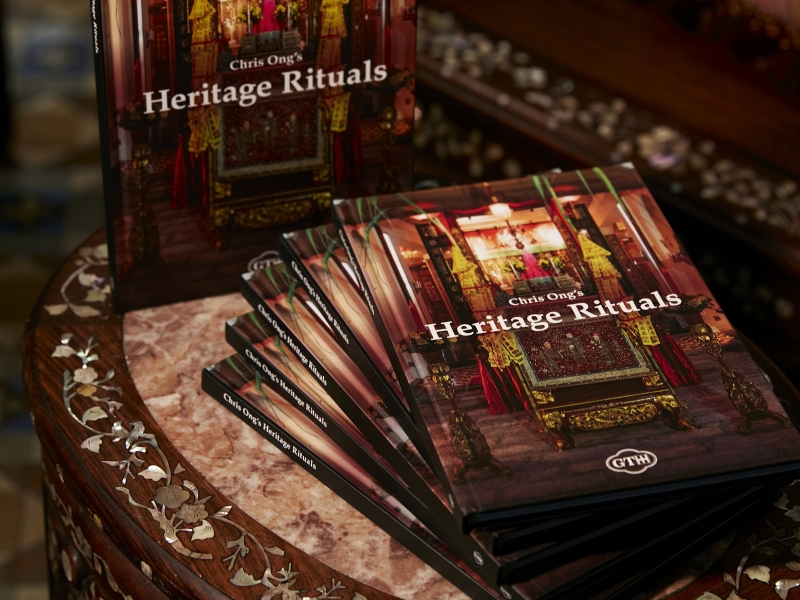
The result is Heritage Rituals, a beautiful, straightforward 108-page hardcover book that is as evocative and nostalgic as it is detailed and informative. From the sending-off of Chao Kun, the Kitchen God, on the 24th day of the 12th lunar month so the deity could give his annual report to the Jade Emperor, to the grand Hokkien thanksgiving celebration of Pai Ti Kong, Ong writes in the first person and peppers each chapter with personal anecdotes and recollections.
“The urgent need to record these rituals has to be practical and realistic,” he shrugs. “Even more so when I see how many people around me suffer from memory loss and dementia. It is an unspoken fear. So we need to rapidly log all that the older generation can share with us, while comparing notes with other practitioners.”
4.png
With George Town inscribed by Unesco as a cultural destination in 2008 and Ong freshly returned to Penang the year before, it seemed like serendipity — and the sweetest of homecomings. “Coming home just prior made me wonder if it was part of a divine plan set out for me. My family is of Baba Nyonya heritage and we lived in a multi-generational home. But it sometimes proved confusing as my parents embraced the post-war modernity, rejecting most of their traditional cultural baggage. It was my grandmother’s persistence in carrying out her rituals in the face of new modernism. When she passed away in the 1980s, I was living overseas, but remembered telling myself how it was the end of an era.”
The palpable sense of loss we feel when loved ones depart this earth could perhaps explain why, out of all the documented heritage rituals, Ong says Qing Ming (Cheng Beng in Hokkien) is the most moving for him. This day is set aside for the annual visit to tend and maintain the graves of ancestors.
“It is undoubtedly the most emotional and confronting,” he agrees. “As we visit the graves, we remember those who have gone before us, and the sacrifices they made. It also forces us to confront our own mortality, reflect on whether our deeds and achievements have made our ancestors proud, and to mull on the legacy we will leave behind.”
Traditionally starting 105 days after Tang Chek or the Winter Solstice, Cheng Beng, unusually, follows the Gregorian calendar, which is based on the sun, as opposed to the moon. “Given that cremation is becoming even more commonplace these days, you can replace a visit to the cemetery with a visit to the columbarium instead. As all my immediate ancestors are buried in Penang, it does not involve too much effort to check on the graves’ condition. It is also the time when all my siblings agree to meet in George Town and observe Cheng Beng together, where we clean and upkeep the graves of our parents, both sets of grandparents and a few great-grandparents. We were well-conditioned by our parents in performing this dutiful act,” he grins. “But, honestly, I consider it a privilege. Did you also know the feng shui and condition of said graves are said to impact the well-being of the descendants? But as a family, we have always taken pride in our final resting places, just as we take pride in the condition and maintenance of our homes.”
body_photo_51.png
Pursuit of jade (emperor)
With a world-renowned collection of antiques and porcelain, and given that each of his hotels resembles a perfect Peranakan jewel box, it goes without saying that Ong’s reputation as an aesthete is rock solid. And it is during Pai Ti Kong (literally translated as “prayers to the Jade Emperor”), always celebrated on the eve of the ninth day of the Lunar New Year, that Ong ceremoniously unboxes all the paraphernalia for the altar table collected over the years. “I can still hear the quiet gasps of my staff and helpers, impressed by what they see and keen to learn more.”
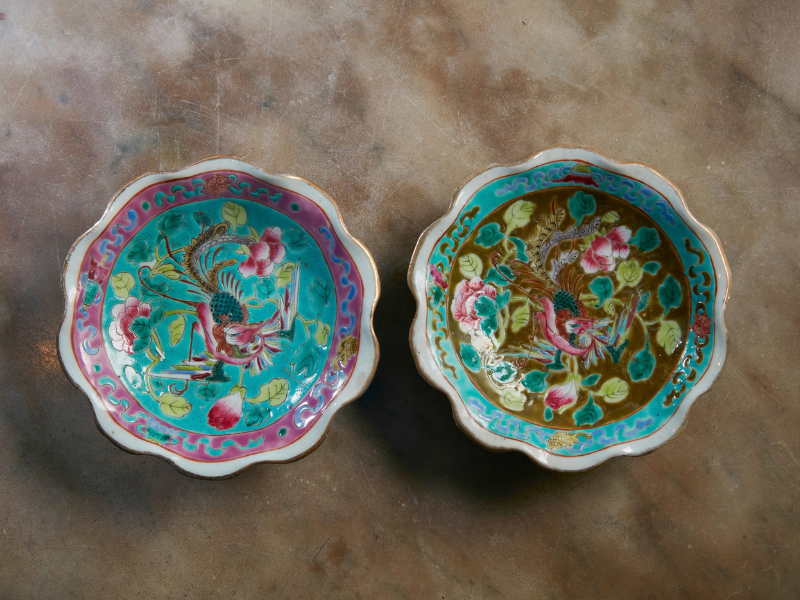
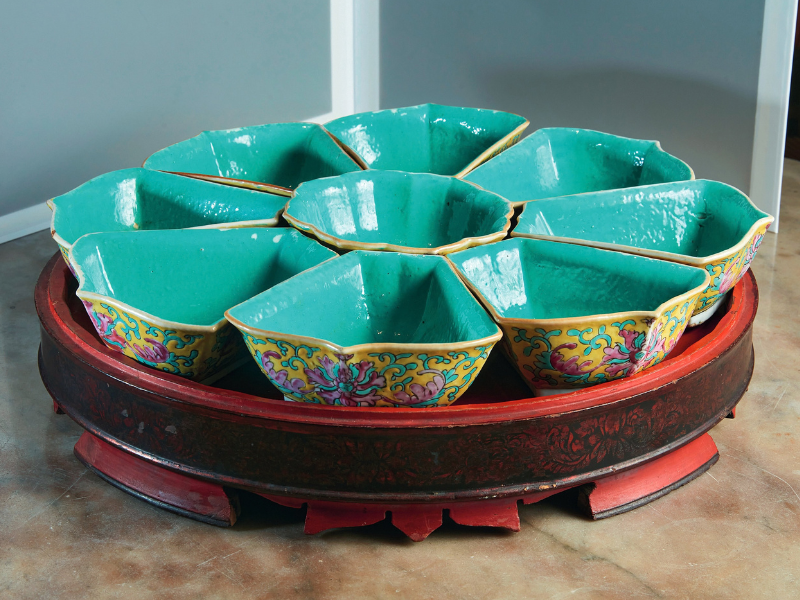
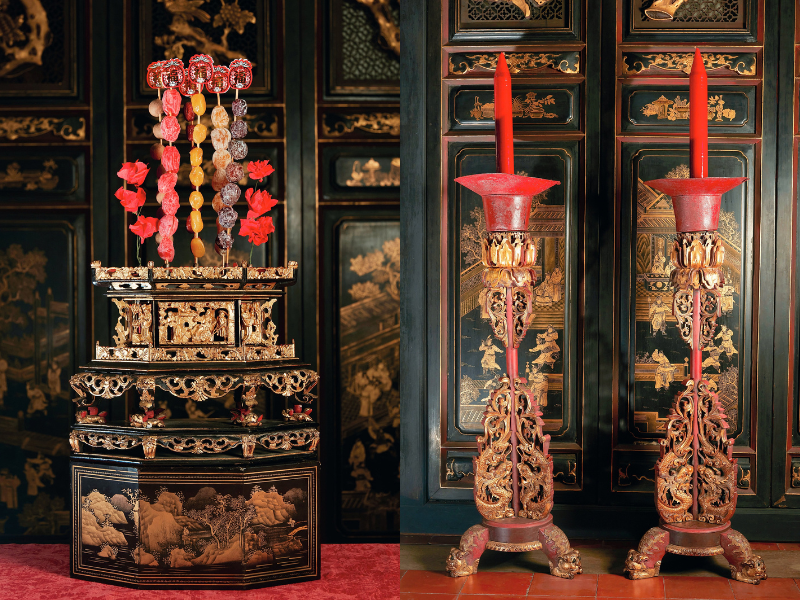
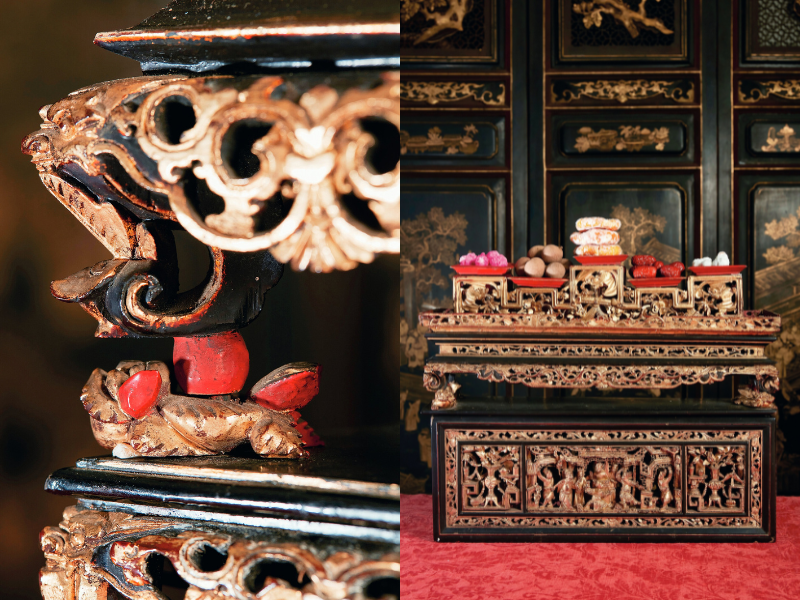
The treasures include lotus offering plates of varying sizes made specifically for the ritual, elaborate lacquer boxes used for the sweetmeat offerings, antique gilded stands and precious giant candlesticks. “The annual opening of my Pai Ti Kong storage box gives me great joy. Surprisingly, I did not inherit anything except oral history and the appreciation of Straits Chinese artefacts and porcelain. One of the most beautiful examples would be the lotus offering plates. I never tire of looking at them!”
Ong singles out a few other outstanding examples. “The one piece that got me really excited was the rectangular carved stand for the ngor siew, or five celestial symbols, made out of pink sugar. There is also the intricately carved gilded chien hup upon which to display the sweetmeat skewers — this is an important altar piece. Oh, and one memorable item I had purchased for Pai Ti Kong was a pair of Nyonya torches, not dissimilar to those you would find on the high altar of a Roman Catholic church. It was its provenance that thrilled me as it was acquired from P G Lim in her last years at Bukit Ceylon,” Ong shares, referring to the late Tan Sri Lim Phaik Gan, Malaysia’s first woman ambassador as well as one of the first female lawyers to practise in the country. “The torches had belonged to her grandmother, Mrs Phuah Hin Leong. I always believed there is an element of the divine in the art of Pai Ti Kong offerings. It drives me to do better, be it in terms of aesthetics or the size or quality of the oblations. I also derive immense satisfaction from getting creative for Pai Ti Kong. Last year, I created a two-tier altar table using antique elements I had collected over the years,” he smiles.
3.png
For those not privy to a private Pai Ti Kong celebration, the most lau juak (lively or bustling) alternative would be to head to Penang’s Chew Jetty at Weld Quay. Here, the prayer altar is said to measure at least 20m in length and is heavily laden with all manner of roast meats, fruit, traditional kuih and willowy green stalks of sugarcane, which commemorate how the Jade Emperor saved the Hokkiens from certain death — at the hands of Sung Dynasty soldiers or marauding pirates, depending on the version you are familiar with — by hiding them in dense cane fields. Their safe emergence on the ninth day of the Lunar New Year is now celebrated by all Hokkiens, with feasting, cultural performances and lavish fireworks displays that start at the stroke of midnight — much to the collective dismay of families with small, sleeping children and pets.
“I think everyone knows George Town during Chinese New Year, and especially Pai Ti Kong, is the place to be,” Ong says in agreement. “I have friends from all over — Hong Kong, China, the main capitals of Asia — who attest to this. The city is practically bursting at the seams during this period. But, like all the great tourist cities such as Venice and Kyoto, the sharp increase in visitors is a double-edged sword. It is great for business but a nightmare for the locals. I mean, we can’t even get a table at our favourite eating spots, and prices that are already inflated get pushed up even further. To put it plainly, we sometimes feel pushed out of our own city.”
Regardless of his worries and grouses, Ong maintains there is no other place he would rather be during this time of great merriment. “Chinese New Year is always meant for family and friends. When I was living in Australia, where the day is just like any other, I undertook some of the rituals associated with the season as a means of reconnecting with my cultural heritage — the importance of Pai Ti Kong being one of them, a ritual embedded in the Hokkien diaspora of Nanyang and in my own DNA. In fact, I would feel uneasy if I did not observe the rite.”
2.png
The ties that bind
Having learnt most of the ceremonial customs by word of mouth from his grandmother, Ong is certain he would win her approval. “I have delved deeper into the reasons behind each offering in order to understand the intentions, all the while relating them to Taoist and Buddhist ceremonies. I am sure what I do now would satisfy even my grandma’s most stringent test.”
And contrary to popular belief that the Chinese New Year is everyone’s favourite festival, Ong says it is the most stressful for him. “The preparations are endless, from making important offerings to ancestors to serving the family reunion dinner, ushering in the New Year at midnight and even preparing the ang pao to distribute to family and staff,” he says wearily.
It was a different story when he was a child. “The first thing I would do in the morning was offer the traditional New Year greetings to the elders in my home,” Ong recalls. “My parents were quite modern and did not expect us to kneel or prostrate ourselves. It was rather more of a modern hug and shaking of hands before they handed us our ang pao. Different households practise different levels of formality. I know of friends who still have to kneel and offer tea!”
The Ong family, however, marked the occasion in a grand manner, with the children getting 15 brand new outfits for all 15 days of the New Year period. “Well over a month before the big day, the shops would be packed. As a rule, we bought clothes only once a year, so this would be it — from pyjamas to casual wear, shoes and, of course, underwear,” he laughs. “Right now, I am lucky if I organised even one new piece of clothing, given the chaos and intensity of my life.”
5.png
As a child, Ong, who was clever with his hands, would make the most of the season by creating red paper cuttings, an auspicious decoration, for sale. “Neighbours and relatives all requested my paper cut-outs! They earned me a lot of pocket money, so I made sure to excel at it. At first, I simply copied the best ones made by my grandmother but, later, began creating more unique designs, with floral motifs and Chinese words. It was a phase I went through, but I have recently started to recreate some of these decorations for own use.”
As the Year of the Horse approaches its latter half and the Ram is ready and waiting to make its entrance, Ong mulls the resilience of the migrant Chinese. “The rituals are proof of that. All of it would evolve and improve as wealth was created. What started out as modest offerings by starving and impoverished newcomers to Nanyang would change, becoming more elaborate and sumptuous, commensurate with changes in socioeconomic standing.”
Leaning in, he lowers his voice and adds in a conspiratorial whisper that “they also probably learnt about class distinction from the pervading British colonial structure. Overlay these social aspirations with Mahayana Buddhist principles of always elevating your offerings each season, and you will soon find everything becomes a competitive sport!”
Heritage Rituals (RM60) by Chris Ong is published by George Town Heritage Hotels.
This article first appeared on Sept 14, 2025 in The Edge Malaysia.