
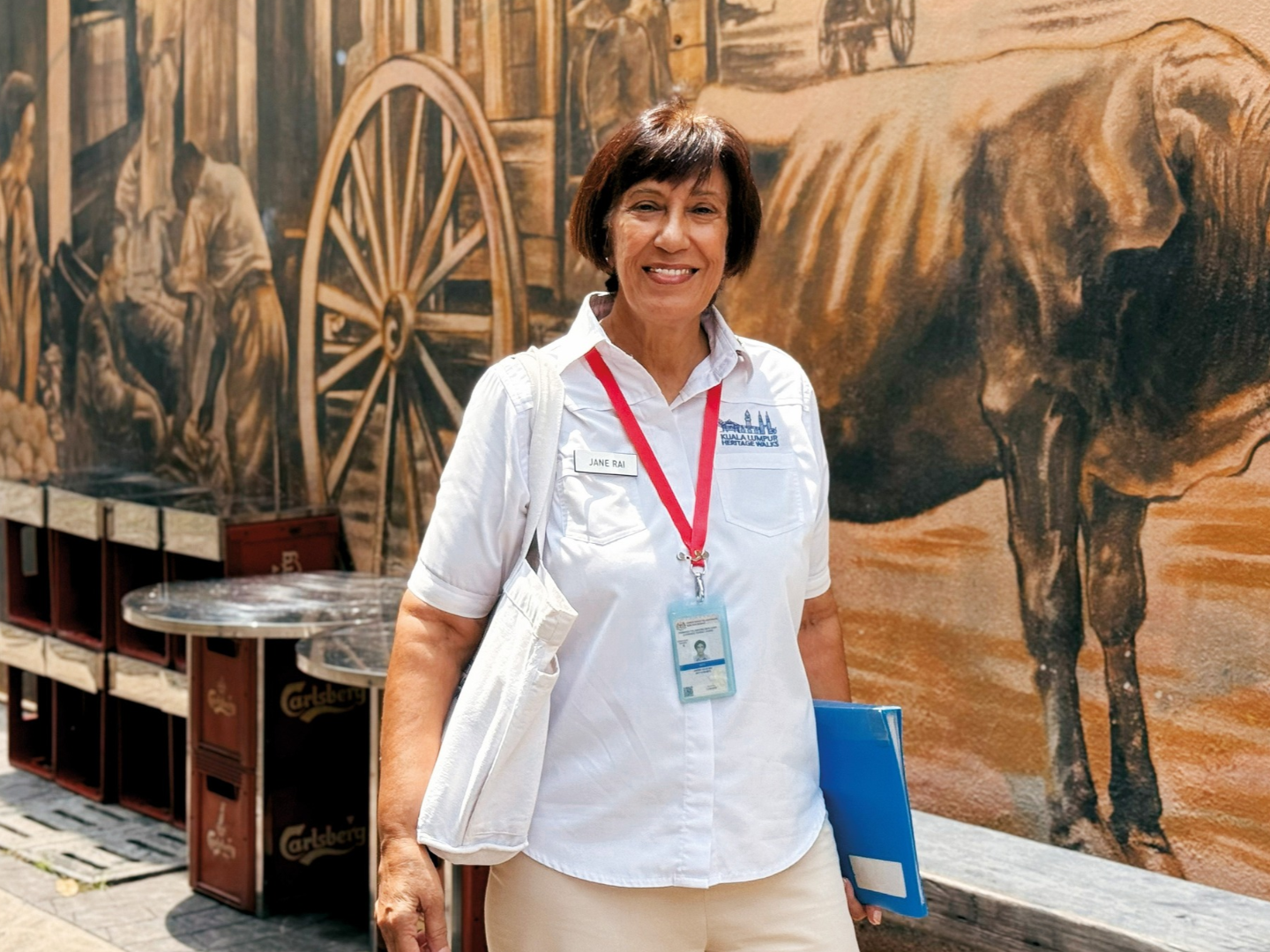
Jane has spent years researching sites and buildings in the city (All photos: Aireena Azni/The Edge)
"I don’t know where I’m going to go today,” Jane Rai, the founder of Free Walk Kuala Lumpur Unscripted (FWKLU), tells a group of curious travellers as they convene for a session with her at Four Points by Sheraton Kuala Lumpur, Chinatown. That sense of adventure is perhaps what makes walking tours interesting, and the chief reason she has continued sharing Downtown KL’s stories with visitors from over 90 countries for more than four decades.
“This is a continuation of what I really enjoyed doing,” Jane says of the tip-based heritage walking tour initiative.
Though the project began just before the pandemic, she has been a tourist guide since 1993, after a short stint as a journalist at a magazine company in the UK, and then at a local newspaper. When she received an offer to work in the travel industry, she jumped at the opportunity.
“I did my training for more than one month in Alor Setar. The course, organised by the ministry, truly opened my eyes and increased my knowledge of the Malaysian cultural dimension. There is so much we don’t know about our nation,” she says. “I wasn’t sure about the job and how it was going to be. But I thought I would just do it and see how it goes. I’ve not looked back since.”
For the majority of her career, Jane was attached to different firms, most covering Chinatown, which she used to frequent as a child of a police officer. “I was born in Kuala Pilah, Negeri Sembilan, but we came to this area a lot as my father lived in the barracks from when I was five to 13 years old.”
This personal attachment and work experience made her an ideal candidate to develop a walking tour programme around the city’s heritage enclave under Dewan Bandaraya Kuala Lumpur. “Back in 2011, I was roped in for the project to create some trails that would be part of the Kuala Lumpur Tourism Master Plan. There were fewer than 20 guides and we came up with four trails encompassing Brickfields, Dataran Merdeka, KL Forest Eco Park and Panggung Bandaraya.
“After the election in 2018, we received a note from the mayor’s office saying they would discontinue all the walking programmes. At that point, I was thinking, why don’t I carry on doing it in my private capacity? The walks had given me the opportunity to introduce visitors not just to KL’s buildings and history, but its people, cultures, stories and everyday life. I felt something meaningful would be lost if that connection with visitors ended.”
4.png
Anchored in home
Initially, FWKLU operated as a private tour where Jane and her team would plan bespoke itineraries for clients according to their preferences and interests. The total cost would cover food and entrance fees to places on the list, among others. “But due to Covid, many of my partners who were supporting the business had to close down. In a way, it impacted my product.”
She then decided to change her business model, focusing on the tip-based approach, which is more popular in the European market. “I’ve been interested in walking tours since I studied in the UK. I used to join those hosted by students on campus and was impressed with the way they did it and the stories they told.”
Jane made sure that her brand stood out by working with a group of experienced tourist guides who are professionally trained and certified. “There are many aspects in the module by the ministry that will help you reach a certain level. We learn a lot of things about government policies, branding and how to carry ourselves. Most importantly, we make sure we give out correct information and know how to handle people.
“The government also wants all the national occupational skills standards to be regulated. You cannot simply ask somebody to be a surgeon, the same way you cannot ask just anyone to be a tourist guide. It is a profession and requires licensing to determine the standard and quality control of our service.”
5.png
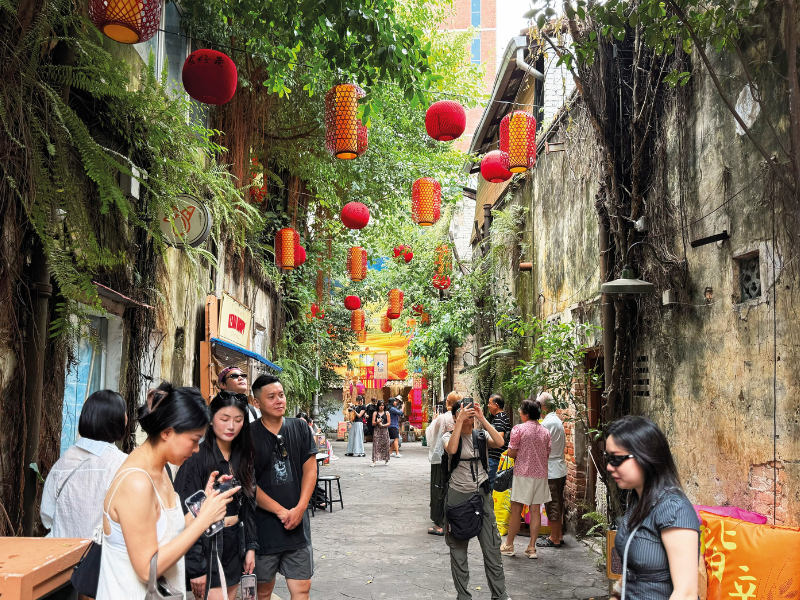
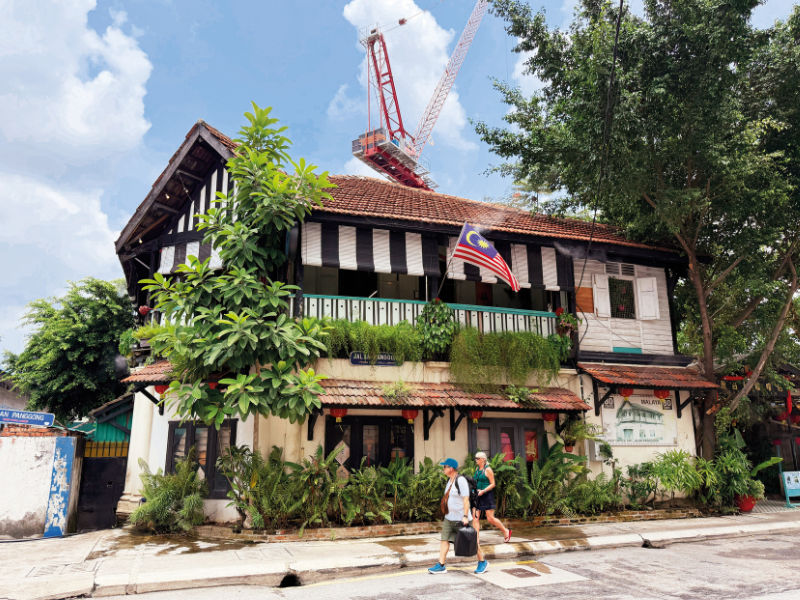
Currently, FWKLU offers East-West Connection and Chinatown Cultural Walk trails, which begin at Cosmo Hotel KL and Four Points respectively. The former traces the beginning of KL along the two riverbanks that once served as a meeting place for different migrant communities, while the latter takes visitors through the vibrant neighbourhood characterised by historic streets and alleys lined with heritage shophouses as well as a diverse culinary scene.
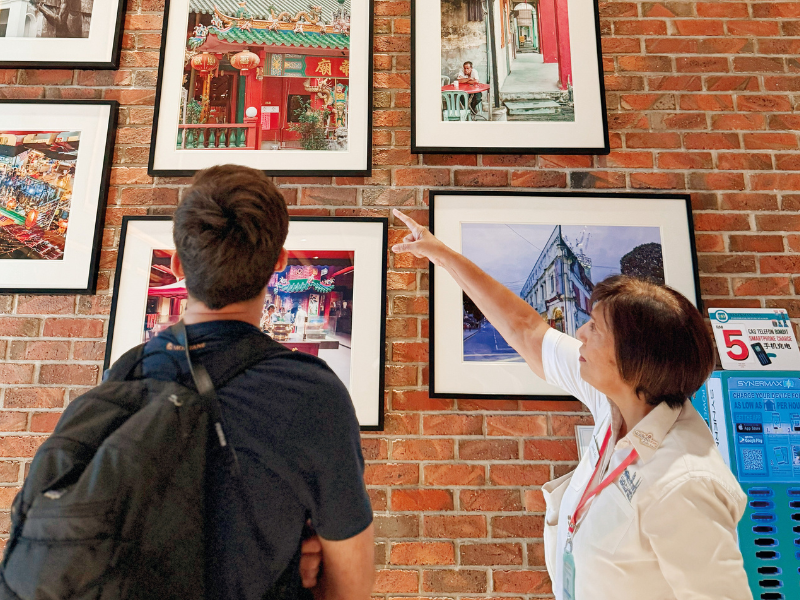
“The tour has a very strong educational undertone,” says Jane, who spent many years researching various sites and buildings in the area. Notes, photographs and maps were compiled in a file that she carries around.
“I’m a great believer in show and tell. From my experience, visual support is extremely important. If you want them to learn about the transformation that has taken place from 100 years ago, you better show them pictures. People may not see everything on the street. A little black-and-white photo will at least help them envision the scene.”
At the heart of every tour is the local community and enterprises that keep the city alive. Jane’s goal is to be the bridge that links different groups of people and cultivate connections beyond the surface. “We step into their property and have a conversation. That is what takes our time. We’re not rushing from one place to another. Generally, the tour is two hours. But when the session gets really engaging, it might drag on a little. None of my guides are calculative. They are given the freedom to do anything. That’s why it is unscripted.”
When she made plans to include visits to shops as part of the itinerary, she made sure the business owners and their successors were on board and comfortable with the concept. “For example, the family behind Kien Fatt Medical Store is very friendly. They don’t mind having a chat with you. There are days when they are busy attending to customers. Then we’ll just walk in and sit down in the back area. Who would have known there is such a space there?
“It’s also great for them because people have taken pictures and posted them on Instagram. It gives them a bit more exposure. If I don’t take you there, you will not simply walk in. Participants can go back to the shop to get their treatment done. That’s good for us if it benefits them.”
Having explored Chinatown since the early 1990s, Jane has observed some significant shifts in the vicinity, citing Kwai Chai Hong as one of the more inspiring projects. “I have seen government and non-government intervention to preserve the area. One of the pleasant transformations is the cleaning of the back lanes. To some extent, if you clear a street and reinvent its purpose, you draw tourists and locals to that area. Therefore, you’re driving the economy.”
3.png

Firm footing
What does it take to become a reputable city storyteller? “A tourist guide must be knowledgeable, enthusiastic and have excellent people skills and the right attitude,” Jane says.
The motivation to continuously advance one’s skills and knowledge is definitely key to being a charismatic and eloquent presenter. When she first started, Jane would learn from international coaches and invite her friends and trainers on her walks. “I wanted to know their feedback and for them to tell me where I could improve. I watched YouTube and attended Ted Talks. I listened to well-known speakers to learn about articulation and develop a great speech.”
About 10% of the guides’ presentations can comprise personal accounts and their connections to a destination. “It cannot overshadow the main narrative. They can be humorous when they need to be. And they need to balance communication with both adults and kids. If a child comes, we do a lot of quizzes and we get the parents to support us along the way.”
Hurdles can arise in different shapes and forms, sometimes showing up as an impatient and inquisitive participant. “You must be able to deal with irritants because there will be interruptions by those who purposely ask too many questions. You mustn’t show your uncomfortable body language and get upset,” she notes.
Another potential issue with running a tip-based tour is that some might misunderstand the concept. “The term ‘free walk’ is tourism jargon; it doesn’t mean the service is free. You don’t pay anything when you book but you reward the guides at the end of the session. The idea behind this model was to make the tours affordable for Malaysians. You tip whatever feels right. We have a guideline of what the average amount per person is on our website.”
2.png
Though she initially found it challenging to navigate social media, Jane gradually saw its importance in connecting with a wider audience and giving them an introduction to the initiative. While most tend to look up the tour on Facebook or Instagram, she still encourages interested parties to check out the FWKLU website, recently redesigned by her nephew.
“I want people to know who we are and what we do before they join. Anyone who goes on any tours must first read what it is all about. It’s the same as when you want to try out a new recipe; you want to know what the ingredients are before you proceed.”
Problems and provocations aside, Jane recognises her role as an “influencer” and the impact she has made through her stories and observation. “I don’t shout out loud. But it’s just natural for people to notice more things when they go to the street. Those who are very vocal would ask why we are not looking after our buildings or complain about our road conditions. I will convey these messages to the right authorities.”
Tourist guides’ influence extends to something as simple as recommending the best places to visit or restaurants to try. “They will most likely take your advice. If I mention one laksa shop, all 15 people might go to the same restaurant. It’s common to hear, ‘We’ll follow you wherever you go’,” she remarks.
Now in her late 60s, Jane has certainly considered retirement, but a strong sense of responsibility drives her to continue on her journey around town. At the moment, FWKLU is preparing to launch a new trail in Bukit Bintang, expected to commence early next year. “I simply cannot bring myself to stop promoting KL as a friendly, welcoming city to the world,” she says.
This article first appeared on Nov 2, 2026 in The Edge Malaysia.