

Izwan's vision for the building's next chapter is to ensure it is a vibrant arena where citizens can inhabit and call their own (Photo: SooPhye)
Stadium Merdeka has, in fact, witnessed two demonstrations of independence in its lifetime. The first occurred in 1957, when prime minister Tunku Abdul Rahman Putra al-Haj declared Malaya’s freedom from British rule. The second transpired in the 1990s, when the people exercised their civic agency and rallied to save this national cradle from demolition, insisting that history was not for sale. To contemplate its near-erasure is sobering, given how close future generations came to losing the very soil on which Merdeka was proclaimed — and where, six years later, a unified Malaysia was born.
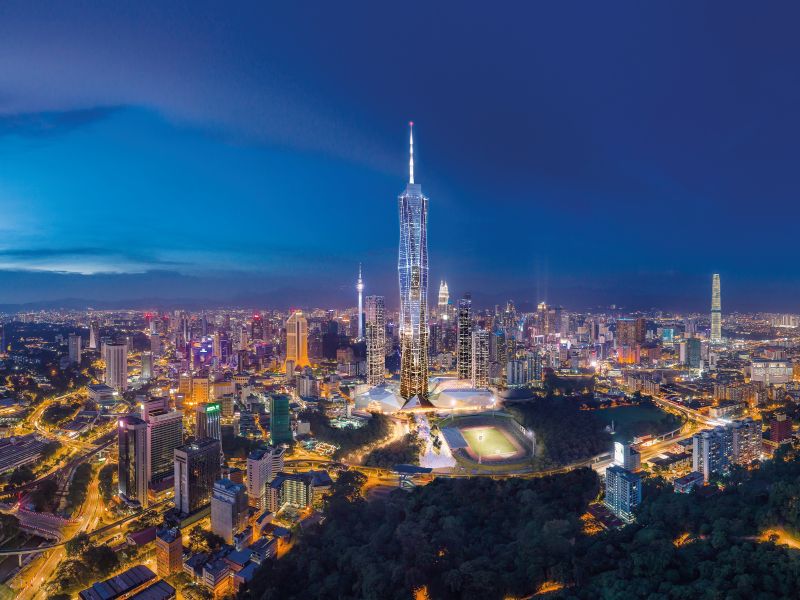
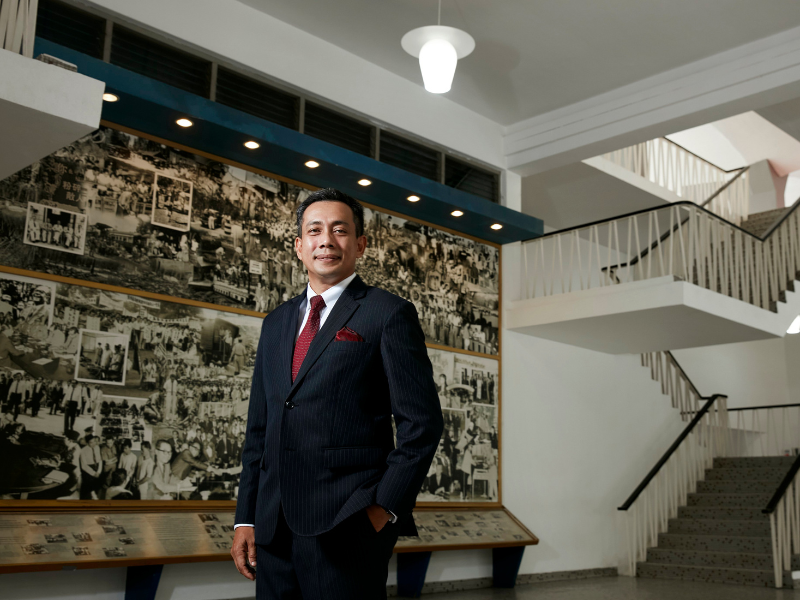
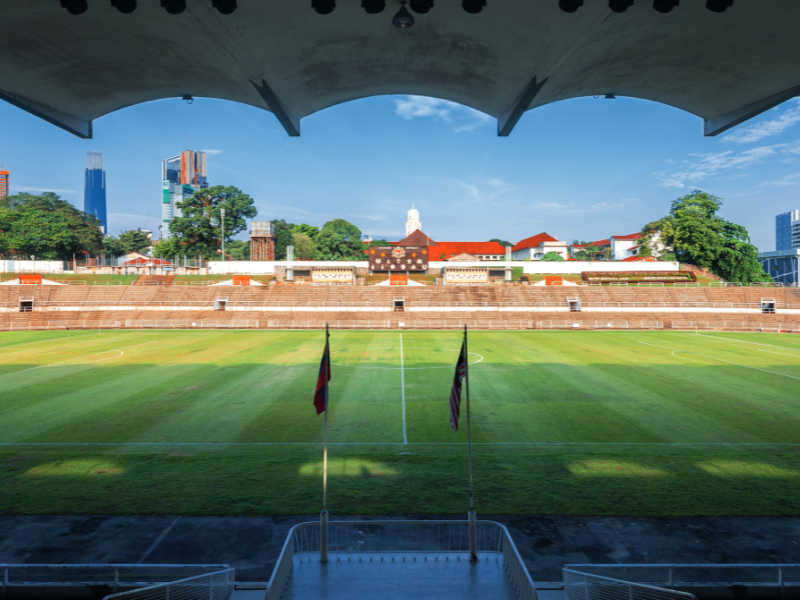
That its presence persists as a living monument today makes the scene from the terraces, where Datuk Izwan Hasli recounts the significance of these hallowed grounds, feel all the more profound. From here, the CEO of PNB Merdeka Ventures Sdn Bhd (PMVSB) surveys the full sweep of Kuala Lumpur’s timeline in a single gaze: the stadium’s manual scoreboard reconstructed in its original form, ts capacity returned to 20,000 following the removal of later upper tiers and mosaic tiling painstakingly restored. Further afield, Victoria Institution’s stripped neo-classical clock tower presides over one of the city’s earliest academic foundations, while directly overhead, the Merdeka 118 tower — renamed Menara Merdeka Maybank last month — draws the eye skyward, its crystalline spire tapering into the clouds. On a sunny day, glints of light dance across its glass façade, gleaming above the old grandstands as an emblem of the country’s continuing ascent.
Izwan is quick to defer credit for the stadium’s RM13 million architectural revival, which was spearheaded by PMVSB, a subsidiary of Permodalan Nasional Bhd, prior to his appointment on Jan 1. Instead, as the caretaker entrusted with breathing renewed purpose into these walls, he holds an unequivocal vision for its next chapter: it should not be a shrine preserved at a reverent distance but a vibrant arena returned to the rakyat — one they can inhabit and call their own once more.
merdeka_118.jpg
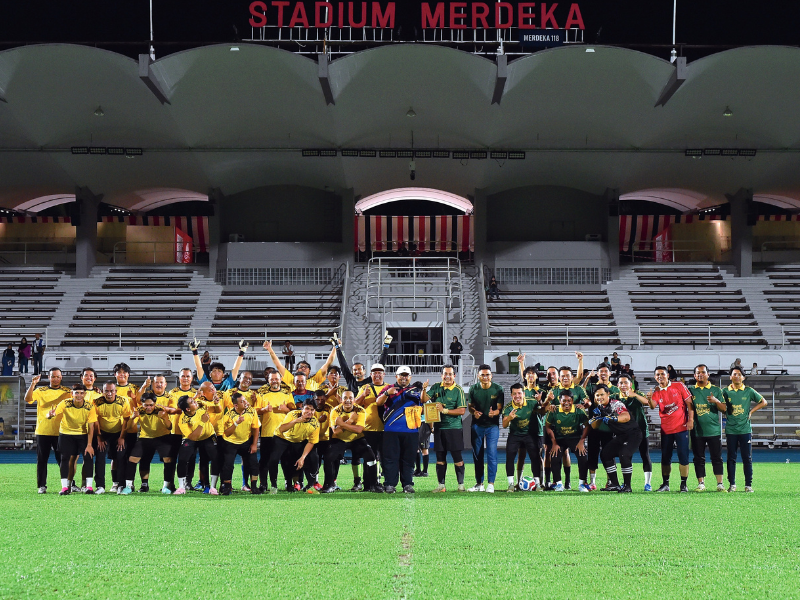
Such a spirit of accessibility was on full display when the Merdeka 118 team invited residents from the Persatuan Penduduk Perumahan Awam Seri Selangor for a friendly match on the reinstated football turf. Families crowded the perimeter, cheering the players on as they turned out in custom jerseys made for the occasion. What gave the day true weight, though, was a brief exchange with one of the participants, proving that heritage is most democratic when it is not embalmed in the past but permeable enough to make room for everyone.
“How could you not be moved when an old uncle holds your hand and says, ‘Terima kasih, tuan. Saya tak pernah rasa saya boleh main di atas padang yang bersejarah ini’. It warms your heart, I tell you. I felt like crying,” Izwan shares.
Moments like these expose the nuanced tightrope he is tasked with walking. Beyond steering the formidable logistics of a 118-storey structure — dwarfed only by Dubai’s Burj Khalifa — as well as activating its surrounding retail and cultural enclave, he bears the delicate charge of aligning a staggering project with KL’s historic soul at its feet.
The value of a landmark — or a “beacon”, in the CEO’s words — is defined not by how high it reaches, but how much taller it makes the nation stand, especially on the world stage. That will be the lasting measure of his mandate.
1.png
Nerves of steel
The instincts required to hold steady at the summit of a generational legacy are rarely cultivated under bright corporate lights alone. In Izwan’s case, it began with an internal compass steadfast enough to withstand the pull of filial duty while charting a path of his choosing.
“When I completed my degree in mechanical engineering, I handed my ijazah to my father and said, ‘Papa, here is your degree.’ Although family obligations are important to me, I knew I had only done it to fulfil his wishes.”
A good-humoured admission in hindsight, this may be, but his resolve back then was absolute. Born and raised in Pekan, the royal capital of Pahang where his parents met, Izwan grew up in a decidedly middle-class household. His father, from Kuantan, worked as a technical instructor at Institut Kemahiran MARA, while his mother, a Raub native, was a nurse. Yet, pragmatism at home did little to temper a precocious fascination with technology. By 12, he was already teaching himself to code PC games and selling copies to schoolmates — a boyhood hustle that cemented IT as his true calling. Nonetheless, the young programmer’s dreams ran headlong into Dad’s idea of a stable trade. Out of reverence, he dutifully earned his engineering parchment at New York’s Rensselaer Polytechnic Institute in the US, then promptly boarded a flight back to the school to pursue a master’s in computer science.
But time has a curious way of vindicating a parent’s foresight.
“They say a father’s wisdom echoes across decades, stretching far beyond what a child can grasp in the moment. When I took on the role of chief operating officer at PETRONAS ICT [the technology arm that provides digital solutions to the oil and gas company worldwide] in 2013, I realised, albeit 20 years later, how greatly my dual qualifications had contributed to the rest of my career.”
That analytical rigour would propel a 25-year trajectory through some of Malaysia’s most strategic economic engines. Izwan entered the energy sector in 2001 with PETRONAS Carigali, ultimately occupying pivotal roles across strategy, project management and business operations in the group. By 2019, his professional footprint had expanded into urban asset management and asset performance as executive director of KLCC Urusharta, overseeing the PETRONAS Twin Towers and wider KLCC precinct. He subsequently served as CEO of Putrajaya Holdings (PjH), guiding its residential, retail and utility portfolios, while helping shape the federal administrative capital into a modern, sustainable township.
2.png
“There is a joke I always tell,” he quips. “When I took over digital, I ran the firewall. When I went to KLCC, I ran the fire protection system. Each assignment left me with a crucial takeaway.” If managing commercial infrastructure tested his technical and operational mettle, stepping into PjH expanded his scope across the real estate value chain. “That transition rounded out my capabilities. As a master developer, it gave me the opportunity to manage hotels, such as DoubleTree by Hilton and The Everly, and lead retail rejuvenation efforts like Alamanda Shopping Centre. Arriving at Merdeka 118 feels like the natural culmination of that journey. I couldn’t have taken this on without both backgrounds, and I remain deeply passionate about both organisations and the people I worked with.”
Chief among them were the senior figures who imparted an enduring lesson in humility. “I’m forever indebted to my mentors, who taught me that this is not a privilege or perk — it is an amanah,” he notes, pointing to a formative conversation in 2007 with Datuk Hashim Wahir, then the incoming CEO of KLCC Property Holdings Bhd. Gazing out at the menara berkembar from a private room at the Mandarin Oriental hotel, the young executive could not resist asking what it felt like to be responsible for an undertaking so vast. “His reply reframed my entire philosophy,” Izwan recalls. “He said: ‘None of this is mine. I’m merely a custodian. You have to make it right and justify it. A century down the road, others will look back at what we did and the photographs we took, seeing us as part of that journey.’ That principle has stayed with me and transformed the way I elevate others.”
A sense of accountability goes a long way towards clarifying why he considers himself unusually suited to the top job at Merdeka 118. Izwan divides the answer into what he calls the “hardware and software”. The former is easier to quantify: a solid technological fluency paired with rare management pedigree. The latter, however, harks back to an observation made by his predecessor Datuk Tengku Ab Aziz Tengku Mahmud, who had shepherded the venture since its inception in 2010 when it was known as Warisan Merdeka. Now an advisor to PMVSB, he noticed how his successor brought a natural sensitivity to the cultural resonance woven into the development. It was an attribute Izwan had never explicitly articulated about himself, yet the comment lingered. “I take that very seriously. I’m not a typical executive who only thinks about dollars and cents,” he asserts.
Temperament, reinforced by a regard for serving an imperative greater than monetary yield, rendered the fit obvious, but curiosity made the move irresistible. The clincher — the deciding spark that altered his course — arrived disguised as an engineering marvel.
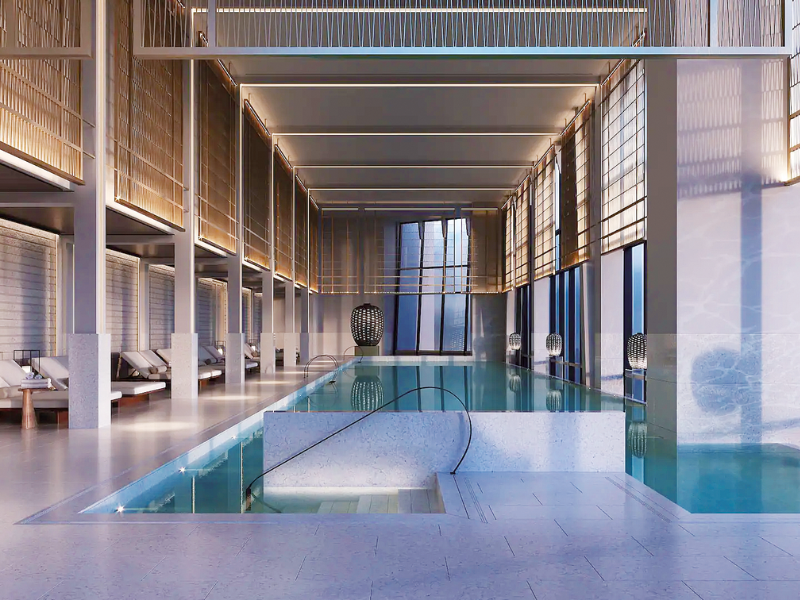
“It happened during a Jabatan Kerja Raya event, during which Datuk Tengku explained the structural mechanics behind Park Hyatt’s infinity swimming pool on Level 99. The tower can safely sway by 1m to 1.5m during strong winds — imperceptible to anyone inside — yet the water remains completely calm. I simply could not comprehend how that was possible. After the presentation, he asked, ‘So, are you coming to join us?’ How could I not, after being blown away by what I’d seen? The pool did it, and I’m not even a swimmer.”
He took the plunge. Now, he has an entire vertical city to run.
3.png
Built to belong
In its entirety, Merdeka 118 is a bold reimagining of KL’s urban centre. Dominating the skyline at 678.9m and officially inaugurated on Jan 10, 2024, the monolith was designed by Fender Katsalidis Architects in association with local firm RSP Architects. According to the Council on Tall Buildings and Urban Habitat, it is one of only four megatowers exceeding 600m, joining Makkah Royal Clock Tower (601m), Shanghai Tower (632m) and Burj Khalifa (828m).
Height, though, is merely the most visible expression of an ambition spanning a 40-acre integrated ecosystem. Grade A offices rise beneath the opulent suites of Park Hyatt and Southeast Asia’s highest observation deck on Level 115, with a mezzanine on 116. At its base, a seven-storey glass-domed retail complex feeds into Merdeka Boulevard, a four-acre public park. Alongside the Oakwood Premier luxury serviced apartment, two premium residential towers, Merdeka Residences, will eventually introduce 800 apartments. Distinct from the living spaces, Look at 118 serves as an experience destination encompassing a textile museum, restaurant, café, gift shop and rooftop lookout. Stadium Negara is undergoing a two-year revitalisation into a sports, arts and events hub, while Stadium Merdeka, reserved for riadah (recreation) and even Hari Sukan for schools, remains embedded within the same fabric. Together, they occupy half the total land area.
Underpinning this blueprint is a strict commitment to sustainability. The project has obtained LEED Platinum certification while working towards GreenRE and Green Building Index standards, supported by high-performance façade glazing, district cooling, grey-water reuse, solar systems and smart air recycling in the car park. It has also achieved the WELL Platinum certification for PNB’s office floors and WELL Platinum Core for Menara Merdeka 118, extending the brief from energy efficiency to the health and comfort of its occupants.
Ratings and metrics may quantify well-being but they cannot fully account for how a place is lived — a quality that frequently hinges on the most understated decisions. “On my very first day as executive director at KLCC, I had the yellow plastic chains that kept people off the grass for 20 years removed. Without seeking board approval, I acted on what was appropriate: the public should be able to feel the earth beneath their feet, sit, play and enjoy the greenery, like in New York’s Central Park, Sydney’s Hyde Park or Barcelona’s Park Güell.
“My immediate decision [at this new address], on the other hand, was to set up a table on the highest floor,” he says, the modesty of the gesture belying its intent. Positioned by the window, it encourages visitors to pause before the panorama — with the Twin Towers, KL Tower and The Exchange 106 arrayed below — and grasp, almost physically, Merdeka 118’s prominence within the capital’s grid. “From that corner, you can admire how thriving KL is from a perspective no one has ever seen. This is a new nexus of gravity. When travellers land at the airport, they will be excited to come straight here.”
4.png
Its potential as a tourist magnet is no mere abstraction — Izwan, after all, has pegged a lofty target of 1.5 million visitors annually for the observation deck when it debuts in September. Before those gates open, though, he wants to invite children from nearby public housing estates, including PPR Seri Selangor and Seri Pahang, to be among the platform’s maiden guests.
“They grew up watching us build this across the road, but they may never otherwise have the chance — or be able to afford — to go inside. If these children go up, see how beautiful everything is and feel that it is partly theirs, they will take care of it.” That belief in shared pride mirrors his exacting expectations on the concourse, where he habitually stops during site walks to pick up stray litter, upholding what he describes as a “Japanese clean” ethos. “We have to be particular because we’re setting the culture and example,” he adds.
It is undeniably a noble sentiment, but the tougher challenge is whether inclusion can extend beyond the symbolic. When PNB unveiled the RM5 billion skyscraper — the centrepiece of a broader precinct budgeted at between RM10 billion and RM11 billion — it ignited widespread debate over more pressing social priorities and opportunity cost of such investment. Across the neighbourhoods and institutions clustered around it, from Chinatown and Kampung Attap to the steps of Chin Woo Stadium and the belt of schools, fears mounted that a complex of this magnitude would become an island of high finance, hastening gentrification, pricing out traditional shopkeepers and leaving long-time inhabitants on its margins. There is, of course, the more prosaic question: In a retail landscape already saturated with shopping centres, do we really need another mall?
The scepticism is not entirely lost on Izwan. “I’m biased on this one,” he concedes, acknowledging that some concerns have merit. “Are we too imposing on the skyline? Are the LED lights too much? Are we crowding the market? Those are valid conversations.” What he resists is the idea that Merdeka 118 was conceived in a vacuum. “The whole philosophy, even before my time, has been to work with the community.”
To narrow that distance, PMVSB began organising regular town hall meetings — a practice he continues twice a year — bringing traders, school leaders and residents into the same room. Occasionally, the sessions produced moments of unexpected levity. Once, a property owner stepped on stage simply to thank the team because the value of his land had risen sharply. “I said, ‘That is fair’,” Izwan smiles. Over time, early unease has softened into an unspoken rapport — on his walkabouts during festivities, the locals now greet him warmly as “big bro”.
The relationship is backed by more than goodwill. Apart from upgrades such as covered walkways and a direct pedestrian bridge to SJK(C) Jalan Davidson, PMVSB, in partnership with Think City, has channelled roughly RM4 million through a grants programme supporting micro-entrepreneurs and artists, while funding improvements to the public realm.
For Izwan, chequebook philanthropy misses the larger point. “The old way of CSR is: we give money, appoint contractors and get the job done. It looks nice on paper,” he explains. “But I don’t want [to inculcate a] mentality where I give money and expect something in return. For example, if we want to repaint the walls of VI, I will ask our corporate tenants — Maybank, Bank of America and Copenhagen Infrastructure Partners — if they’d like to join the students.”
5.png
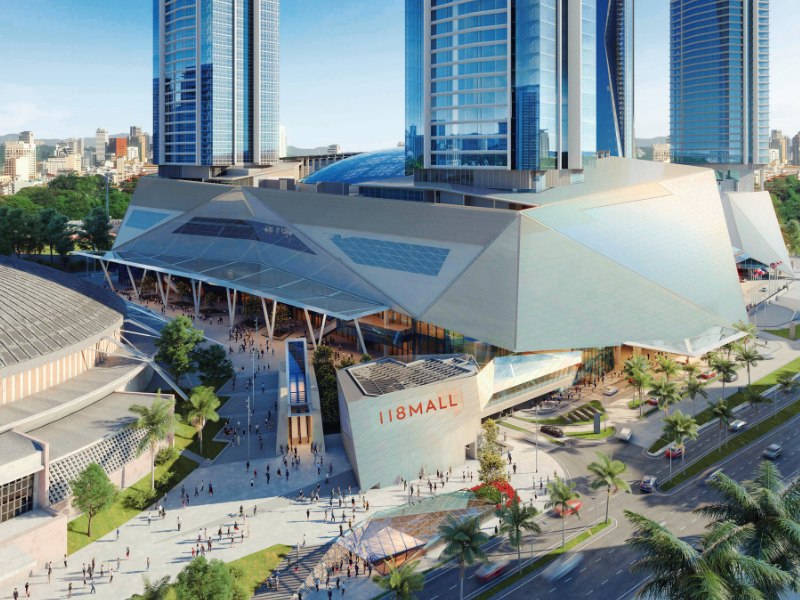
The same logic extends to the inevitable doubt hanging over 118 Mall, earmarked for a November opening, and aiming to attract as many as 22 million visitors in its first year. By no stretch is this another luxury retail proposition competing for discretionary spend.
“It’s going to be a community mall,” Izwan emphasises, pointing first to the 10,000 to 11,000 office workers expected within the precinct, then to the crowds spilling out from football matches at Stadium Merdeka and concerts at Stadium Negara — all of whom will need accessible locations to eat, shop or linger.
To embody this locality, even anchor tenants are adapting their formats: familiar names such as Village Grocer, Decathlon and an evolution of Sogo department store, together with a 44,000 sq ft Makanizm food hall, will sit alongside concept boutiques specifically designed around heritage cues to match the neighbourhood vibe. Observation deck visitors will descend directly to Level 3’s Malaysian Artisan District, envisioned as a contemporary showcase of home-grown craft, food and creativity. Elsewhere, anamorphic screens on Level 4 are intended to turn into a canvas for immersive brand activations.
Scrutiny extends, too, to the edifice’s renaming following Maybank’s move into 33 floors — a lightning rod for backlash among those who consider the spire as a physical echo of Tunku Abdul Rahman’s outstretched arm as he chanted “Merdeka”. Izwan answers by widening the aperture. “Merdeka 118 will always refer to and remain the precinct. Plus, my role has never focused solely on a building. It is to make sure everything works and interconnects seamlessly.” To him, its architectural composition is catalytic precisely because old and new are made to work in concert. “Warisan sells. Heritage is cool, and it can be economically productive without being reduced to decoration.”
That stewardship brings an acute awareness of his small part in a much longer continuum. “I started a lot of things and never saw them finished, but I finished a lot of things I never started,” he remarks, illustrating a leadership style that leaves little room for executive vanity and plenty for dissent, challenge and sharper minds around the table. As the country approaches its 70th anniversary next year, his view from the peak remains clear-eyed. “We’re far from perfect, but those of us carrying this responsibility must push it further forward and make things right when they’re not. I’m deeply conscious of the privilege of sitting here — and remarkably proud of what we’ve accomplished.”
The keystone to his life’s work is perhaps best captured in a phrase he returns to often: menggapai ke langit, berakar di bumi, which translates as “reach for the sky, but stay rooted to the earth”. An icon only ever rises as high as the ground — and the people — supporting it.
This article first appeared on Aug 17, 2026 in The Edge Malaysia.