
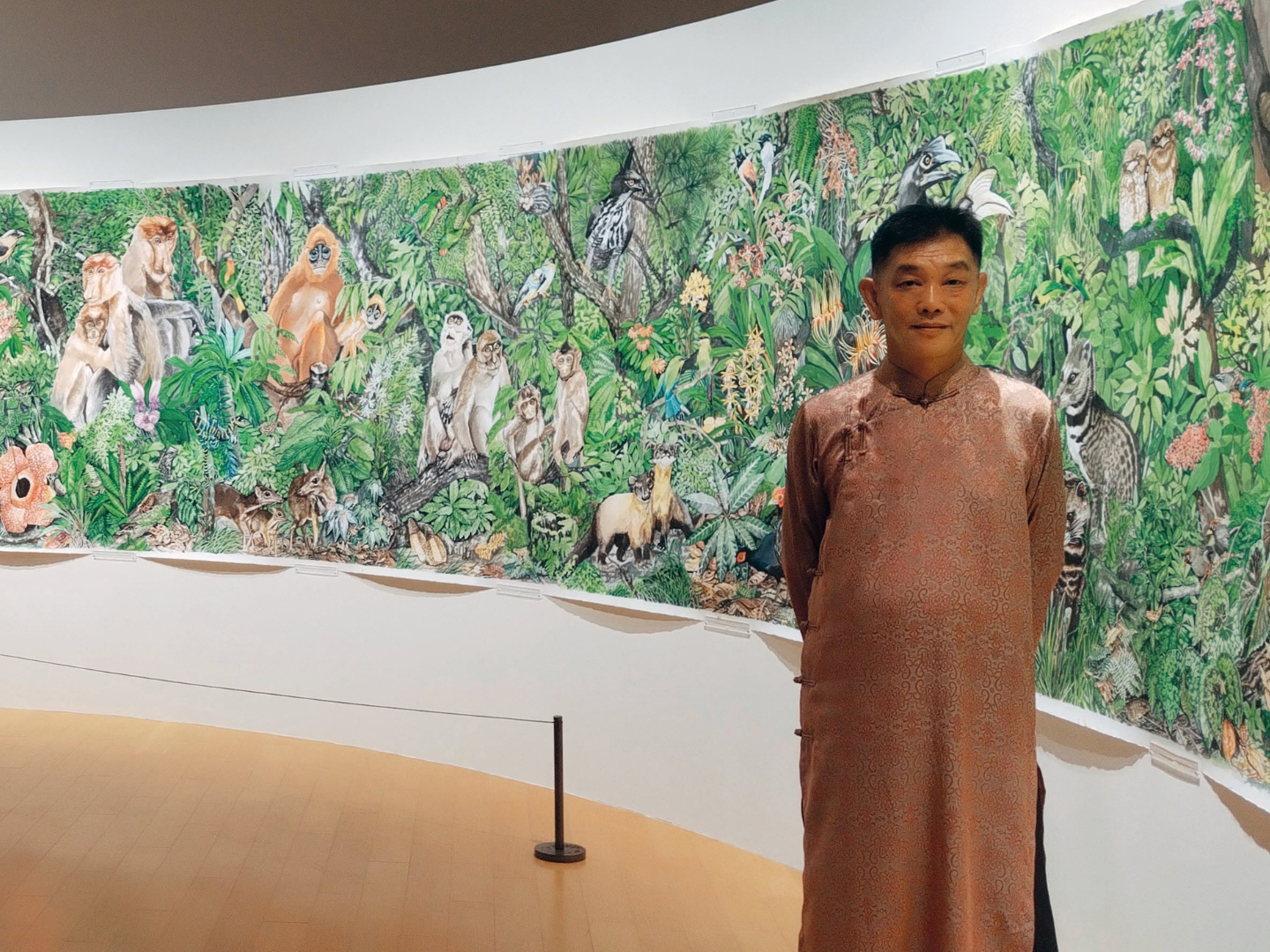
Bong Shin Siong sees nature as his muse (Photo: Calvin Goh Chin Seng)
Bulbophyllum binnendijkii is an orchid native to Borneo that blooms for a remarkably short period. Because it resides deep within the thick jungle foliage, colours alone are not enough to attract insects and reliably reproduce. The most efficient solution is to emit a foul, rotting odour to entice flies. The flower has evolved a specific anatomy that traps the bug and causes pollen to stick to its body, thereby heightening its odds of survival.
Sarawakian artist Bong Shin Siong is able to convey this entire process from memory for two reasons: first, he is an enthusiastic orchidist; and second, it is one of several hundred species he has painstakingly researched for his paintings depicting Borneo’s plants and creatures.
Before his brush touches paper, Bong studies books, articles and photographs to fully comprehend the physical characteristics and behaviours of his subject. Nature has been his lifelong muse, and he has dedicated his most recent years to capturing the island’s diverse wildlife through an ongoing series of watercolour paintings spanning 10m and 20m titled Flora and Fauna of Borneo I and II respectively. The latter, which comprises 128 distinct species, is being shown at Taiwan’s Asia University Museum of Modern Art as part of its ongoing exhibition, Tanahair: Navigating Asianness from Malaysia.
Still, he admits, “Orchids are the hardest. Each type has a unique structure that serves its pollination. To draw them, you have to understand why they look like that.” Making sense of the intrinsic, elaborate rules that shape every petal, spot and leaf is crucial not only for realistic rendering, but also so that his work may become an accurate archive of the region’s organisms amid an era where modernisation is actively threatening many habitats.
4.png
Home Grown
Bong is a native species in his own way. Born and raised in Lundu, Kuching, the 60-year-old completed both his primary and secondary education there, after which he spent a brief period as a temporary art teacher at an elementary school.
“From young, I loved drawing. I grew up surrounded by art. My late father was an oil painter and member of the Sarawak Fine Arts Society,” he explains. “I never had any formal education in it — whenever I saw him working, I would watch. That’s how I picked it up, though really, I don’t think I ever learnt — it’s just something I’ve always known.”
Dad was a modern-day Renaissance man, a creative spirit who dabbled in violin, sports and horticulture. A vibrant home teeming with music and wild orchids taught a young Bong to chase creativity with crayons and appreciate the natural world for its inherent beauty. His enduring penchant for drawing plants and animals started, like most childhood fascinations, with the littlest of inspirations. “When I was six or seven, there was this susu pekat Cap Junjung (Milkmaid-brand sweetened condensed milk) that came with stickers of butterflies, birds and sunflowers. Then, when I was in Form 4, the World Wildlife Foundation also released this album where you could paste animal stickers in. Because of that, I learnt about all these creatures around the world.”
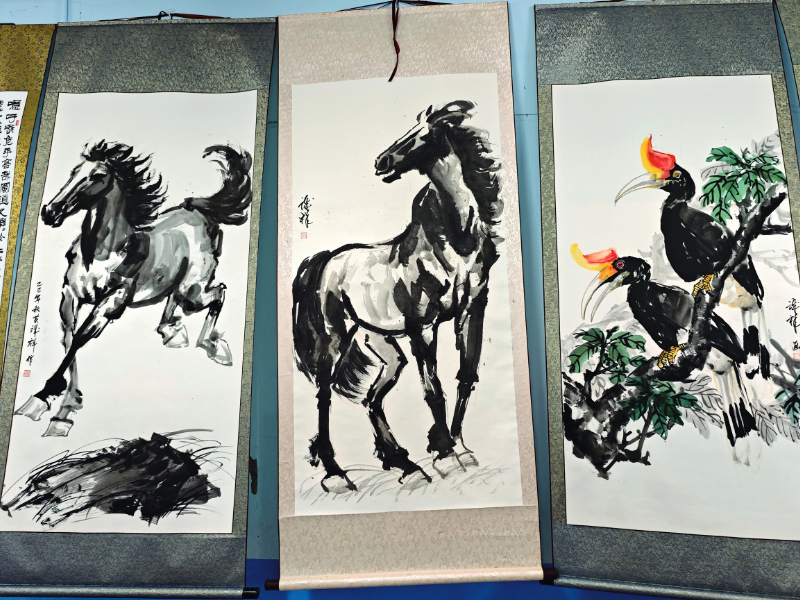
Later in life, Bong travelled to Hong Kong to study Cantonese cuisine and Western pastry, working in hotel kitchens. While there, he took classes in Lingnan-style Chinese ink painting and seal carving, and has since further refined his skill set with traditional crafts including calligraphy and paper cutting. Unfortunately, his culinary career was curtailed due to health concerns, leading him to return to Lundu and seek other sources of income.
Why not paint professionally? “Honestly, I still wouldn’t call myself a full-time artist, even now!” he says with a dismissive wave of the hand. “This is simply my hobby. I never thought about it in terms of making a career, it was just something I enjoyed. Besides, back then, making a living from art was not something one could even consider — to sell even one painting was very hard.”
3.png
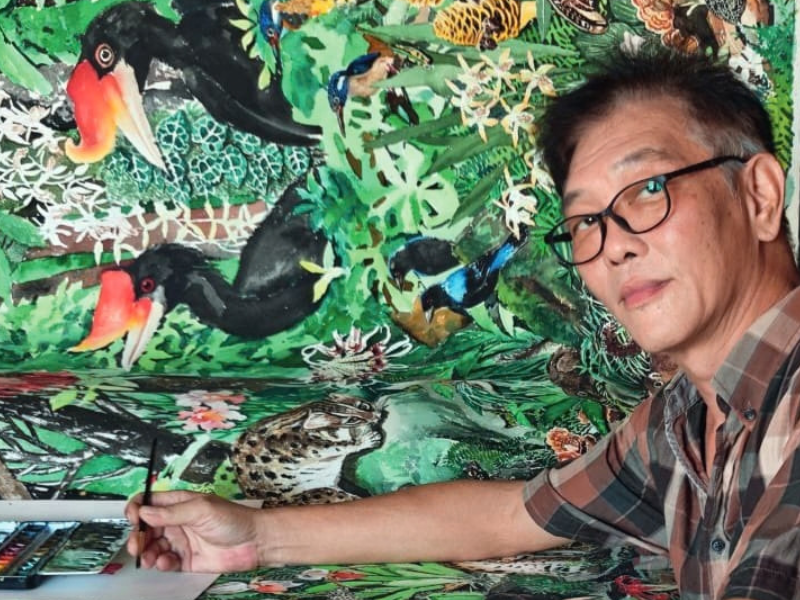
Now semi-retired, Bong spends an average of five hours a day on his pieces, though when the mood strikes, he can work for full days without sleep. His creations are easily identified by their intense vividness of colour and almost three-dimensional depth.
“Many people who see my pieces often remark, ‘This doesn’t look like watercolour’. Actually, it’s because I use techniques from Chinese ink painting. This is my signature. When you paint, you have to find your own identity. People in Kuching just have to take one look at these works to tell that they’re mine.
“I find I prefer this medium over something like acrylic. I used to draw with oil paints, but because my father used them, I knew they were expensive. When I first started out, I didn’t have money, so I would just purchase cheap watercolours. You only need a bit to shade in a large area after all, and they dry much quicker. But as it turns out, once I started using them professionally, good watercolours are expensive too!” he laughs.
His extra-long works use rolls from Arches or Canson — the crème de la crème of watercolour paper — that come in 10ft rolls, the largest size commercially available. The lengths are then positioned side by side, like a diptych.
“Another thing is that I’ve never had a university education or training in fine arts. Those courses go over things like horizon lines or perspective, but my drawings don’t have any of those,” he notes.
2.png
Kingdom creation
Although his first canvases followed a more conventional size, Bong says the idea to work on a particularly lengthy tapestry originally came at the request of a friend.
“At the time, I used several sheets of paper joined together to pull it off. I became increasingly interested in this style of art, and I have many acquaintances who basically go into the forests every day to capture what is there.” Over the years, Bong has built a network of nature photographers, botanists and birdwatchers who frequently share their research with him.
“When I see them post images on social media, I ask for their permission to use their photos as a reference for my work. I also search online to learn about the ecology, size and scientific names of the species I want to depict. As long as I have an image, I can draw directly from it.”
Following his current momentum, Bong is in the midst of completing a 30m-long painting — his largest yet, of course — more than half of which has been completed over the past eight to nine months. On average, these extensive pieces take just over a year to complete. “But really, if I feel inspired, it can be very fast. Just the other day, I did a 24m painting for deputy premier of Sarawak Dr Sim Kui Hian in two weeks,” he says.
Although certain species are repeated across each work, Bong makes a point to always express them in a different pose or arrangement. “The reason I choose to keep expanding my canvas is because I realise there are still so many animals I have yet to draw. In the end, the more I paint, the bigger it gets. It’s also a way of challenging myself. But I should really stop, these types of paintings can’t be sold!” he jokes.
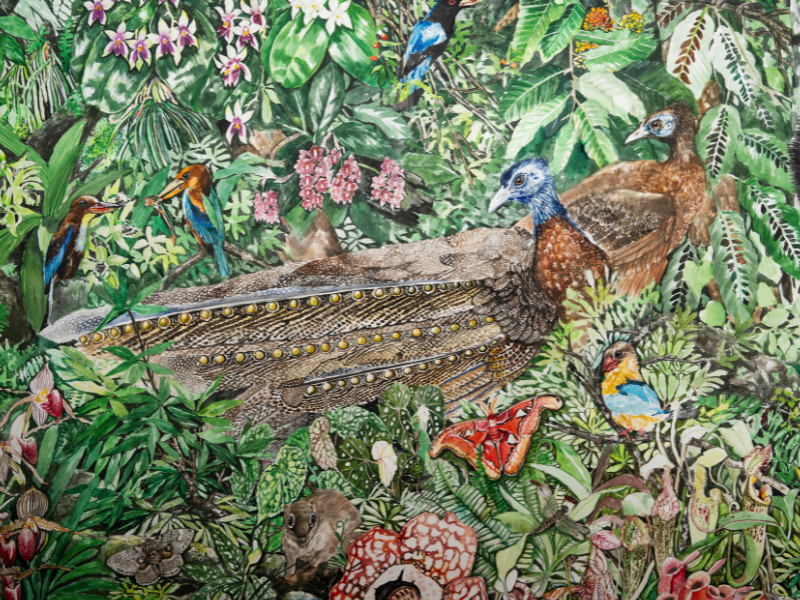
The greatest difficulty remains fidelity. “Capturing the beauty of animals, their shapes, colours and patterns is very hard. When I begin painting a creature, I need to learn about it first — the feathers of a bird, the colours of a butterfly, the markings on a lizard, these are already artworks in and of themselves. I rely on my research to express their beauty.”
Details like pheasant courtship rituals, moth mating cycles or the neotenic nature of trilobite beetles might seem aesthetically irrelevant, but Bong insists these are crucial factors in encapsulating the inherent energy and allure of each living being. “I was aware of these things very early. I always wondered why some orchids smelled very lovely and others not at all. Where do these scents come from? We need to ask ourselves many ‘whys’ in order to learn.”
His workshop in Lundu is only 6ft by 8ft, meaning the sheets can never be fully extended at once. Instead, he works on them one section at a time, coiling up the ends as he goes. “It’s simply too large for me to think up the composition of the entire piece in advance,” he says. “My routine is like this: After I’ve finished my work for the day and before I go to bed, I’ll think about what I’m going to draw tomorrow. Then I’ll do some research, and the next day, I carry on.” In the early days, Bong would sketch out drafts before putting ink to paper, but now he simply mixes the colours and lets his eyes and hands do the rest. “I don’t plan — whatever comes to my mind, I just draw it out.”
The sheer size of each piece is no sweat to the expert brushstrokes of a patient artist, and the real estate greatly benefits his style of realism. Up close, one can discern the delicate wrinkles of an orangutan’s lips as clearly as the green striations on a Rajah Brooke’s birdwing.
But it also means Bong goes entire months and years without seeing his paintings in their entirety. “That day, when it was hanging at the exhibition [in Taiwan], was the first time I’d ever seen the entire painting,” he smiles.
copy_of_po_luo_zhou_dong_zhi_wu_ii_122.jpg

The opportunity to have his work shown abroad came up when the deputy director of the Asia University Museum of Modern Art, Tsai Ming-Jiun, was in Kuching with two colleagues last March. She visited Hoan Gallery, where founder Hoan Kee Huang handed her a brochure for Flora and Fauna of Borneo II. Then considering holding an exhibition around the theme of Asianness, Tsai held several discussions with her co-curators, eventually settling on the current theme and for Bong’s 20m masterpiece to be presented.
Once the show concludes, the work will be returned to Kuching, as Bong will be hosting a solo exhibition in the near future, hopefully at either Hoan Gallery or the Sarawak Museum. Asked if he has any immediate plans to bring his paintings to Kuala Lumpur, he chuckles with cautious optimism. “Not at the moment. It has to be discussed with the gallery, but maybe one day — you never know!”
The international feature has been a meaningful step towards Bong’s ultimate goal of preserving Borneo’s wildlife while raising greater awareness surrounding the multitudes of plants, animals and insects that reside within the land. “Lots of forests are being developed and destroyed, which is why many species have lost their native habitats. Animals are still able to move and escape, but plants cannot run away. They exist inside our earth, and once you cut them down, they are simply gone,” he laments.
“When I was growing up, I saw hornbills, eagles and even thousands of flying foxes soaring around during the fruiting season. But this was decades ago. Now, you will not find a single one out in the open. We’re not talking about the flora and fauna of the whole world — even when it comes to local species, many children have no idea what they are called. Before, I too had no idea Sarawak has eight different types of hornbills. My paintings are made with the hope that people will be able to recognise and appreciate these creatures. For the ones that still exist, let us not wait until they are near extinction to start protecting them. We should strive to do what is within our power to help.”
'Tanahair: Navigating Asianness from Malaysia' runs until Nov 1. For more information, visit asiamodern.asia.edu.tw.
This article first appeared on Aug 31, 2026 in The Edge Malaysia.